
TL;DR:
- Handling an Israeli estate from abroad is complex because Israeli inheritance law imposes strict procedural and documentary requirements that foreign lawyers cannot meet without local licensing. A licensed Israeli attorney is essential for court appearances, filings, asset registration, and dispute resolution, especially for foreign documents needing apostilles and translations. Engaging a local expert early ensures smoother probate, protects assets, and avoids costly delays or disputes.
Handling an Israeli estate from abroad is far more complicated than most families expect. The question of why an Israeli estate needs a local lawyer comes up constantly, and the honest answer is this: Israeli inheritance law operates under its own distinct legal framework, with specific courts, procedural requirements, and documentary standards that foreign attorneys simply cannot satisfy. Many families assume that a lawyer back home, or a general international attorney, can manage the process remotely. That assumption leads to delays, rejected filings, frozen assets, and in some cases, costly disputes that could have been avoided entirely.
Key Takeaways
| Point | Details |
|---|---|
| Israeli law governs Israeli assets | The Succession Law of 1965 controls all inheritance of assets located in Israel, regardless of where the deceased lived. |
| Foreign lawyers face strict limits | Practicing Israeli law without Israel Bar admission is a criminal offense, restricting foreign counsel from court and registry work. |
| Probate orders are mandatory | Banks and the Land Registry will not release inherited assets without a valid Israeli court-issued probate order. |
| Documentation errors cause serious delays | Missing apostilles or improper translations regularly stall probate filings and can result in outright rejection. |
| Local expertise protects your interests | A licensed Israeli attorney handles court appearances, registrations, disputes, and tax issues that foreign counsel legally cannot. |
Why Israeli estate needs a local lawyer: the legal foundation
Before understanding why local representation matters so much, it helps to know what legal framework you are actually dealing with. Israeli inheritance is governed by the Succession Law of 1965, which is the primary statute controlling how estates are administered, how wills are validated, and how assets pass to heirs. This law applies to all assets physically located in Israel, regardless of where the deceased person lived or held citizenship.
The probate process in Israel runs through the Family Court or, in some cases, the Rabbinical Court, depending on the circumstances of the estate. Here is what that process generally involves:
- Filing a probate application with the relevant Israeli court, accompanied by the original will (if one exists), death certificate, and identification documents for all heirs
- Serving notice on all interested parties, including heirs who may be located in multiple countries
- Obtaining a probate order or succession order from the court, which is the legal document that authorizes heirs to access and transfer assets
- Registering the probate order with the Israel Land Registry, Israeli banks, and other relevant authorities
One point that surprises many families is that trusts created abroad do not substitute for an Israeli probate order. Israeli banks and the Land Registry require local court approval before releasing any inherited property or accounts. You cannot bypass this step with a foreign court order or a power of attorney drafted overseas.
For families dealing with a foreign will, the requirements become even more specific. Foreign wills require apostille authentication and a certified Hebrew translation before Israeli courts will accept them. These are not optional formalities. Document formality in foreign wills is substantive, not cosmetic, making local legal knowledge essential to avoid procedural pitfalls.
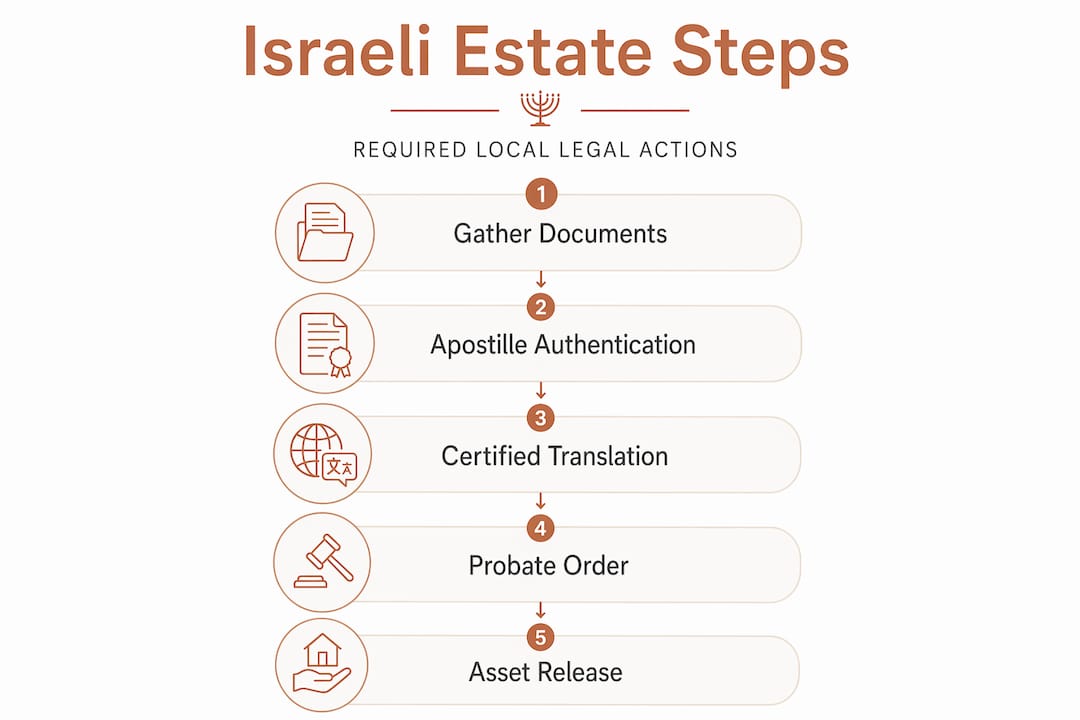
Pro Tip: Start gathering apostille-authenticated documents as early as possible. Apostille processing through foreign government agencies can take weeks, and Israeli courts will not schedule hearings until the paperwork is complete and correctly translated.
The role of asset location and residency also shapes jurisdiction. If the deceased owned real estate in Israel, that property falls under Israeli law and Israeli courts, full stop. The location of the asset determines which legal system applies, not the nationality of the deceased or the heirs.
What foreign lawyers cannot do in Israeli estate cases
This is where many families run into serious trouble. It is natural to turn to a trusted attorney at home when a family member passes away. But that attorney, no matter how experienced, faces hard legal limits when it comes to Israeli estate matters.
Practicing Israeli law without Bar admission is a criminal offense in Israel. Foreign-qualified lawyers have no standing to appear in Israeli courts, file documents with the Land Registry, or formally represent clients before Israeli authorities. Their role is limited to advising on their own jurisdiction’s law. When the work moves to Israel, they are legally stopped.
Here is a direct comparison of what each type of attorney can and cannot do:
| Task | Foreign Lawyer | Licensed ইসরায়েলি আইনজীবী |
|---|---|---|
| Advise on home country law | Yes | Limited |
| File probate application in Israel | No | Yes |
| Appear in Israeli Family Court | No | Yes |
| Register assets with Land Registry | No | Yes |
| Communicate with Israeli banks | Limited | Yes |
| Handle apostille and Hebrew translations | No | Yes |
| Represent clients in Rabbinical Court | No | Yes |
| Negotiate inheritance disputes in Israel | No | Yes |
Beyond the legal restrictions, there are practical barriers. Israeli court filings must be submitted in Hebrew. Correspondence with the Land Registry, tax authorities, and banks is conducted in Hebrew. An attorney who does not read, write, and speak the language fluently cannot effectively manage these interactions, no matter how skilled they are in their own legal system.
The consequences of relying on non-specialist or foreign counsel show up quickly:
- Probate applications rejected due to improperly formatted documents
- Delays of months or years while families wait for corrected filings to be resubmitted
- Bank accounts remaining frozen because the power of attorney presented does not meet Israeli standards
- Property transfers stalled at the Land Registry due to missing or incorrect documentation
- Disputes escalating because no one with proper standing is there to represent the heirs’ position
Only Israeli licensed lawyers can appear in all relevant Israeli forums for inheritance cases, including family courts, civil courts, and Rabbinical courts. That coverage matters enormously when an estate involves both civil assets and religious law questions about marital property or religious community membership.
The real benefits of local Israeli legal representation
Understanding the importance of local legal counsel is one thing. Seeing exactly what a licensed Israeli attorney does for you is another. The benefits of local legal representation in an Israeli estate go well beyond simply having someone who speaks the language.
Full courtroom access. A licensed Israeli attorney can appear before every court and authority relevant to your estate, from Family Court to the Rabbinical Court to the Land Registry. No gaps, no workarounds.
Correct handling of foreign documentation. Foreign legal opinions and compliance with Israeli technical standards are mandatory in cross-border estate matters. A local attorney knows exactly what format, certification, and translation is required for each document, and they know which mistakes will cause a rejection.
Property registration. Real estate is often the largest and most valuable asset in an Israeli estate. Mistakes in property transactions within inheritance can be extraordinarily costly. A local attorney manages the registration process at the Israel Land Registry with precision, protecting heirs from title disputes and transfer errors.
Tax risk management. Israeli tax law intersects with inheritance in ways that are not always obvious. An experienced Israeli attorney identifies potential tax exposures before they become problems, particularly in situations involving the sale of inherited property or the distribution of assets among multiple heirs.
Dispute resolution. Co-ownership disputes are common when multiple heirs inherit a single property. A local attorney can negotiate settlements, pursue partition orders through the courts, and represent heirs in mediation or litigation.
Faster timelines. An attorney who knows the local courts, registrars, and banking procedures can move cases forward efficiently. They know which filings to prioritize, which offices to follow up with, and how to avoid the procedural bottlenecks that slow down unrepresented or poorly represented estates.
Pro Tip: If you are an heir living outside Israel, look for an Israeli attorney who is experienced with cross-border Israeli legal matters. They will know how to coordinate between Israeli authorities and your home country’s legal requirements without creating conflicts between the two systems.
দ Israeli inheritance law framework also gives executors specific responsibilities that require legal knowledge to fulfill properly. Executors often must be Israeli residents and rely on an attorney to navigate probate administration. If you are serving as an executor from abroad, you almost certainly need local counsel to fulfill your legal duties.
How to choose the right Israeli attorney for your estate
Not every attorney who practices in Israel is the right fit for an estate matter involving foreign heirs. Here is what to look for when selecting representation:
Verified Israel Bar admission. Confirm that the attorney is a licensed member of the Israel Bar Association. This is non-negotiable. Without it, they cannot legally represent you in court or before Israeli authorities.
Specialization in inheritance and real estate law. General practice attorneys may lack the specific knowledge needed for probate proceedings, Land Registry filings, and inheritance tax planning. Look for a firm that handles these matters regularly.
Experience with international clients. An attorney who works primarily with Israeli residents may not understand the additional steps required for foreign heirs, such as coordinating apostilles, working with foreign consulates, or managing time zone differences in communication.
English fluency and clear communication. You need an attorney who can explain Israeli legal procedures in plain English, respond to your questions promptly, and keep you informed at every stage of the process.
A track record in probate and cross-border cases. Ask about their experience with estates similar to yours. Have they handled cases involving foreign wills? Multiple heirs in different countries? Disputed properties?
Red flags to watch for. Be cautious of attorneys who promise unrealistic timelines, cannot clearly explain the probate process, or seem unfamiliar with the specific requirements for foreign documentation. Also be wary of firms that do not offer clear communication channels for clients living abroad.
দ right Israeli lawyer for your estate will be someone who combines deep knowledge of Israeli succession law with genuine experience serving clients who are not physically present in Israel.
Common pitfalls in Israeli estate administration
Even with the best intentions, families who try to manage Israeli estates without proper local representation run into the same problems repeatedly. Understanding these pitfalls helps you appreciate why local expertise is not optional.
Documentation errors and missing apostilles. Incorrect documentation or a missing apostille leads to probate delays and rejection of filings by Israeli authorities. A file can sit at the Registrar for months simply because one document was not properly authenticated. An experienced attorney catches these issues before submission, not after rejection.
Banking deadlocks. Israeli banks have specific requirements for powers of attorney. A power of attorney drafted in another country, even if it appears comprehensive, may not meet Israeli banking standards. The result is a frozen account that heirs cannot access until the correct documentation is provided.
Co-ownership disputes. When multiple heirs inherit a property together, disagreements about what to do with it are common. One heir may want to sell; another may want to keep it. Without legal representation, these disputes can drag on for years. A local attorney can pursue a partition order or negotiate a buyout arrangement to resolve the situation.
Unintended tax consequences. Selling inherited Israeli property without proper legal advice can trigger unexpected tax liabilities. The timing of a sale, the structure of the transaction, and the residency status of the heirs all affect the tax outcome.
“The most preventable delays in Israeli estate cases come down to one thing: families trying to manage the process from abroad without someone on the ground who knows the system. By the time they call us, months have already been lost.”
A qualified Israeli attorney addresses all of these risks proactively. They know which probate order steps to follow, which authorities to notify, and how to structure the estate administration to minimize friction and protect every heir’s interests.
Our perspective: what we have learned from years of Israeli estate work

I have worked with families from across the world who are dealing with Israeli inheritance matters, and the pattern I see most often is this: people underestimate how procedurally demanding the Israeli system is until they are already in the middle of it.
The assumption that a trusted attorney at home can handle the Israeli side of things is understandable. It is also consistently wrong. What I have learned is that the procedural hurdles in Israeli probate are not bureaucratic inconveniences. They are substantive legal requirements, and getting them wrong has real consequences for real families.
What actually makes the difference is not just legal knowledge. It is knowing the people, the courts, the registrars, and the banks. It is knowing that a particular court office requires filings in a specific format, or that a certain bank branch has its own internal requirements for releasing inherited accounts. That kind of knowledge only comes from doing this work regularly, in Israel, with Israeli institutions.
I have also seen what happens when families wait too long to engage local counsel. By the time they reach out, they are often dealing with rejected filings, frozen accounts, and sometimes disputes that have escalated because no one was there to manage them early. Engaging a local Israeli attorney at the start of the process is not a luxury. It is the single most effective thing a family can do to protect the estate and their own interests.
— Menora Law
How Menora Law helps families with Israeli estate matters
Menora Law works with individuals and families around the world who are dealing with Israeli inheritance, probate, and estate administration. Whether you are managing a straightforward probate application or a contested estate involving multiple heirs and real property, Menora Law provides the full range of Israeli estate legal services you need, handled by attorneys who are fully licensed by the Israel Bar Association.
The firm’s approach is built around clear communication, responsive service, and deep familiarity with Israeli courts, registries, and banking institutions. For clients living abroad, Menora Law offers remote representation and coordinates directly with Israeli authorities on your behalf.
If you are dealing with an Israeli estate and need trusted local counsel, visit মেনোরা আইন to learn more about how the firm can help you protect your interests and move the process forward efficiently.
FAQ
What makes Israeli inheritance law different from other countries?
Israeli inheritance is governed by the Succession Law of 1965, which applies to all assets located in Israel regardless of the deceased’s nationality. Foreign court orders and trusts do not replace the requirement for an Israeli probate order.
Can a foreign lawyer handle an Israeli estate?
No. Practicing Israeli law without Bar admission is a criminal offense in Israel. Foreign attorneys cannot appear in Israeli courts, file with the Land Registry, or formally represent clients before Israeli authorities.
What documents are required to probate a foreign will in Israel?
Foreign wills must be apostille authenticated and accompanied by a certified Hebrew translation before Israeli courts will accept them for probate proceedings.
How long does Israeli probate typically take?
Timelines vary depending on the complexity of the estate, the number of heirs, and whether the documentation is complete and correctly formatted. Missing apostilles or translation errors are among the most common causes of significant delays.
Do heirs need to travel to Israel to handle an estate?
Not necessarily. A licensed Israeli attorney can represent heirs in court and before Israeli authorities remotely, coordinating the process on their behalf. Firms like Menora Law specialize in serving overseas clients throughout the entire estate administration process.
Recommended
- Israeli Real Estate Lawyer | Los Angeles | Lawyer | 7 Steps To Buy Land In Israel
- Israeli Lawyer Tips: How To Easily Buy Land In Israel As A Foreigner According To Land Law In Israel? | Menora Law
- Why Is It Good To Be Represented By An Israeli Lawyer In United States In 2024-2025 | Menora Law
- ব্লগ আর্কাইভ | মেনোরা ল


 English
 Afrikaans
 العربية
 বাংলা
বাংলা Čeština
 简体中文
简体中文 Nederlands
 Suomi
Suomi Français
 Deutsch
 עִבְרִית
 हिन्दी
 Magyar
 Italiano
 日本語
日本語 한국어
한국어 Polski
 فارسی
فارسی Português do Brasil
 Русский
 Español de México
 Українська