
Banks in Israel release inheritance funds only after an heir presents a Tzav Yerusha (inheritance order) or Tzav Kiyum Tzava’a (probate order) from the Registrar of Inheritance Affairs or a court. The only exception is a narrow, written authorization for urgent costs like funeral bills, which the bank or Registrar must approve in advance. If any document originates outside Israel, certified Hebrew translations and a foreign-law opinion need to be lined up early, since they routinely become the bottleneck.
TL;DR:
- A signed inheritance or probate order from the Registrar of Inheritance Affairs is necessary to unlock and access inheritance funds in Israel.
- Certified Hebrew translations and foreign-law opinions are critical for international families, often causing delays if started late.
- Banks freeze accounts immediately upon learning of death, blocking debit cards, automatic payments, and the ability of joint account holders and agents to act.
- Heirs can request limited releases for urgent expenses like funeral costs, but all requests must be in writing with full documentation and unanimous consent.
- Engaging legal help early, especially for foreign wills or international heirs, speeds up the process by handling document requirements, filings, and bank interactions efficiently.
Why Banks Freeze Accounts on Death (and What Happens Next)
The moment a bank learns of a customer’s death, it locks the account. This isn’t bureaucratic caution for its own sake. Banks have a legal duty to make sure money goes to the right people, and paying out to the wrong person, even a spouse or child who seems obviously entitled, creates real liability for the bank.
Once the freeze happens, a few things occur almost immediately:
- Debit and credit cards linked to the account stop working.
- Standing orders and automatic payments (rent, utilities, insurance premiums) get canceled or bounce.
- Anyone who had signing authority on the account, including a spouse with a joint mandate, loses the ability to withdraw funds.
Lifetime powers of attorney don’t survive the account holder’s death either, a point confirmed in estate-planning guidance for Israel. Heirs sometimes assume an existing power of attorney still works. It doesn’t, and this is one of the most common surprises families run into.
Bank policies on documentation and internal review times vary from institution to institution, so calling the specific branch early, rather than waiting for a probate order to show up, tends to save weeks.
What Documents Does the Bank Actually Require?
Before you walk into a branch, gather the right paperwork. Missing even one item can send you back to square one, so treat this as your working checklist:
- Original death certificate, issued by the Population and Immigration Authority. Copies are usually accepted for initial inquiries, but the bank will want to see an original at some point.
- The inheritance order or probate order. A Tzav Yerusha applies when the deceased left no will; a Tzav Kiyum Tzava’a applies when there is a valid will. Both come from the Tajemník pro záležitosti dědictví, and this document is what actually unlocks the account.
- Identification for every heir, plus proof of relationship such as birth or marriage certificates.
- The account details and, if one exists, a copy of the original Israeli will.
- Certified Hebrew translations of any foreign documents, along with a foreign-law opinion if the will was drafted under another country’s law.
- Notarized powers of attorney for heirs who cannot appear in Israel in person.
- Bank-specific forms, written consent from all heirs, and disclosure of any outstanding debts tied to the account.
Pro Tip: Order your certified translations the same week you request the death certificate. Translation and foreign-law opinions are the single biggest source of delay for international families, and starting them late can add months to a process that otherwise takes weeks.
How Do You Get an Inheritance or Probate Order?
Most estates go through the Registrar of Inheritance Affairs, not a courtroom. You only end up in Family Court or a Rabbinical Court when someone contests the will, when heirs can’t be located, or when the case involves religious status disputes.
The sequence looks like this:
- Secure the original death certificate.
- Collect identification and proof of relationship for every heir.
- File the application with the Registrar (or the appropriate court if there’s a dispute).
- Wait through the public notice period, which allows anyone with a claim or objection to come forward.
- Receive the order once no objections are filed, or once the court resolves any that were.
Uncontested cases with straightforward documentation often clear in a few months. Cross-border cases, especially ones involving a foreign will, missing heirs, or a foreign-law opinion that still needs to be drafted, routinely take longer. The Zákon o dědictví z roku 1965 is the statutory basis for how the Registrar and courts handle all of this, and it’s worth knowing that name even if you never read the text yourself.
International heirs almost always benefit from legal representation at this stage, since the Registrar expects foreign documents to arrive already translated and legally validated, not submitted as-is and fixed later.
Can You Access Funds Before the Order Is Issued?
Yes, but only through a specific, narrow channel. Heirs can request limited release of funds for funeral costs or essential living expenses, and both the bank and the Registrar treat these requests strictly.
- Invoices and receipts for funeral costs or urgent bills are typically required before any release happens.
- Some banks run a short-track or small-estate procedure for lower-value accounts, but eligibility is narrow and requires unanimous, written agreement from every heir, as detailed in Bank Hapoalim’s own procedural guidance.
- Verbal requests get nowhere. Everything needs to be in writing, and an expired power of attorney won’t substitute for proper authorization.
Pro Tip: Get every heir’s written agreement on letterhead or a signed form before approaching the bank about a short-track release. Banks reject these requests instantly if even one heir hasn’t signed on, even informally.
Joint Accounts, Foreign Wills, and Heirs Living Abroad
A handful of complications show up again and again, and each one has a fairly predictable fix once you know what’s coming.
- Joint accounts. Whether a surviving co-owner can keep using the account depends on the bank’s survivorship practice and how the account was structured. Some joint accounts allow the surviving holder continued access; others get frozen just like a sole account until probate documentation arrives.
- Foreign wills. A will drafted outside Israel is generally recognized, but the Registrar usually requires a certified Hebrew translation plus a written opinion confirming the will’s validity under the law where it was signed, a requirement laid out in guidance on Israeli inheritance law and foreign wills.
- Pensions, Kupot Gemel, and life insurance. These typically pass through beneficiary designations (Mutav), not the will, which means they bypass probate entirely. Heirs need to Kontakt the fund administrator directly rather than assuming these assets flow through the estate.
- Heirs abroad. Notarized powers of attorney, apostilles or consular legalization, and remote legal representation let overseas heirs move the process forward without flying to Israel. This is exactly the kind of case where help for international heirs claiming Israeli assets makes the difference between months of back-and-forth and a process someone else handles on your behalf.
A 90-Day Plan for Heirs
Spreading the work across three phases keeps you from missing a step or duplicating effort.
- Days 0 to 7: Get the death certificate, secure the deceased’s original documents, notify every bank and insurer involved, and pull recent account statements before standing orders get cleaned up or lost.
- Weeks 1 to 8: Gather IDs and proof of relationship for each heir, order certified Hebrew translations, arrange a foreign-law opinion if any document originated abroad, and file with the Registrar (or the appropriate court if the case is contested).
- Weeks 8 to 16: Present the issued order to the bank, resolve any outstanding debts tied to the account, and coordinate distribution among heirs. Handle beneficiary-designated accounts, like pensions or insurance, as a separate claim rather than assuming they’re covered by the same order.
Pro Tip: If you live outside Israel, ask your local notary about apostille requirements before you start collecting documents. Getting the apostille on the front end avoids a second round trip through the same paperwork. Heirs who can’t be physically present often lean on a foreign beneficiary’s guide to Israeli will rights to understand what a notarized power of attorney needs to cover before it’s signed.
When Does It Make Sense to Bring in Menora Law?
Menora Law works specifically with international clients navigating Israeli inheritance and probate matters, which puts us in a different position than a firm that only handles local, uncontested cases. The work usually breaks down into a few concrete tasks:
- Collecting and organizing the documents the Registrar and banks require.
- Drafting and filing the inheritance or probate application.
- Arranging certified translations and foreign-law opinions for wills executed outside Israel.
- Following up directly with bank estate departments so heirs aren’t stuck on hold from another time zone.
- Representing heirs in court when a will is contested or an heir can’t be located.
Cases involving missing heirs, foreign wills, or assets scattered across more than one country tend to move faster with legal representation, particularly when the heirs themselves can’t appear in Israel in person.
What the Research Actually Tells Heirs to Prioritize
Most guides on this topic bury the real lesson under a pile of generic steps. The document that unlocks everything is the inheritance or probate order, full stop. Everything else, IDs, translations, bank forms, exists to support that one filing. Heirs who understand this early stop wasting time chasing secondary paperwork before they’ve even started the Registrar application.
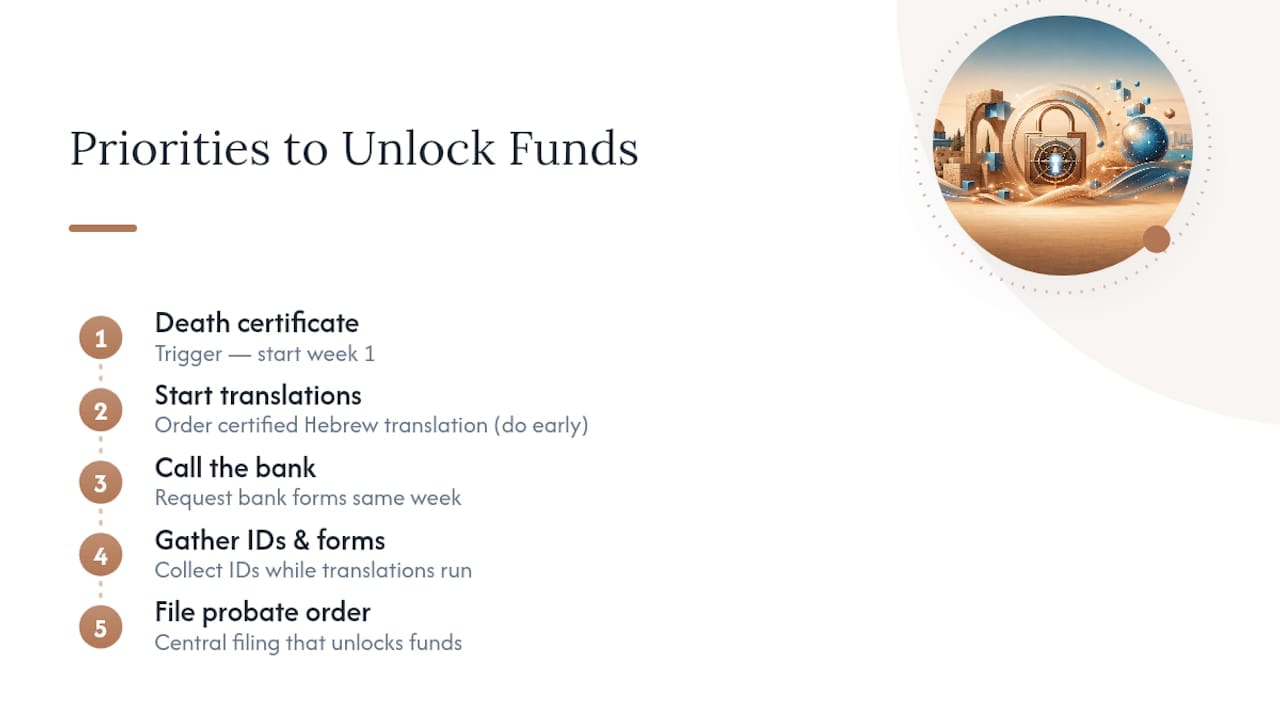
The conventional advice tends to underplay how much foreign documentation slows things down. A will drafted in New York or London isn’t rejected outright, but it needs a certified Hebrew translation and a foreign-law opinion before the Registrar will touch it, and those two items alone can eat two months if you start them late. That’s the piece most families discover only after they’ve already lost the time.
If there’s one thing to prioritize first, it’s this: call the bank and start the translation process in the same week you get the death certificate. Don’t wait for the order to arrive before you start gathering the supporting documents. Sequence matters more than speed here, and heirs who work in parallel finish months ahead of heirs who work in sequence.
— Menora Law
Get Remote Help From Menora Law on Your Inheritance Case
Menora Law is built for exactly the situation this article describes: heirs who need an Israeli inheritance order handled correctly, but can’t or don’t want to fly to Israel to manage it themselves. We work remotely with clients across the United States and internationally, obtaining the inheritance or probate order, arranging certified translations and foreign-law opinions, and liaising directly with Israeli bank estate departments on your behalf.
If you’re ready to move forward, the process starts simply: schedule a consultation, send over the basic documents you already have (death certificate, will if one exists, account information), and we’ll map out exactly what the Registrar and your bank will need from there. Explore Menora Law’s full range of inheritance and estate services to see how we handle document preparation, Registrar filings, and bank follow-up for clients managing an estate from abroad.
Where to File and Verify Documents
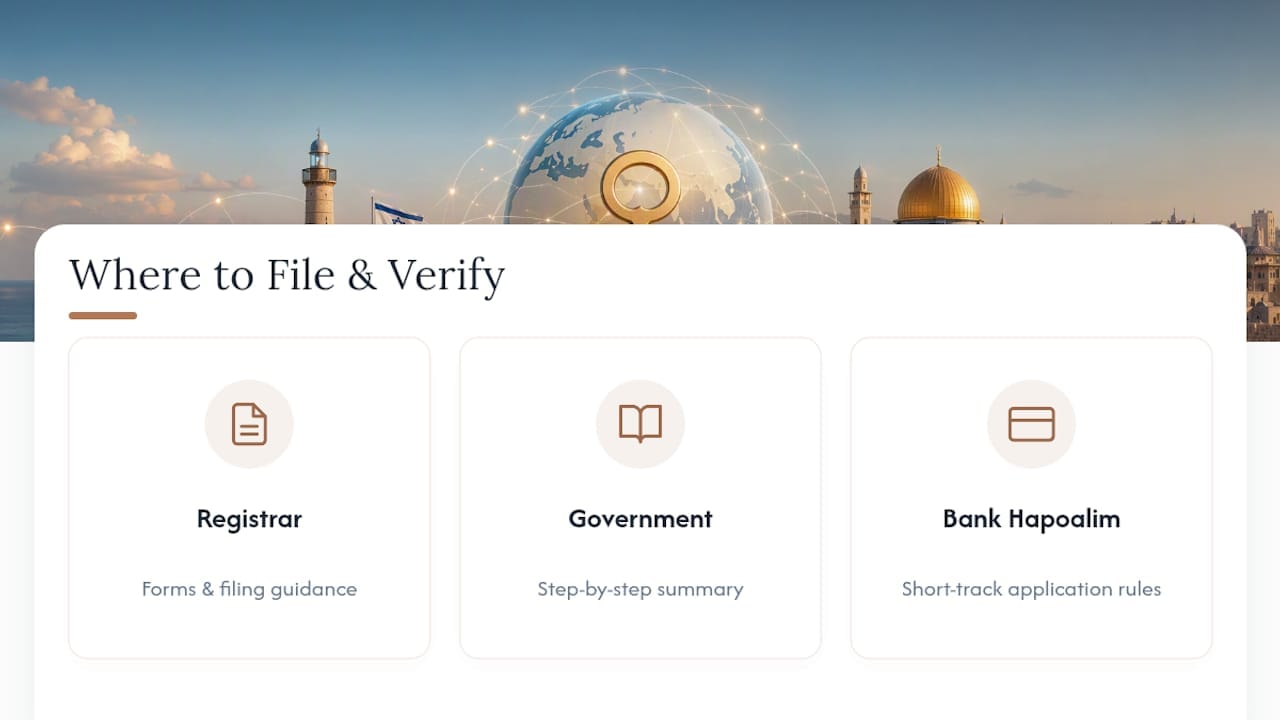
Start with the Registrar of Inheritance Affairs for forms and filing, and the Gov for a step-by-step government summary. For a real example of bank-specific rules, Bank Hapoalim’s guide to dividing inheritance funds shows exactly what a short-track application requires.
This article is general information, not a substitute for advice from a qualified lawyer. Consult a qualified legal professional about your own circumstances before acting on anything here.
Sources
- Rasham Yerusha (Registrar of Inheritance Affairs)
- Gov
- Bank Hapoalim — guide to dividing inheritance funds in a bank account (PDF)
- IBANet private-client / estate-planning guide — Israel
FAQ
Can You Withdraw Money From a Deceased Person’s Bank Account?
No, not without a Tzav Yerusha or Tzav Kiyum Tzava’a from the Registrar of Inheritance Affairs. Banks freeze the account on notice of death, and only limited, written authorization for funeral or essential costs is possible before that order arrives.
How Do You Locate a Deceased Person’s Unclaimed Funds in Israel?
The government’s unclaimed funds registry, often referred to informally as Har HaKesef, lets heirs search for balances tied to a deceased relative’s name. It won’t release the money on its own, but it’s the right starting point for locating accounts you didn’t know existed.
Who Can Withdraw Pension, Kupat Gemel, or Life Insurance Funds From a Deceased Account Holder?
These typically pass through a beneficiary designation, not the will or probate order, so the named beneficiary claims directly from the fund administrator. Heirs should check the beneficiary form on file rather than assuming these assets are covered by the estate’s inheritance order.
What Happens to a Deceased Person’s Bank Debts?
Outstanding debts and liabilities tied to the account generally become claims against the estate, settled before or during distribution to heirs. The bank will typically disclose known liabilities as part of the estate distribution process, which is one more reason to work with someone who can review the account history before funds move.
Does Menora Law Handle Inheritance Cases for Heirs Living Outside Israel?
Yes. Menora Law represents international heirs remotely, handling the Registrar filing, translations, foreign-law opinions, and bank liaison without requiring the client to travel to Israel. Pricing depends on the complexity of the estate and is available on request through Menora Law’s inheritance services.


 English
 Afrikaans
 العربية
 বাংলা
বাংলা Čeština
 简体中文
简体中文 Nederlands
 Suomi
Suomi Français
 Deutsch
 עִבְרִית
 हिन्दी
 Magyar
 Italiano
 日本語
日本語 한국어
한국어 Polski
 فارسی
فارسی Português do Brasil
 Русский
 Español de México
 Українська