
Yes, foreign companies can open a business bank account in Israel, but approval hinges on the bank’s risk review, not just paperwork. Israeli banks run their own KYC/AML checks on beneficial ownership, source of funds, and business activity before saying yes. The single biggest step you can take right now is building a bank-ready file that answers those questions before the bank asks them, ideally with an izraelský právník certifying the ownership structure and documents.
TL;DR:
- Building a comprehensive, bank-ready file with clear ownership, source-of-funds, and notarized translations significantly increases approval chances in Israel.
- Approval depends on a thorough risk review that considers the company’s ownership structure, jurisdiction of incorporation, and transaction history rather than just submitted documents.
- Most bank applications take between 30 to 60 days, with longer timelines possible for layered ownership structures or politically exposed persons.
- The type of account needed varies based on transaction volume, with checking, multi-currency, or trade-finance accounts suited to different operational needs.
- Involving legal counsel early to certify ownership structure and source-of-funds can shorten approval time and prevent delays caused by notarization or translation errors.
What Is a Business Bank Account in Israel for Foreign Companies?
A business bank account in Israel for a foreign company is a corporate account held with an Israeli bank by a company incorporated abroad, or by an Israeli subsidiary of a foreign parent. Not every foreign business needs one on day one, but several triggers make it necessary rather than optional.
If you’ve registered a company in Israel, you’re already required to have a local account to receive VAT refunds, pay local staff, or settle with Israeli suppliers. Even without a local entity, some foreign businesses open an account here to manage a physical branch, hold escrow funds for a real estate deal, or run payroll for local employees.
Common reasons a foreign company needs a local account:
- Paying salaries and social security contributions to Israeli employees
- Collecting and remitting VAT on local sales or services
- Settling invoices with Israeli suppliers or landlords in shekels
- Managing funds tied to Israeli real estate transactions
- Meeting a signed contract clause that requires local banking
Some companies get by for a short stretch using a personal account or an international payment provider. That works for occasional small transfers, but mixing personal and business funds creates a messy audit trail. It’s also one of the exact red flags Israeli banks look for later when you do apply for a proper corporate account, since it can look like an attempt to obscure the real source of funds.
What Do Israeli Banks Actually Check Before Approving an Account?
Israeli banks don’t approve business accounts on documentation alone. They run a risk-based KYC/AML review that follows Bank of Israel guidance, and the depth of that review scales with how risky your company looks on paper.
Three things drive the risk score: who ultimately owns and controls the company, where it’s incorporated, and how money is expected to move through the account. A Delaware holding company with three layers of nominee shareholders draws far more scrutiny than a UK-based operating company with a public, named ownership register.
Certain patterns consistently trigger deeper review or outright rejection, according to Auren Israel’s guidance for foreign companies entering Israel:
- Ownership chains routed through several jurisdictions with no clear final beneficial owner
- Incorporation in a jurisdiction the bank treats as high risk for money laundering
- Large, unexplained cross-border transfers with no supporting contract or invoice
- No real economic activity or presence connecting the company to Israel
Pro Tip: Draw your ownership structure as a one-page chart before you walk into the bank. A visual chain from parent company to ultimate beneficial owner, with percentages labeled, does more to build trust than three pages of dense legal text saying the same thing.
Approval isn’t the finish line, either. Israeli banks continue monitoring activity after the account opens, and a sudden spike in transaction volume or an unfamiliar counterparty can trigger a freeze or a request for fresh documentation. Banks would rather see a simple, well-explained ownership structure and a short memo on where the money comes from than an impressive-looking but opaque corporate stack.
What Documents Does the Bank Require to Open an Account?
Israeli banks publish specific document lists for corporate account applicants, and Bank Hapoalim’s documentation requirements give a good sense of how detailed these lists get. Missing even one item is the most common reason applications stall. Build your file in this order:
- Company formation documents. Certificate of incorporation, articles or memorandum of association, and a current extract from the company registry showing active status.
- Board authorization. Minutes of a board resolution formally authorizing the account opening and naming who is allowed to sign.
- Ownership records. A full list of beneficial owners with their ownership percentages, plus certified ID copies for each one. If ownership runs through holding entities, add a legal opinion tracing the chain to the final human owners.
- Signatory identification. Passports, proof of address, and either a power of attorney or a formal signature protocol for everyone authorized to operate the account, along with specimen signatures.
- Business and financial evidence. Recent management or audited accounts, signed contracts with clients or suppliers, sample invoices, and a reference letter from your existing bank.
- Compliance and source-of-funds documents. A written explanation of where the company’s money comes from, any internal AML policy the company maintains, and certified translations of every foreign-language document.
Every document originating outside Israel typically needs notarization and, depending on the country, an apostille under the Hague Convention. Certified legal translation matters more than people expect here. A translation that doesn’t match the notarized original word for word gets kicked back, and that single mismatch can add weeks to your timeline.
If you’re still finalizing your corporate structure in Israel, it’s worth reading how opening an Israeli company as a foreigner connects to this same document trail, since several items overlap.
How Long Does It Take to Open a Business Account in Israel?
Most straightforward applications take several weeks from submission to activation. Factoring in file preparation, clarification rounds, and final approval, the full process for a foreign company setting up in Israel commonly runs 30 to 60 days.
The process breaks into four stages:
- Prepare. Assemble the bank-ready file described above. This stage takes anywhere from a few days to a few weeks depending on how quickly you can gather notarized originals and translations.
- Submit. Choose your bank and channel. Some banks route foreign corporate applicants to a dedicated international or corporate desk rather than a standard branch, which usually moves faster.
- Clarify. Expect at least one round of follow-up questions. Banks routinely ask for more detail on ownership or transaction plans before moving forward.
- Activate. Once conditional approval comes through, the account activates and you can begin funding it.
Timelines stretch considerably longer when ownership is layered across multiple jurisdictions, when a beneficial owner is a politically exposed person, or when the company plans large, recurring international transfers from day one. In those cases, budget closer to the upper end of that 60-day window, or beyond it.
Submitting parallel applications to two or three banks, rather than waiting on one response before trying another, meaningfully shortens the time it takes to get a working account. Assign one person on your team to own the process and be the single point of Kontakt with the bank or your lawyer. Fragmented communication across several employees is one of the quiet reasons applications drag on longer than they need to.
What Are the Biggest Obstacles and How Do You Get Around Them?
Most rejected or stalled applications trace back to the same handful of fixable problems, not to some unwritten rule against foreign ownership.
Ownership presentation is the first hurdle. A notarized ownership chart paired with a signed confirmation from each beneficial owner clears up more confusion than any amount of narrative explanation. When the structure runs through multiple holding entities, providing an independent legal opinion that traces the chain and confirms there are no undisclosed owners is one of the highest-impact documents you can hand a compliance officer.
Source-of-funds evidence is the second. Bank compliance teams move faster when they can see a direct line between money and its origin: signed contracts, matching invoices, and payment traces from a named counterparty. A concise two-page memo tying those pieces together tends to clear review far faster than a thick folder of unconnected statements.
Translation and notarization errors cause more delays than people expect. A certified translator and the correct apostille chain for the document’s country of origin prevent the most common resubmission requests.
Pro Tip: If your ownership structure has more than one layer, or if a beneficial owner is a public figure, involve local counsel before you submit anything. A lawyer who can certify your file and speak to the bank directly on your behalf often shaves weeks off the process.
- Present ownership as a single, labeled chart, not a written paragraph
- Back every large transfer with a contract or invoice the bank can trace
- Use certified translators and confirm the correct apostille chain for your country
- Loop in a local accountant or attorney early if the structure is anything but simple
How Menora Law Helps Foreign Companies Get Bank-Ready
Menora Law works with foreign companies to build the exact file Israeli banks expect: verified ownership documentation, certified translations, notarization guidance, and a clear source-of-funds narrative. We also correspond directly with bank compliance officers on a client’s behalf, which matters most when ownership is layered, tax exposure needs framing correctly, or an operational deadline is close. For company formation and the tax questions that often surface alongside banking, our guides on starting a company in Israel and tax exposure for foreign companies cover the ground that overlaps with this process.
How Does Account Opening Connect to Company Registration and VAT?
Banking, company registration, and VAT registration in Israel aren’t three separate errands. They’re one connected process, and doing them out of order is a common source of delay.
You generally need an active company registration with the Israeli Registrar of Companies before a bank will open a corporate account, since the bank verifies your registry extract as a core document. Once the account exists, VAT registration with the Israel Tax Authority typically requires proof of that same active bank account, since VAT refunds and payments route through it directly.
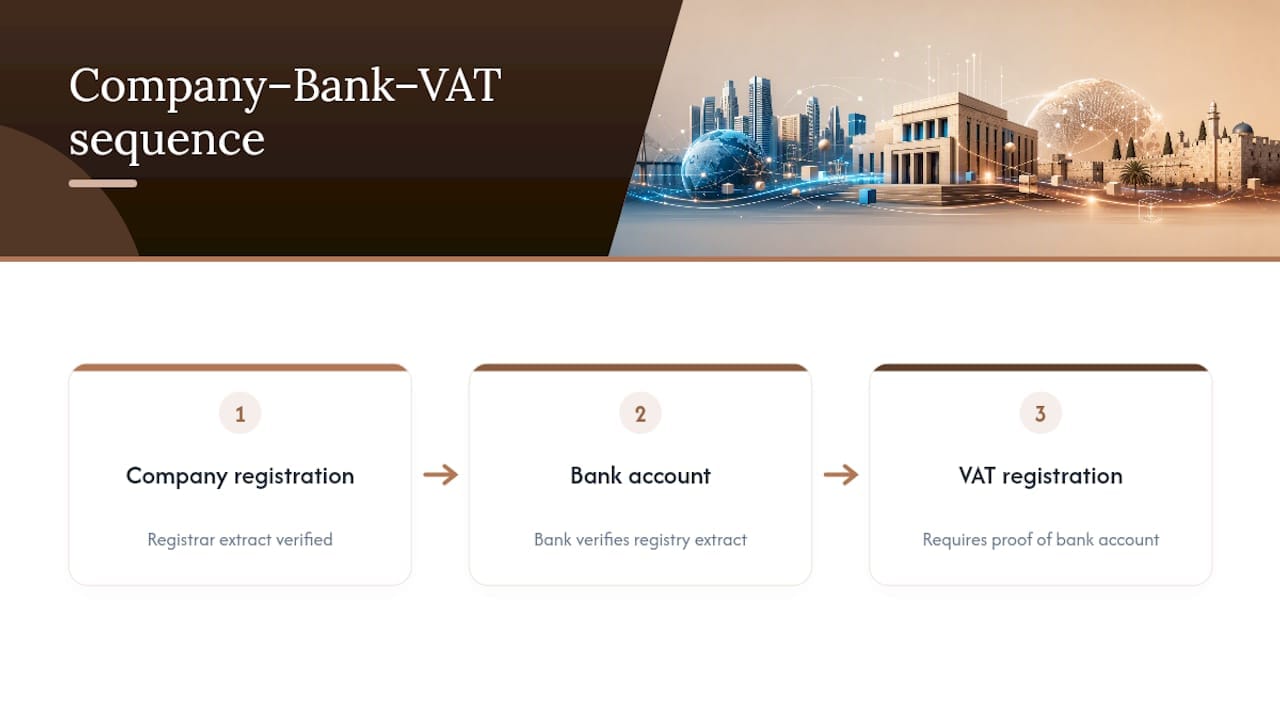
This creates a practical sequencing problem for foreign companies moving fast: register the company, open the bank account, then register for VAT, each step depending on proof of the one before it. Trying to skip ahead, say, signing local contracts before the account is active, often means routing early payments through a parent company account abroad, which then shows up as an unexplained cross-border flow when the bank eventually reviews your Israeli account. That’s exactly the kind of pattern that slows down approval rather than speeding it up.
Companies planning any local hiring, VAT-liable sales, or ongoing supplier relationships in Israel should treat the bank account as the second domino, not an afterthought squeezed in after operations already started.
What Types of Business Accounts Can Foreign Companies Open?
Most Israeli banks offer a small set of core account types, and which one fits depends on how your company plans to move money.
A standard checking account (the day-to-day operating account) is the default for most foreign-owned businesses handling local payroll, supplier payments, and VAT transactions in shekels. A savings or deposit account sits alongside it for companies parking reserve funds or holding a security deposit, sometimes a requirement for newcomers with no Israeli credit history. A multi-currency account lets a company hold and transact in US dollars, euros, or other major currencies alongside shekels, which matters most for businesses invoicing international clients or paying overseas suppliers without converting currency on every transaction.
Some banks also offer trade-finance-linked accounts bundled with letters of credit or FX hedging tools, aimed squarely at import/export businesses. Mizrahi-Tefahot’s business checking account, for example, is built around international trade services, a dedicated business banker, and cross-border transfer capability, which makes it a reasonable starting point to compare against for companies with heavy international transaction volume.
The right choice depends less on company size and more on transaction pattern. A services company invoicing a handful of overseas clients monthly has very different needs than a manufacturer moving inventory and payments across three countries. Ask any bank you’re considering to walk through their multi-currency and trade-finance offerings specifically, since these features vary more between banks than the basic checking account does.
What Do Business Bank Accounts Cost in Israel?
Fee structures vary by bank, but most Israeli business accounts charge a combination of a monthly maintenance fee, per-transaction charges for wires and checks, and sometimes a minimum balance requirement.
International wire transfers typically carry the highest per-transaction fees, both incoming and outgoing, and foreign companies moving money across borders regularly should expect this to be their largest recurring banking cost. Some banks waive or reduce monthly fees for accounts that maintain a set minimum balance, while others charge a flat fee regardless of balance. Because published fee schedules change and vary meaningfully bank to bank, ask your relationship manager for a current, written fee schedule before opening rather than relying on a general estimate.
Newer entrants to the Israeli banking system sometimes face an additional cost layer. Companies and individuals with no existing Israeli credit history are occasionally asked to provide a guarantor, a security deposit, or to open a personal account first before qualifying for business credit lines or an overdraft facility, according to guidance for new immigrants navigating Israeli banking basics. This isn’t unique to foreign companies specifically, but it does affect foreign-owned entities without a local track record.
Ask about fees for these specific items before signing:
- Monthly account maintenance
- Incoming and outgoing international wires
- Currency conversion spreads on multi-currency accounts
- Minimum balance thresholds and penalties for falling below them
What Online Banking Features Are Available for Foreign Companies?
Most major Israeli banks offer English-language online and mobile banking portals for business accounts, though the depth of English support varies noticeably from bank to bank. Look for a portal that supports multi-user access with defined permission levels, since foreign companies often need a finance officer abroad and a local operations manager to both have visibility without both having full transaction authority.
International wire initiation directly through the online platform, rather than requiring an in-branch visit, is now standard at larger banks and worth confirming before you choose one. Real-time balance and transaction visibility across multiple currencies matters if you’re running a multi-currency account, since reconciling wire timing against invoice due dates gets complicated fast without it.
Several banks, including Discount Bank’s corporate account offerings, publish English-language guidance and application steps aimed specifically at foreign and corporate applicants, which can make the initial application smoother if English fluency among your team is limited. Ask specifically about remote account management capability during your application process. A foreign company representative who never plans to visit Israel in person needs confirmation, in writing, that ongoing account management, wire approvals, and document submission can all happen remotely before committing to a particular bank.
What Are the Tax and Legal Implications of Holding an Israeli Account?
Opening a business bank account in Israel doesn’t by itself create Israeli tax residency or a permanent establishment for your foreign company, but it’s rarely viewed in isolation. Israeli tax authorities look at the whole picture: local employees, a local office, signed local contracts, and a bank account together tend to suggest genuine business activity here, which can trigger corporate tax obligations even for a company incorporated abroad.
VAT compliance is the most immediate practical implication. Any company with taxable activity in Israel, meaning sales or services delivered locally, generally needs to register for VAT and route those transactions through the local account. Keeping clean records of what flows through the account, and why, becomes important both for the bank’s ongoing monitoring and for any future tax authority inquiry.
Foreign-owned companies should also think about withholding tax obligations on payments made through the account to local contractors or employees, and how profits eventually repatriated to the foreign parent get treated under any applicable tax treaty. These questions get complicated quickly, and getting the structure wrong at the banking stage can create tax exposure that’s expensive to unwind later. Reviewing tax exposure for foreign companies operating in Israel before finalizing your banking setup is worth the hour it takes.
Are There Alternatives to Traditional Banks for Foreign Businesses?
Traditional bank accounts aren’t the only option, and for some foreign companies they’re not even the fastest one to start with. Fintech payment platforms and international payment service providers let a foreign business receive and send money in multiple currencies without going through Israel’s full corporate KYC process, and many onboard new business clients in days rather than weeks.
These alternatives work well for a specific use case: a foreign company that needs to invoice Israeli clients or pay a handful of local contractors, without yet needing full local banking infrastructure like payroll processing or VAT remittance. They’re often the right stopgap while a full Israeli bank application is still in progress.
They come with real limits, though. Payment service providers generally can’t handle the full range of functions an Israeli-registered company eventually needs: local payroll with social security withholding, VAT remittance directly to the tax authority, or the kind of banking relationship that supports business loans and credit lines. Companies planning any real local operations, actual employees, ongoing local contracts, physical premises, will eventually need a proper Israeli business account regardless of how they start. Treat a fintech platform as a bridge, not a permanent substitute, and start your bank application in parallel rather than waiting until the platform’s limitations become a problem.
How Do You Add or Change Authorized Signatories on the Account?
Adding a signatory to an Israeli business account isn’t a quick form submission. Banks treat any change to signing authority as its own mini KYC event, since it changes who can move money.
The company typically needs to submit a fresh board resolution naming the new signatory and specifying their exact authority level, whether that’s sole signing rights, joint signing with another authorized person, or authority capped at a certain transaction amount. The new signatory goes through the same identity verification as original signatories did: certified passport copy, proof of address, and a specimen signature on file with the bank.
If the new signatory is also a beneficial owner or director who wasn’t previously disclosed, expect the bank to run a fresh ownership and risk check on that individual specifically, which can take several days to a couple of weeks depending on their background and location. Removing a signatory tends to move faster, usually requiring just a board resolution and a signed notice, since it reduces rather than expands who can access the account.
Companies with signatories living abroad should ask upfront whether the bank accepts notarized signature specimens sent remotely or requires an in-person visit, since policies differ by bank and this affects how quickly you can make changes after the account is already active.
Clarify the Economic Story, Not Just the Paperwork
Banks don’t reward applicants who submit the thickest file. They reward the ones who can explain, in plain language, where the money comes from and why it’s moving the way it is. A tight two-page source-of-funds memo consistently outperforms a stack of unconnected statements and invoices, because it does the compliance officer’s job for them instead of leaving them to piece the story together.
Appoint one person inside your company to own this process from start to finish, someone who talks directly to the bank or your lawyer and isn’t juggling the conversation across three different colleagues. That single point of Kontakt is often the quiet difference between a 30-day approval and a 60-day one.
— Menora Law
How Menora Law Can Help You Open an Israeli Business Account
Legal services are available to help you build the dossier the way Israeli compliance officers want to see it: ownership charted clearly, source of funds explained in writing, and every document notarized and translated correctly the first time.
Typical legal support covers reviewing your corporate structure and flagging anything a bank might question, assembling and certifying the document dossier, and communicating with bank compliance officers until the account activates. Initial consultations usually cover ownership structure, intended banking activity, and which Israeli banks fit your transaction profile.
If you’re also finalizing your Israeli entity, we handle that alongside the banking work, since the two processes overlap closely. Reach out through Menora Law’s main site to schedule a consultation and start building your bank-ready file before you submit anything to a bank.
Useful Resources for Foreign Companies
Two starting points worth bookmarking: Bank Hapoalim’s account documentation list and Discount Bank’s English-language corporate account guide.
This article is general information, not a substitute for advice from a qualified financial advisor. Consult a qualified financial professional about your own circumstances before acting on anything here.
Sources
- Deel — Entity setup in Israel
- Auren Israel — Opening a bank account in Israel for foreign companies
- Bank Hapoalim — Documents for opening an account
- Mizrahi-Tefahot — business checking account
FAQ
Which Bank Is Best for a Foreign Company Opening an Account in Israel?
There’s no single best bank. The right one depends on your transaction profile: companies with heavy international trade often do well with banks offering strong FX and trade finance services, while companies with simpler local operations may prioritize a bank with the fastest English-language onboarding and lowest fees.
Can a Foreign Citizen Open a Bank Account in Israel?
Yes, foreign citizens can open both personal and business accounts in Israel, though business accounts for foreign-owned companies go through a more detailed KYC/AML review than a personal account does. Approval depends on providing clear beneficial ownership information and a credible explanation of source of funds.
Can You Open a Business Bank Account in Israel Online?
Some banks allow parts of the application, like initial document submission, to happen online or remotely, but most Israeli banks still require identity verification and final signing to happen in person or through a notarized remote process. Ask your chosen bank directly about remote onboarding options for foreign corporate applicants before assuming full online setup is possible.
What Are the Benefits of Opening a Business Account in Israel?
A local business account lets a foreign company pay local employees and suppliers directly in shekels, collect and remit VAT properly, and build the banking relationship needed for future credit or trade finance. It also removes the compliance risk of routing Israeli business activity through a personal account or foreign account, which banks tend to flag during review.
How Long Does the Whole Process Take From Start to Finish?
Most straightforward applications activate within several weeks, with the full process from company setup through a working account commonly landing in the 30 to 60 day range. Complex ownership structures or politically exposed beneficial owners can push that timeline longer.


 English
 Afrikaans
 العربية
 বাংলা
বাংলা Čeština
 简体中文
简体中文 Nederlands
 Suomi
Suomi Français
 Deutsch
 עִבְרִית
 हिन्दी
 Magyar
 Italiano
 日本語
日本語 한국어
한국어 Polski
 فارسی
فارسی Português do Brasil
 Русский
 Español de México
 Українська