
TL;DR:
- Serving legal documents in Israel internationally requires strict adherence to procedural rules and the Hague Service Convention. Proper translation into Hebrew, accurate forms, and verified Israeli addresses are essential to avoid delays or case dismissal. Engaging local Israeli process servers and legal counsel enhances the likelihood of valid service and timely case progression.
Serving legal documents in Israel internationally is the formal process of delivering official court or legal papers to parties located in Israel from a foreign country, in compliance with both Israeli procedural law and international legal frameworks. The recognized industry term for this process is “service of process,” and getting it right is not optional. If you serve documents incorrectly, an Israeli court can stall your case, dismiss your claim, or refuse to start the defendant’s response deadline. Israel acceded to the Hague Service Convention, which is the primary international treaty governing cross-border delivery of judicial documents in civil and commercial matters. That accession gives overseas plaintiffs a structured, court-recognized path to deliver legal papers to Israeli defendants. Menora Law works with international clients on exactly these situations, and this guide walks you through every step.
What are the legal prerequisites for serving legal documents in israel internationally?
The first thing you need to confirm is whether the Hague Service Convention applies to your situation. Israel is a signatory, so the Convention governs most civil and commercial service requests coming from other member states. That means your documents must follow the Convention’s procedural rules before an Israeli court will recognize the service as valid.
Translation requirements
Documents served in Israel must be translated into Hebrew unless the recipient is presumed to understand English or Arabic. This rule catches many overseas plaintiffs off guard. You cannot simply send English-language court papers and assume they will be accepted. A certified Hebrew translation is the default requirement, and skipping it is one of the fastest ways to invalidate your service entirely.
Required forms and documentation
The Hague Service Convention uses a standardized request form called the USM-94. This form must accompany your documents when submitting to Israel’s Central Authority. It identifies the requesting authority, the recipient’s address, the nature of the documents, and the method of service requested. Incomplete or incorrectly completed USM-94 forms are a common reason for delays.
Here is a summary of the core documentation requirements:
- Certified Hebrew translation of all documents to be served (unless English or Arabic is acceptable for the specific recipient)
- Completed USM-94 form identifying parties, addresses, and service method
- Original documents plus the required number of copies as specified by Israel’s Central Authority
- Proof of the recipient’s address in Israel, including street address and city
- Cover letter from the requesting authority or attorney explaining the nature of the request
Israeli procedural rules on address and representation
Israeli courts require a valid Israeli address for service. If the defendant has a local representative in Israel, service on the representative is permitted even when the defendant is located abroad. This is a practical option worth knowing. It can significantly speed up the process when the defendant has an Israeli attorney, business agent, or registered office.
| Requirement | Details | Notes |
|---|---|---|
| Hebrew translation | Mandatory unless recipient understands English or Arabic | Must be certified |
| USM-94 form | Required for Hague Convention submissions | Must be complete and accurate |
| Valid Israeli address | Required for all service attempts | PO Box addresses are generally not accepted |
| Copies of documents | Number specified by Central Authority | Confirm count before submitting |
| Proof of representation | Required if serving a local representative | Must show authority to receive service |
How do you execute service of process to israel from abroad?
The execution phase is where most overseas plaintiffs either get it right or create problems that take months to fix. The steps below reflect the standard workflow for valid service under the Hague Convention and Israeli procedural rules.
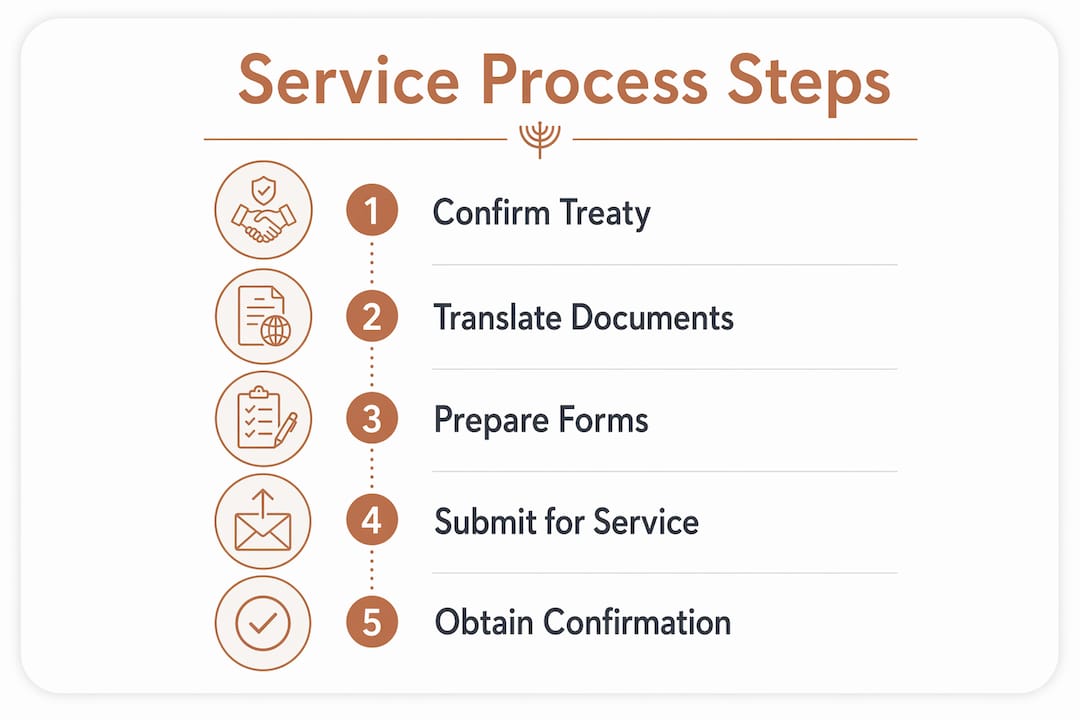
Confirm the correct method of service. You have three main options: formal service through Israel’s Central Authority under the Hague Convention, service through diplomatic or consular channels, or direct personal service by a local Israeli process server. The Hague Convention route is the most commonly used and court-recognized method for civil and commercial matters.
Prepare and translate your documents. Gather all documents that need to be served. Have them translated into Hebrew by a certified translator. Complete the USM-94 form accurately. Double-check the recipient’s Israeli address before submitting anything.
Submit to Israel’s Central Authority if using the Hague Convention route. Israel’s Central Authority processes Hague Convention applications for service of documents. You submit through your own country’s Central Authority, which forwards the request to Israel. The Israeli Central Authority then arranges service and returns a certificate of service once completed.
Engage a local Israeli process server for personal service. Overseas plaintiffs often use personal service via an in-country process server in Israel with proof of delivery. This is faster than the Central Authority route and gives you documented, verifiable proof of service. Local process servers in Israel are familiar with court requirements and know how to handle situations where the recipient is difficult to locate.
Document every attempt. Local service often involves at least three documented attempts to satisfy Israeli valid service criteria and demonstrate due diligence. Each attempt should be logged with date, time, and outcome. This documentation becomes your proof of service if the defendant later challenges whether they were properly served.
Obtain and file the certificate of service. Once service is completed, you receive a certificate or affidavit confirming delivery. File this with the Israeli court handling your case. Without it, the court cannot start the defendant’s response clock.
Track the receipt date carefully. Service timing impacts the entire procedure and requires tracking receipt dates to calendar the 30-day response period effectively. Mark the confirmed service date immediately and count forward from there.
Pro Tip: If you are using a local Israeli process server, ask them to provide electronic confirmation of delivery with a digital signature. Local legal courier services in Israel provide delivery with electronic signature and proof of service, which is far easier to present in court than a handwritten log.
Typical timelines vary by method. Central Authority service through the Hague Convention generally takes 2–6 months from submission to receipt of the service certificate. Personal service by a local process server can be completed in days to a few weeks, depending on the recipient’s availability and address accuracy.

What are the common challenges in international document service to israel?
Most problems for overseas plaintiffs arise from incorrect or delayed service rather than substantive legal issues. That finding should reset your priorities. You can have a strong legal claim and still lose procedural ground because the papers were not delivered correctly.
Address and translation errors
An incorrect address is the single most common reason service fails. Israeli courts do not accept service to a PO Box as valid personal service. If the address you have is outdated or incomplete, the process server cannot complete delivery, and your case stalls. Similarly, submitting untranslated documents when Hebrew is required gives the court grounds to treat the service as invalid.
Procedural timing and defense deadlines
Israeli small claims require valid service to start the defendant’s 30-day defense deadline. The defendant’s statement of defense is due within 30 days from the date they receive the claim. That clock does not start until valid service is confirmed. If your service is defective, the 30-day period never begins, and your case can sit in procedural limbo indefinitely.
Consequences of invalid service
If mail is not collected or the address is wrong, the case can stall or be dismissed until you prove valid service. Israeli courts treat defective service as a serious procedural failure, not a minor technicality.
This is not a situation where you can simply re-serve and pick up where you left off. Depending on the stage of proceedings and applicable statutes of limitations, a failed service attempt can cost you your right to pursue the claim entirely.
Practical steps to avoid these problems
- Verify the recipient’s current Israeli address through official sources or local counsel before initiating service
- Use a certified Hebrew translator with experience in legal documents, not a general translation service
- Hire a local Israeli process server who documents each attempt and provides a formal affidavit
- Coordinate with Israeli legal counsel to review your service plan before submission
- Keep copies of every document, translation, and correspondence related to the service process
Engaging local Israeli legal professionals dramatically improves the likelihood of valid service and timely defense actions. That is not a generic recommendation. It reflects the reality that Israeli procedural rules have specific requirements that are easy to miss from abroad and difficult to correct after the fact.
Formal vs. expedited service methods: which one should you use?
Choosing between formal Hague Convention service and expedited personal service is a practical decision that depends on your timeline, budget, and the nature of your case. Both methods are legally recognized under Israeli law when executed correctly.
Formal hague convention service
Formal service through Israel’s Central Authority is the most court-recognized route for international document delivery. It follows a documented chain of custody from your country’s Central Authority to Israel’s, and the resulting certificate of service carries strong evidentiary weight. The tradeoff is time. Expect a process that takes several months from start to finish.
Expedited personal service
Expedited service through a local Israeli process server is faster and more flexible. You engage the process server directly or through Israeli counsel, provide the documents and recipient address, and the server attempts delivery. This method works well for time-sensitive matters, including small claims filings where the 30-day defense deadline needs to start as soon as possible.
Pro Tip: For civil litigation with strict court deadlines, use expedited personal service to get the clock started, then follow up with formal documentation. Review the Israeli civil litigation process to understand how service timing fits into the broader procedural timeline.
| Method | Typical Timeline | Cost Range | Best For | Risk Level |
|---|---|---|---|---|
| Hague Convention (Central Authority) | 2–6 months | Higher (admin fees, translation, filing) | Complex civil or commercial cases | Low, if documents are correct |
| Personal service (local process server) | Days to weeks | Moderate (process server fee, translation) | Time-sensitive claims, small claims court | Low with experienced server |
| Diplomatic/consular channels | Several months | High | Cases involving government parties | Low but slow |
| Mail service (where permitted) | Weeks | Low | Limited circumstances only | High (recipient may not collect) |
Mail service carries the highest risk. If mail is not collected or the address is wrong, the case can stall or be dismissed. Mail service should only be used when specifically authorized by the court and when you have high confidence in the recipient’s address and willingness to collect correspondence.
Key takeaways
Valid service of process in Israel requires Hebrew-translated documents, a confirmed Israeli address, documented delivery attempts, and a filed certificate of service to start any procedural deadlines.
| Point | Details |
|---|---|
| Hague Convention applies | Israel is a signatory, so formal cross-border service follows Convention rules and requires the USM-94 form. |
| Hebrew translation is mandatory | Documents must be translated into Hebrew unless the recipient is confirmed to understand English or Arabic. |
| Three documented attempts required | Local process servers must log multiple delivery attempts to satisfy Israeli valid service standards. |
| 30-day defense clock starts at service | The defendant’s response deadline only begins once valid service is confirmed, making timing critical. |
| Local counsel reduces risk | Engaging Israeli legal professionals significantly improves the chance of valid, timely service. |
What menora law has learned about serving documents to israel from abroad
After working with international clients on Israeli legal matters for years, the pattern is clear. The clients who run into trouble are almost never the ones with weak legal claims. They are the ones who underestimated the procedural side of getting their documents properly delivered.
The Hague Convention gives you a framework, but it does not guarantee success. We have seen cases where the documents were perfectly prepared, the USM-94 was complete, and the translation was certified, but the service still failed because the recipient’s address had changed and no one verified it beforehand. That kind of mistake costs months.
The most effective approach we have found is to treat service as its own project, separate from the substantive legal work. That means verifying the address through Israeli sources before anything is sent, engaging a local process server who knows Israeli court standards, and building a calendar around the confirmed service date the moment delivery is completed.
One thing that surprises many of our clients is how much the 30-day defense deadline matters strategically. Once valid service is confirmed, the defendant must respond within 30 days. If you have done your preparation correctly, that clock is now running in your favor. If you have not, you are the one waiting.
We also recommend that clients review the Israeli jurisdiction rules for foreigners before initiating any service process. Understanding which court has authority over your matter, and whether service on a local representative is available, can change your entire approach and save significant time.
The bottom line is this: service of process in Israel is manageable from abroad, but it rewards preparation and punishes shortcuts.
— Menora Law
How menora law helps you serve legal documents in israel
Menora Law is an Israeli law firm focused on international clients who need reliable, knowledgeable representation inside Israel. When it comes to serving legal documents to Israeli parties from abroad, Menora Law handles the full process: assessing your translation requirements, coordinating with local Israeli process servers, tracking delivery attempts, and filing proof of service with the relevant court.
You get direct communication, a clear service plan, and a team that understands both the procedural requirements and the strategic implications of getting service right. Whether your matter involves civil litigation, a business dispute, or a cross-border claim, Menora Law provides the local expertise you need to move your case forward. Kontakt Menorský zákon today to discuss your situation and get a clear picture of your options.
FAQ
What is the hague service convention and does it apply to israel?
The Hague Service Convention is an international treaty governing the cross-border delivery of judicial documents in civil and commercial matters. Israel acceded to the Convention, so it applies to most formal service requests from other member states directed to parties in Israel.
Does every document served in israel need to be translated into hebrew?
Hebrew translation is required unless the recipient is presumed to understand English or Arabic. Submitting untranslated documents when Hebrew is required gives the court grounds to treat the service as invalid.
How long does it take to serve legal documents in israel from abroad?
Formal service through Israel’s Central Authority under the Hague Convention typically takes 2–6 months. Personal service by a local Israeli process server can be completed in days to a few weeks, depending on address accuracy and recipient availability.
What happens if service is defective or the defendant does not collect the documents?
If mail is not collected or the address is wrong, the case can stall or be dismissed until valid service is proven. Defective service means the defendant’s 30-day response deadline never starts, leaving your case in procedural limbo.
Can you serve an israeli defendant through their local representative?
Yes. Judicial documents may be served on the defendant’s representative in Israel even when the defendant is located abroad, provided the representative has authority to receive service on the defendant’s behalf. This option can significantly speed up the process in cross-border legal matters.


 English
 Afrikaans
 العربية
 বাংলা
বাংলা Čeština
 简体中文
简体中文 Nederlands
 Suomi
Suomi Français
 Deutsch
 עִבְרִית
 हिन्दी
 Magyar
 Italiano
 日本語
日本語 한국어
한국어 Polski
 فارسی
فارسی Português do Brasil
 Русский
 Español de México
 Українська