
Under Israeli law, an exclusive copyright license should be documented in writing, and an exclusive patent license is best recorded at the Israel Patent Office to preserve enforcement against third parties. Before you sign anything, check for Israel Innovation Authority funding restrictions and prepare for Israeli withholding tax on royalty payments. The sections below walk through the statutory rules, the clauses we recommend, and a checklist you can run from term sheet to signature.
TL;DR:
- Define permitted acts, territory, duration, and field of use; also set audit costs, sublicensing approvals, breach remedies, and any wind down period.
- If the Israel Innovation Authority funded the technology, obtain required approval before transferring or sublicensing it outside Israel, and review grant records before signing.
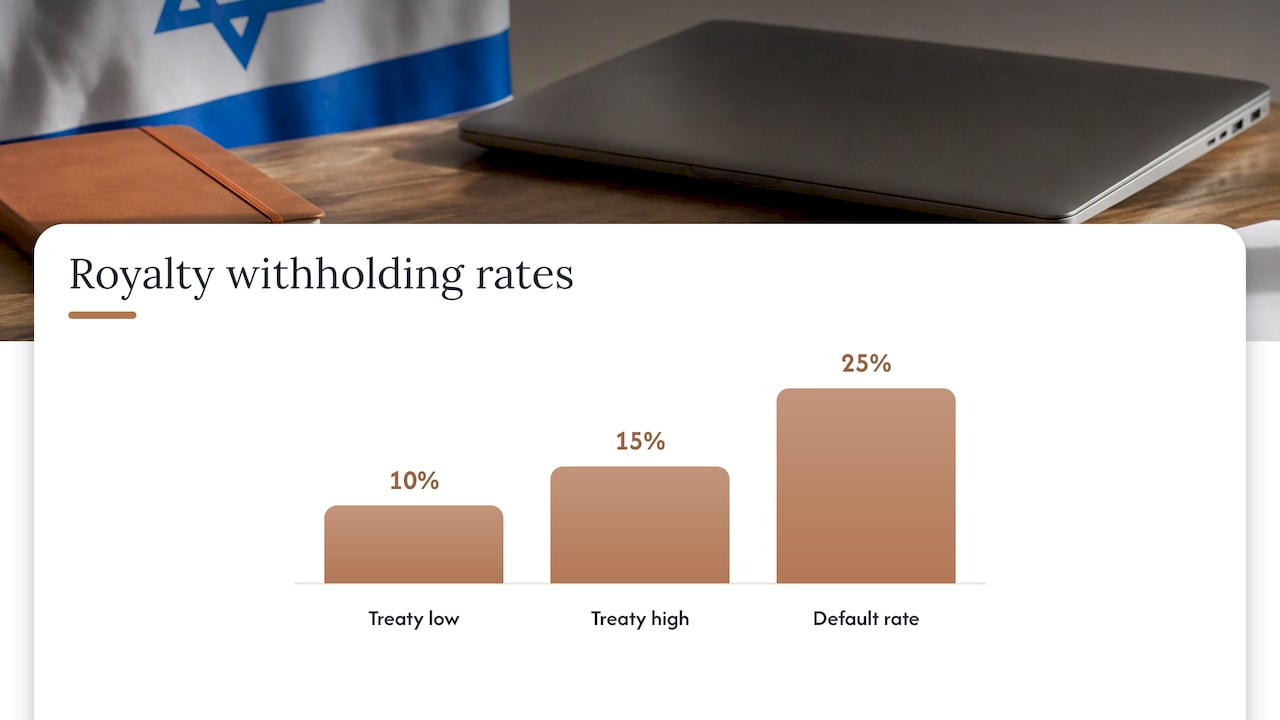
- Royalties face 25% default withholding, while treaties commonly reduce the rate to 10% to 15%; require a current residency certificate and specify who bears shortfalls.
- Search Israel Patent Office records for encumbrances before signing, because a foreclosure or registered claim can limit the licensor’s ability to grant clean rights.
- Private trademark coexistence agreements do not bind the Israel Trademark Office’s application review, so check registration and actual use before relying on an arrangement.
What Israeli law requires: form, recording, and types of licenses
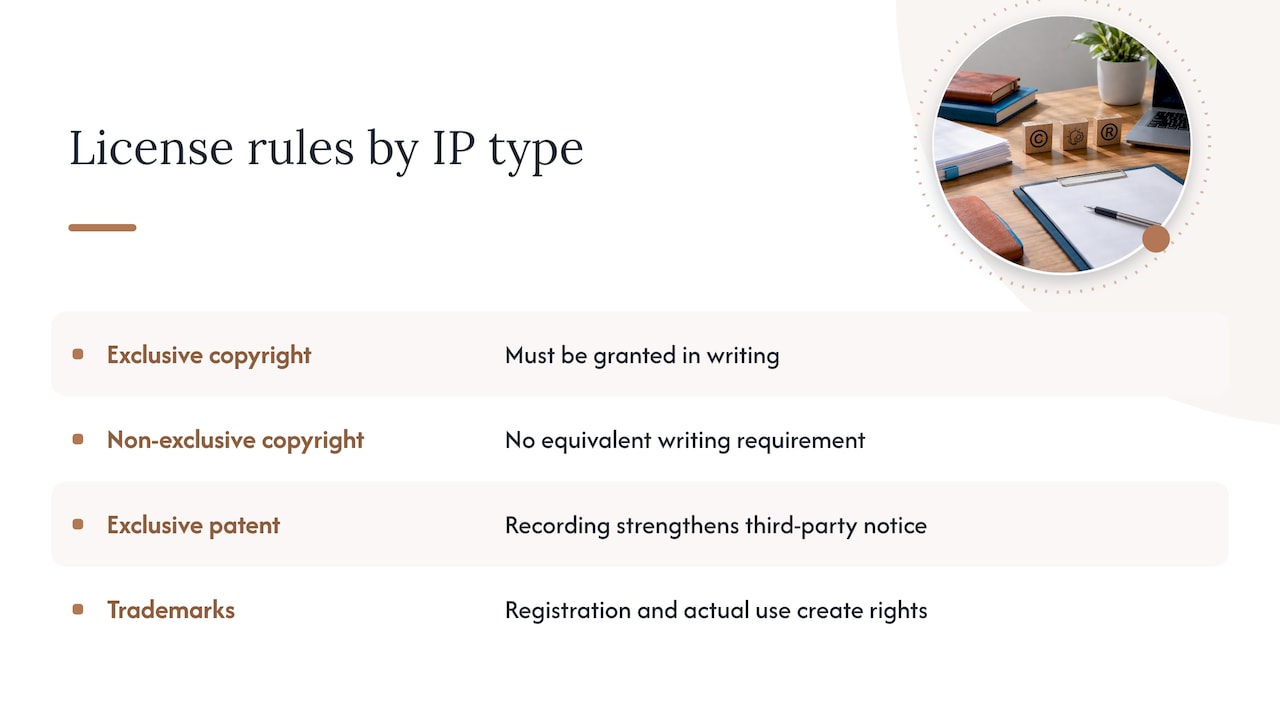
An exclusive copyright license must be granted in writing to be legally valid, a rule set out directly in the Copyright Act, 2007. The statute also lets parties limit a license by territory, time period, or specific permitted acts, so the written agreement carries real legal weight rather than serving as a formality. A non-exclusive copyright license has no equivalent writing requirement, though we still recommend putting it in writing for evidentiary reasons.
Patents work differently. The Patents Law, 5727-1967 establishes the ownership and enforcement framework, and recording an exclusive license at the Israel Patent Office strengthens your notice to third parties and your enforcement position if a dispute arises later. Recording is not always required for the license to bind the parties to each other, but it matters a great deal once someone outside the agreement is involved.
Trademarks sit under the Trademark Ordinance, and both registration and actual use create rights. A private co-existence agreement between two parties does not bind the Israel Trademark Office’s own discretionary review of a later application, which catches foreign licensors off guard more often than it should, according to the Chambers practice guide on Israeli trademarks and copyright. Whether a grant is exclusive or non-exclusive changes who can sue, who can sublicense, and how a court will read the remedies clause, so get that word right before anything else.
Key contract clauses every Israel-focused license must include
A license governed by Israeli law needs the same backbone as any commercial contract, but a few clauses deserve extra attention because of how Israeli courts and regulators read them.
- Grant of rights: spell out exactly which acts are permitted (reproduce, adapt, manufacture, distribute) and whether affiliates or subcontractors are covered.
- Scope limits: define field of use, territory, duration, and exclusivity, and add anti-shelving language if the licensee must actively commercialize rather than sit on the rights.
- Payment mechanics: fix the royalty base, reporting cadence, currency, and what happens if a payment is late, including any escrow arrangement.
- Audit and reporting rights: set an inspection cadence (annually is common) and name who bears the cost of an audit that reveals an underpayment.
- Sublicensing and assignment: require licensor approval for sublicenses, but carve out an exception for a corporate reorganization or sale of the licensee’s business.
- Warranties, indemnities, and termination: state what happens to the license on breach, insolvency, or expiration, and whether the licensee gets a wind-down period to sell existing stock or finish a project.
Él Licensing Playbook published by the Israel Innovation Authority notes that deals involving a research institution or technology transfer office often run through a Research and License Agreement structure rather than a simple commercial license, which changes who signs and who holds approval rights. If a university or research center sits anywhere in the chain of title, confirm which template actually governs before you negotiate clause by clause.
Pro Tip: Draft the audit clause before you draft the royalty clause. An audit right with no teeth makes every royalty number in the agreement a matter of trust rather than law.
Israel-specific constraints: IIA-funded IP, patent encumbrances, and government approvals
Two Israel-specific issues change deal structure often enough that we check for them on every file.
- IIA-funded technology: IP developed with grants from the Israel Innovation Authority is subject to R&D Law restrictions on transferring or sublicensing know-how outside Israel, and moving that technology abroad generally requires prior approval from the IIA committee.
- Patent encumbrances: a patent can carry a registered encumbrance or foreclosure at the Israel Patent Office, which affects whether a licensor can grant clean rights, and the office maintains an online registration and cancellation procedure for these filings.
- Diligence timing: ask the licensor directly whether any grant funding touched the technology, request IIA correspondence and approval letters, and run a patent record search before signing rather than after.
Missing an IIA disclosure is one of the most common ways an otherwise solid license becomes unenforceable exactly where the licensee needs it most.
Tax and payment practicalities for royalties from Israel
Royalty payments from Israel to a foreign licensor are generally subject to a default withholding tax of 25%, though applicable bilateral tax treaties commonly bring that rate down to roughly 10% to 15%, according to cross-border tax commentary on Israeli royalty withholding. That gap is large enough to change the real value of a royalty-based deal, so it needs to live in the contract, not just in a side conversation.
Build in a requirement for a current tax residency certificate from the licensor, a gross-up clause that specifies who absorbs a withholding shortfall, and a tax indemnity that covers a later reassessment. Word the payment clause so invoicing and reporting dates line up with when a residency certificate needs to be on file, because a late certificate can mean the higher default rate applies regardless of what the treaty allows.
Practical negotiation and redline checklist (term sheet to signature)
A licensing deal under Israeli law moves faster when the steps happen in a set order rather than all at once.
- Pre-steps: sign an NDA, agree a term sheet with a no-shop period, and confirm chain-of-title documents for the IP changing hands.
- Due diligence: check for IIA funding history, search Israel Patent Office and Trademark Office records, and confirm the licensor actually owns what it claims to license.
- Negotiation: licensors typically press for minimum royalties and tight sublicensing control, while licensees push for broader territory and longer exclusivity; a milestone-based royalty schedule often satisfies both sides.
- Execution: sign, record the exclusive patent license at the Patent Office, file the tax paperwork tied to the first payment, and schedule the first audit window on the calendar rather than leaving it open-ended.
A well-structured no-shop period during negotiation protects both sides from a deal unraveling midway, a principle covered in detail in this no-shop clause playbook built for sale and licensing negotiations alike.
Pro Tip: Record the patent license as soon as signatures are in place. Waiting invites a gap where a third party could claim no notice of your rights.
How Israeli practice changes common international templates
We regularly see foreign-drafted templates arrive in Israel missing an IIA disclosure section, written with vague exclusivity language that courts here read narrowly, or silent on patent recording entirely. Local review catches these gaps early, lines up IIA approval steps, confirms the Patent Office filing, and coordinates the tax residency paperwork before the first royalty payment is due. If you are working from a template built for another jurisdiction, a targeted review before signature is worth the hour it takes.
— Menora Law
Drafting and reviewing your Israeli IP license with Menora Law
Getting the formalities right on paper is only half the job. We draft and review intellectual property licensing agreements for clients abroad, handle IIA approval filings when grant-funded technology is involved, record exclusive patent licenses at the Israel Patent Office, and coordinate the tax residency documentation that keeps royalty payments flowing at the treaty rate rather than the default rate.
- Due diligence on ownership, IIA funding history, and encumbrances before you sign.
- License drafting and clause negotiation under Israeli law.
- Patent Office recording and trademark coordination for exclusive grants.
- Tax coordination for withholding, residency certificates, and gross-up language.
- Enforcement support if a dispute over scope or payment comes up later.
Because so many of our clients are overseas, we built our practice around remote consultations and fast turnaround, so you do not need to fly to Israel to get a license reviewed properly. If you want a licensing agreement checked before signature, or need one drafted from scratch, reach out through our services overview and we will walk through the specifics of your deal.
This article is general information, not a substitute for advice from a qualified lawyer. Consult a qualified legal professional about your own circumstances before acting on anything here.
Preguntas más frecuentes
Does an IP license in Israel need to be in writing?
An exclusive copyright license must be in writing under the Copyright Act, 2007 to be legally valid. A non-exclusive license has no such statutory requirement, but a written agreement is still the safer practice for proving scope and payment terms later.
What happens if licensed IP was developed with Israel Innovation Authority funding?
Technology developed with Israel Innovation Authority grants is subject to R&D Law restrictions on transferring or sublicensing the know-how abroad. Moving or sublicensing that technology outside Israel generally requires prior approval from the IIA committee, so check funding history before signing.
How much withholding tax applies to royalties paid out of Israel?
Royalties paid from Israel are generally subject to a default withholding tax of 25%, though a bilateral tax treaty commonly reduces that rate to roughly 10% to 15%. Treaty relief usually requires a current residency certificate from the licensor on file before payment.
Should an exclusive patent license be recorded at the Israel Patent Office?
Recording an exclusive license at the Israel Patent Office under the Patents Law, 5727-1967 strengthens notice to third parties and supports enforcement if a dispute arises later. It is a practical protective step even when the parties consider it unnecessary between themselves.
Can Menora Law help draft or review an IP licensing agreement under Israeli law?
Yes, we draft, review, and negotiate intellectual property licensing agreements governed by Israeli law. We work remotely with clients abroad through our services page, so a trip to Israel is not required.
Sources
- Copyright Act, 2007 (Israel) — WIPO Lex
- Israel Innovation Authority guidance — IIA-funded IP
- Cross-border tax commentary (royalty withholding guidance)
- Licensing Playbook 2024 (Israel Innovation Authority)


 English
 Afrikaans
 العربية
 বাংলা
বাংলা Čeština
 简体中文
简体中文 Nederlands
 Suomi
Suomi Français
 Deutsch
 עִבְרִית
 हिन्दी
 Magyar
 Italiano
 日本語
日本語 한국어
한국어 Polski
 فارسی
فارسی Português do Brasil
 Русский
 Español de México
 Українська