
Israeli high-tech raised $7.6 billion in the first half of 2026 alone, a jump of roughly 52% over the same period last year, with cybersecurity and CoreAI pulling in most of that capital. If you are weighing a position in this market, the practical point is this: money is concentrating into fewer, bigger rounds, so your choice of entry route matters as much as your choice of sector.
TL;DR:
- Cybersecurity captured about 33.8% of first half 2026 funding, while CoreAI raised nearly $1.6 billion; deep tech ventures often require longer development and additional financing.
- Direct investments provide control but tie up capital until an exit; funds spread company risk but charge fees and can take years to return capital.
- Angels Law relief requires qualifying equity in eligible Israeli R&D companies, complete documentation, required holding periods, and investment before the order expires December 31, 2026.
- Due diligence should verify the cap table, intellectual property ownership, employment agreements, and Innovation Authority grant restrictions, which can limit technology transfers or manufacturing locations.
Funding Snapshot and Recent Trends You Should Know
The headline numbers tell a recovery story. Israel Innovation Authority’s 2026 annual report puts 2025 fundraising at roughly $14.6 to $15 billion, alongside record exit value near $84 billion and a high-tech sector that made up about 18.3% of GDP. That momentum carried into 2026: Tech Review and IVC data show $7.6 billion raised in H1 2026 compared with the same stretch a year earlier.
Around 52% more capital flowed into Israeli high-tech in H1 2026 than in H1 2025, according to Tech Review and IVC figures, and that growth is not evenly spread across hundreds of small checks.
A few patterns stand out for anyone sizing up an entry point:
- The number of quarterly funding rounds has fallen from around 140 in 2019 and 2020 to roughly 105 per quarter in the 2023 to 2026 window.
- Average round size has grown even as round count shrank, meaning a smaller group of companies now absorbs most new capital.
- The 2025 exit total of roughly $84 billion, reported by the Innovation Authority, sets a high bar for liquidity expectations in later rounds.
- Fewer, larger deals typically mean later-stage investors face steeper entry valuations than they would have a few years ago.
If you are looking for broad exposure, that concentration argues for spreading commitments across several vehicles rather than betting on a single late-stage round.
Which Sectors Are Pulling in Investor Capital
Cybersecurity and CoreAI are not just popular labels right now, they are where the dollars are actually going. In H1 2026, cyber companies raised about $2.57 billion, or roughly 33.8% of all capital deployed in Israeli high-tech, while CoreAI companies pulled in close to $1.6 billion over the same period.
That split matters for how you think about risk and timeline:
- Cybersecurity’s one-third share reflects steady enterprise demand and a long track record of Israeli exits in the category.
- CoreAI’s roughly $1.6 billion in H1 2026 shows capital flowing consistently rather than in isolated spikes.
- Deep-tech fields including defense, space, and quantum computing are drawing growing attention as public and private investors look past software-only bets.
Cyber alone accounted for about a third of all H1 2026 fundraising, a share confirmed by Tech Review and IVC reporting.
The trade-off is time horizon. Software and cyber companies tend to reach revenue and exit milestones faster than hardware-heavy deep-tech ventures, which often need additional rounds and longer development cycles before a sale or public listing becomes realistic. If your capital needs to turn over within a few years, that distinction should shape which subsector you lean toward.
Who Is Actually Writing the Checks
Foreign capital dominates Israeli high-tech funding rounds, and that has been true for several reporting periods. Data cited in Innovation Authority’s prior annual report shows foreign investors making up roughly 68% to 70% of active participants in Israeli rounds, meaning local funds are often co-investing alongside, rather than leading, the largest checks.
A few shifts worth tracking:
- Local venture funds have raised somewhat smaller, more disciplined vintages in recent years, a pullback from the oversized funds of 2021.
- Sovereign wealth and strategic corporate investors have become more visible at the later stages, which tends to push up entry valuations for anyone trying to get into a hot round.
- Crossover and growth-stage funds increasingly set the pricing benchmark for Series C and later rounds, which affects what retail-adjacent investors can realistically access.
If you are investing through a fund rather than directly, ask your manager how much of their allocation competes with this foreign capital for the same deals.
Tax Incentives and Public Programs That Change Your Returns
Two public mechanisms directly affect what you keep after taxes and how much risk the state absorbs alongside you. The Angels Law, currently in force as a temporary order, offers a tax credit or deferral benefit to qualifying investors who put equity into early-stage Israeli R&D companies, provided the investment meets documentation and holding-period requirements.
- The Angels Law temporary order remains in effect through December 31, 2026, so timing your qualifying investment before that window closes matters.
- Qualifying investments must generally be structured as straight equity, since deferred instruments can disqualify you from the credit.
- The company receiving your investment typically needs to meet R&D spending or turnover thresholds set by the tax authority.
- Innovation Authority’s Startup Fund increased its matching caps for pre-seed, seed, and Round A deal in 2026, offering non-dilutive support alongside private capital.
The Angels Law benefit window closes December 31, 2026, based on the temporary order’s terms, which leaves a narrowing runway for investors who want to claim it this cycle.
These programs tend to favor deep-tech and hardware ventures that private capital alone finds harder to fund, which partly explains why that category is attracting more attention despite longer development timelines.
How You Can Actually Get Exposure to This Market
There is no single right way to invest in Israeli high-tech, and the route you pick should match how much liquidity and control you need.
- Direct primary investment puts you straight into a company’s cap table, but it usually requires accredited status, meaningful minimum checks, and tolerance for near-total illiquidity until an exit.
- Venture fund commitments spread your capital across a portfolio a manager selects, smoothing out single-company risk but layering on management fees and a multi-year J-curve before returns materialize.
- Secondary market purchases let you buy existing shares in later-stage private companies, often at a discount or premium depending on demand, though pricing transparency and liquidity remain limited compared with public markets.
- Public market proxies, such as funds or indexes with exposure to listed Israeli tech names, offer daily liquidity and lower minimums, at the cost of missing the earliest, highest-growth stage of a company’s life.
Pro Tip: If you are new to this market, pairing a smaller direct allocation with a diversified fund commitment often balances upside against the concentration risk we described earlier.
Whichever route you choose, the legal groundwork, entity structure, contractual protections, and tax positioning, looks different depending on whether you are buying primary shares, fund units, or secondary stakes. That is where the wrong assumption can cost you the most.
Our Legal and Tax Checklist Before You Commit Capital
Before any capital moves, we recommend confirming a short list of items that determine whether your investment qualifies for available benefits and holds up contractually.
- Confirm the investment is structured as equity, not a convertible or deferred instrument, to preserve Angels Law eligibility.
- Verify the target company’s R&D spending or turnover meets the thresholds the tax authority requires for that benefit.
- Decide whether you need an Israeli entity or can invest as a foreign individual, since tax-residency treatment affects your reporting obligations.
- Insist on vesting schedules, board observer or voting rights, and transfer restrictions appropriate to your stage and check size.
Pro Tip: Engage counsel before term sheet signing, not after, since several Angels Law documentation requirements are far easier to satisfy at closing than to retrofit later.
We handle these engagements for clients through remote consultations, so distance never has to slow down your closing timeline.
Deal Structures and Shareholder Agreements You Will Encounter
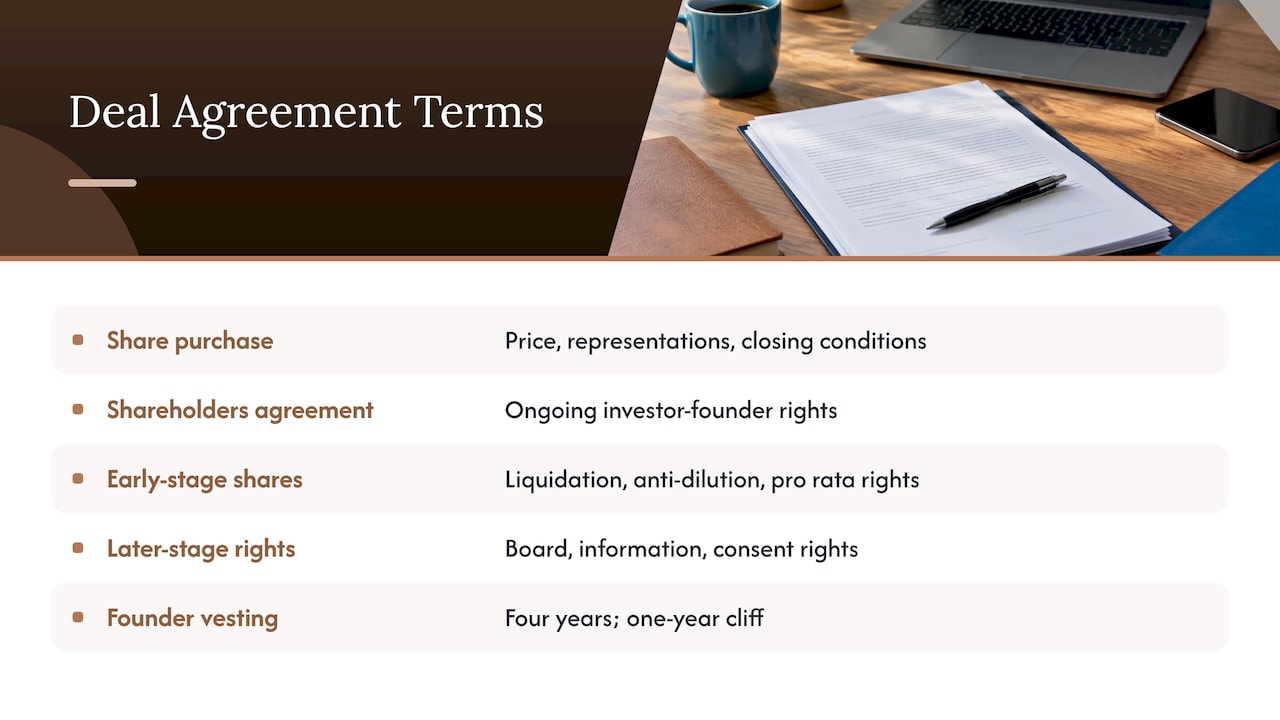
Most Israeli high-tech rounds follow a familiar shape: a share purchase agreement sets out price, representations, and closing conditions, while a shareholders agreement (often layered on top of, or incorporated into, the company’s articles) governs ongoing rights among investors and founders. Early-stage rounds typically use preferred shares carrying liquidation preference, anti-dilution protection, and pro rata rights for future rounds.
As rounds progress, the shareholders agreement tends to grow more detailed. Later-stage investors commonly negotiate board seats or observer rights, information rights covering financial reporting, and consent rights over major decisions like a sale of the company, a new financing round, or a change in business direction. Drag-along and tag-along provisions are standard, protecting majority holders’ ability to execute an exit while giving minority holders a path to participate on the same terms.
Founder vesting, typically over four years with a one-year cliff, remains near-universal in Israeli tech deals and protects investors against a co-founder leaving early with a full equity stake intact. Transfer restrictions, usually a right of first refusal for existing shareholders before shares can be sold to an outside party, are another fixture worth confirming before you sign.
For foreign investors, one added layer is making sure the agreement’s governing law and dispute resolution clauses point clearly to Israeli courts or an agreed arbitration forum, since ambiguity here becomes expensive if a dispute ever arises. Reviewing these documents before signing, rather than after a disagreement surfaces, is the difference between a straightforward negotiation and a costly one.
How Long the Investment Process Actually Takes
Timelines vary by deal type, but a typical primary investment in an Israeli high-tech company moves through a few recognizable phases. Initial term sheet negotiation, once a lead investor and valuation are agreed, usually runs two to four weeks, supported by thorough preparation including organizing an investor data room to streamline due diligence. Legal and financial due diligence, covering corporate records, IP ownership, employment agreements, and existing contracts, often takes another three to six weeks depending on how organized the company’s data room is.

Definitive documents, the share purchase agreement and shareholders agreement, are typically drafted and negotiated in parallel with the later stages of due diligence, which can compress or extend the overall timeline depending on how many points remain open. Closing itself, once documents are signed, usually happens within days, though funds transfer and corporate filings can add another week.
If your investment is meant to qualify for Angels Law benefits, build in extra time before year-end: completing documentation and holding-period requirements well ahead of the December 31, 2026 sunset is far safer than racing a deadline. Secondary purchases tend to move faster since they skip primary issuance mechanics, but they still require transfer approval from the company and sometimes a right-of-first-refusal waiver from existing holders, which can add its own delay.
What Investing in Israeli High-Tech Actually Costs
Beyond the capital you commit, expect a handful of recurring costs tied to any serious investment in this market. Legal fees for due diligence, document drafting, and negotiation are the most variable line item, scaling with deal complexity and how much back-and-forth the term sheet requires. A straightforward secondary purchase typically costs less in legal fees than a primary round with a full shareholders agreement negotiation.
If you invest through a venture fund, management fees and carried interest apply on top of your commitment, standard practice across the industry, and worth confirming against the fund’s specific terms before you sign a subscription agreement. Direct investors avoid those layered fees but absorb the full legal and diligence cost themselves.
Currency conversion is a cost many foreign investors underestimate. Since Israeli companies typically raise in US dollars but may report and pay taxes in shekels, USD to NIS exchange-rate movements can meaningfully affect both the company’s runway and your eventual returns when converting back to your home currency. Tax filing costs, including any professional preparation needed to claim Angels Law benefits or report capital gains on an eventual exit, add a further line item worth budgeting for from the outset rather than discovering at tax season.
Protecting the Intellectual Property Behind Your Investment
Intellectual property is often the single most valuable asset inside an Israeli high-tech company, and confirming it is properly owned and protected should happen before, not after, you wire funds. Start with ownership: verify that all patents, copyrights, and trade secrets were properly assigned from founders and employees to the company itself, since gaps here are a common and expensive surprise in later due diligence.
For software-driven companies, licensing terms with any third-party code or data providers need review, since a poorly structured license can create liability or limit the company’s ability to sell its product internationally. We have helped foreign-related tech companies fix licensing gaps that would otherwise have surfaced during a later funding round or acquisition.
Deep-tech and biotech investments carry an added layer: manufacturing agreements and research partnerships need their own IP provisions, since a university collaboration or contract manufacturer arrangement that lacks clear ownership language can cloud title to the core technology. We regularly secure IP and manufacturing protections for biotech ventures before a grant or investment closes, precisely because retrofitting these protections after the fact is far harder.
Trade secret protection deserves separate attention from patents, particularly for companies whose edge lies in proprietary algorithms or processes they have chosen not to patent. Confirming the company has taken the steps Israeli law requires to maintain trade secret status, reasonable confidentiality measures and restricted access, is worth a direct question during diligence.
Rules Foreign Investors Need to Follow in Israel
Foreign investors can generally invest in Israeli high-tech companies without restrictions that apply to many other countries’ sensitive sectors, though a few practical rules still apply. Securities offered to the public, as opposed to private placements to a limited group of sophisticated investors, trigger prospectus and disclosure requirements under Israeli securities law, so most early-stage rounds are structured as private placements specifically to avoid that threshold.
Tax reporting obligations depend on your residency status. A foreign investor who is not an Israeli tax resident is typically taxed in Israel only on Israeli-source income, including capital gains from selling shares in an Israeli company, though treaty relief may apply depending on your home country’s tax treaty with Israel. We have written in detail about capital gains tax treatment on Israeli share sales, including the forms involved, which is worth reviewing before you plan an exit.
Foreign investors working with Israel Innovation Authority-backed companies should also be aware of grant-related conditions, since IIA funding can carry restrictions on technology transfer or manufacturing location that affect a company’s flexibility after your investment closes. We have guided foreign buyers around common IIA grant traps that otherwise cause closing delays of 45 to 60 days.
Due Diligence Steps You Should Not Skip
Legal due diligence on an Israeli high-tech investment covers more ground than most foreign investors expect on their first deal. Corporate housekeeping comes first: confirming the company’s cap table matches its actual share issuances, that board and shareholder approvals were properly documented, and that no undisclosed liabilities or litigation sit on the balance sheet.
IP diligence, covering patent, copyright, and trade secret ownership, deserves its own dedicated review rather than a quick checklist pass, particularly for any company whose value rests primarily on its technology rather than its revenue. Employment and contractor agreements need checking too, since Israeli labor law has specific requirements around severance and notice periods that differ from US practice and can create unexpected liabilities for a company that has not documented them correctly.
Regulatory and grant compliance rounds out the list for companies that have received Innovation Authority funding, since those grants carry conditions that survive into your investment and can affect future financing or acquisition flexibility. If a dispute has ever arisen between founders or early shareholders, reviewing how it was resolved, and whether the resolution is properly documented, can save you from inheriting someone else’s unfinished conflict. We have helped investors secure control quickly during partner disputes that surfaced only after a deal had already closed, a situation far easier to prevent than to fix.
Where the Next 12 to 24 Months Look Promising
Cyber and CoreAI look likely to keep attracting steady capital, while deep-tech and defense gain ground as public matching programs expand. Watch the USD-NIS exchange rate, VC fundraising pace, and regional developments closely, and favor a mix of instruments over a single concentrated bet.
How We Help You Invest in Israeli High-Tech With Confidence
Investing across borders raises legal questions that a funding headline never answers: how your round should be structured, whether you qualify for Angels Law benefits, and what protections belong in your shareholders agreement. We handle exactly these questions for clients putting capital into high-tech, biotech, and related ventures.
Our work for investors typically covers:
- Transactional due diligence on target companies, including IP ownership and corporate compliance review.
- Structuring investments to preserve Angels Law tax benefits where they apply.
- Entity selection and tax-residency guidance for investors based outside Israel.
- Drafting and negotiating shareholder agreements, vesting terms, and transfer restrictions.
| What you need | How we help |
|---|---|
| Entry into a funding round | Due diligence, deal structuring, contract drafting |
| Angels Law qualification | Documentation review and timing guidance |
| Post-close protection | Shareholder agreement enforcement, dispute response |
| Remote representation | Full case handling without travel to Israel |
We represent clients from different countries entirely remotely, with consultations scheduled around your time zone and documents handled electronically from start to close. If you are ready to move on an Israeli high-tech investment, reach out through our main services page to set up a consultation.
This article is general information, not a substitute for advice from a qualified financial advisor. Consult a qualified financial professional about your own circumstances before acting on anything here.
Preguntas más frecuentes
What is the current funding level for Israeli high-tech?
Israeli high-tech raised about $7.6 billion in H1 2026, up roughly 52% from the same period in 2025. Cyber and CoreAI companies accounted for the largest shares of that total.
Which sectors are attracting the most investment right now?
Cybersecurity led with about 33.8% of H1 2026 funding, followed closely by CoreAI companies raising close to $1.6 billion in the same period. Deep-tech fields including defense and quantum are drawing growing but smaller shares of capital.
How does the Angels Law benefit foreign investors?
The Angels Law temporary order offers a tax credit or deferral benefit for qualifying equity investments in early-stage Israeli R&D companies, provided documentation and holding-period rules are met. The current order is in force through December 31, 2026.
Do I need an Israeli lawyer to invest in an Israeli startup?
You are not legally required to retain Israeli counsel, but given the complexity of entity structuring, tax residency rules, and shareholder agreement terms, working with a lawyer familiar with Israeli high-tech transactions significantly reduces the risk of a costly mistake. We provide this support remotely for clients based outside Israel.
What should I check before investing in an Israeli high-tech company?
Confirm the company’s IP ownership, cap table accuracy, and any Innovation Authority grant conditions before committing capital. We also recommend reviewing whether the investment structure preserves eligibility for available tax benefits before signing a term sheet.
Sources
- Annual Report: The State of High-Tech 2026 (Innovation Authority)
- Calcalist coverage of Tech Review / IVC H1 2026
- Maariv summary of Tech Review / IVC H1 2026
- The Angels Law promotes investments in Israeli high-tech startups (Lexology)


 English
 Afrikaans
 العربية
 বাংলা
বাংলা Čeština
 简体中文
简体中文 Nederlands
 Suomi
Suomi Français
 Deutsch
 עִבְרִית
 हिन्दी
 Magyar
 Italiano
 日本語
日本語 한국어
한국어 Polski
 فارسی
فارسی Português do Brasil
 Русский
 Español de México
 Українська