
Israeli Civil Litigation and Arbitration Explained by Israeli Law Firm
The Israeli civil litigation process explained clearly is something most international clients and legal professionals never get before they find themselves in the middle of a dispute. Israel’s civil court system operates under rules that differ substantially from those in the United States, the United Kingdom, and most of Western Europe. There is no jury. Religious courts hold real authority over civil matters. Arbitration carries binding consequences that can strip parties of protections they assumed they had. This guide covers every critical stage, from filing your first claim to enforcing a judgment, so you can approach Israeli courts with confidence rather than guesswork.
Key Takeaways
| Point | Details |
|---|---|
| No jury system in Israel | All civil claims are decided by professional judges, making legal preparation and written arguments especially critical. |
| Religious courts hold civil power | Under new legislation, rabbinical and sharia courts can arbitrate civil disputes with rulings enforceable as court judgments. |
| Arbitration consent is binding | Signing an arbitration form in Israel can lock parties into religious law with limited civil court recourse. |
| Litigation follows structured stages | Civil lawsuits in Israel proceed through filing, service, discovery, pre-trial, trial, and judgment in a defined sequence. |
| Legal representation is non-negotiable | Israeli procedural rules are strict; qualified local counsel is the single most important factor in case outcomes. |
The Israeli civil litigation process explained: structure and stages
Understanding Israeli litigation starts with recognizing that the system is adversarial but entirely judge-driven. All civil claims are decided by professional judges without any jury involvement. That distinction matters more than it sounds. Without a jury, persuasion shifts from emotional storytelling to legal precision, documented evidence, and well-constructed written submissions.
Here is how the standard steps in civil litigation in Israel unfold:
- Filing the Statement of Claim. The plaintiff files a formal Statement of Claim with the appropriate court, detailing the legal basis for the dispute, the facts, and the relief sought. The claim must meet procedural requirements regarding format, fees, and jurisdiction. Filing in the wrong court is a common and costly mistake.
- Service of process. Once filed, the claim must be formally served on the defendant. Israeli procedural rules govern how service is executed, including special provisions for serving parties located abroad, which is particularly relevant for international clients.
- Statement of Defense. The defendant submits a formal Statement of Defense within the prescribed timeframe, addressing each claim. Both parties may also file counterclaims at this stage, expanding the scope of the dispute.
- Discovery and document exchange. Both sides exchange relevant documents and may conduct examinations for discovery. This phase can be extensive in commercial disputes involving contracts, real estate, or corporate matters.
- Pre-trial conference and mediation. Civil courts conduct pre-trials to explore settlement options before trial. Israeli judges actively encourage mediation at this stage, and many disputes resolve here without proceeding further.
- Trial. Witness examination at trial includes direct examination, cross-examination, and re-examination, all conducted by the attorneys for each side before the judge. There is no jury deliberation. The judge evaluates credibility and weighs evidence directly.
- Judgment and enforcement. The judge delivers a written judgment. Enforcement mechanisms include wage garnishment, asset seizure, and liens on property. Appeals proceed to the District Court and, in significant cases, to the Supreme Court.
Pro Tip: File your Statement of Claim with a detailed factual narrative and clear legal grounds from the outset. Israeli judges rely heavily on written submissions, and a poorly drafted initial claim can undermine your position throughout the entire proceeding.
Religious courts and arbitration in Israeli civil disputes

This is where the Israeli legal system overview diverges most sharply from what international clients expect. Israel has a parallel track of religious courts, including rabbinical courts for Jewish matters and sharia courts for Muslim matters, that have historically handled personal status issues like marriage and divorce. Recent legislation has dramatically expanded their reach.
New law grants religious courts broad arbitration authority over civil matters, including financial disputes and property disagreements, with procedural characteristics that differ fundamentally from civil court proceedings. The key mechanism is consent: parties sign an arbitration form agreeing to have their dispute resolved under religious law. Once that form is signed, the consequences are significant.
Key features of religious court arbitration in Israel include:
- Binding rulings without civil confirmation. Religious arbitration rulings do not require judicial confirmation from a civil court, unlike typical private arbitration awards. They are automatically enforceable as if they were court judgments.
- Limited civil court oversight. Civil courts have minimal authority to review or overturn religious arbitration decisions, even when procedural irregularities occur.
- Proceedings governed by religious law. The substantive rules applied are those of halacha or sharia, not Israeli civil law principles. This can produce outcomes that differ materially from what a civil court would decide.
- Concerns over rights protections. Critics, including legal scholars at the Israel Democracy Institute, have raised concerns about gender representation and the protection of basic civil rights within religious arbitration forums.
- Inflexibility in procedure. Religious arbitration is less flexible than private arbitration and does not offer the procedural customization that commercial parties typically expect.
Consenting to religious court arbitration is not simply choosing a faster forum. It is choosing a different legal system entirely, one with its own rules, its own standards of proof, and its own conception of fairness. Parties who sign arbitration forms without understanding these consequences often discover there is no path back to civil court.
Civil litigation versus arbitration: a strategic comparison
Choosing between civil courts and arbitration, whether private or religious, is one of the most consequential decisions in any Israeli civil dispute. The right choice depends on the nature of the dispute, the relationship between the parties, and the legal protections each side needs to preserve.
| Factor | Civil litigation | Private arbitration | Religious court arbitration |
|---|---|---|---|
| Decision-maker | Professional judge | Appointed arbitrator | Religious court judge |
| Governing law | Israeli civil law | Agreed rules or Israeli law | Religious law (halacha/sharia) |
| Civil court oversight | Full | Moderate | Minimal |
| Enforceability | Standard court judgment | Requires court confirmation | Automatic, no confirmation needed |
| Duration | Often multi-year | Typically faster | Variable |
| Privacy | Public proceedings | Private | Limited privacy |
| Rights protections | Full civil law protections | Agreed protections | Potentially limited |
| Cost | Court fees plus legal costs | Arbitrator fees plus legal costs | Lower administrative costs |
Civil litigation offers transparency, procedural rigor, and the full protection of Israeli civil law. For disputes involving significant assets, complex commercial relationships, or parties with unequal bargaining power, the civil court system provides the most reliable framework. The steps in civil litigation Israel follows are well-defined, and the appellate process provides meaningful error correction.
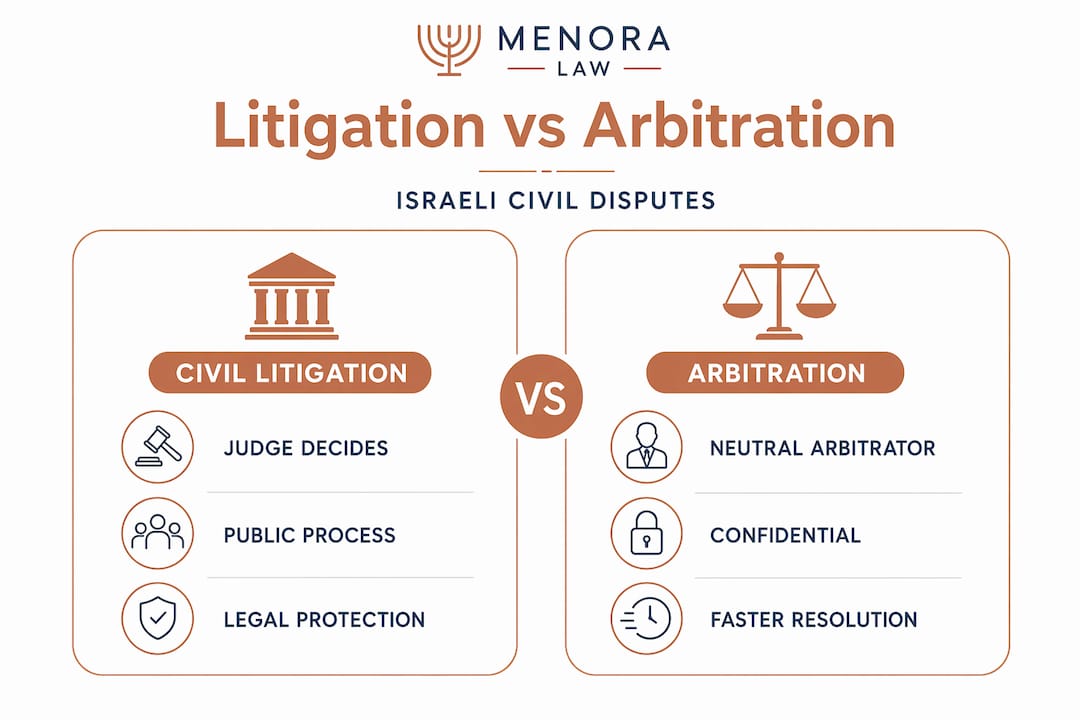
Private arbitration offers speed and confidentiality, making it attractive for commercial parties who want to resolve disputes without public exposure. The arbitrator can be selected for subject-matter expertise, and proceedings can be scheduled more efficiently than civil court dockets allow.
Religious court arbitration presents a more complex calculation. The speed and lower administrative cost may appear attractive, but arbitration consent can procedurally lock parties into a forum where civil law protections do not apply. For international clients unfamiliar with religious law principles, this is a significant risk.
Pro Tip: Before signing any arbitration clause in an Israeli contract, including lease agreements, consult with qualified Israeli counsel about the specific forum and governing law. What appears to be a standard dispute resolution clause may carry binding consequences that are very difficult to reverse.
Practical guide to navigating Israeli courts successfully
Knowing how to navigate Israeli courts effectively requires preparation well before a dispute reaches the courtroom. Here is what experienced practitioners recommend:
- Retain qualified Israeli legal counsel immediately. Israeli procedural rules are strict, and deadlines are enforced. An attorney licensed in Israel who understands both the substantive law and the local court culture is not optional. It is the foundation of any viable litigation strategy.
- Prepare your documentary evidence early. Discovery in Israeli civil proceedings can be extensive. Organize contracts, correspondence, financial records, and any other relevant documents before filing. Courts expect parties to be prepared, and gaps in documentation are difficult to remedy later.
- Take pre-trial mediation seriously. Many Israeli civil disputes resolve at the pre-trial conference stage. Entering mediation with a realistic assessment of your position and a clear settlement range saves time and legal costs. Judges notice when parties negotiate in bad faith.
- Prepare witnesses carefully. Litigation in Israel requires thorough preparation for witness examination. Witnesses should understand the structure of direct and cross-examination and be prepared to respond to challenging questions without becoming defensive or evasive.
- Understand the timeline realistically. Civil litigation in Israel can span multiple years, particularly in complex commercial disputes. Build that timeline into your financial and business planning rather than assuming a quick resolution.
- Know your post-judgment options. If you obtain a favorable judgment, enforcement is a separate process. Asset searches, garnishment orders, and liens require additional filings. If the losing party is located abroad, international enforcement treaties may apply.
- Evaluate arbitration consent in every contract. Legal professionals advise caution regarding arbitration clauses because of their binding legal consequences and the limited recourse available once consent is given.
Pro Tip: If you are an international client managing a dispute in Israel from abroad, establish a clear communication protocol with your Israeli attorney from day one. Court deadlines do not pause for time zone differences or delayed email responses.
My perspective on Israeli civil litigation and its evolving complexity
I have worked with clients navigating Israeli civil courts and religious arbitration forums long enough to recognize a pattern that repeats itself with troubling regularity. Clients arrive after having signed an arbitration clause they did not fully understand, often buried in a lease agreement or commercial contract, and they discover that the forum they consented to operates under entirely different rules than they anticipated.
The expansion of religious court authority over civil matters is a genuine shift in the Israeli legal system overview, not a minor procedural footnote. In my view, the most significant risk is not the religious law itself but the near-total absence of civil court oversight once arbitration is underway. When a ruling is automatically enforceable without judicial confirmation, the normal checks that protect litigants simply do not apply.
What I have learned from watching these cases unfold is that informed consent is everything. A client who understands exactly what they are agreeing to when they sign an arbitration form can make a rational strategic choice. A client who signs without understanding has, in practical terms, waived rights they may never recover.
The Israeli civil litigation process is not inherently hostile to international clients or unfamiliar parties. It is structured, it is judge-driven, and it rewards preparation. The challenge is that the system is evolving, and the intersection of civil and religious jurisdiction creates complexity that even experienced practitioners must monitor continuously. Staying current on legislative changes, particularly those affecting religious court authority, is not optional for anyone practicing or litigating in this space.
— Menora Law
How Menora Law can guide you through Israeli civil litigation
Menora Law specializes in representing international clients through every stage of the Israeli civil litigation process, from initial case assessment to post-judgment enforcement. Whether you are facing a contract dispute, a property claim, or a complex commercial matter, the firm’s attorneys provide clear guidance on forum selection, arbitration risks, and procedural strategy tailored to your specific situation.

For clients managing disputes from the United States or elsewhere abroad, Menora Law’s ability to coordinate across time zones and provide on-site representation in Israeli courts makes a measurable difference in case outcomes. The firm’s Israeli legal services cover the full spectrum of civil litigation needs, including advising on arbitration consent before you sign anything that could limit your options later. If you are facing a civil dispute in Israel or need to evaluate your legal position before it becomes a dispute, ottaa yhteyttä Menora Law today for a personalized consultation.
FAQ
Does Israel use a jury system in civil cases?
No. Israeli courts have no jury system. All civil cases are decided by professional judges who evaluate evidence and deliver written judgments.
What happens if I sign a religious court arbitration form in Israel?
Signing that form consents to having your dispute resolved under religious law, with rulings that are automatically enforceable as court judgments and subject to minimal civil court review.
How long does civil litigation in Israel typically take?
Complex civil disputes in Israel often take several years from filing to final judgment, depending on the court’s docket, the complexity of the evidence, and whether the parties pursue settlement at the pre-trial stage.
Can foreign judgments be enforced in Israel?
Yes, Israel recognizes foreign judgments under specific conditions, including reciprocity agreements and procedural requirements. Enforcement requires a separate application to an Israeli court to have the foreign judgment recognized and executed.
When should I choose arbitration over civil litigation in Israel?
Private arbitration may suit commercial disputes where speed, confidentiality, and subject-matter expertise are priorities. However, you should avoid religious court arbitration unless you fully understand the governing law and have received independent legal advice on the procedural consequences.


 English
 Afrikaans
 العربية
 বাংলা
বাংলা Čeština
 简体中文
简体中文 Nederlands
 Suomi
Suomi Français
 Deutsch
 עִבְרִית
 हिन्दी
 Magyar
 Italiano
 日本語
日本語 한국어
한국어 Polski
 فارسی
فارسی Português do Brasil
 Русский
 Español de México
 Українська