
TL;DR:
- An Israeli liquidation preference gives preferred shareholders priority payment over common shareholders during liquidity events. It can significantly reduce or eliminate proceeds for founders and employees in small exits, making negotiation of preference terms crucial. Most deals favor a 1x non-participating preference to protect investor downside while allowing founder upside.
An Israeli liquidation preference is a contractual right, written into a company’s articles of association and investment agreement, that gives preferred shareholders priority payment over ordinary (common) shareholders when a liquidity event occurs. In plain terms: before founders, employees, or common stockholders see a single shekel, preferred shareholders get paid first. The practical takeaway is immediate — liquidation preference reorders the entire exit waterfall, and in small-to-mid exits it can eliminate proceeds for founders and employees entirely. Verify the preference type and multiple before you sign anything.
- Preferred shareholders receive payment before common shareholders in any sale, merger, or winding-up.
- The preference type (participating vs. non-participating) and the multiple (1x, 2x, etc.) determine how much is left for everyone else.
- Israeli Companies Law governs how these rights are documented and enforced through the articles of association.
- If your term sheet contains unfamiliar preference language, instruct Israeli counsel before closing.
Pro Tip: Ask your investor to confirm in writing whether the preference is participating or non-participating. That single word changes the math dramatically at exit.
What are the main types of liquidation preference in Israeli term sheets?
Israeli term sheets typically use one of four structures. Understanding each one before you negotiate is the difference between protecting your upside and giving it away.
| Preference Type | How It Works | Founder Impact |
|---|---|---|
| Non-participating (straight preferred) | Investor takes either the preference amount OR converts to common — not both | Most founder-friendly; limits double-dipping |
| Participating preferred (uncapped) | Investor takes preference first, then shares remaining proceeds pro rata with common | Least founder-friendly; investor collects twice |
| Capped participation | Investor participates until total return reaches a defined multiple cap, then stops | Middle ground; limits upside compression |
| Pari passu / seniority | Multiple investor classes share proceeds equally (pari passu) or in ranked order (senior) | Stacked senior preferences compress common returns most severely |
Non-participating preferred is the structure most favorable to founders. The investor chooses: take the liquidation preference amount, or convert to common and share proceeds proportionally. They cannot do both. This is why 1x non-participating is widely treated as market standard — it gives investors downside protection without eliminating founder upside in a good exit.

Participating preferred (sometimes called “full participating”) lets the investor collect their preference first and then participate alongside common shareholders in whatever remains. This is double-dipping, and it compresses founder returns at every exit size.
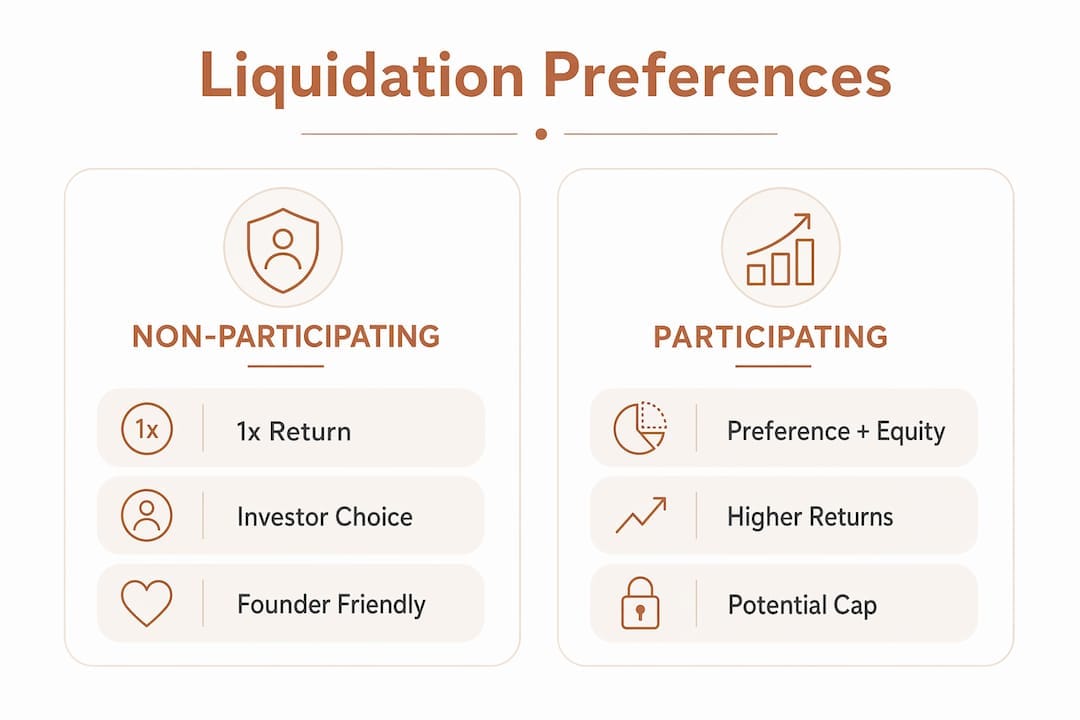
Capped participation limits total investor return to a defined multiple of the original investment. Once that cap is hit, the investor stops participating. Participation caps reduce double-dipping at high proceeds while still giving investors some upside sharing.
Multiples — 1x means the investor recovers their full investment before anyone else receives proceeds. A 2x multiple means they recover double their investment first. The liquidation preference equals the original issue price multiplied by outstanding preferred shares, times the liquidation multiple. Multiples above 1x are less common in Israeli practice but do appear in down rounds or bridge financings.
How does the payout waterfall actually work? Worked examples
The priority order in an Israeli exit runs as follows:
- Secured creditors and liquidation costs
- Preferred shareholders (per their preference terms and seniority)
- Common shareholders (founders, employees, option holders) — only if proceeds remain
Worked numeric waterfalls are an essential negotiation tool because small changes in preference type or multiple alter distributions materially. Always run three scenarios against your cap table before accepting preference language.
Assumptions for all three examples below:
- Investor A invested $2M for 30% of the company (preferred shares, 1x preference)
- Founders and employees hold 70% (common shares)
| Exit Scenario | Exit Proceeds | Investor A Receives | Common Holders Receive |
|---|---|---|---|
| Low exit — 1x participating | Low exit amount | Full preference to investor, nothing left for common holders | |
| Mid exit — capped participation (with cap) | Moderate exit amount | Preference plus prorated share up to the cap | Remaining proceeds to common holders |
| High exit — investor converts to common | High exit amount | Investor converts to common and shares pro rata | Common holders receive the remainder |
Example 1 (low exit): Proceeds do not cover the investor’s preference. The investor takes the entire amount, leaving nothing for common holders. This is the scenario Israeli practitioners flag most often as harmful to founder and employee incentives.
Example 2 (mid exit): With a participation cap, the investor takes their preference first, then shares remaining proceeds pro rata up to the cap. Founders and employees receive the residual proceeds.
Example 3 (high exit): At a high exit value, the investor’s share as common stock exceeds the preference amount, making conversion to common shares the economically rational choice. Common holders receive the remaining proceeds.
Pro Tip: Pull four numbers from your term sheet before any negotiation call: investment amount, liquidation multiple, participation cap (if any), and each class’s ownership percentage. Those four figures let you run every scenario in minutes.
Why do liquidation preferences matter so much for founders and employees?
The stakes are higher than most founders realize until it is too late. Israeli commentary has flagged aggressive participating preferences as harmful to founder and employee morale, and the economic consequences flow directly into hiring and retention.
- Option pool value: Employee stock options are common shares. In a low or mid exit with stacked preferences, options can expire worthless even when the company sells for a meaningful sum.
- Later-round dilution: Each new preferred round adds another layer to the preference stack. Later investors often negotiate senior or pari passu rights, which can subordinate earlier common holders further.
- Fundraising attractiveness: A cap table loaded with aggressive preferences signals risk to future investors and can make subsequent rounds harder to close on reasonable terms.
- Behavioral effects: When employees understand their options may pay out nothing in a realistic exit, morale and retention suffer. Israeli startups competing for engineering talent cannot afford that signal.
Liquidation preferences are among the most critical clauses in VC term sheets because they directly determine how exit proceeds are shared. Founders who treat preference language as boilerplate often discover the real cost only at closing.
Pro Tip: If a term sheet uses the phrase “senior participating preferred” without a cap, treat it as a red flag requiring immediate counsel review. That combination is the most aggressive structure available.
What should you push back on when negotiating Israeli liquidation terms?
Negotiation is easier before you sign than after. Here is a practical checklist for founders and investors reviewing an Israeli term sheet.
Founder negotiation objectives:
- Push for 1x non-participating as the baseline preference.
- Resist uncapped participation — insist on a cap if participation is unavoidable.
- Avoid seniority structures that pay later rounds before earlier ones without clear justification.
- Limit multiples to 1x unless the investor provides a specific, documented rationale.
- Confirm the definition of “liquidation event” in the articles — a broad definition can trigger preference on transactions you did not intend to cover.
Red flags to watch for:
- Uncapped participating preferred with no conversion option
- Senior preferences that stack later rounds above earlier investors
- Liquidation multiples above 1x without a corresponding valuation justification
- Vague “deemed liquidation” definitions that could capture restructurings or asset sales
- Conversion-trigger traps that make it economically irrational to convert to common
Term-sheet review checklist (have counsel verify each item):
| Item | What to Check |
|---|---|
| Articles of association | Confirm preference rights are correctly reflected and enforceable under Israeli Companies Law |
| Definition of “liquidation event” | Scope: does it cover sale, merger, asset sale, deemed liquidation? |
| Conversion rights | When can preferred convert to common, and at what ratio? |
| Pari passu language | Are all preferred classes treated equally, or is there a seniority stack? |
| Participation cap | Is there a cap, and at what multiple does it apply? |
Questions to ask your investor:
- “Is this preference participating or non-participating?”
- “What is the participation cap, if any?”
- “How is ‘liquidation event’ defined in the draft articles?”
- “Will later rounds receive senior or pari passu treatment?”
How does liquidation preference apply across different exit events in Israel?
The trigger matters as much as the preference terms themselves. Israeli term sheets typically define the following as liquidation events:
- Sale or merger where existing shareholders lose majority control
- Asset sale covering substantially all company assets
- Deemed liquidation — a contractual definition that can extend preference triggers to transactions that are not technically a winding-up
- Voluntary winding-up under the Israeli Companies Law, which follows a structured process including creditor notification and Registrar of Companies filings
VC contracts frequently define sale and merger transactions as liquidation events to trigger preference payouts even when the company continues operating under a buyer. This drafting choice is consequential: a founder who expects an acquisition to be treated as a going-concern transfer may find preference rights activated instead.
IPOs and public listings change the calculus entirely. Preferred shares typically convert to common upon an IPO, eliminating the preference. The conversion ratio and any anti-dilution adjustments should be confirmed in the articles before the company files for listing.
Insolvency: Under Israeli practice, secured creditors rank above preferred shareholders in a court-supervised liquidation. Preferred shareholders receive priority over common holders only after creditors are satisfied. In a genuine insolvency, preferred liquidation preferences may return little or nothing if liabilities exceed assets.
What does it cost and how long does it take to negotiate or enforce these clauses in Israel?
Typical timeline:
- Term-sheet negotiation: days to two weeks for straightforward structures; longer when multiple investor classes are involved
- Definitive documents (shareholders’ agreement, amended articles): 2–6 weeks depending on cap-table complexity and cross-border coordination
- Enforcement or litigation: months to years, depending on whether the dispute proceeds to the Israeli courts or resolves through arbitration
Key cost drivers for international clients:
- Number of investor classes and complexity of the preference stack
- Need for amendments to existing articles of association
- Cross-border evidence gathering and document translation
- Litigation versus negotiated settlement
Practical budgeting guidance: Fixed-fee arrangements for term-sheet review and standard document drafting keep costs predictable for overseas clients. Menora Law recommends agreeing on scope and fee structure at the outset, particularly for clients managing the engagement remotely.
Pro Tip: If your shareholders’ agreement includes an arbitration clause, check whether it specifies Israeli arbitration or international arbitration. Israeli arbitration can resolve preference disputes faster than court proceedings, but the clause must be drafted correctly to be enforceable.
How Menora Law helps international clients with liquidation-preference matters
Menora Law provides Israeli corporate legal services for international founders, investors, and heirs who need experienced Israeli counsel without being physically present in Israel.
Menora Law reviews term sheets, drafts protective amendments to articles of association, negotiates on behalf of founders or investors, and represents clients in Israeli courts or arbitration when preference disputes arise. Every engagement includes a concise redline of the preference language, a negotiation memo identifying the key risks, and a worked waterfall analysis tailored to the client’s actual cap table.
What to bring to your first call with Menora Law:
- The current term sheet or shareholders’ agreement
- The company’s articles of association (or the most recent draft)
- A current cap table showing all share classes and ownership percentages
- Any prior investment agreements that established existing preference rights
Menora Law handles remote intake efficiently. Clients across multiple time zones regularly instruct the firm by email, with document review and strategy calls conducted online. For founders and investors who cannot travel to Israel, remote legal representation covers the full scope of term-sheet negotiation, document drafting, and enforcement proceedings.
Pro Tip: Send your cap table and term sheet before the first call. Menora Law can prepare a preliminary waterfall analysis in advance, so the consultation focuses on strategy rather than data gathering.
Key Takeaways
A 1x non-participating liquidation preference is the market standard in Israeli venture deals; anything more aggressive requires careful scrutiny and, in most cases, negotiation before signing.
| Point | Details |
|---|---|
| Check preference type first | Confirm whether the preference is participating or non-participating before any other analysis. |
| Run three exit scenarios | Model a low, mid, and high exit against your cap table to see real dollar outcomes for each share class. |
| Push for 1x non-participating | Resist uncapped participation and stacked seniority; both compress common-holder returns significantly. |
| Verify the articles of association | Counsel must confirm preference rights are correctly drafted and enforceable under Israeli Companies Law. |
| Menora Law for cross-border review | Menora Law provides remote term-sheet review, waterfall analysis, and negotiation support for international clients. |
Menora Law’s perspective on liquidation preferences
What surprises most international founders is not the existence of liquidation preferences — they expect those. What catches them off guard is how quickly a “standard” term sheet can include language that is anything but standard. A participating preference with no cap and a senior seniority structure can leave founders and employees with nothing in an exit that looks successful on paper. The gap between headline valuation and actual founder proceeds is almost always explained by preference language that was accepted without a worked example.
The right time to address this is before you sign, not after the deal closes. Menora Law works with founders and investors at the term-sheet stage precisely because that is when the leverage exists. Once documents are executed, renegotiating preference terms requires unanimous investor consent, which is rarely forthcoming.
If you are reviewing an Israeli term sheet from outside Israel, do not rely on general VC guidance written for other jurisdictions. Israeli Companies Law has its own procedural requirements, and the articles of association must reflect the preference terms correctly to be enforceable. Getting that right from the start is the most cost-effective legal investment you can make.
Ready to review your Israeli term sheet?
Menora Law works with international founders and investors who need clear, practical guidance on Israeli liquidation terms before they sign.

Whether you need a term-sheet redline, a cap-table waterfall analysis, or representation in an Israeli preference dispute, Menora Law handles the full scope remotely. Send your term sheet and cap table to get a preliminary assessment, and schedule an initial consultation to discuss your specific situation. For broader corporate matters, the firm’s Israeli business law services cover the full range of transactional and advisory work for overseas clients.
Ottaa yhteyttä Menora Law today to request a term-sheet review or cap-table waterfall analysis before your next closing.
Useful sources
The following primary sources informed this article and are recommended for further reading on liquidation preferences and Israeli corporate practice:
- Investopedia: Liquidation Preference Explained — clear general primer on preference mechanics and definitions
- HSBC Innovation Banking: A Deep Dive into Liquidation Preferences — industry authority on VC term-sheet practice and market standards
- Wall Street Prep: Liquidation Preference — detailed explanation of participating vs. non-participating structures
- Carta: Liquidation Preferences — Standard and Non-Standard Terms — practical guidance on multiples and cap-table modeling
- Mondaq: How to Grant Preferred Shares and Remain on the Path Towards Your Startup’s Success — Israel-specific practitioner commentary on preference risks and mitigation
For Menora Law’s related service pages:
- Israeli Securities Law for Startups
- Liiketoimintalaki Israelissa
- Legal Israel: What Foreigners and Investors Must Know
This article provides general information about Israeli liquidation preferences and is not legal advice. Preference terms, enforcement procedures, and Israeli Companies Law requirements vary by transaction. Confirm the rules that apply to your specific situation with qualified Israeli counsel before signing any agreement.
FAQ
What is an Israeli liquidation preference?
An Israeli liquidation preference is a contractual right in an investment agreement that gives preferred shareholders priority payment over common shareholders when a company is sold, merged, or wound up under Israeli Companies Law.
What is the market standard for liquidation preferences in Israeli deals?
A 1x non-participating liquidation preference is widely treated as the market standard because it protects investor downside without eliminating founder upside in a successful exit.
What is the difference between participating and non-participating preferred?
Non-participating preferred gives investors a choice: take the preference amount or convert to common shares. Participating preferred lets investors take the preference first and then share remaining proceeds with common shareholders, effectively collecting twice.
When does a sale trigger liquidation preference in Israel?
Most Israeli term sheets define a sale, merger, or asset sale as a “liquidation event,” which activates preference rights even when the company continues operating under a new owner. The exact definition in the articles of association controls.
How can Menora Law help with liquidation-preference review?
Menora Law reviews term sheets, drafts protective amendments, runs worked waterfall analyses for your cap table, and represents international clients in Israeli negotiations or disputes, all available remotely.


 English
 Afrikaans
 العربية
 বাংলা
বাংলা Čeština
 简体中文
简体中文 Nederlands
 Suomi
Suomi Français
 Deutsch
 עִבְרִית
 हिन्दी
 Magyar
 Italiano
 日本語
日本語 한국어
한국어 Polski
 فارسی
فارسی Português do Brasil
 Русский
 Español de México
 Українська