
Yes, foreigners can legally register an Israeli company or open a foreign branch, with no citizenship or residency requirement standing in the way. The first practical move is gathering authenticated passports and incorporation documents, picking three backup company names, and contacting an avocat israélien to handle document authentication before you file with the Registrar of Companies.
TL;DR:
- Foreigners can freely register an Israeli company or open a branch without residency or citizenship restrictions, but thorough document preparation and authentication are essential.
- Choosing between a local company and a branch depends on your business scope, with a local company offering liability protection and partnerships being suitable for national hiring and incentives.
- Opening an Israeli bank account is often the most time-consuming step, requiring detailed AML checks, certified documents, and possibly in-person meetings, especially for foreign signatories.
- Ongoing compliance involves annual filings, financial statements, and payroll obligations, with directors liable for missed deadlines and noncompliance.
- Delays often result from incomplete or improperly authenticated documents, so pre-approving signatures and securing apostilles early streamline the process.
Foreigners Opening a Company in Israel: Which Structure Fits?
Most foreign founders choose between two paths: an Israeli limited company (חברה בע"מ) or a foreign branch. An Israeli limited company is a separate legal entity, similar to an LLC or Ltd elsewhere. It holds its own assets, signs its own contracts, and limits shareholder liability to whatever capital they put in. A foreign branch is different. It is not a standalone entity but an extension of the parent company, meaning the parent stays legally and financially responsible for whatever happens in Israel.
The choice usually comes down to what the business actually does here:
- Choose a local company if you plan to hire Israeli employees, sign local contracts, apply for tax incentives, or build something with staying power.
- Choose a branch if you’re testing the market, running a limited-scope project, or need a lighter footprint without full incorporation.
- Consider both if the parent company wants direct control now but may spin off a subsidiary later as operations grow.
Our guide on types of Israeli business entities breaks down the finer distinctions if you’re still weighing options.
How Do You Register a Company With the Registrar of Companies?
Registration itself is not the hard part. Getting your paperwork in order before you file is. Here’s the practical order of operations:
- Pick three company names and check availability through the Registrar’s online name search before you commit to branding or letterhead.
- Draft your articles of association, which set out share structure, director powers, and company purpose.
- Collect identity documents for every shareholder and director. Passports, proof of address, and (for a branch) the parent company’s original incorporation certificates.
- Authenticate everything. Foreign documents typically need certified Hebrew translation, and depending on your home country, an apostille or consular authentication too, since branch registration under Section 346 specifically requires translated bylaws and original incorporation papers.
- Confirm signature requirements. Some filings need original wet signatures, not scans, especially for board resolutions and powers of attorney.
- Submit through the gov.il portal or on paper. Online filing is faster, and using the Registrar’s own services cuts down on rejected applications from missing information.
Pro Tip: Start collecting apostilles the day you decide to incorporate, not the week you plan to file. Apostille processing abroad can take longer than the entire Israeli registration process, and it’s the single most common bottleneck we see with international clients.
Our guide to Israeli limited companies covers director and shareholder requirements in more depth if you want the full picture before filing.
Branch or Subsidiary: What Actually Changes Legally?
The legal distinction is not a technicality. It changes who is on the hook.
- Liability: A branch leaves the parent company exposed to Israeli claims and obligations. A subsidiary caps liability at the company’s registered share capital.
- Registration burden: Branches must submit original, translated incorporation certificates from the home country, plus a registered Israeli address for service of process.
- Tax posture: A branch is often treated as a permanent establishment, meaning Israeli tax authorities can tax profits attributable to local activity even without a separate Israeli entity.
A branch is operationally simpler when you’re moving fast and don’t want a second corporate layer. A subsidiary makes more sense once you’re hiring locally, seeking investment, or planning to apply for the incentives covered later in this guide.
What Do Israeli Banks Require to Open a Business Account?
Opening the bank account is usually the slowest part of the whole process, slower than the Registrar filing itself. Banks apply strict anti-money-laundering (AML) checks, and foreign ownership adds extra scrutiny.
Expect to provide:
- A certified certificate of incorporation and articles of association.
- A board resolution naming the authorized signatory on the account.
- Passports and proof of address for every beneficial owner and signatory.
- A description of your business activity or a short business plan, since banks want to see the money trail before they open an account for an entity with no Israeli operating history.
Many banks also require an in-person meeting for foreign signatories, or at minimum a notarized power of attorney if someone local is signing on your behalf. Before picking a bank, check whether it has an international or corporate desk experienced with foreign-owned companies. That single factor often determines whether onboarding takes two weeks or two months.
Pro Tip: Appoint one Israeli-based signatory early in the process. It simplifies both the bank relationship and several Registrar steps, and it means you’re not flying in every time a document needs a live signature.
Registering for Tax and Hiring Employees: What’s Required?
Once the company exists on paper, it needs to exist for tax purposes too. Three registrations typically follow incorporation:
- VAT registration with the relevant regional VAT office, required for almost any business selling goods or services in Israel.
- Income tax file with the Israel Tax Authority, which assigns your company a taxpayer number for annual reporting.
- Employer and withholding registration, triggered the moment you hire your first employee or engage a contractor subject to withholding.
Director and management residency matters more than founders expect. If key decisions are made by directors physically in Israel, tax authorities may treat the company as Israeli tax resident regardless of where it was incorporated, which pulls worldwide income into Israeli tax scope. When every director and shareholder is foreign, tax authorities commonly ask for a local tax representative to handle correspondence and withholding filings.
Payroll in Israel involves social security contributions, pension obligations, and monthly withholding, none of which is intuitive if you’ve never run payroll here. Engage a local accountant before your first hire, not after.
How Long Does It Take and What Does It Cost?
Registrar filings usually clear within a few days to two weeks when the paperwork is complete and accurate. The real bottleneck is almost always the bank account, which can take several weeks longer, especially with layered foreign ownership.
State fees are modest compared to professional costs. One widely cited example puts the Registrar’s company registration fee around 3,048 ILS, with a discount for online filing versus in-person submission. Professional fees for legal, accounting, translation, and apostille processing vary by complexity.
The biggest delay culprit is missing or improperly authenticated documents. Prepare translations and apostilles in advance, and pre-appoint an Israeli signatory, and you eliminate most of the friction before it starts.
For a fuller cost breakdown, see our page on what it actually costs to open an Israeli company as a foreign founder.
What Our Legal Service Handles for Foreign Founders?
We work with foreign founders navigating Israeli incorporation from abroad. That includes preparing and authenticating documents, filing with the Registrar of Companies, liaising directly with banks on your behalf, and drafting shareholder and director resolutions that satisfy both Registrar and bank requirements.
Since many clients call in from different time zones, remote representation is standard practice, not an exception. When a document needs a signature in Tel Aviv while you’re in New York or London, we bridge that gap.
Full legal representation earns its cost when ownership structures get complicated or once you’re hiring employees and need someone managing compliance continuously. Simpler cases, a single shareholder incorporating a straightforward company, sometimes only need document preparation and a filing service rather than full representation. Either way, the goal is the same: get you registered correctly the first time.
Staying Compliant After You Register
Incorporation is the beginning, not the finish line. Israeli companies carry ongoing obligations that catch foreign owners off guard more often than the registration process itself.
Every company must file an annual report with the Registrar of Companies confirming current directors, shareholders, and registered address. Miss this, and the company risks being flagged as inactive, which complicates everything from bank relationships to future financing.
Annual financial statements need preparation by a licensed Israeli accountant, even for dormant companies with no revenue. Tax filings follow a separate calendar: monthly or bimonthly VAT reports, annual corporate income tax returns, and periodic withholding reports if you have employees or subcontractors.
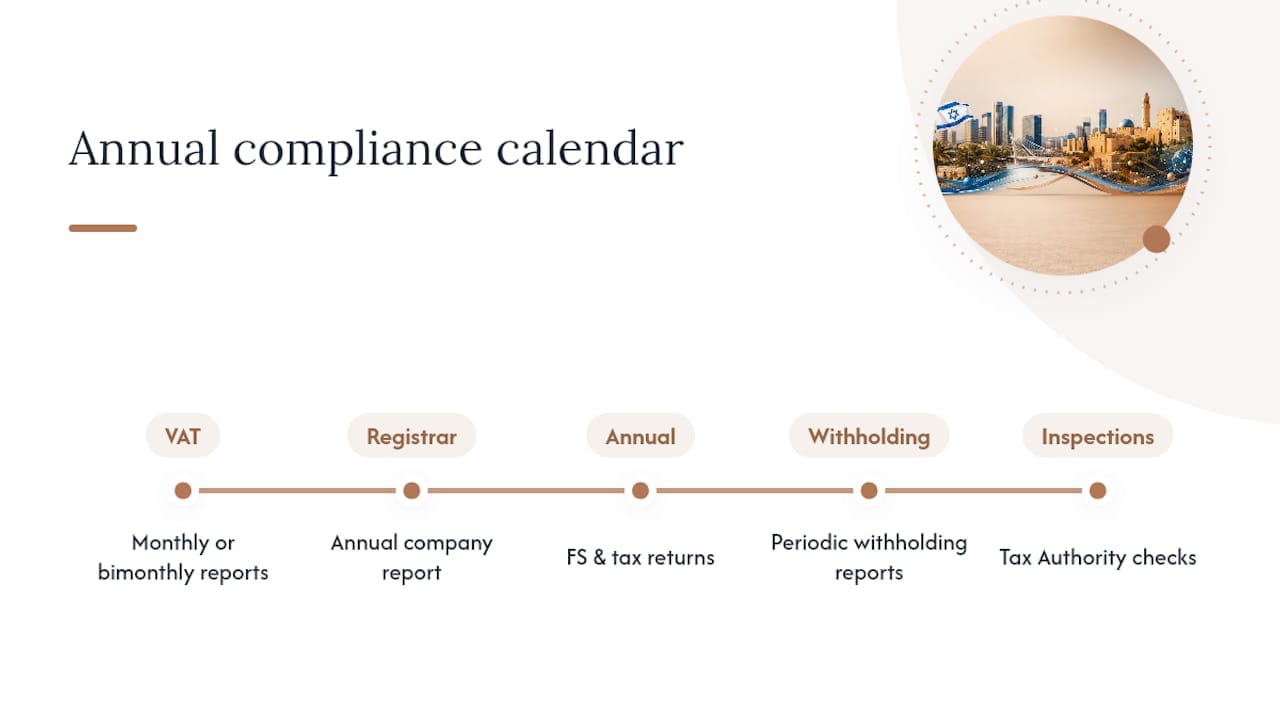
The Tax Authority conducts periodic inspections, particularly for companies claiming incentive programs or showing unusual VAT patterns. These are not necessarily adversarial. Often, they’re routine verification that your reported activity matches your filings. But they go far more smoothly when your bookkeeping has been consistent from day one rather than patched together right before an inspector calls.
Directors also carry personal exposure if a company fails to meet its filing obligations. Israeli law allows for director liability in cases of gross negligence or deliberate noncompliance, which is one more reason foreign-owned companies benefit from a local accountant who tracks deadlines even when the owners are thousands of miles away.
Budget for this ongoing cost from the start. It’s not a one-time expense, it’s a recurring part of keeping the company in good standing.
Hiring in Israel: What Foreign Employers Need to Know
Israeli labor law leans protective of employees, more so than many foreign founders expect coming from less regulated markets. A few realities shape how you’ll need to structure employment from day one.
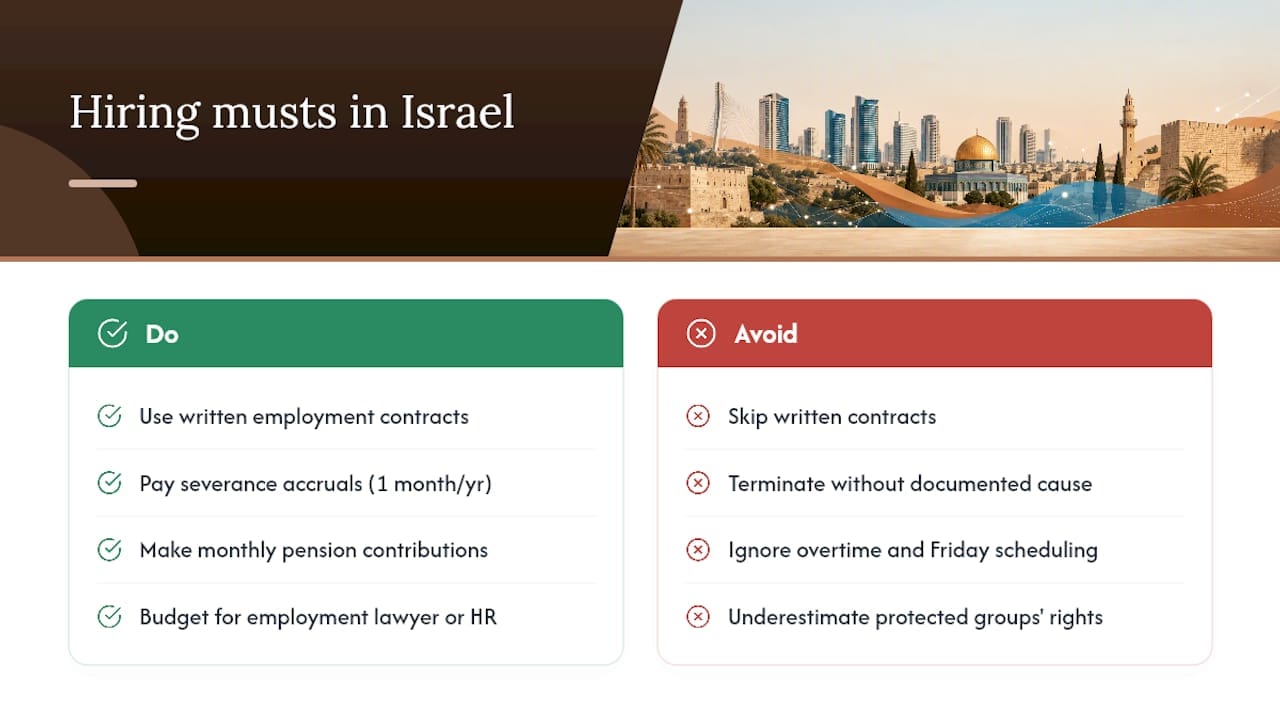
Written employment contracts are effectively mandatory. While not always legally required in every case, Israeli courts and the Ministry of Labor expect clear terms covering salary, hours, notice periods, and severance conditions. Skipping this invites disputes you can’t easily win.
Severance pay is a legal entitlement, not a negotiated perk. Employees generally accrue severance equal to one month’s salary per year of service, funded through mandatory pension contributions most employers make monthly rather than as a lump sum at termination.
Working hours are capped, with overtime rules kicking in beyond standard limits and paid at premium rates. The standard workweek runs shorter than in many countries, and Friday, tied to the Jewish Sabbath, factors into scheduling in ways that surprise employers used to a Monday through Friday, five-day standard.
Termination requires advance notice scaled to tenure, and dismissing an employee without documented cause or proper process can trigger legal claims that are expensive to settle. Pregnant employees, reservists, and union-affiliated workers carry additional protections that make termination even more procedurally sensitive.
For any company planning to hire more than a handful of employees, budgeting for an Israeli employment lawyer or HR consultant upfront is far cheaper than untangling a wrongful termination claim later.
Tax Incentives Available to Foreign-Owned Companies
Israel actively courts foreign investment, and the tax code reflects that. The Encouragement of Capital Investments Law offers reduced corporate tax rates for companies classified as “Preferred Enterprises” or “Preferred Technology Enterprises,” a category that covers much of Israel’s tech and R&D sector.
Companies operating in designated development zones can qualify for even lower rates than the standard corporate tax rate, part of a long-running government push to spread economic activity beyond the Tel Aviv core.
R&D grants through the Israel Innovation Authority support qualifying technology companies, sometimes covering a meaningful share of approved research costs in exchange for royalty repayment once the company generates revenue.
Foreign-owned companies are generally eligible for these programs on the same terms as Israeli-owned ones. Eligibility depends on the nature of the business (particularly for tech and export-oriented incentives), not on the citizenship of the shareholders. That said, the application process for R&D grants and Preferred Enterprise status is document-heavy, and approval isn’t automatic. Getting the classification right from the start avoids a costly reclassification later.
Protecting Intellectual Property in Israel
If your company’s value lives in a brand, invention, or proprietary process, registering that protection in Israel should happen early, not after a competitor forces the issue.
Trademarks register with the Israel Patent Office and protect brand names, logos, and slogans used in commerce. Israel follows a first-to-file system in most respects, meaning the company that files first generally wins the registration, regardless of who used the mark first in another country.
Patents also file through the Israel Patent Office, and Israel is a member of the Patent Cooperation Treaty, which lets foreign applicants extend an existing international patent application into Israel within set deadlines rather than starting from scratch.
Copyright protection is automatic upon creation under Israeli law, no registration required, though registering trademarks and patents still matters enormously for enforcement.
For companies building original designs, whether packaging, product shape, or industrial design, design registration protects up to 15 years of exclusivity, but only if filed within 12 months of the design becoming public. Miss that window, and the protection may be lost entirely.
Understanding Israeli Business Culture as a Foreign Founder
Israeli business culture runs more direct than many foreign founders anticipate. Meetings tend to move fast, questions get asked bluntly, and pushback on an idea isn’t a sign of hostility, it’s often just how negotiation works here. Founders coming from more formal or hierarchical business cultures sometimes misread this directness as rudeness. It rarely is.
Relationships still matter, but they build differently than in slower-paced markets. A single productive meeting can move a deal forward faster than months of relationship-building elsewhere. That speed cuts both ways: decisions can happen quickly, but so can a deal falling apart if trust breaks down.
The workweek runs Sunday through Thursday, with Friday and Saturday off for the Sabbath. Scheduling calls or expecting responses on a Friday afternoon or Saturday, standard practice in the US or UK, will simply go unanswered. Jewish holidays also shift business rhythms throughout the year in ways a foreign calendar won’t flag automatically.
Bureaucracy, frankly, moves slower than the informal business culture suggests. The contrast between fast-moving deal conversations and slow-moving government paperwork catches founders off guard constantly. Plan around it rather than fighting it.
What Founders Actually Get Wrong
The mistake we see most often isn’t legal, it’s sequencing. Founders start bank account paperwork before their apostilles are ready, or they pick a company name before checking availability, and end up refiling weeks later. Incomplete apostilles and translations that don’t match bank formatting requirements account for most of the delays we untangle for international clients.
The fix is almost always the same: get documents authenticated and translated before you touch the Registrar portal, and appoint a local signatory early so you’re not chasing signatures across time zones. If you want a plan built around your specific ownership structure and timeline, reach out. We work with clients remotely across time zones as a matter of routine, not exception.
— Menora Law
Ready to Register Your Israeli Company?
Here’s what working with Menora Law actually looks like: an initial consultation to map your ownership structure and goals, a document checklist tailored to your home country and business type, and then representation through both Registrar filing and bank account opening, the two stages where foreign founders get stuck most often.
Because most clients call from outside Israel, scheduling is built around your time zone rather than asking you to work around ours. Whether incorporating a subsidiary, registering a branch, or untangling a multi-shareholder structure with partners in different countries, the process runs smoother with experienced legal assistance handling the on-ground details.
If you’re ready to move forward, visit our business law practice page to schedule a consultation and get a document checklist built around your specific situation.
Where to Verify Official Requirements
Check the Registrar of Companies portal for current filing procedures, and review branch registration requirements before submitting foreign incorporation documents.
This article is general information, not a substitute for advice from a qualified lawyer. Consult a qualified legal professional about your own circumstances before acting on anything here.
Sources
- What are the conditions to open a foreign company branch in Israel?
- Gov
- פתיחת חברה בעמ בישראל – מדריך מעשי להקמת חברה בשנת 2026 | CPA DIGITAL
FAQ
Can a Foreigner Own 100% of an Israeli Company?
Yes. Israeli law places no restriction on foreign ownership percentage, and company ownership does not require Israeli residency or citizenship.
Does Owning an Israeli Company Grant Residency or a Visa?
No. Company ownership and immigration status are separate legal tracks, and investor visa routes like the B-5 permit have their own independent requirements.
How Long Does Israeli Company Registration Take?
Registrar filing typically clears within days to two weeks with complete paperwork, though opening a business bank account is usually the slower phase for foreign-owned companies.
Do I Need to Visit Israel in Person to Register a Company?
Not necessarily for Registrar filing, but many banks require an in-person meeting or a notarized power of attorney for foreign signatories before opening an account.
What’s the Difference Between a Branch and a Subsidiary for Tax Purposes?
A branch is often treated as a permanent establishment with the foreign parent liable for Israeli tax obligations, while a subsidiary is a separate taxable entity with liability capped at its share capital.
Can Menora Law Represent Me Remotely From Abroad?
Yes. Menora Law regularly represents international clients remotely, handling document preparation, Registrar filings, and bank liaison without requiring the client’s physical presence in Israel.


 English
 Afrikaans
 العربية
 বাংলা
বাংলা Čeština
 简体中文
简体中文 Nederlands
 Suomi
Suomi Français
 Deutsch
 עִבְרִית
 हिन्दी
 Magyar
 Italiano
 日本語
日本語 한국어
한국어 Polski
 فارسی
فارسی Português do Brasil
 Русский
 Español de México
 Українська