
TL;DR:
- A family holding company in Israel is a legally defined structure where all shareholders belong to the same family unit and can elect a special tax status. This status passes income directly to a designated shareholder, avoiding corporate and dividend taxes but requiring strict adherence to eligibility and ongoing maintenance rules. Proper planning and legal coordination are essential to protect family control, inheritance rights, and tax benefits across generations.
An Israeli family holding company, known formally in Hebrew as a Chevra Mishpachtit, is a corporate structure where every shareholder belongs to the same family unit and the company elects a special tax status under the Israeli Income Tax Ordinance. This structure is not simply a regular private company with family owners. It is a legally defined category with specific eligibility rules, a formal election process, and a distinct tax treatment that passes income directly to a representative shareholder. If you are managing family assets in Israel, planning an inheritance, or building a multi-generational business, understanding what an Israeli family holding company is and how it works is the right place to start.
What is an Israeli family holding company?
A family holding company in Israel is defined under Israeli tax law as a company where all shareholders are members of the same family unit, and the company has formally elected to be treated as a “Family Company” for tax purposes. The family unit includes parents, children, siblings, and spouses. No outside shareholders are permitted. This is not a loose definition. The law draws a clear boundary around who qualifies.

The tax election is what makes this structure genuinely useful. Once elected, the company’s income is not taxed at the corporate level in the traditional sense. Instead, income is attributed to a single representative shareholder and taxed at that person’s personal tax rates. Business income starts at a 31% tax rate, while passive income such as rental or investment returns is taxed at 25%. That pass-through treatment is the core financial benefit of the structure.
The Israeli Income Tax Ordinance governs this election. Families who want to use this structure must file the election within three months of the company’s incorporation. Missing that window means losing the option entirely, at least for that company’s early years. The law is precise on timing, and there is no grace period.
How do you establish and maintain family company status in Israel?
Establishing a family holding company in Israel requires meeting several clear legal criteria from the start. The process is straightforward if you plan ahead, but the rules leave no room for error.
The eligibility requirements are:
- All shareholders must belong to the same family unit. The law defines this as parents, children, grandchildren, siblings, and spouses. A single outside shareholder disqualifies the entire company from election.
- The tax election must be filed within three months of incorporation. This is a hard deadline under the Income Tax Ordinance. Late filings are not accepted.
- The company must maintain its family-only shareholder composition. If a share is transferred to someone outside the family unit, the company loses its elected status.
- Income is attributed to a representative shareholder. The family designates one member whose personal tax rates apply to the company’s income. This person does not need to hold the majority of shares, but they are the tax anchor for the structure.
- National Insurance contributions are divided differently. While income tax is attributed to the representative shareholder, National Insurance contributions are divided among all shareholders according to their ownership percentage.
Maintaining the status requires ongoing attention. Share transfers, even within the family, must be documented carefully. If a shareholder dies and shares pass to someone outside the defined family unit through inheritance, the company’s status is at risk. This is why succession planning must be built into the corporate structure from day one.
Pro Tip: Before incorporating, map out every potential future shareholder, including children who may inherit shares. If any heir falls outside the legal family unit definition, address this in your Articles of Association before filing the tax election.
The election can also be voluntarily ceased. However, once a company revokes its family company status and returns to regular corporate taxation, it cannot re-elect this status again. That one-way door makes the initial decision one of the most consequential choices a family can make when structuring a business in Israel.
How does a family company differ from other Israeli business structures?
The term “family holding company” gets used loosely in conversation, but Israeli law draws sharp distinctions between different structures. Understanding those differences helps you choose the right vehicle for your goals.
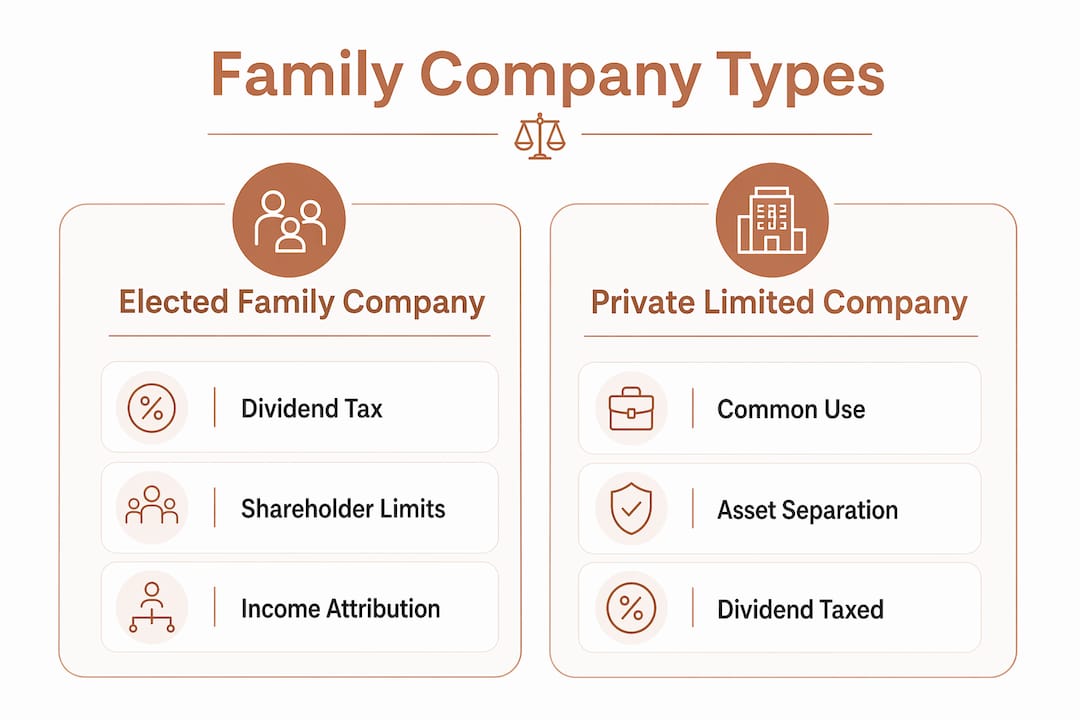
The Private Limited Company (Chevra Ba’am)
Le Private Limited Company is the most common structure for family businesses in Israel. It separates personal assets from business assets, which protects founders from personal liability. Shares can be transferred by sale, gift, or inheritance without dissolving the business. This flexibility makes it the preferred vehicle for families who want straightforward succession without the tax election constraints of a formal family company. The trade-off is that the company pays corporate tax on its profits, and shareholders then pay dividend tax on distributions.
The elected Family Company (Chevra Mishpachtit)
The elected family company avoids dividend taxation entirely. Because income is attributed directly to the representative shareholder, distributions are not taxed as dividends under this model. That is a meaningful advantage for families whose company generates consistent profits. The limitation is the rigid shareholder composition rule and the irreversible nature of the election.
Large-scale family holding groups
Some Israeli families control large holding entities that operate more like institutional investors than small family businesses. Entities such as Elco Ltd. began as industrial holding companies and evolved into diversified investment vehicles with professional management teams. Similarly, Mivtach Shamir Holdings operates as a multi-family office with broad investment portfolios and hybrid governance structures. These entities are not “Family Companies” in the tax law sense. They are large private or public holding groups that happen to be family-controlled. Their scale, governance complexity, and investment diversification place them in an entirely different category.
The table below compares these three structures on the criteria that matter most for family asset management and inheritance planning.
| Criteria | Elected Family Company | Private Limited Company | Large Family Holding Group |
|---|---|---|---|
| Shareholder eligibility | Family unit only | Open to any shareholders | Family-controlled, often public |
| Tax treatment | Pass-through to representative shareholder | Corporate tax plus dividend tax | Corporate tax, complex structures |
| Dividend taxation | None under election | Applies on distributions | Applies, often with planning |
| Share transferability | Restricted to family unit | Flexible (sale, gift, inheritance) | Governed by corporate documents |
| Governance complexity | Low to moderate | Moderate | High, professional management |
| Succession planning | Requires careful alignment | Relatively straightforward | Complex, multi-generational |
The right structure depends on your family’s size, the nature of your assets, and your long-term goals. A family with three siblings and a single business property has very different needs from a family managing a portfolio of real estate, securities, and operating companies.
What are the tax advantages and limitations of Israeli family holding companies?
The tax benefits of a family company election are real and specific. They are also paired with limitations that families often underestimate.
The core tax advantages include:
- No dividend tax on distributions. Because income is attributed directly to the representative shareholder, the company does not create a second layer of taxation when it distributes profits. This is the most significant financial benefit for families who draw regular income from the company.
- Pass-through taxation at personal rates. Business income is taxed starting at 31% and passive income at 25%, applied at the individual level rather than the corporate level. For families in lower personal tax brackets, this can produce meaningful savings.
- Simplified tax reporting. The company files as a single tax unit through the representative shareholder, reducing administrative complexity compared to structures that require separate corporate and dividend filings.
The key limitations are equally important to understand:
- The election is permanent in one direction. Once the family company status is revoked, the company cannot re-elect this status. This is not a decision to reverse lightly.
- Shareholder composition is rigid. Any breach of the family-only rule, even an accidental one through inheritance or a share gift to an in-law outside the defined unit, can terminate the election.
- The representative shareholder bears the full tax burden on paper. Even if other family members receive economic benefit from the company, the tax liability sits with one person. This can create internal family tension if not addressed in a shareholder agreement.
- National Insurance contributions follow a different allocation. The split between tax attribution and National Insurance allocation adds a layer of complexity that requires professional guidance to manage correctly.
Pro Tip: Review the representative shareholder designation every few years. If that person’s personal income increases significantly from other sources, the combined tax rate on company income may exceed what a regular corporate structure would cost. Tax planning is not a one-time exercise.
The advantages of Israeli family holdings are genuine, but they require ongoing legal and tax oversight to preserve. Families who set up the structure and then ignore it for years often discover problems only when a shareholder dies or a share transfer triggers an unexpected review.
How does inheritance law affect Israeli family holding companies?
Inheritance is where family holding companies face their greatest practical risks. Israeli inheritance law, codified in the Succession Law of 1965, governs how assets pass after death. Company shares are estate assets subject to that law. But the company’s own Articles of Association often impose additional restrictions that can override or complicate the inheritance process.
Proper succession planning using wills and shareholder agreements prevents disputes and operational breakdown. Without those instruments in place, heirs may find themselves locked in disputes over control, voting rights, and the economic value of their inherited shares.
The specific risks for family holding companies include:
- Ownership fragmentation. If a shareholder dies without a will, shares may pass to multiple heirs under intestate succession rules. Each heir becomes a partial owner, which can dilute decision-making authority and complicate the family-unit composition requirement.
- Loss of family company status. If shares pass to an heir who falls outside the legally defined family unit, the company’s tax election is at risk. This can trigger an unexpected tax reclassification at the worst possible time.
- Pre-emption rights and consent clauses. Corporate Articles of Association frequently include clauses that require existing shareholders to approve any share transfer, including transfers by inheritance. Heirs who are not approved by the other shareholders may find their ownership rights severely limited.
- Difference between inheriting shares and inheriting business assets. An heir who inherits shares in a family company does not automatically gain operational control. Voting rights, management authority, and economic distributions are all governed by the company’s corporate documents, not just the inheritance order.
Le Israeli Succession Law of 1965 provides the legal framework for how assets pass, but it does not override a company’s internal governance rules. That gap between inheritance law and corporate law is where most family business disputes originate.
The solution is to align your corporate documents with your estate plan before any shareholder dies. A well-drafted will, a shareholder agreement that addresses inheritance scenarios, and Articles of Association that reflect your succession intentions work together to protect the company and the family. Menora Law works with families to build exactly this kind of integrated legal framework, combining Israeli corporate law expertise with deep knowledge of the inheritance and succession law that governs what happens when a shareholder is no longer alive.
Key Takeaways
An Israeli family holding company offers genuine tax advantages and structured succession benefits, but only when the election is made correctly and maintained with ongoing legal oversight.
| Point | Details |
|---|---|
| Tax election is irreversible | Once revoked, a company cannot re-elect Family Company status, making the initial decision permanent. |
| Shareholder composition is strict | All shareholders must belong to the defined family unit; any outside shareholder terminates the election. |
| Inheritance requires advance planning | Shares pass under Israeli Succession Law of 1965, but corporate articles can restrict transfers and fragment control. |
| Pass-through taxation removes dividend tax | Income attributed to the representative shareholder avoids a second layer of dividend taxation on distributions. |
| Corporate documents must align with estate plans | Wills, shareholder agreements, and Articles of Association must work together to protect family control across generations. |
What families often get wrong about this structure
Working with families on Israeli corporate and inheritance matters, one pattern stands out clearly. Families treat the family company election as a tax filing, not as a foundational legal decision. They focus on the immediate benefit, which is avoiding dividend tax, and they underestimate the long-term constraints they are accepting.
The irreversibility of the election is the most misunderstood feature. Families assume they can always restructure later if circumstances change. They cannot. Once the election is revoked, that company is a regular corporation for the rest of its existence. If the family grows, if a child marries someone who becomes a shareholder, or if the business expands in ways that require outside investors, the family company structure becomes a constraint rather than an asset.
The second common mistake is treating the corporate documents and the estate plan as separate projects. They are not. The Articles of Association govern what happens to shares when a shareholder dies. If those articles include pre-emption rights or consent requirements that the family never read carefully, heirs can find themselves legally blocked from exercising the ownership they inherited. Aligning these documents requires someone who understands both Israeli corporate law and Israeli inheritance law at the same time.
The families who use this structure well are the ones who plan it as a system, not a transaction. They draft the Articles of Association with inheritance scenarios in mind. They designate the representative shareholder thoughtfully. They revisit the structure every few years as the family and the business evolve. That kind of integrated planning is what separates a family company that works across generations from one that creates disputes the moment the founders are gone.
— Menora Law
Menora Law’s guidance on family holding companies in Israel
Families and international clients who want to structure or review an Israeli family holding company need legal guidance that covers corporate law, tax law, and inheritance law together.
Menora Law provides exactly that integrated approach. The firm advises clients on the family company tax election, shareholder agreement drafting, and succession planning under Israeli law, all with the capacity to work remotely with clients based outside Israel. Whether you are forming a new structure or reviewing an existing one, Menora Law’s team brings the depth of knowledge that this kind of planning requires. For families concerned about what happens to company shares after a shareholder’s death, the firm’s Israeli inheritance law guide is a practical starting point. Contacter Menora Law to discuss your family’s specific situation with an attorney who specializes in Israeli law for international clients.
FAQ
What is a family company under Israeli tax law?
A family company under Israeli tax law is a corporation where all shareholders belong to the same defined family unit and the company has elected special tax status under the Income Tax Ordinance. Income is attributed to a representative shareholder and taxed at personal rates rather than corporate rates.
Can a family company in Israel re-elect its status after revoking it?
No. Once a company revokes its family company election and returns to regular corporate status, Israeli tax law does not permit it to re-elect this status again. This makes the initial election a permanent, one-way decision.
How does inheritance affect a family holding company in Israel?
Shares in a family company are estate assets governed by the Israeli Succession Law of 1965, but the company’s Articles of Association may impose additional transfer restrictions. If shares pass to an heir outside the defined family unit, the company’s tax election can be terminated.
What is the deadline to elect family company status in Israel?
The election must be filed within three months of the company’s incorporation. Missing this deadline means the company cannot elect family company status for that period, and the opportunity may be lost permanently depending on the circumstances.
How is a family company different from a private limited company in Israel?
A private limited company allows flexible share transfers and is open to any shareholders, while a family company restricts ownership to a defined family unit and offers pass-through taxation. The private limited company pays corporate tax plus dividend tax on distributions, whereas the family company avoids dividend tax entirely under its election.


 English
 Afrikaans
 العربية
 বাংলা
বাংলা Čeština
 简体中文
简体中文 Nederlands
 Suomi
Suomi Français
 Deutsch
 עִבְרִית
 हिन्दी
 Magyar
 Italiano
 日本語
日本語 한국어
한국어 Polski
 فارسی
فارسی Português do Brasil
 Русский
 Español de México
 Українська