
TL;DR:
- An Israeli legal opinion letter is a formal, professionally signed document that provides an authoritative legal analysis on a specific issue under Israeli law. It guides decision-making in inheritance, property transactions, compliance, and cross-border deals, offering a reliable legal position for third parties. Properly prepared, these letters carry significant weight with banks, courts, and authorities, though they are not binding rulings.
An Israeli legal opinion letter is a formal document written by a qualified Israeli advocate that provides authoritative legal analysis on a specific question of Israeli law. Whether you are handling an inheritance from a relative in Tel Aviv, buying property in Jerusalem, or meeting regulatory requirements as a foreign business, this document gives you a clear, expert position you can act on. Understanding what it contains, how it is prepared, and what it actually means for your situation is the first step toward making confident decisions under Israeli law.
What is an israeli legal opinion letter explained?
An Israeli legal opinion letter is defined as a formal written document from a licensed Israeli advocate that outlines a considered legal view on a specific question or set of questions. It is not a court ruling. It does not bind a judge or a government authority. What it does is give you a well-reasoned, professionally supported position that you can present to banks, tax authorities, foreign courts, or business partners.
The letter is issued under the professional responsibility of the advocate who signs it. That matters because it carries real weight. A bank reviewing a cross-border transaction, a foreign probate court examining an Israeli estate, or a regulatory body assessing compliance will treat a signed legal opinion from a licensed avocat israélien as authoritative guidance. It is not casual advice given over the phone.
The contexts where these letters appear most often include Israeli inheritance and succession matters, real estate purchases by foreign nationals, business licensing and regulatory compliance, and cross-border transactions involving Israeli entities. Each of these situations involves legal questions that require a clear, documented answer grounded in Israeli statutes and case law. The opinion letter provides exactly that.
How is an israeli legal opinion letter prepared?
Preparing a reliable legal opinion letter follows a structured process. The advocate does not simply write down an opinion. The process moves through distinct stages, each of which strengthens the final document.
The preparation process typically includes these steps:
- Fact gathering: The advocate collects all relevant documents, background information, and client instructions. This includes contracts, title deeds, inheritance documents, corporate records, or any other materials relevant to the legal question.
- Legal research: The advocate researches applicable Israeli statutes, regulations, and court decisions. This is where the analysis is grounded. Citations to the Succession Law of 1965, the Land Law of 1969, or relevant Supreme Court rulings give the letter its authority.
- Legal analysis: The advocate applies the law to the specific facts. This is the core of the letter. It is where the advocate explains why the law leads to a particular conclusion in your situation.
- Drafting the conclusion: The letter ends with a clear, direct conclusion. The advocate states their professional view on the legal question and, where appropriate, provides practical recommendations.
A well-structured opinion letter includes six core sections: an introduction identifying the client and purpose, a statement of the facts, a clear articulation of the legal questions, a detailed analysis, a conclusion, and any relevant disclaimers or limitations on scope.
The quality of the letter depends heavily on the clarity of the legal questions asked. Vague questions produce vague answers. A good advocate will work with you to frame the questions precisely before drafting begins.

Pro Tip: Before engaging an advocate to prepare a legal opinion letter, write down the specific decision you need to make. The clearer your question, the more useful the letter will be. “Can a foreign national inherit Israeli real estate without a probate order?” is a far better question than “Tell me about Israeli inheritance law.”
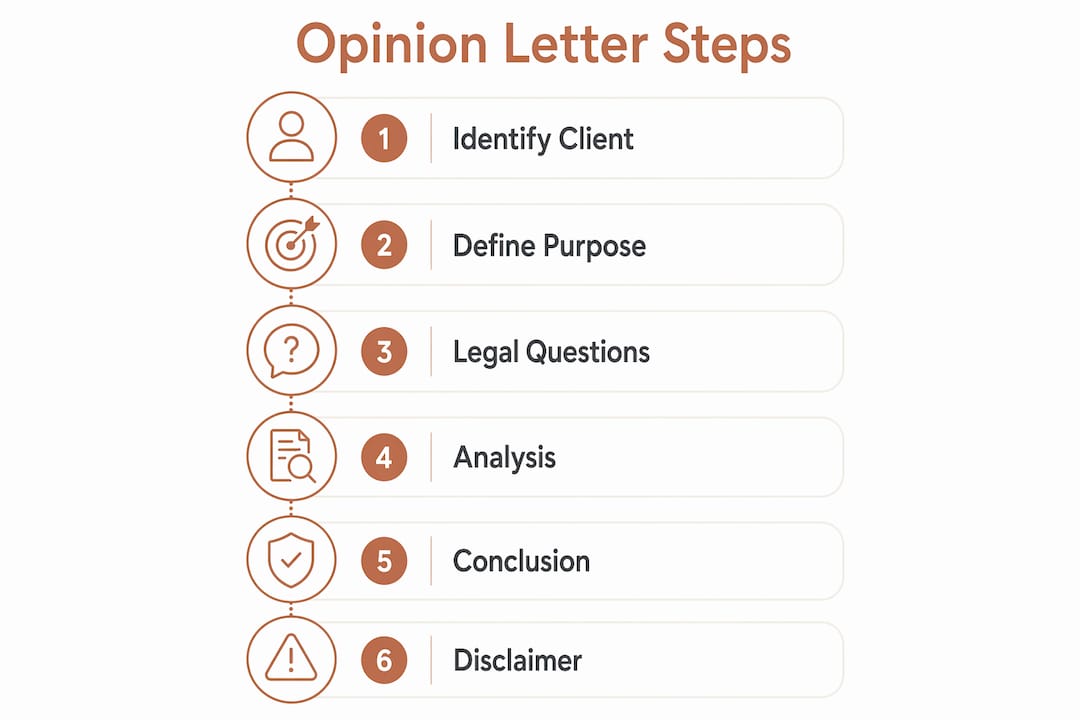
Clear language and proper citation of statutes and court cases are what separate a useful opinion letter from a generic summary. The letter should read as a professional document that a third party can rely on, not as a memo summarizing what the lawyer thinks.
Why do israeli legal opinion letters matter for inheritance, investment, and compliance?
The practical value of an Israeli legal opinion letter becomes clear when you look at the specific situations where it is used. Opinion letters guide decision-making, help prove legal positions, and build trust with authorities and business partners. Here is how that plays out across the three most common contexts.
Inheritance and estate matters. When a foreign national inherits assets from an Israeli relative, foreign courts and financial institutions often require proof of what Israeli law says about the inheritance. An opinion letter from a licensed Israeli advocate explains the applicable provisions of the Succession Law of 1965, the rights of the heir, and the steps required to transfer assets. You can read more about how Loi israélienne sur les successions works in practice to understand the broader framework.
Property investment. Foreign buyers purchasing real estate in Israel face questions about ownership rights, tax obligations, and transfer procedures. An opinion letter addresses whether a specific transaction is legally sound, what restrictions apply under the Land Law of 1969, and what the buyer’s legal exposure is. This is especially important for investors who are not physically present in Israel and cannot easily consult local counsel on short notice.
Regulatory and corporate compliance. Foreign businesses operating in Israel or entering into contracts with Israeli entities need to know whether their activities comply with Israeli law. An opinion letter can confirm that a contract is enforceable, that a business structure meets local regulatory requirements, or that a specific transaction does not trigger licensing obligations. For English-speaking clients, Israeli legal compliance guidance is particularly valuable when navigating unfamiliar regulatory territory.
Cross-border transactions. When Israeli and foreign legal systems interact, each side needs to understand what the other’s law says. An Israeli legal opinion letter gives the foreign party a documented, reliable statement of Israeli law that their own lawyers can work with.
Dealing with banks and tax authorities. Financial institutions and tax authorities in Israel and abroad often require formal legal opinions before releasing funds, approving transactions, or accepting filings. A signed opinion letter from a qualified Israeli advocate satisfies that requirement in a way that informal advice cannot.
The importance of legal opinion letters in these contexts is not theoretical. They are the document that moves a transaction forward, resolves a dispute about applicable law, or satisfies a regulatory requirement. Without one, you are often left in a holding pattern.
How to read and interpret an israeli legal opinion letter
Reading a legal opinion letter effectively means knowing what each section is doing and what weight to give it. The document has a clear structure, and each part serves a different purpose.
Identifying the legal questions
The legal questions section is the most important part of the letter to read first. It tells you exactly what the advocate was asked to address. If the questions do not match your actual situation, the rest of the letter may not be relevant to your decision. Check this section carefully before reading further.
Understanding the analysis section
The analysis is where the advocate applies Israeli law to your facts. This section will cite specific statutes, regulations, and court decisions. You do not need to understand every legal reference, but you should be able to follow the logic. The advocate should explain why a particular law applies and what it means for your situation. If the reasoning is unclear, that is a signal to ask for clarification.
Distinguishing conclusions from advisory remarks
Not every statement in a legal opinion letter carries the same weight. The conclusion section states the advocate’s firm professional view. Other parts of the letter may include advisory remarks, observations about risk, or notes about areas of legal uncertainty. These are not the same as the conclusion. A good letter makes this distinction clear.
| Section | What It Does | How to Use It |
|---|---|---|
| Introduction | Identifies client, scope, and purpose | Confirm it matches your situation |
| Facts | States the factual basis for the analysis | Verify accuracy before relying on the letter |
| Legal Questions | Defines what the advocate was asked | Check alignment with your actual decision |
| Analysis | Applies Israeli law to the facts | Follow the reasoning, ask if unclear |
| Conclusion | States the advocate’s professional view | This is the section you act on |
| Disclaimers | Limits the scope and use of the letter | Understand what the letter does not cover |
Recognizing scope and limitations
Every legal opinion letter includes disclaimers. These are not attempts to avoid responsibility. They define the boundaries of the advice. A letter addressing Israeli inheritance law does not cover tax implications in your home country. A letter about a specific contract does not address future regulatory changes. Understanding these limits helps you know when you need additional advice.
Pro Tip: If you receive a legal opinion letter and a section of the analysis is unclear, send a written follow-up question to the issuing advocate. A good lawyer will clarify without hesitation. The letter is only useful if you understand it.
How do israeli legal opinion letters differ from other legal documents?
The distinction between an Israeli legal opinion letter and other types of legal documents is one that trips up many clients. Getting this wrong can lead to misplaced reliance or, conversely, undervaluing a document that carries real authority.
Here is how opinion letters compare to the most common alternatives:
Informal legal advice. A phone call or email from your lawyer is informal advice. It is not documented, not signed under professional responsibility, and cannot be presented to a third party as authoritative. Opinion letters are formal documents from qualified lawyers, unlike informal advice or public advisory opinions which are generally non-binding.
Government advisory opinions. Israeli government ministries and regulatory bodies sometimes issue advisory opinions on how they interpret specific regulations. These are primarily advisory and non-binding in the same way a private legal opinion is, but they reflect the government’s own interpretation of its rules. They are not a substitute for independent legal advice.
Court expert reports. When a court appoints an expert to provide a legal opinion, that report is prepared for the court’s use and is intended to influence judicial proceedings. It is a formal document, but it serves a different purpose than a private legal opinion letter prepared for a client.
Binding court rulings. A judgment from an Israeli court is binding on the parties. A legal opinion letter is not. It is an authoritative professional view, not a judicial decision. Understanding this distinction prevents a common misunderstanding: the letter tells you what the law says and how it applies to your situation. It does not create a legal outcome by itself.
Notarized documents. Notarization confirms the authenticity of a signature or document. It does not provide legal analysis. A notarized document and a legal opinion letter serve completely different functions.
The key point is that legal opinion letters provide direction, not binding judgments. Their authority comes from the professional standing of the advocate who signs them and the quality of the legal reasoning they contain. For foreigners dealing with Israeli legal jurisdiction rules, understanding this distinction is particularly important when deciding which documents to obtain and how to use them.
Key takeaways
An Israeli legal opinion letter is the most reliable tool for establishing a documented, authoritative legal position under Israeli law, and it is the document that third parties, courts, and regulators will accept as professional guidance.
| Point | Details |
|---|---|
| Definition and authority | A legal opinion letter is a formal, signed document from a licensed Israeli advocate carrying professional weight. |
| Structured preparation | Quality letters follow a clear process: fact gathering, legal research, analysis, and a firm conclusion. |
| Practical importance | These letters are required for inheritance transfers, property purchases, compliance filings, and cross-border transactions. |
| Reading the letter | Focus on the legal questions and conclusion sections first; treat disclaimers as scope limits, not weaknesses. |
| Key distinction | Opinion letters provide authoritative direction but are not binding court rulings or government decisions. |
What we have learned from years of preparing these letters
After working with international clients on Israeli legal matters across inheritance, real estate, and compliance, the pattern we see most often at Menora Law is this: clients receive a legal opinion letter and do not know what to do with it. They either treat it as a binding court order or dismiss it as just a lawyer’s opinion. Both reactions miss the point.
A well-prepared legal opinion letter is a professional tool. It gives you a documented, reasoned position that you can take to a bank, a foreign court, a tax authority, or a business partner. It does not guarantee an outcome. What it does is put you in the strongest possible position to argue your case, complete your transaction, or satisfy a regulatory requirement.
The clients who get the most value from these letters are the ones who come to us with a specific question and a clear decision they need to make. The clients who struggle are the ones who ask for a general overview of Israeli law and then wonder why the letter does not help them move forward. The letter is only as useful as the question behind it.
We have also found that foreign clients often underestimate how much weight Israeli banks and government offices give to a properly prepared opinion letter from a licensed Israeli advocate. In many cases, it is the single document that unlocks a process that has been stalled for months.
One more thing worth saying: not every lawyer who practices Israeli law has experience preparing opinion letters for international use. The letter needs to be written in a way that a foreign lawyer, bank, or court can understand and rely on. That requires a specific kind of drafting skill, not just legal knowledge.
— Menora Law
How menora law can help with your israeli legal opinion letter
Menora Law prepares Israeli legal opinion letters for international clients across inheritance, real estate, and compliance matters. If you are dealing with an Israeli estate, considering a property purchase in Israel, or need to satisfy a regulatory or banking requirement, a properly prepared opinion letter from a licensed Israeli advocate is often the document that moves your matter forward.
Menora Law works with clients remotely, communicates in English, and responds quickly. You do not need to be in Israel to get authoritative Israeli legal advice. Visit Loi Menora to learn more about how the firm supports international clients with trusted, experienced Israeli legal representation across all practice areas.
FAQ
What is an israeli legal opinion letter?
An Israeli legal opinion letter is a formal document written by a licensed Israeli advocate that provides authoritative analysis and a professional conclusion on a specific question of Israeli law. It is used to support decisions in inheritance, investment, compliance, and cross-border transactions.
Is an israeli legal opinion letter legally binding?
No. A legal opinion letter is not a court ruling or a binding legal judgment. It is an authoritative professional view that carries weight with banks, regulators, and foreign courts, but it does not create a binding legal outcome by itself.
Who can issue a legal opinion letter in israel?
Only a licensed Israeli advocate, registered with the Israeli Bar Association, can issue a legal opinion letter that carries professional authority under Israeli law. The advocate’s signature creates professional accountability for the analysis.
When do i need an israeli legal opinion letter?
You typically need one when a bank, foreign court, tax authority, or business partner requires formal documentation of your legal position under Israeli law. Common situations include inheriting Israeli assets, purchasing property in Israel, and meeting corporate compliance requirements.
How long does it take to prepare an israeli legal opinion letter?
Preparation time depends on the complexity of the legal questions and the volume of documents involved. Straightforward matters may take a few days. Complex inheritance or investment matters involving multiple legal questions can take one to two weeks.


 English
 Afrikaans
 العربية
 বাংলা
বাংলা Čeština
 简体中文
简体中文 Nederlands
 Suomi
Suomi Français
 Deutsch
 עִבְרִית
 हिन्दी
 Magyar
 Italiano
 日本語
日本語 한국어
한국어 Polski
 فارسی
فارسی Português do Brasil
 Русский
 Español de México
 Українська