
A foreign resident can use a trust in Israel, whether to hold property, plan for heirs or run an investment. But the trust is only half the story. In Israel, the tax treatment depends on where the settlor, the beneficiaries and the trustees live, and the trust has to be registered and reported to the Israel Tax Authority on time. Get those two things right and a trust can work well from abroad. Get them wrong and you can end up with a trust the tax authorities don’t recognize the way you expected.
This guide walks through how Israeli trusts work for people who live outside Israel, which forms matter, and where families and investors most often get caught out. It covers Israeli law only.
TL;DR
- In Israel, a trust is a legal relationship in which a trustee holds or acts with property for a beneficiary or another purpose. It is set out in the Trust Law, 1979.
- For foreign residents, tax classification drives the structure. The residency of the settlor, beneficiaries and trustees decides how the trust is taxed in Israel.
- A trust connected to Israel generally has to be opened as a file at the Israel Tax Authority (Form 152), and trustees file an annual report (Form 1327).
- If a trust has a foreign resident beneficiary, Form 143 is attached to the annual report. The deadline is generally April 30 of the following year.
- A foreign trust can still be pulled into the Israeli system if it has an Israeli trustee, beneficiary or asset. Get a professional review before you sign anything.
What a trust is under Israeli law
The starting point is the Trust Law, 1979. It defines a trust as a relationship to property under which a trustee must hold the property, or act with it, for the benefit of a beneficiary or for another purpose. The same law says a trust is created by law, by a contract with a trustee, or by a deed of endowment (hekdesh).
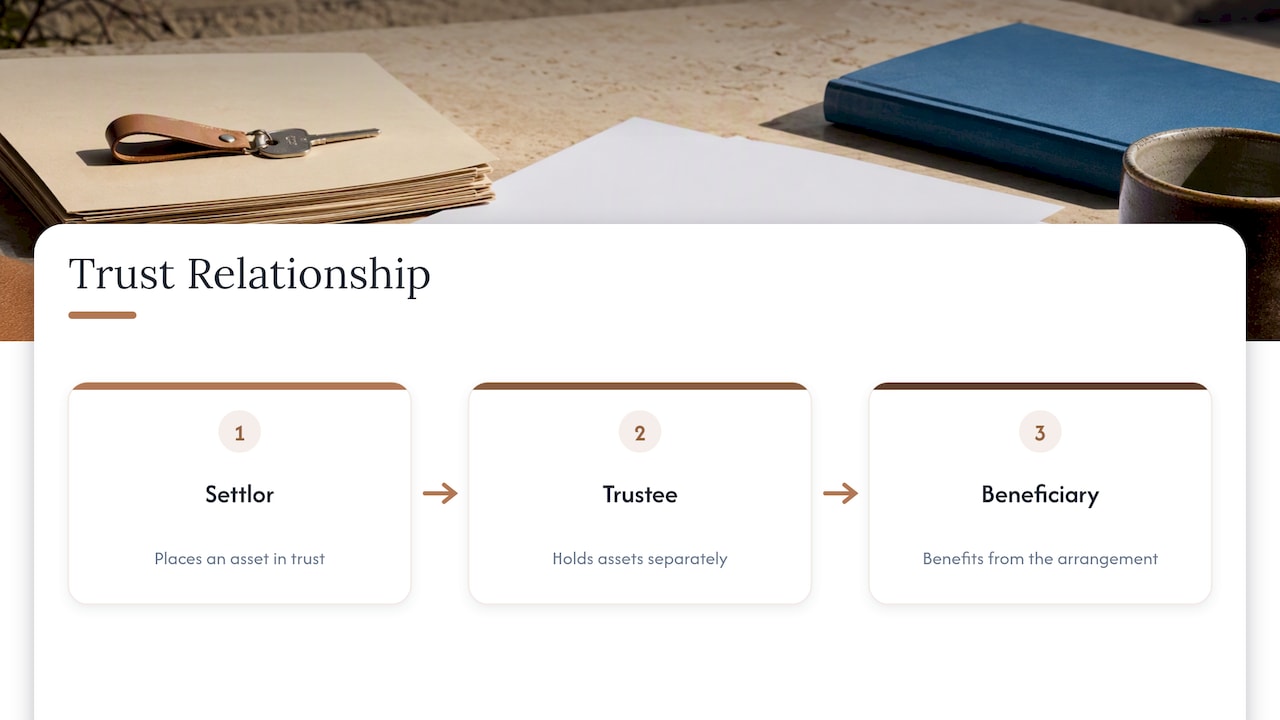
That sounds abstract, so here is a plain version. Someone (the settlor) puts an asset into the hands of someone else (the trustee). The trustee must manage it for the people or purpose named in the arrangement (the beneficiaries). The trustee doesn’t get to treat it as their own.
One rule matters more than most: trust assets have to be kept separate from the trustee’s personal assets. This is a basic requirement under the Trust Law framework, and it protects the integrity of the trust. Practitioners point out that when this is ignored, the trust’s favorable tax position can be put at risk.
The Trust Law is a civil law tool. It tells you what a trustee owes a beneficiary. It does not tell you how the trust will be taxed. For that you need the Income Tax Ordinance, and that is where foreign residents usually find the real complexity.
Why residency decides almost everything
The Israeli tax system sorts trusts into categories. The category depends on who the settlors, beneficiaries and trustees are, and whether they are Israeli tax residents. The Income Tax Ordinance sets this out in its trust chapter. Sections 75G and 75J are the ones foreign clients meet most often, including the category called a “foreign resident beneficiary trust”.
For an individual, the Ordinance defines an Israeli resident as someone whose center of life is in Israel. To decide that, it looks at the whole picture of family, economic and social ties. So residency isn’t just a matter of where your passport says you live or how many days you spent here last year. It is a question of fact, and it can change over time.
According to a published practice guide on Israeli private wealth, a trust is subject to Israeli taxation and reporting if it has at least one Israeli tax resident settlor or beneficiary, or an Israeli asset. A trust whose beneficiaries are all non-residents is treated differently from one with Israeli beneficiaries, and different again from a trust whose settlor returns to live in Israel.
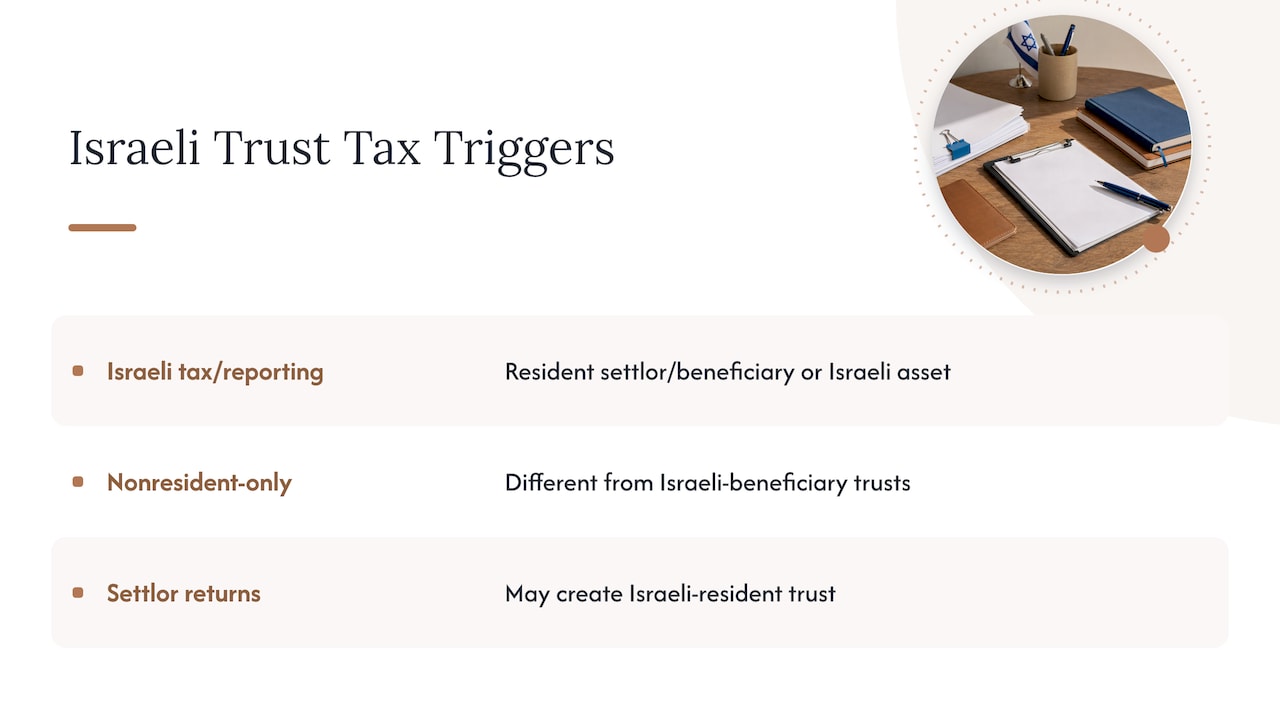
That last case is not theoretical. The Tax Authority’s list of new reportable positions for 2025 includes a position on relatives’ trusts that became Israeli resident trusts after the settlor immigrated or returned to Israel and changed from a foreign resident to an Israeli resident. If you are an Israeli citizen living abroad and might come back, think about this before you set anything up.
The practical takeaway
Before choosing a structure, answer these questions on paper:
- Where does each settlor live, and could that change in the next ten years?
- Where does each beneficiary live, including children and grandchildren who may move?
- Who will be the trustee, and where do they live?
- Does the trust hold, or will it hold, any Israeli asset such as an apartment, land, shares in an Israeli company or a bank account?
If the answer to the last question is yes, or if any person on the list is, or may become, an Israeli resident, assume Israel has an interest in the trust until a professional tells you otherwise.
Foreign trusts with an Israeli connection
Many foreign clients assume that a trust established abroad is out of Israel’s reach. That is a risky assumption. Practitioners regularly see foreign residents surprised by how far Israeli international tax rules reach. If a trust has any link to Israel, whether an Israeli resident trustee, an Israeli resident beneficiary or an asset in Israel, the Israel Tax Authority may assert taxing rights.
The most common ways this happens:
- An inheritance that includes Israeli property. A family trust set up abroad receives an apartment in Tel Aviv from an estate. The trust now holds an Israeli asset.
- A beneficiary who moves to Israel. A child of the settlor makes aliyah, or an Israeli citizen who has lived abroad for years returns.
- An Israeli trustee or adviser. A relative or an Israeli professional is named as trustee or as a person with authority over the trust.
- A property purchase through a trust. A foreign buyer uses a trust structure to hold Israeli real estate. Our article on trusts for international buyers of Israeli property covers the audit issues this raises.
None of these is a reason not to use a trust. They are reasons to design it with Israel in mind from day one, not to discover Israel later.
Opening the trust file: Form 152
Creating a trust, or transferring assets into one, is not just a private matter between you and your trustee. Where the trust falls within the Israeli tax system, you need to open a file for it at the Israel Tax Authority. The Form 152 service page on gov.il is where this starts.
Many people, including some local practitioners, treat this as a formality. It isn’t. The trust file gives the trust its tax identity in Israel. Without it, the trust risks not being recognized for tax purposes, which can lead to unfavorable treatment of its assets and income.
The Tax Authority needs to know exactly who is involved: the settlors, the beneficiaries and the trustees. For non-residents, this includes identity documents such as passport copies. Collect these early, because foreign documents can take time to gather and may need to be translated or legalized.
The annual report: Form 1327 and its annexes
Once the trust exists, someone has to report on it every year. Trustees use Form 1327, the annual statement of income in Israel and abroad for trustees. It covers both Israeli-source and foreign-source income, and the annexes you need depend on the structure of the trust.
The general deadline is April 30 of the year after the tax year. Deadlines can be extended or changed, so always check the current service page before you rely on a date.
| Form | What it is for | Who files it |
|---|---|---|
| 152 | Opening a trust file at the Tax Authority | Trustee, or the person acting for the trust |
| 1327 | Annual statement of Israeli and foreign income | Trustee |
| 143 | Declaration for a trust with a foreign resident beneficiary, attached to Form 1327 | Trustee |
| 144 | Appointing a representative when there is no Israeli resident trustee | Settlor or beneficiary acting as representative |
Form 143 for foreign resident beneficiaries
If your trust is classified as having a foreign resident beneficiary, Form 143 is the declaration the trustee attaches to the annual report. It refers to Sections 75J(f) and 75J(a)(4)(b) of the Income Tax Ordinance, and it asks for the trust’s details, including its file number, the date it was created and any change in the trust’s type or its termination.
This is the filing foreign clients most often miss. It is easy to overlook when the trustee is abroad and nobody told them the Israeli deadline applies to them.
Form 144 when there is no Israeli trustee
What if you want to keep the trust entirely in your own hands and don’t want an Israeli trustee? The law has a mechanism for this. Where a trust has no Israeli resident trustee, a representative settlor or beneficiary can be designated as the Contactez point for the Tax Authority, using Form 144.
That helps international families meet their reporting duties from abroad without being forced to appoint a local trustee. But the representative takes on real responsibilities. Choose the person carefully and make sure they understand the reporting calendar.
Three situations where foreign residents use Israeli trusts
The right structure depends on what you are trying to do. These are the situations we see most.
1. Holding or buying Israeli real estate
Foreign buyers sometimes want a trust to hold an Israeli property, either for privacy, to plan for their children, or because several family members are involved. The tax and reporting position of such a structure has to be checked before the purchase, not after. A trust that appears in the land registry and in the tax file needs to match, and the Tax Authority will look at who really stands behind it. See our guides on trusts for international buyers and on remote due diligence for Israeli property.
2. Planning for heirs
Many of our clients are heirs or owners who live abroad, with property in Israel. A trust can hold assets for the next generation, but it does not replace a will, and it does not remove the need to deal with the estate itself. If someone has already died and left assets in Israel, the first step is usually the probate or inheritance order. Read about what overseas heirs need to do first and about unlocking Israeli assets after a cross-border death.
3. Business and investment holdings
Founders and investors abroad sometimes hold shares in Israeli companies through a trust, for example to separate ownership from control or to hold shares for employees or family. These structures raise corporate, tax and reporting questions at the same time. They are best planned together with the company’s structure, not added later.
Mistakes we would help you avoid
- Treating the trust as purely private. If it has an Israeli link, it may need a Tax Authority file and annual reports.
- Missing the annual deadline. The report is generally due April 30 of the following year, and trusts with foreign resident beneficiaries need the extra Form 143.
- Mixing personal and trust assets. Keep them separate. Bank accounts, property titles and records should all show the trust as a separate holder.
- Ignoring future residency changes. A beneficiary who moves, or a settlor who returns to Israel, can change the classification.
- Choosing a trustee with no thought for the reporting duties. A trustee abroad still has obligations that touch Israel.
- Relying on foreign advice alone. A structure that works well elsewhere may not be recognized, or may be taxed differently, in Israel.
How to approach it, step by step
- Map the people and assets. List settlors, beneficiaries, trustees and every asset, noting the residency of each person.
- Check the classification. Work out which category the trust falls into under the Income Tax Ordinance, and how that could change.
- Decide on the trustee. An Israeli resident trustee, a foreign trustee with a designated representative, or a professional trustee each carry different duties.
- Draft the trust deed. It should fit both the Trust Law and the tax classification you are aiming for.
- Open the file. File Form 152 with the Tax Authority and gather identification documents for every party.
- Move the assets. Transfer them in properly, keeping them separate from personal assets.
- Calendar the reporting. Put Form 1327 and any annexes, such as Form 143, in the diary well before April 30.
- Review every year. Check whether anyone’s residency, or the assets, have changed.
Our view at Menora Law
We work with people who live abroad and have something in Israel: a property, an inheritance, a company, a family member. In our experience, a trust is rarely the first problem. The first problem is that nobody has looked at the whole picture, meaning who lives where, what is held in Israel and which Tax Authority filings follow.
That is why we start with the facts, not the structure. We ask where each person lives and what each person might do in the next few years. Then we tell you plainly whether a trust is the right tool, or whether a will, a company or a simple ownership arrangement does the job with less reporting.
Because we are an Israeli law practice focused on international clients, we can handle this remotely. You don’t need to fly to Israel to sign documents, answer questions or review a draft. We can also arrange on-site consultations abroad when a meeting in person is better. We answer quickly, because trust and estate questions often come with a deadline attached.
One piece of advice we repeat often: ask before you sign, not after. It is far easier to design a trust correctly than to repair one that was set up without an Israeli review.
— Menora Law
Getting help with an Israeli trust
If you hold, or expect to hold, assets in Israel and are thinking about a trust, we can help you with the legal side from start to finish: assessing the structure, preparing documents, handling the Tax Authority filings and coordinating with your other advisers. For related matters, our services also include estate administration, inheritance orders, wills, real estate transactions and corporate work. You can also read our overview of three legal routes for foreigners holding assets in Israel.
Contacter Menora Law to discuss your situation. Tell us who is involved and what is held in Israel, and we will tell you what we would do.
FAQ
Can a foreign resident set up a trust in Israel?
Yes. The Trust Law allows a trust to be created by law, by contract with a trustee or by a deed of endowment, and it does not limit this to Israeli residents. The practical question is how the trust will be classified for tax purposes, which depends on where the settlor, beneficiaries and trustees live.
Do I need an Israeli trustee?
Not necessarily. Where there is no Israeli resident trustee, a representative settlor or beneficiary can be designated to deal with the Tax Authority using Form 144. You should consider carefully whether to take on that role or appoint a local professional.
What happens if I miss the Form 1327 deadline?
The general deadline is April 30 of the year following the tax year. Late or missing filings can create administrative problems and tax exposure, so Contactez a lawyer or accountant as soon as you notice the miss. Check the Tax Authority’s service page for the current rules.
Is a trust a replacement for a will?
No. A trust holds assets under the terms of the trust deed, while a will deals with what happens to the estate on death. Many families need both, and they should be drafted to work together under Israeli law.
Does a trust abroad still matter to Israel?
It can. If the trust has an Israeli resident trustee or beneficiary, or holds an asset in Israel, the Israel Tax Authority may assert taxing rights. A professional assessment of the specific arrangement is the safest way to know.
Sources
- Trust Law, 1979 (Knesset)
- Trust Law framework (Knesset legislation database)
- Income Tax Ordinance (Nevo)
- Income Tax Ordinance, new version, definition of resident (Nevo)
- Israeli private wealth practice guide, tax section
- New reportable positions for 2025 (Israel Tax Authority)
- Form 152 service page (Israel Tax Authority)
- Form 1327 service page (Israel Tax Authority)
- Form 143 declaration (Israel Tax Authority)
- Form 144 service page (Israel Tax Authority)


 English
 Afrikaans
 العربية
 বাংলা
 Čeština
 简体中文
 Nederlands
 Suomi
 Français
 Deutsch
 עִבְרִית
 हिन्दी
 Magyar
 Italiano
 日本語
 한국어
 Polski
 فارسی
 Português do Brasil
 Русский
 Español de México
 Українська