
If a partner dispute is threatening your Israeli company, the first move is simple: preserve every record you can find, stop any partner from making unilateral changes to bank access or corporate control, and call Israeli corporate counsel before you send another email. Israeli courts generally favor keeping a company alive over shutting it down, and mediation or arbitration often resolves these fights faster than litigation. But when a partner is actively moving money or locking others out, you need a lawyer who can request interim relief from an Israeli court right away.
TL;DR:
- Court orders freeze assets and appoint temporary managers only in serious cases where money or control is actively moving out of the company.
- A written shareholders agreement with clear dispute resolution terms significantly reduces the risk of costly, lengthy litigation.
- Early evidence preservation, including bank statements and communication logs, is crucial within the first 48 hours of a dispute to strengthen legal position.
- Israeli courts favor buyout structures that keep the company operational over dissolution, especially when seeking interim relief or court approval.
- Mediation and arbitration are faster, more private options that can often resolve disputes without the need for lengthy court proceedings.
Common Causes and Dispute Scenarios: How to Recognize Your Case
A dispute in an Israeli company rarely erupts overnight. It usually builds for months, sometimes years, before it becomes a legal problem. Recognizing the pattern early can save you time, money, and a company you built from scratch.
Most partner disputes in Israeli companies fall into a handful of recognizable categories:
- Control fights where one partner tries to sideline another from decision making, bank access, or day to day operations.
- Distribution disputes over profits, dividends, or how proceeds from a sale or exit get split.
- Suspected fraud or misappropriation, including diverted client contracts, hidden side deals, or manipulated books.
- Exit and dilution conflicts that surface after a fundraising round changes the cap table and one founder feels squeezed out.
- Family inheritance fights, particularly in closely held companies where a shareholder’s death shifts ownership to heirs who were never part of the business.
Israeli companies, especially smaller ones and startups founded quickly, often run on handshake deals and informal understandings rather than fully drafted agreements. That habit feels efficient in year one. By year three, when the company is worth real money, the absence of a written agreement becomes the single biggest source of uncertainty in Israeli courts. Judges cannot enforce terms nobody wrote down, so oral arrangements tend to produce longer, costlier fights.
The operational cost compounds fast. A company stuck in a leadership standoff loses vendor confidence, misses payroll deadlines, and often can’t sign new contracts because nobody can agree who has authority to sign. That’s why speed matters more than most people initially believe.
Israeli Legal Framework and Remedies: What the Law Can (and Can’t) Do
Israeli company law gives shareholders and partners several distinct paths to a remedy, and understanding which one applies to your situation shapes everything else about your strategy.
The core statutory tool is the oppression remedy, which lets a minority shareholder petition the court when majority partners act in a way that unfairly harms their interests. This sits alongside dissolution powers, which allow a court to order a company wound up when partners can no longer function together. Courts also recognize fiduciary duty claims against directors and controlling shareholders who breach their obligations to the company or to fellow owners, and they will enforce a properly drafted shareholders or founders agreement almost like a contract, because that’s exactly what it is.
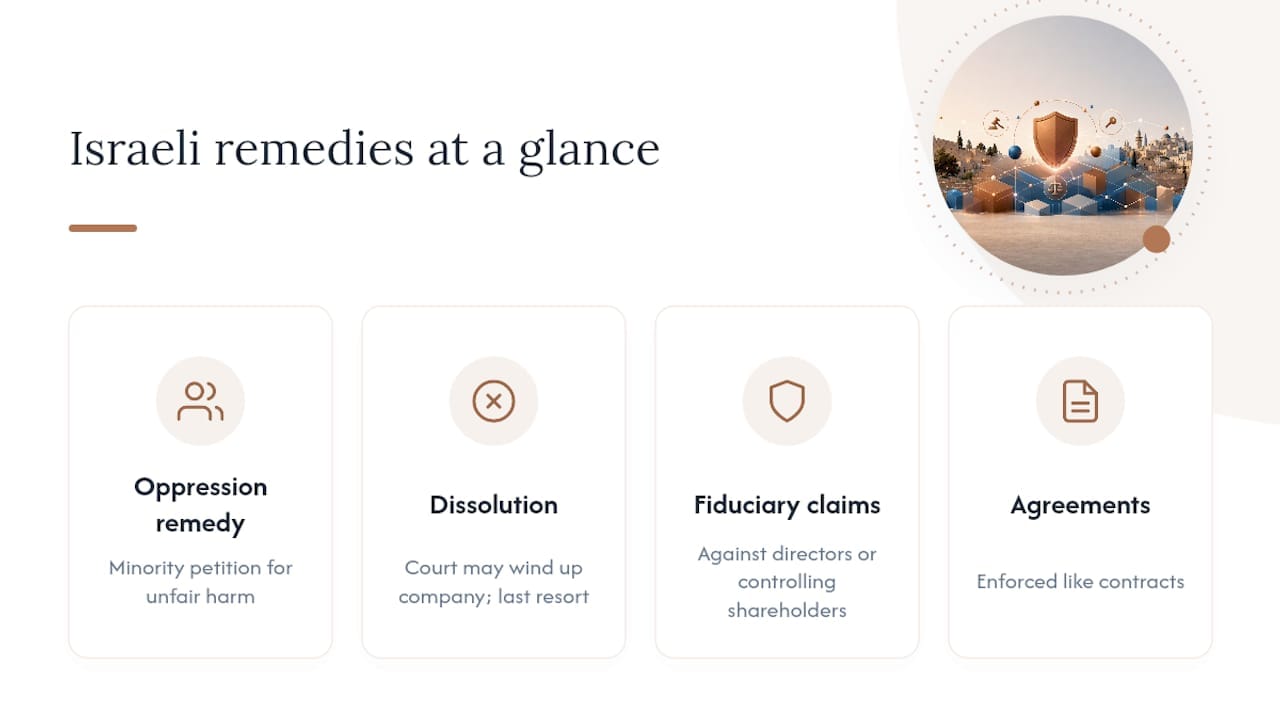
Here’s the part most people don’t expect: Israeli courts treat dissolution as a remedy of last resort. Judges consistently prefer a buyout structure that keeps the company running and preserves its value, over an order that liquidates it. That preference shapes how your lawyer should frame a petition from the start. If your legal strategy leads with “shut it down,” you’re often working against the court’s default instinct rather than with it.
Interim remedies matter just as much as the final outcome, sometimes more. Israeli courts can issue injunctions to freeze specific actions, order asset freezes to stop money from moving offshore or into a partner’s personal account, and in serious cases appoint a temporary manager or receiver to run the company while the dispute plays out. These orders buy time and prevent irreversible damage while the deeper legal questions get resolved.
It helps to be realistic about enforcement limits. A court order is a piece of paper until someone acts on it. If a bank signatory ignores a freeze order, or a partner overseas simply refuses to comply, enforcement becomes its own battle, particularly in cross-border situations. Hybrid strategies that combine ADR with court interim relief tend to work better precisely because they secure enforceable control over Israeli assets while a broader resolution gets negotiated elsewhere. A judgment that can’t be enforced against a bank account or a company registry entry in Israel isn’t worth much, no matter how strong it reads on paper.
First Practical Steps Checklist: Preserve, Prepare, Protect
The first 48 hours after a partner dispute surfaces often determine how the whole case plays out. Evidence preservation and an early review of your corporate documents are consistently cited by Israeli legal practitioners as the two moves that matter most early on. Work through these in order:
- Document and preserve evidence. Pull bank statements, email threads, WhatsApp or Slack messages, signed contracts, and any system access logs before anyone has a chance to delete or alter them.
- Limit unilateral control lawfully. Check who the current bank signatories are, request copies of recent board minutes, and audit who has access to company systems, financial software, and shared drives. Do not lock a partner out yourself without legal advice. Acting unilaterally can expose you to your own liability claim.
- Review your corporate documents immediately. Pull the articles of association, any shareholders or founders agreement, and the terms of any options or SAFE instruments. Look specifically for dispute triggers and any clause requiring mediation or arbitration before litigation.
- Decide whether interim relief is needed now. If money or assets are actively moving, a demand letter alone won’t stop it. A demand letter should still spell out the specific breach, the relief you’re seeking, and a firm deadline, because Israeli courts want to see that you tried a direct resolution before rushing to file.
Pro Tip: Screenshot everything the moment you suspect trouble, even messages that seem unimportant. Chat apps let people delete messages, and a screenshot with a visible timestamp often carries more weight in a dispute than a later claim about what someone said.
Resolution Pathways in Israel: Mediation, Arbitration, and Litigation, How to Pick
Not every partner dispute needs a courtroom. Choosing the right pathway early often determines whether your company survives the fight with its value, its reputation, and its client relationships intact.
Negotiation and mediation work best when both sides still want the company to succeed and the dispute is really about terms, not trust. Israeli mediators often build a practical “day after” plan rather than just a settlement number, structuring the buyout price alongside future governance so the business can keep operating without the departing partner creating friction. Mediation also protects your reputation with clients, banks, and investors who never need to hear the details. Many Israeli mediation providers, including Nishri Mediators, now run sessions online, which makes this option realistic even when a shareholder lives overseas.
Arbitrage offers a private, faster alternative to court, with awards that are generally easier to enforce across borders than a foreign court judgment. It has real limits though: arbitrators often can’t issue the same urgent interim relief a court can, so the seat of arbitration and the governing law clause need careful drafting for any Israeli-connected company with overseas partners.
Litigation becomes necessary when you need an urgent court order, when a partner refuses to negotiate in good faith, or when the dispute involves conduct serious enough to warrant a public remedy. Israeli court timelines vary widely depending on the district and the complexity of the case, but urgent interim applications can move within days when the facts justify it.
Buyout mechanics deserve their own attention regardless of which pathway you choose:
- External valuation by an independent appraiser, often the fairest starting point when partners distrust each other’s numbers.
- Shotgun or BMBY (buy me buy you) clauses, which force one side to name a price and let the other choose to buy or sell at it.
- Tax and corporate consequences, since a buyout structured poorly can trigger avoidable tax exposure for either party.
How to Choose Legal Counsel: Questions, Deliverables, and Red Flags
Not every business lawyer has actually handled a live partner dispute. Ask direct questions before you sign an engagement letter:
- Has this lawyer secured interim court orders in Israel before, or only handled routine corporate filings?
- Do they have hands-on experience with mediation and arbitration, not just litigation?
- Can they handle cross-border enforcement if a partner or asset sits outside Israel?
- Have they worked through valuation disputes and tax-aware buyout structuring?
At intake, expect a serious firm to ask for your founders or shareholders agreement, recent financial statements, corporate registry filings, and any communications tied to the dispute. On fees, ask whether the engagement is hourly, flat-fee for a defined phase, or a hybrid, and get a rough timeline in writing. A vague answer to “what’s our strategy for the next 30 days” is a warning sign worth taking seriously.
Menora Law’s Perspective: How We Approach Partner Disputes Involving Israeli Companies
Our approach starts with mapping control and assets before we file anything. Who holds the bank signatures, who controls the cap table, where the money actually sits. From there, we work to preserve interim remedies while pursuing mediation or arbitration where it genuinely makes sense, and we structure any buyout with tax consequences in mind from day one, not as an afterthought.
We’ve guided cases toward mediated buyouts, temporary manager appointments, and narrowly targeted interim relief, always shaped by the specific facts rather than a one-size template. For overseas clients, we run initial consultations remotely and keep communication fast, because a dispute involving Israeli assets doesn’t pause while you book a flight. Expect a direct conversation about your documents, your timeline, and realistic outcomes at the first meeting.
Tax Implications Arising From Partner Dispute Resolutions or Company Dissolution
A buyout or dissolution triggers tax consequences that catch a lot of business owners off guard, precisely because they weren’t thinking about tax while they were focused on winning the underlying fight.
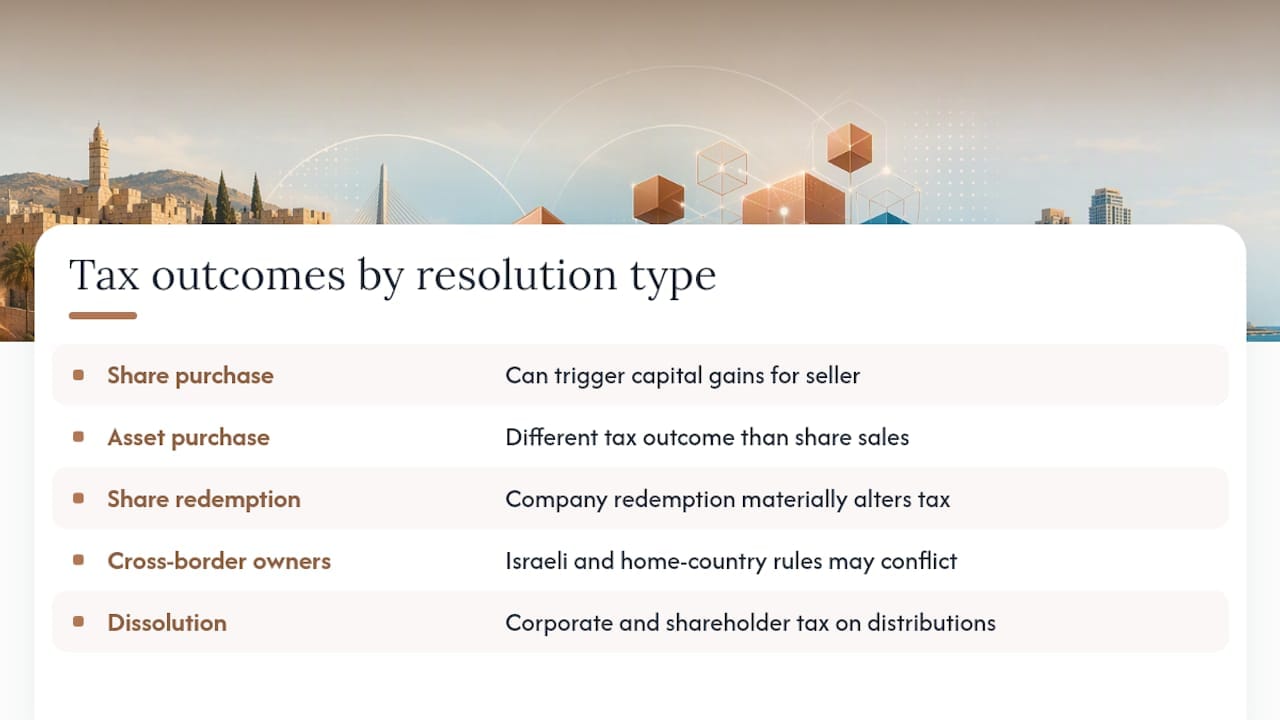
When one partner buys out another, the transaction can generate capital gains exposure for the seller, and how the deal gets structured (share purchase versus asset purchase versus a company redemption of shares) changes the tax outcome materially. Cross-border owners face an extra layer of complexity, since Israeli tax treatment and the shareholder’s home-country tax rules don’t always align neatly, and a deal that looks clean on the Israeli side can still create a reporting problem abroad.
Dissolution carries its own tax footprint. Distributing remaining assets to shareholders after winding down a company can trigger tax at the corporate level and again at the shareholder level, depending on how the assets are characterized and distributed.
This is exactly why tax planning shows up early in complex buyout negotiations rather than after a deal is signed. In one documented case, a founder buyout combined mediation, an independent valuation, and expedited tax planning, including tax insurance, to get the deal closed on a workable timeline without leaving either side exposed to an unexpected tax bill later. Bringing a tax-aware structure into the negotiation from the start, rather than bolting it on afterward, tends to produce a deal that actually survives Contactez with the tax authority.
Strategies to Prevent Escalation of Disputes Beyond Legal Actions
Legal remedies exist for a reason, but the smartest partners treat court as the last stop, not the first. A few practical habits keep disagreements from turning into lawsuits.
Regular, structured communication is the simplest one, and the most ignored. Partners who hold scheduled check-ins on finances, strategy, and role clarity tend to catch friction while it’s still manageable. Waiting until frustration boils over almost always means the disagreement is now tangled up with months of unspoken resentment, which makes any negotiation harder.
Bringing in a neutral third party early, before positions harden, changes the tone of a dispute entirely. A business advisor, an accountant both sides trust, or a mediator brought in at the first sign of real disagreement can often defuse a conflict that would otherwise escalate into formal claims. Waiting until lawyers are drafting demand letters means the relationship has usually already broken past the point where informal resolution feels possible.
The most effective long-term prevention tool, though, is written into the company from day one: a shareholders or founders agreement with clear exit triggers, a pre-agreed valuation method, and defined dispute resolution steps. Practitioners across Israeli corporate law consistently point to this document as the single biggest predictor of how smoothly a dispute resolves, because it removes the guesswork about what happens next before anyone is angry enough to fight over it.
Specific Examples or Case Studies of Partner Disputes in Israeli Companies
Real cases show these disputes rarely follow a single script, but the patterns repeat often enough to be instructive.
A notable example involves the Silynx shareholder dispute, which centered on allegations of improper dilution and questionable share transfers tied to an inheritance situation within the company. The case highlights a pattern that shows up repeatedly in Israeli family-owned or closely held businesses: when a shareholder passes away and ownership shifts to heirs who weren’t part of the original founding team, disputes over how shares were transferred, valued, or diluted often follow. Formal approval processes and clean documentation at the time of any transfer become critical evidence years later, precisely when memories are unreliable and the people who made the original decisions may no longer be available to explain them.
Founder buyout disputes in the tech sector follow a different but equally common pattern: one founder wants out, the remaining partners want to keep the company running without a costly fight, and the resolution hinges on a fair valuation combined with a tax structure that doesn’t punish either side. These cases tend to resolve faster when partners bring in mediation and valuation expertise early rather than letting positions calcify into a courtroom fight.
How Cultural Factors and Business Practices in Israel Influence Partner Disputes
Israeli business culture runs on relationships and speed in ways that shape how partner disputes unfold, for better and for worse.
Startups here often move fast, sometimes deliberately skipping the formal paperwork that founders elsewhere would insist on before taking a single dollar of investment. That speed helps companies launch quickly. It also means a lot of Israeli companies operate for years on handshake understandings about equity splits, roles, and exit terms, understandings that feel completely clear to the people who made them and completely ambiguous to a court later asked to enforce them.
Family involvement in Israeli businesses adds another layer. It’s common for companies to include relatives as shareholders, advisors, or informal decision makers, which blurs the line between business disagreement and family conflict when things go wrong. A dispute that would be purely commercial in a company with unrelated partners often carries emotional weight that slows down negotiation and makes mediation, frankly, more valuable, not less.
There’s also a cultural comfort with direct, blunt confrontation in Israeli business dealings that can look like a crisis to outside observers when it’s really just how disagreements get aired locally. Foreign partners sometimes misread the intensity of an Israeli partner’s opening position as a sign the relationship is unsalvageable, when in local practice it’s often just the opening move in what becomes a fairly standard negotiation.
Editorial Take: What Actually Matters When a Partner Dispute Hits an Israeli Company
Most advice on partner disputes focuses too heavily on legal theory and not enough on enforceability. Winning a claim about who breached what duty means very little if the other side still controls the bank account, the company seal, or the servers when the dust settles. The research on Israeli practice backs this up consistently: the firms that resolve these disputes well spend their early energy securing practical control, not building the strongest possible legal argument.
The conventional advice to “get a lawyer and sue” also undersells how often mediation actually produces a better outcome, faster, with less reputational damage. Israeli courts clearly favor buyouts over dissolution, which tells you something important: the system itself is built to keep companies running, not to punish partners by shutting everything down. Readers should prioritize documentation and interim protection first, negotiation second, and litigation only when the other side leaves no real alternative.
*— Menora Law
Get a Prompt Case Review From Menora Law
This firm offers specialized legal services focused on Israeli corporate matters. We focus specifically on Israeli law for international and local business owners, which means you get a strategy built around Israeli courts, Israeli enforcement mechanics, and Israeli tax rules from the first consultation, not a generic playbook adapted after the fact.
Our team handles dispute strategy, requests for interim relief, representation in mediation and arbitration, buyout structuring with tax planning built in, and cross-border enforcement support for partners or assets located outside Israel. We also assist with foundational documents like the Israeli founders agreement for clients looking to prevent disputes before they start, and with the broader business law services that keep a company’s governance defensible.
If a dispute is unfolding right now, don’t wait for it to get worse. Reach out to Loi Menora for a prompt case review. Bring whatever corporate documents, communications, and financial records you already have, and we’ll walk you through remote representation options and what realistic next steps look like for your specific situation.
This article is general information, not a substitute for advice from a qualified lawyer. Consult a qualified legal professional about your own circumstances before acting on anything here.
Sources
- סכסוך שותפים בחברה: מניעה, ניהול ופתרון משפטי | עו"ד שמעון צור
- Civil mediation – Nishri Mediators
- Founders’ dispute in a tech company | נמרוד ירון ושות׳
FAQ
What Counts as a Partner Dispute in an Israeli Company?
A partner dispute covers disagreements over control, profit distribution, alleged fraud, dilution after fundraising, or ownership fights following an inheritance. It becomes a legal matter when partners can no longer resolve it through normal negotiation.
Can a Court Force the Dissolution of an Israeli Company?
Yes, but Israeli courts treat dissolution as a last resort and usually prefer a buyout structure that keeps the company operating. Full dissolution typically only happens when no workable buyout or governance fix exists.
Is Mediation Actually Enforceable in Israel?
A mediated settlement can be turned into a binding agreement, and Israeli courts will enforce it like any other contract once signed. Many Israeli mediators, including Nishri Mediators, also run sessions online, which works well for overseas shareholders.
What Should I Bring to a First Consultation With Menora Law?
Bring your shareholders or founders agreement, recent financial records, corporate registry documents, and any communications tied to the dispute. Menora Law’s business law services team uses these to assess your options and outline a strategy at intake.
How Long Does an Interim Relief Request Take in Israeli Courts?
Timelines vary by district and case complexity, but urgent interim applications involving frozen assets or unauthorized control can move within days when the facts justify speed. A slower, standard dispute without immediate risk of harm typically takes longer to reach a hearing.


 English
 Afrikaans
 العربية
 বাংলা
বাংলা Čeština
 简体中文
简体中文 Nederlands
 Suomi
Suomi Français
 Deutsch
 עִבְרִית
 हिन्दी
 Magyar
 Italiano
 日本語
日本語 한국어
한국어 Polski
 فارسی
فارسی Português do Brasil
 Русский
 Español de México
 Українська