
If someone close to you died and left a provident fund (kupat gemel) in Israel, you can usually claim the money through the fund manager. Who gets paid, and which papers you need, depends on one thing first: did the account holder name beneficiaries? If they did, those people are generally paid according to the designation. If not, the heirs are paid, and that normally means an inheritance order (tzav yerusha) or a probate order (tzav kiyum tzavaa). There is a shortcut for small balances. This guide walks through each route in plain language.
TL;DR
- Named beneficiaries come first. The fund pays according to the beneficiary designation, unless a later will specifically refers to the provident fund and a probate order approves it.
- No beneficiaries named? The heirs are paid under the will and a probate order, or under an inheritance order.
- Small balance shortcut. For balances up to NIS 8,000, a spouse, parent or child may withdraw without any court order if at least three years have passed since the death, and they sign an indemnity letter.
- Mind the clock on taxes. For certain funds, tax-free treatment applies for a limited window after death, so ask the fund manager about your fund early.
- You can live abroad. The process is paperwork-driven, and a lawyer can handle it remotely.
Who is entitled to the money: beneficiaries or heirs?
This is the question that trips most families up. Many people assume a provident fund is part of the estate and goes wherever the will says. In Israel, that is often not the case.
A provident fund account usually has a beneficiary designation. According to one of the major fund managers, payment is made according to that designation, unless a later will that specifically refers to the provident fund is submitted and approved by a probate order. If no beneficiaries were registered, payment follows the law: a will and probate order, or an inheritance order.
In practice, this gives you three scenarios:
- Beneficiaries were named, and there is no later will touching the fund. The beneficiaries claim directly. No court order is needed for the fund itself.
- Beneficiaries were named, and the person also left a will. Another fund manager’s guidelines say the beneficiaries may redeem only after a probate order is issued and it can be determined that the will does not apply to the account. So a will can slow things down even when the designation is clear.
- No beneficiaries were named. The heirs claim, and they must show an inheritance order or a probate order.
That second scenario is the one we see cause the most confusion. A family assumes the designation settles everything, then the fund asks for a probate order anyway. Knowing this up front saves weeks.
What if the designation is out of date?
People change their lives and forget their paperwork. A designation from twenty years ago might name a former spouse, or a parent who died long before. The fund manager checks eligibility on the basis of the designation and the fund’s own rules, as one insurer explains. If a named person can’t be paid, or if the designation is unclear, you may need a court order after all. If you suspect a problem, get advice before you submit anything, because a wrong claim can freeze the file.
Documents you will need
The exact forms differ slightly between fund managers, but the core set is consistent. According to a fund manager’s published guide, a beneficiary submits:
- A withdrawal request and a beneficiary or heir declaration form.
- A copy of their ID.
- A copy of the death certificate.
- A cheque, or a cancelled cheque, in their own name.
An heir also provides an original or certified copy of the inheritance order or the probate order.
Severance-pay funds (kesafim pitzuim) need more. The same guide lists a survivor’s affidavit verified by a lawyer, plus confirmation from the employer or Form 161.
Two practical points:
- Payment goes only to an account owned by the claimant. One fund manager states this directly. If you live overseas without an Israeli account, plan for this early.
- Each entitled person submits a separate request. If three siblings inherit, there are three requests, and each person is paid their own share.
A note for people abroad
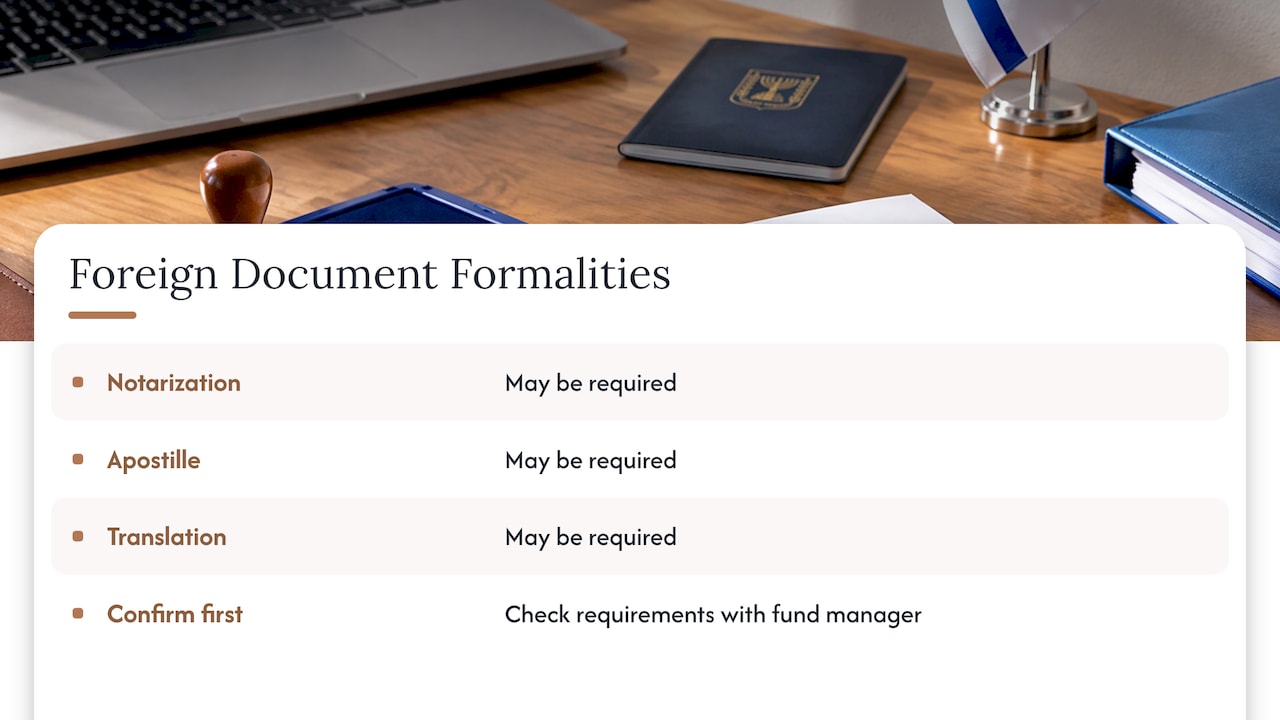
If you’re an heir living outside Israel, the documents are usually where the delay happens. Death certificates issued abroad, powers of attorney and identity documents may need to be notarized, apostilled or translated before an Israeli institution accepts them. Check the specific requirement with the fund manager and your lawyer before you spend money on certified copies. This is one reason we work remotely with clients overseas: signatures and documents can be arranged without a trip to Israel.
How to apply, step by step
The steps below follow what the fund managers publish. Details can vary a little between them.
- Find out which funds exist. Ask the family for statements, or request a search. Israel’s capital market authority runs a service for locating forgotten savings, and a lawyer can help with that. Don’t assume there’s only one fund. People often have several, including old ones from past employers.
- Identify the type of account. Provident fund (kupat gemel), pension fund, managers’ insurance or life insurance. The rules differ (more on that below).
- Check for a beneficiary designation. Ask the fund manager. It decides who is paid first.
- Decide if you need a court order. If there’s no designation, or a will complicates things, you’ll need an inheritance order or a probate order. If the balance is small, see the shortcut below.
- Gather the documents listed above.
- Submit the request. Each entitled person submits their own.
- Choose: withdraw or transfer. See the next section.
How long does payment take?
Once the fund has complete, proper documents, one manager states that the request is processed within four business days. Another gives the same four-day figure for approval and payment.
The key words are “complete and proper.” The four days start when the paperwork is right, not when you first call. The real wait is usually getting the inheritance order or probate order, which can take months, especially when heirs live abroad or when someone objects. We don’t promise a number for that, because it depends on the case and on the court. What we can say is that clean, early preparation shortens it.
Withdraw the money or keep it invested?
You don’t have to take the cash. According to one fund manager, the person entitled can choose between two options:
- Withdraw the full amount they’re entitled to. Partial withdrawal isn’t possible.
- Transfer the amount to a new provident fund account in their own name. That account is blocked to further deposits, but the money can be withdrawn at any time. Tax may apply to profits accumulated after the transfer.
An insurer’s guidance adds that the transfer option applies to provident funds only, not to every product.
Which is better? It depends on your tax position, your need for cash and the fund’s fees. If you don’t need the money now and the tax treatment of the transfer suits you, keeping it invested can make sense. If you need liquidity, or you live abroad and want to simplify your affairs, withdrawing is cleaner. Talk to a licensed tax adviser or accountant about your own numbers before choosing, because the right answer changes with each person’s situation.
The small-balance shortcut: up to NIS 8,000
Getting a court order can cost more than a small account is worth. That’s the reason the Capital Market, Insurance and Savings Authority issued a circular allowing a simpler route, as one insurer explains.
Under the fund manager’s published conditions, heirs may withdraw without an order if all of these are true:
| Condition | What it means |
|---|---|
| Balance | No more than NIS 8,000 at the time of the request |
| Time since death | At least three years |
| Who applies | The spouse, a parent or a child |
| Court orders | The fund verifies that no inheritance or probate order was issued or applied for |
| Paperwork | A signed declaration and indemnity |
The threshold isn’t frozen. It’s updated every January 1 according to the Consumer Price Index, so check the current figure with the fund manager. The shortcut also doesn’t apply to severance-pay funds where Section 5 of the Severance Pay Law applies.
What the indemnity letter means
The applicant signs a statement that, to the best of their knowledge, they are an heir at law of the deceased, states their share, and promises to indemnify the fund if it later has to pay the money, or part of it, to someone else. That’s a real commitment. Before you sign, make sure you’re actually entitled, and that no other relative has a claim. If the family is split, or if there’s a will, it’s wiser to get proper advice first.
Taxes on inherited provident fund money
Tax is where details matter most, and where a few weeks can change the outcome. We’ll stay with what the fund managers publish, and we encourage you to confirm the treatment of your specific account with the manager and a tax adviser.
For funds under Amendment 190 designated as a recognized pension, Meitav explains the following:
- If the member died before age 75, beneficiaries may receive the funds tax-free as a one-time sum for up to 90 days after death. After that, the profit component is subject to 25% tax.
- If the member died after age 75, beneficiaries may withdraw as a one-time sum with 15% tax on nominal profit, or receive a tax-exempt monthly pension if they’re over 60.
The practical lesson is simple: the 90-day window is short, and getting a court order can take longer than that. If tax-free treatment may be available, start the process quickly and ask the fund manager what documents will stop the clock from running against you.
Severance-pay funds follow their own rules, and the tax treatment depends on the deceased person’s circumstances. We’d rather you ask than guess.
Inheritance in Israel itself isn’t taxed, but that’s a separate question from income tax on fund proceeds, and your own country’s rules may apply to you as a resident elsewhere. We only advise on Israeli law, so for tax in your country of residence you’ll need a local adviser.
Provident funds, pension funds and life insurance: not the same
People use “kupat gemel” loosely, but the products behave differently when the owner dies.
- Provident fund (kupat gemel). Savings that can usually be withdrawn as a lump sum by beneficiaries or heirs, or transferred into a new account in the claimant’s name, as described above.
- Pension fund. Designed to pay a monthly income. The pension system has its own survivors’ insurance framework, under which a spouse or children may receive a survivors’ pension. In some situations, where survivors’ insurance was waived, they may instead receive the accumulated savings.
- Managers’ insurance and life insurance. These are insurance policies with their own named beneficiaries and policy terms. They don’t automatically follow the will either.
So the answer to “who gets the money?” has to be asked product by product. A family that finds three or four financial products shouldn’t assume one set of rules covers them all.
Common mistakes we see
- Assuming the will controls everything. A will can’t override a valid beneficiary designation unless it meets the conditions described earlier.
- Applying for the wrong thing. Submitting an heir’s request when a beneficiary designation exists, or the reverse, leads to rejected files.
- Missing a tax window. Waiting for the “right time” can cost money when a time-limited exemption is involved.
- Signing the indemnity letter carelessly. It makes you personally responsible if someone else turns out to be entitled.
- Forgetting forgotten accounts. Old employer funds, study funds and dormant policies are easy to miss. We handle abandoned property claims as part of our work for international families.
- Splitting the paperwork across countries without a plan. Documents prepared abroad may need to be legalized for Israeli use.
Our perspective
Provident fund claims look like simple forms, and sometimes they are. But when an estate has heirs in several countries, a will written years ago, a beneficiary designation nobody remembers and a tax window ticking, the form is the easy part.
At Menora Law, we work on Israeli law only, and we work with families overseas every day. We design our approach around the fact that most of our clients can’t just walk into a fund’s branch. We handle the inheritance or probate order, the correspondence with the fund managers, the estate distribution and the tax questions in one place, and we communicate quickly so you aren’t left guessing.
What we try to give clients is a clear map before anything gets filed: which funds exist, who is entitled under which rule, whether a court order is needed, and what the safest order of steps is. Remote representation means you can sign what’s needed from where you live, without flying to Israel.
If you’re facing a provident fund claim that doesn’t fit the simple case, we’d rather help you set it up properly the first time than fix a rejected file later.
Loi Menora
When it makes sense to get a lawyer involved
You can often handle a straightforward beneficiary claim yourself. A lawyer becomes valuable when:
- There’s no beneficiary designation and you need an inheritance order or a probate order.
- There’s a will, and it might refer to the provident fund.
- Heirs disagree, or one of them can’t be reached.
- You’re abroad and documents need legalizing, translating or signing remotely.
- The balance is significant and the tax treatment depends on timing.
- You suspect there are more accounts than anyone has found.
In those cases, someone who knows how the Israeli registry of inheritance, the courts and the fund managers actually operate saves you time and avoids expensive errors.
How Menora Law can help
We’re an Israeli law practice focused on international clients. For provident fund and pension claims after a death, we can obtain the Israeli inheritance order or probate order you need, address inheritance-related tax questions, and help distribute the estate’s assets in Israel. If the matter goes to court, we manage inheritance cases in the Israeli family courts. We also prepare, file and modify wills in Israel, so your own family doesn’t face the same maze.

If you’d like us to look at your situation, contact Menora Law with the name of the deceased, the funds you know about and where the heirs live. We’ll tell you which route applies and what the next step is.
FAQ
Can I withdraw an inherited provident fund without an inheritance order?
Yes, in two situations. If you’re a named beneficiary, the fund generally pays according to the designation. Otherwise, if the balance is up to NIS 8,000, at least three years have passed, and you’re the spouse, parent or child, you can use the shortcut and sign an indemnity letter.
How long does the fund take to pay?
The fund managers we reviewed state four business days from the moment they receive complete, proper documents. The longer part is usually getting the court order, if one is needed, and legalizing documents from abroad.
Do I have to withdraw the money, or can I keep it invested?
You can withdraw the full amount or transfer it to a new provident fund account in your name. Partial withdrawal isn’t possible, and the new account is blocked to further deposits. Ask a tax adviser how each choice affects you.
Does a will decide who gets the provident fund?
Not by itself. Payment follows the beneficiary designation unless a later will specifically refers to the fund and a probate order approves it. If no beneficiaries were named, the will and probate order, or an inheritance order, decide.
Can I claim from outside Israel?
Yes. The claim is documents-based, and payment must go to an account in your own name. A lawyer in Israel can coordinate the court order, the paperwork and the fund manager remotely.
Sources
- Withdrawing funds from a deceased member’s account (Meitav)
- Withdrawal of funds by beneficiaries and heirs (Analyst)
- Withdrawing a deceased person’s money from a provident fund (Altshuler Shaham)
- Instructions for withdrawal by a beneficiary or heir (Menora Mivtachim)
- Low-balance deceased account withdrawal (Altshuler Shaham)
- Low-balance withdrawal FAQ (Clal)
- Eligibility to withdraw from a deceased member’s account (Clal)
- Low-balance withdrawal and indemnity (Phoenix)
- Amendment 190 (Meitav)
- Survivors’ insurance in the pension framework (Kol Zchut)


 English
 Afrikaans
 العربية
 বাংলা
 Čeština
 简体中文
 Nederlands
 Suomi
 Français
 Deutsch
 עִבְרִית
 हिन्दी
 Magyar
 Italiano
 日本語
 한국어
 Polski
 فارسی
 Português do Brasil
 Русский
 Español de México
 Українська