
Every foreign estate document submitted to Israeli authorities must be translated into Hebrew and properly certified before any Israeli court, registry, or government office will act on it. That is the core rule, and there are no exceptions.
Here is what that means in practice:
- Who certifies: An Israeli notary fluent in both languages, or a sworn translator’s affidavit that an Israeli notary then certifies. For wills and court orders, a lawyer-reviewed translation is strongly preferred.
- Authentication required: A Hague Apostille (for countries in the Apostille Convention) or consular legalization (for non-member countries) on the original foreign document before translation.
- Where documents are submitted: The Registrar of Inheritance Affairs (for a Tzav Yerusha probate order), the Israeli Land Registry (Tabu) for property transfers, or the Ministry of Interior (MOI) for status-related matters.
Pro Tip: Never send a translation certified only by a foreign notary without an apostille or Israeli notary certification. Israeli registrars will reject it outright, and restarting the process can cost months.
Which estate documents need Hebrew translation for Israeli probate
The list is longer than most heirs expect. Israeli authorities require certified Hebrew translations of virtually every foreign document that touches the estate. Below is the standard set, organized by submission point.

| Document | Where It’s Submitted | Notes |
|---|---|---|
| Foreign will | विरासत मामलों के रजिस्ट्रार | Must include certified Hebrew translation + foreign-law opinion |
| Death certificate | Registrar / MOI | Certified copy + translation |
| Marriage certificate | Registrar / MOI | Required to establish spousal rights |
| Divorce decree | Registrar / MOI | Needed when prior marriage affects succession |
| Foreign probate grant or letters of administration | Registrar | Proof of status only; Israel issues its own order |
| Title deed / Tabu extract | Tabu (Land Registry) | Certified copy; Tabu may require original inspection |
| Power of attorney (POA) | Tabu / Registrar | Must name specific parcel numbers for Tabu |
| Foreign court orders | Registrar / relevant court | Lawyer-reviewed translation strongly preferred |
| Beneficiary ID documents (passport, national ID) | All authorities | Certified copy; translation if not in English or Hebrew |
A few practical points worth knowing:
- Tabu generally accepts certified copies of title deeds, but the original may be requested for inspection.
- The Registrar of Inheritance Affairs and MOI offices can differ in how strictly they apply certification rules, so confirming requirements before filing saves time.
- Originals should always travel with the submission package, even when certified copies are the formal requirement.
Who can translate and certify estate documents for use in Israel
This is where many heirs go wrong. Not every bilingual professional qualifies.
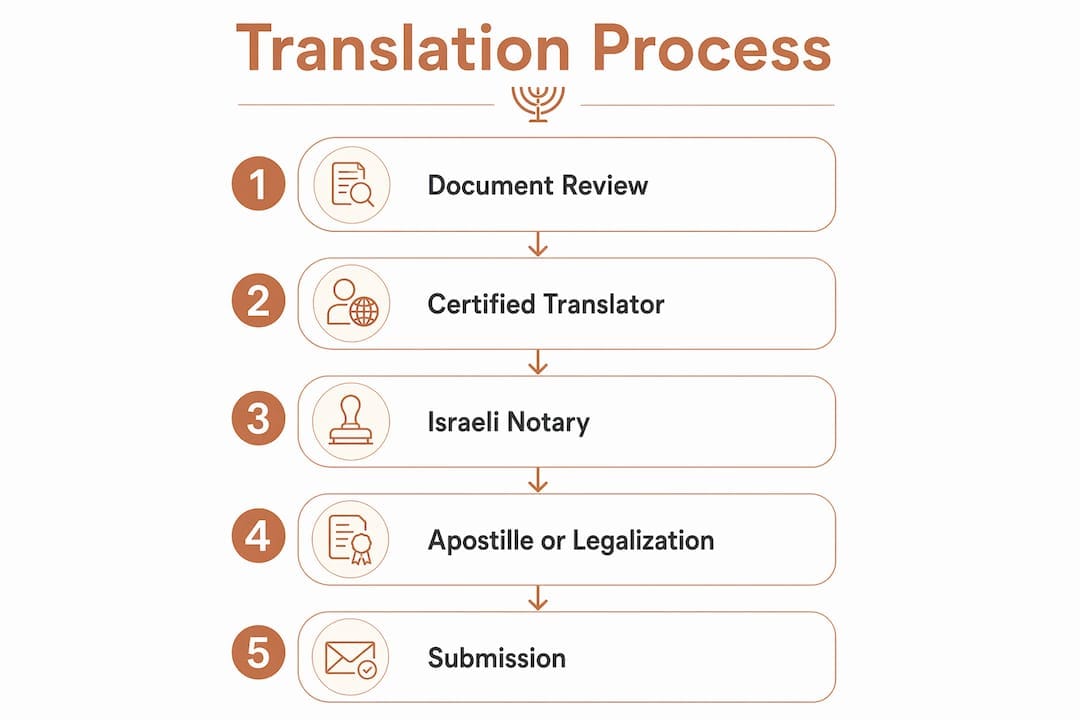
Israeli notaries may certify a translation only if they are personally fluent in both the source language and Hebrew, or if a qualified translator provides a sworn affidavit that the notary then certifies. The Notary Law is explicit on this point. Some MOI and Tabu offices apply this rule strictly; others are more flexible. That inconsistency is exactly why lawyer-reviewed translations have become the safer standard for complex documents.
For wills, court orders, and foreign probate grants, practitioners increasingly prefer translations prepared or reviewed by an इज़राइली वकील with legal expertise in both jurisdictions. The reason is straightforward: legal terminology does not translate word-for-word across legal systems. A translator who renders the text accurately in a linguistic sense may still produce a document that misrepresents the legal meaning, which registrars and notaries are trained to notice.
Key rule: A notarized translation in Israel is a statement about method and verification, not just language. For wills and court orders, the notary or reviewing lawyer must confirm that the legal meaning, not only the words, has been preserved. A translation that is linguistically correct but legally imprecise will be rejected.
Pro Tip: If your document originates in a language the Israeli notary does not speak, ask upfront whether they will accept a translator’s affidavit or require a lawyer-reviewed translation. Getting that answer before you pay for a translation saves you from starting over.
How apostilles and consular legalization work for Israeli estate documents
Israel is a member of the Hague Apostille Convention, which means foreign public documents from other member countries can be authenticated with an apostille rather than full consular legalization. The sequence matters.
Step-by-step for documents originating abroad:
- Obtain a notarized copy of the original document in the country of origin.
- Secure an apostille from the competent authority in that country (for Hague Convention members) or obtain consular legalization through the Israeli embassy or consulate (for non-member countries).
- Have the document translated into Hebrew by a qualified Israeli notary or lawyer-reviewed translator.
- If the translation is done abroad, that translated document may itself require an apostille or Israeli notary certification before Israeli authorities will accept it.
- Submit the complete package (original or certified copy + apostille + certified Hebrew translation) to the relevant Israeli authority.
The decision tree is simple: if the originating country is a Hague Convention member, the apostille path is faster. If not, consular legalization through the Israeli diplomatic mission is required. Documents translated abroad generally still need apostille or consular legalization, and Israeli authorities may require a final notary certification in Israel on top of that.
- Death certificates and marriage certificates from most Western countries follow the apostille path without issue.
- Foreign wills often require both an apostille on the original and a separate foreign-law opinion confirming valid execution.
- Powers of attorney drafted abroad for use at Tabu must be apostilled and must specify the parcel number and transaction details. A generic POA will be refused.
Pro Tip: Draft any POA intended for Tabu with the specific land parcel number, block, and lot included. A general “authorize my representative to handle all real estate matters” clause is not enough. Tabu will send it back.
How translated documents move through Israeli probate and property transfer
Understanding the workflow helps you see where delays actually happen and what you can do to shorten them.
The path for an international heir with Israeli assets typically runs like this:
- File a probate application with the Registrar of Inheritance Affairs, including the translated will (if one exists), translated death certificate, and supporting documents. The Registrar reviews whether the will is valid under Israeli law and whether a foreign-law opinion is needed.
- Obtain the Tzav Yerusha (probate order). For a straightforward Israeli will, this can take a few months. For a foreign will, the Registrar typically requires a legal opinion from an attorney in the foreign jurisdiction confirming the will’s valid execution, which adds weeks or months to the process.
- Transfer property at Tabu. Once the probate order is issued, heirs can apply to the Israeli Land Registry to transfer title. Tabu requires its own set of translated and certified documents, including the probate order, the heir’s ID, and any POA used for the transfer.
A critical point that surprises many heirs: a foreign probate grant is not directly enforceable in Israel. It serves as evidence of the heir’s status, but Israel will still issue its own independent probate order. That step cannot be skipped, and it requires the full translation and certification package regardless of what a foreign court has already decided.
Improper translation and authentication can add months and significant costs to estate settlement. The most common delay triggers are missing foreign-law opinions and retranslation requirements when the first translation is rejected.
Before filing, heirs should:
- Pre-translate all core documents and obtain apostilles before contacting the Registrar.
- Confirm whether the foreign will requires a foreign-law opinion and commissions it early.
- Prepare a Tabu-specific POA with correct parcel details, apostilled and translated.
- Keep certified copies of every document in a single organized package.
Common mistakes that cause rejections or delays at Israeli authorities
Most rejections are preventable. The same errors appear repeatedly, and they are almost always avoidable with a pre-submission checklist.
Frequent rejection causes:
- Translation certified by a foreign notary only, with no apostille or Israeli notary certification.
- Israeli notary who is not fluent in the source language certifying a translation without a proper translator affidavit.
- Missing apostille on the original document, or an apostille obtained from the wrong authority.
- Inconsistent names or dates across documents (e.g., a death certificate spells the name differently than the will).
- Generic POA submitted to Tabu without parcel numbers or transaction specifics.
- Foreign-law opinion missing or insufficient for a foreign will.
- Formatting errors: missing page numbers, unsigned pages, or uncertified annexes.
- Using a translator without legal training for wills or court orders, where legal terminology requires specialist knowledge.
Pre-submission checklist for executors:
- Verify that every document has an apostille or consular legalization from the correct authority.
- Confirm the Israeli notary is fluent in the source language or that a proper translator affidavit is attached.
- Cross-check all names, dates, and identifying details across every document in the package.
- Confirm the POA lists the specific Tabu parcel number, block, and lot.
- Commission the foreign-law opinion early if a foreign will is involved.
- Have an इज़राइली वकील review the full package before submission.
Pro Tip: For wills, court orders, and complex title deeds, use a lawyer-reviewed translation rather than a standard sworn translator. The cost difference is modest compared to the cost of a rejected submission and the months it takes to correct.
Key Takeaways
Every foreign estate document submitted in Israel must be translated into Hebrew and certified by an Israeli notary or lawyer-reviewed translator, with an apostille or consular legalization on the original, before Israeli authorities will process the estate.
| Point | Details |
|---|---|
| Hebrew translation is mandatory | All foreign estate documents must be translated into Hebrew before Israeli authorities will act on them. |
| Certification standard matters | Use an Israeli notary fluent in both languages or a lawyer-reviewed translation; foreign-only certification is not accepted. |
| Apostille before translation | Obtain an apostille (or consular legalization) on the original document before the Hebrew translation is certified. |
| Tabu POA must be specific | Any power of attorney for the Land Registry must name the exact parcel number and transaction details or it will be refused. |
| Menora Law handles the full process | Menora Law coordinates document review, apostille, certified translation, foreign-law opinions, and Tabu filings for international heirs. |
What Menora Law sees in cross-border estate cases
The pattern Menora Law encounters most often is this: a family abroad learns that a relative has passed away and left property in Israel, and they assume the foreign probate grant they already hold will be enough. It is not. Israel requires its own probate order, and the translation and certification requirements apply in full, regardless of what a foreign court has already decided.
The second most common scenario is a foreign will that was perfectly valid where it was drafted but triggers a foreign-law opinion requirement in Israel. That opinion takes time and costs money, and it could have been avoided entirely if the person had drafted a simple Israeli will while they were alive. For international clients who own Israeli assets, drafting an Israeli will in advance is often the most cost-effective decision they can make. It bypasses the foreign-law-opinion step entirely and shortens the probate timeline considerably.
Menora Law works with overseas clients remotely, reviewing documents, coordinating apostilles, arranging certified translations, and filing probate applications without requiring clients to travel to Israel. The intake process is straightforward: send the documents, get a clear assessment of what is missing, and move forward with a defined plan.
Menora Law’s services for international heirs dealing with Israeli estate documents
For international heirs facing Israeli estate translation requirements, Menora Law offers a concrete, end-to-end service that covers every step from document review to Tabu registration.
Menora Law’s services for overseas clients include:
- Document checklist and gap review: Identify exactly which documents are missing, mistranslated, or improperly certified before filing.
- Apostille and legalization coordination: Guide clients through obtaining the correct authentication in their home country.
- Certified Hebrew translations: Arrange Israeli notary-certified or lawyer-reviewed translations for wills, court orders, death certificates, and title deeds.
- Foreign-law opinions: Commission and review foreign-law opinions required for foreign wills.
- Tabu-specific POA drafting: Prepare powers of attorney that meet Tabu’s exact requirements, including parcel numbers and transaction details.
- Probate filing (Tzav Yerusha): Prepare and file the complete probate application with the Registrar of Inheritance Affairs.
- Tabu property transfers: Manage the full Land Registry transfer process after the probate order is issued.
The engagement is fully remote. Clients send documents, Menora Law reviews them, coordinates authentication and translation, and manages the Israeli filings. To get started, schedule a virtual consultation or review Menora Law’s Israeli inheritance law guide for a full picture of what the process involves.
Useful sources and next steps
Vetted sources for further reading:
- Israeli Registrar of Inheritance Affairs — official filing requirements and forms
- Menora Law: Israeli Probate Process Explained — step-by-step probate guide for families
- Menora Law: Foreign Beneficiary Israeli Will Rights — rights of foreign heirs and required documentation
- Menora Law: International Heir Israeli Asset Claim — practical checklist for claiming Israeli assets from abroad
- Menora Law: Israeli Inheritance Law Guide — full overview of inheritance law for international clients
- Menora Law: Succession and Probate Law — legal framework governing Israeli probate orders
Your immediate next steps:
- Gather all original documents (will, death certificate, marriage certificate, title deeds, POA) and obtain notarized copies. Secure an apostille or consular legalization on each original from the competent authority in the country of origin.
- संपर्क करना Menora Law for a remote document review. The team will identify any gaps, arrange certified Hebrew translations, and prepare the full submission package for the Registrar of Inheritance Affairs or Tabu.
For a direct consultation, visit Menora Law’s Israeli estate administration service or the firm homepage to reach the team.
This article is general information about Israeli legal requirements, not legal advice for your specific situation. Confirm current rules with the Israeli Registrar of Inheritance Affairs or a qualified Israeli attorney before filing.
सामान्य प्रश्न
Can a certified translation be done outside Israel?
Yes, but it must still meet Israeli standards. A translation done abroad typically needs an apostille on the translated document itself, and Israeli authorities may still require final certification by an Israeli notary.
Can you translate your own estate documents for Israeli authorities?
No. Israeli authorities require certification by an Israeli notary or a lawyer-reviewed translation. Self-prepared translations are not accepted for probate or Tabu filings.
Does a foreign probate grant replace the Israeli probate process?
No. A foreign probate grant serves as evidence of heir status, but Israel requires its own independent probate order (Tzav Yerusha) before local assets can be transferred.
What happens if names are inconsistent across translated documents?
Inconsistent names or dates across documents are a common rejection cause. All documents must reflect identical identifying details; discrepancies require correction before the Registrar or Tabu will process the file.
Can Menora Law handle the translation and probate process remotely?
Yes. Menora Law manages the full process for overseas clients remotely, from document review and translation coordination to probate filing and Tabu registration, without requiring clients to travel to Israel.


 English
 Afrikaans
 العربية
 বাংলা
বাংলা Čeština
 简体中文
简体中文 Nederlands
 Suomi
Suomi Français
 Deutsch
 עִבְרִית
 हिन्दी
 Magyar
 Italiano
 日本語
日本語 한국어
한국어 Polski
 فارسی
فارسی Português do Brasil
 Русский
 Español de México
 Українська