
TL;DR:
- Israeli absentee property law transfers control of certain lands to the state if owners are classified as absentees. Heirs outside Israel must address absentee designation and navigate complex legal procedures to claim or compensate for affected properties. Professionals experienced in Israeli property and inheritance law can assist international claimants in managing these legal challenges.
Israeli absentee property law is defined as a legal framework enacted by the Israeli Knesset in 1950 that transfers custodial control of certain properties to the Israeli state when the original owners are classified as “absentees.” Understanding what is Israeli absentee property law matters deeply if you are an international heir, a property claimant, or anyone with ties to land in Israel. The law created the Custodian of Absentee Property, a government body that holds, manages, and can dispose of designated lands. Its reach extends from properties abandoned during the 1948 conflict all the way to East Jerusalem after 1967. The legal and practical consequences of this law remain very much alive today, affecting property ownership in Israel for thousands of families worldwide.
What is Israeli absentee property law and who does it classify as an absentee?

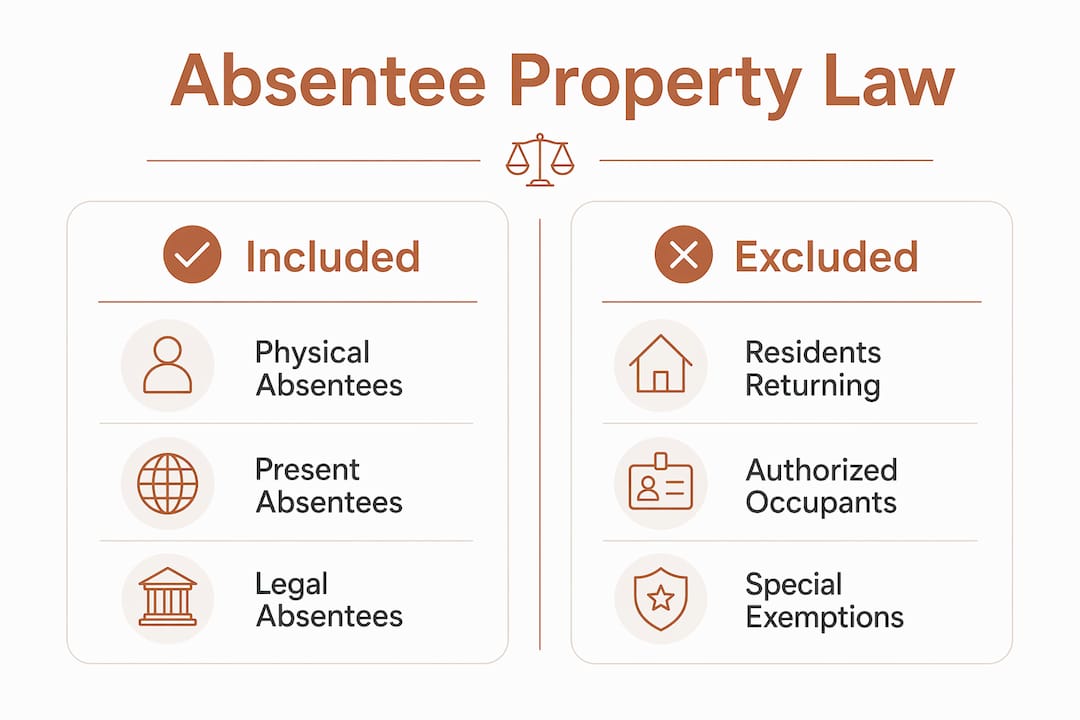
The Absentee Property Law of 1950 defines an “absentee” as any person who, between November 29, 1947, and the end of the state of emergency, was a citizen or subject of an Arab state, was in one of those states, or was in any part of mandatory Palestine outside Israeli-controlled territory. That definition is broad by design. It captures not only Palestinians who fled outside Israel’s borders but also those who were displaced internally and never left the country at all.
The law created two distinct legal categories that still matter for property claims today.
- External absentees are Palestinians who left Israel’s territory entirely, including refugees who fled to neighboring countries such as Jordan, Lebanon, Egypt, and Syria during and after the 1948 war.
- Present absentees are Palestinians who remained inside Israel’s borders but were absent from their specific property during the qualifying period. About 30,000–35,000 Palestinians inside Israel were classified as present absentees and lost their land rights under this law. That number represents Israeli Arab citizens who hold Israeli identity cards yet are legally barred from exercising ownership rights over their former homes and lands.
The distinction between physical presence and legal property rights is what makes this law unique in Israeli jurisprudence. A person can live in Israel, pay taxes, and hold citizenship, yet still be classified as legally absent from their own property.
Who is excluded from absentee classification?
Not every Palestinian displaced during 1948 automatically falls under the law. Exclusions exist for persons who were continuously present in Israel from the end of the qualifying period onward and who were never absent from their property during that window. Jewish owners of properties in East Jerusalem also received specific protections under later amendments. The law’s exclusions are narrow, and the burden of proving non-absentee status falls on the claimant, not the state.
Pro Tip: If you believe a property in Israel may be affected by absentee designation, the first step is obtaining a title search through the Israeli Land Registry (Tabu) before taking any other action. That document will show whether the Custodian of Absentee Property holds any registered interest in the land.
How did the absentee property law originate and evolve since 1950?
The law did not appear out of nowhere in 1950. Its roots go back to Emergency Regulations enacted during the 1948 Arab-Israeli War, when the Israeli provisional government began seizing properties of those who had fled or been displaced. The formal Absentee Property Law of 1950 codified those emergency measures into permanent legislation and established the Custodian of Absentee Property as a standing government office with full ownership powers over designated lands.
The scale of what followed was significant. The 1950 law and its amendments enabled the transfer of two million dunams of land to government bodies. To put that in perspective, two million dunams equals roughly 500,000 acres, an area larger than the entire state of Rhode Island.
The law evolved through several major legislative steps:
- 1948 Emergency Regulations. The provisional government issued emergency orders allowing seizure of properties belonging to those who had fled. These regulations formed the legal foundation for the 1950 law.
- 1950 Absentee Property Law. The Knesset formally enacted the law, creating the Custodian of Absentee Property and defining the categories of absentees and absentee property in statutory terms.
- 1967 extension to East Jerusalem. After Israel annexed East Jerusalem following the Six-Day War, the law’s reach extended to properties in that area. This created a new wave of potential absentee designations for Palestinian residents of East Jerusalem who had family or property connections across the new boundary lines.
- 1970 Legal and Administrative Procedures Law. This amendment aimed to exempt East Jerusalem Palestinians from absentee designation regarding properties in the newly annexed areas, while simultaneously enabling the release of Jewish-owned properties in East Jerusalem back to their owners.
- 1973 Absentees’ Property Compensation Law. This law shifted the framework from potential property return toward monetary compensation. It restricted Palestinians’ ability to reclaim physical ownership and offered financial payment as the primary remedy instead.
“The 1973 Compensation Law effectively closed the door on physical restitution for most absentee property claimants. By converting property rights into compensation claims, the law transformed a question of land ownership into a question of financial settlement, a shift with profound consequences for Palestinian families and their heirs across generations.”
The cumulative effect of these amendments is a legal structure that has grown progressively more difficult to challenge. Each legislative layer added new restrictions while narrowing the pathways available to claimants.
What are the practical legal implications of absentee property law today?
The Custodian of Absentee Property holds the same legal rights as a property owner over all designated absentee lands. That means the Custodian can lease, sell, or assign absentee property under Israeli law without the original owner’s consent. Occupying or building on absentee property without authorization can result in eviction or demolition orders. These are not theoretical risks. They are active legal powers exercised regularly in Israeli courts.
For property owners and heirs, the practical restrictions break down into several categories.
| Legal Area | What the Law Does |
|---|---|
| Physical access | Absentee owners and unauthorized occupants can be evicted by court order |
| Sale or transfer | The Custodian, not the original owner, holds the right to sell or lease the property |
| Inheritance | Heirs cannot automatically inherit absentee property; legal recognition is required first |
| Compensation | Monetary compensation is available in limited circumstances under the 1973 law |
| Reclamation | Physical return of property is barred in most cases; compensation is the primary remedy |
The compensation framework under the 1973 law sounds like a solution, but it carries significant limitations. Compensation amounts are calculated based on historical valuations, not current market values. The process requires formal legal proceedings in Israeli courts, and claimants must prove their ownership rights before any payment is considered.
Pro Tip: Heirs dealing with absentee property claims should gather all original ownership documents, including Ottoman-era title deeds (known as Tapu), British Mandate land records, and any Israeli Land Registry entries, before consulting an Israeli attorney. These documents are the foundation of any legal claim.
The law continues to be the principal legal framework allowing ongoing administration of Palestinian lands within Israel and East Jerusalem. That means new disputes still arise today when properties change hands, when development projects affect designated lands, or when heirs attempt to assert ownership rights inherited from displaced relatives.
How does absentee property law affect inheritance for international heirs?
イスラエルの相続法 applies to property claims in Israel, but absentee property status adds a layer of legal complexity that standard inheritance procedures do not address. When a property has been designated as absentee property, the Custodian of Absentee Property holds legal control over it. An heir cannot simply present a will or a probate order and expect to receive the property. The absentee designation must be addressed separately before any inheritance claim can proceed.
Heirs living outside Israel face particular challenges in this process.
- Proving ownership lineage. Heirs must establish a clear legal chain from the original registered owner to themselves, which often requires records spanning multiple generations and multiple countries.
- Overcoming the absentee designation. The heir must demonstrate either that the original owner did not qualify as an absentee, or that the property was improperly designated, which requires formal legal proceedings in Israeli courts.
- Meeting procedural deadlines. Israeli courts impose strict filing deadlines for property and inheritance claims. Missing these deadlines can permanently bar a claim, regardless of its underlying merit.
- Navigating language and jurisdictional barriers. Court filings, title searches, and official correspondence must be conducted in Hebrew and through Israeli legal procedures. International heirs without local representation face serious practical obstacles.
- Pursuing compensation when reclamation is blocked. When physical return of property is not legally possible, heirs may still pursue monetary compensation under the 1973 framework. This requires a separate legal process with its own documentation requirements.
Heirs abroad face significant hurdles without qualified legal representation to claim property or compensation. The combination of absentee property law and Israeli succession law creates a procedural maze that is genuinely difficult to navigate without an attorney who knows both frameworks. Remote legal representation is available and is the standard approach for international clients working with Israeli law firms. Menora Law handles these cases for clients located outside Israel, managing court filings, document authentication, and negotiations with the Custodian of Absentee Property on behalf of heirs who cannot be physically present.
Understanding your legal obligations as a citizen abroad is also relevant here. Failing to act on a property claim within the required timeframes can result in permanent loss of rights, even when the underlying ownership claim is valid.
Key Takeaways
Israeli absentee property law transfers custodial control of designated lands to the Israeli state, and heirs abroad must address that designation directly before any inheritance claim can succeed.
| Point | Details |
|---|---|
| Core legal definition | The 1950 law classifies owners as absentees based on their status during the 1947–1949 period, not their current location. |
| Present absentee category | About 30,000–35,000 Palestinians inside Israel lost property rights despite remaining in the country. |
| Custodian’s powers | The Custodian of Absentee Property can lease, sell, or assign designated land without the original owner’s consent. |
| Inheritance complications | Heirs must resolve the absentee designation before Israeli inheritance law can transfer property rights. |
| Compensation over reclamation | The 1973 law shifted the primary remedy from physical return to monetary compensation, with strict procedural requirements. |
What working with absentee property cases has taught us
Absentee property law is one of the most misunderstood areas of Israeli property law, and that misunderstanding costs clients real opportunities. The most common mistake we see is heirs who assume that winning a probate order in an Israeli court automatically gives them access to the property. It does not. The absentee designation sits on top of the inheritance process like a separate lock on the same door. You need two keys, not one.
The second pattern we see constantly is delay. Families hold onto documents for decades, waiting for the “right moment” to file a claim. Israeli courts do not reward patience in this context. Procedural deadlines are real, and once they pass, the legal options narrow significantly. The families who protect their interests are the ones who act early, even when the outcome is uncertain.
There is also a widespread belief that absentee property claims are always hopeless because the law favors the state. That is not entirely accurate. The 1970 and 1973 amendments created specific pathways, narrow ones, but real ones, for compensation and in some cases for property release. We have seen clients recover meaningful compensation through these channels when they had proper documentation and qualified representation.
The honest truth about absentee property proceedings is that they require patience, precise documentation, and an attorney who knows both the property law and the inheritance law frameworks simultaneously. Treating them as separate problems is a mistake. They interact at every stage of the process.
— Menora Law
Menora Law’s approach to absentee property and inheritance claims
Absentee property cases require a legal team that understands both Israeli property law and the specific challenges facing international clients. Menora Law works with heirs and property owners located outside Israel, handling the full legal process remotely so you do not need to travel to pursue your claim.
Menora Law’s practice covers absentee property designation challenges, inheritance proceedings, compensation claims under the 1973 framework, and title disputes before Israeli courts. Every case begins with a thorough review of the property’s registration status and the client’s ownership documentation. If you are an international heir dealing with a property that may be affected by absentee designation, getting a clear legal assessment early is the most important step you can take. Read Menora Law’s complete guide to Israeli inheritance law or コンタクト the firm directly to discuss your situation with an experienced Israeli attorney.
よくある質問
What is the Israeli Absentee Property Law of 1950?
The Absentee Property Law of 1950 is an Israeli statute that transfers custodial control of properties belonging to classified “absentees” to the Custodian of Absentee Property, a government body with full ownership powers over designated lands.
Who qualifies as a present absentee under Israeli law?
A present absentee is a Palestinian who remained inside Israel’s borders after 1948 but was absent from their specific property during the qualifying period. About 30,000–35,000 Palestinians inside Israel were classified this way, losing property rights despite holding Israeli residency or citizenship.
Can heirs reclaim absentee property through inheritance?
Absentee property status blocks automatic inheritance. Heirs must first challenge the absentee designation or pursue compensation under the 1973 framework before any property rights can transfer through Israeli succession law.
What powers does the Custodian of Absentee Property hold?
The Custodian holds the same rights as a property owner and can lease, sell, or assign absentee property under Israeli law. Unauthorized occupation of absentee property can result in eviction or demolition orders.
How can international heirs protect their rights under absentee property law?
International heirs should gather all original ownership records, file claims within Israeli court deadlines, and retain an Israeli attorney experienced in both absentee property law and inheritance proceedings. Remote legal representation through firms like Menora Law is the standard approach for clients located outside Israel.


 English
 Afrikaans
 العربية
 বাংলা
বাংলা Čeština
 简体中文
简体中文 Nederlands
 Suomi
Suomi Français
 Deutsch
 עִבְרִית
 हिन्दी
 Magyar
 Italiano
 日本語
日本語 한국어
한국어 Polski
 فارسی
فارسی Português do Brasil
 Русский
 Español de México
 Українська