
Israeli startups use convertible notes because they let founders close funding quickly, defer the valuation conversation to a later priced round, and preserve negotiating flexibility on both sides. As J.P. Morgan explains, convertible instruments speed up early-stage deals by postponing difficult valuation negotiations while compensating early investors through caps and discounts. The Israel Innovation Authority’s ecosystem, shaped by decades of government programs including Yozma and the current Startup Fund, makes this instrument especially practical for founders who need to move fast alongside non-dilutive grant funding. Menora Law works with international founders and investors navigating exactly these structures under Israeli law.
The four reasons Israeli startups reach for convertible notes first:
- Speed: A note can close in days rather than the weeks a priced round requires.
- Valuation deferral: No need to agree on a company value before the market has spoken.
- Investor alignment: Caps and discounts reward early risk without locking in a permanent price.
- Bridge convenience: Notes work cleanly as a bridge to a Series A or alongside IIA grants.
Key Takeaways
Israeli startups use convertible notes because they close faster, defer valuation to a later priced round, and work cleanly alongside IIA non-dilutive grants, making them the most practical early-stage financing instrument in the Israeli ecosystem.
| Point | Details |
|---|---|
| Speed and valuation deferral | Convertible notes close in days and defer the valuation negotiation to the Series A, when the company’s worth is clearer. |
| Cap vs. discount dilution | When the Series A valuation exceeds double the cap, the cap produces significantly more shares for the investor than the discount would. |
| IIA grant interaction | IIA Startup Fund grants cover 60% (pre-seed) to 30% (Round A) of a round and pair well with convertible notes, because both avoid immediate equity pricing. |
| Israeli drafting risks | Vague qualified financing definitions and missing fallback pricing formulas are the most common causes of disputes in Israeli convertible note deals. |
| メノラ法 | Menora Law provides remote Israeli-law review of convertible note terms and conversion clauses for international founders and investors. |
How a convertible note moves from loan to equity
あ convertible loan under Israeli law starts as debt. The investor wires money, the company signs a loan agreement, and the investor becomes a creditor, not a shareholder. That legal status matters: until conversion, the investor holds no equity and has no voting rights as a shareholder.
Conversion follows a defined sequence:
- Investment closes. The company receives the principal. Interest begins accruing, typically at a fixed annual rate stated in the note.
- A triggering event occurs. The most common trigger is a qualified financing, defined in the note as a priced equity round above a minimum threshold (often $1 million or more). Other triggers include a change of control (acquisition) or the maturity date.
- Conversion price is calculated. The note converts at whichever price is lower: the capped price (principal plus accrued interest divided by the cap-implied price per share) or the discounted price (the Series A price per share multiplied by one minus the discount rate).
- Shares are issued. The company issues new shares to the investor, the loan is extinguished, and the investor becomes a shareholder.
- If no conversion event occurs before maturity, the note typically becomes repayable on demand, or the investor may have an option to convert at a pre-agreed fallback price. This backstop protects investors but creates real repayment risk for founders.
When reviewing a conversion clause, check three things: whether the qualified financing threshold is defined precisely, whether accrued interest converts alongside principal, and whether the fallback pricing formula is explicit rather than left to negotiation.
Why founders and early investors both like this structure
Speed is the most cited reason, and it is real. A convertible note requires far fewer negotiated terms than a priced round. There is no cap table restructuring, no shareholder agreement to negotiate from scratch, and no need to agree on a pre-money valuation before the company has meaningful traction. Founders can go from term sheet to wired funds in a matter of days.
Valuation deferral matters just as much. Early-stage valuation is largely guesswork, and a low valuation agreed under pressure can haunt founders for years. By deferring that number to a Series A, when the company has revenue, users, or a product in market, both sides get a more defensible price. The investor accepts the uncertainty in exchange for a discount or cap.
From the investor’s side, the cap and discount are the compensation for taking early risk. A cap significantly lower than the Series A pre-money valuation means the note converts at a lower price per share than what new investors pay, producing a meaningful return on the early bet. That alignment keeps sophisticated angels and seed funds willing to move quickly.
Two scenarios illustrate this in practice. In a pre-seed close, a founder needs $300,000 to build a prototype before approaching institutional investors. A convertible note lets her close that round in two weeks with a single document, without giving up a board seat or agreeing to a valuation she cannot defend. In a bridge-to-Series-A scenario, a company has a signed term sheet from a lead VC but needs three months of runway to satisfy a closing condition. A convertible note from existing investors bridges that gap without reopening the cap table negotiation.
Key terms you need to understand before signing
Every convertible note contains the same core commercial terms. Knowing what each one does in practice is the difference between a fair deal and an expensive surprise.
Valuation cap. The maximum company valuation at which the note converts. If the cap is $6 million and the Series A prices the company at $12 million, the noteholder converts as if the company were worth $6 million, receiving twice as many shares per dollar as the new investors. Formula: conversion price = cap ÷ fully diluted shares at conversion.
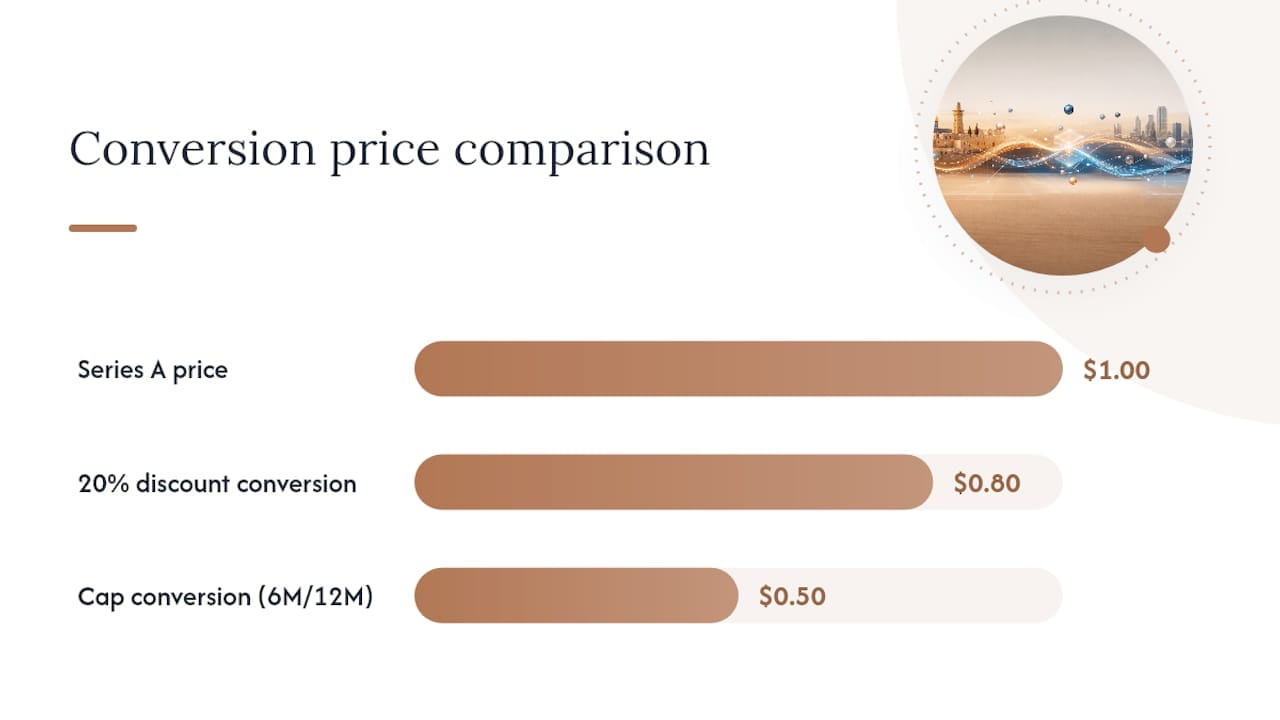
Discount rate. A percentage reduction applied to the Series A price per share. A 20% discount on a $1.00 per share Series A means the note converts at $0.80 per share. When both a cap and a discount exist, the investor typically gets whichever produces the lower conversion price (more shares).
Interest rate. Most notes carry simple or compounding interest, commonly at a typical annual range in Israeli practice. Interest accrues on the principal and is added to the amount that converts, slightly increasing the investor’s share count.
Maturity date. The date by which a qualified financing must occur or the note becomes due. Typical maturities run over a period of about one to two years. If the company misses that window, the investor can demand repayment, which can be fatal for a cash-constrained startup.
Qualified financing. The minimum size of a priced equity round that triggers automatic conversion. A note might define this as “a bona fide equity financing raising at least $1,500,000 from third-party investors.” Vague definitions here are a common source of disputes.
Common structural variations include cap-only notes (no discount), discount-only notes (no cap), and notes with both. Cap-only notes are simpler but give investors less protection if the Series A prices very low. Discount-only notes are rare at early stages because they offer no ceiling on dilution if the company’s valuation rises sharply.
Pro Tip: If a note offers both a cap and a discount, ask your lawyer to model both conversion scenarios before signing. The “lower of” formula can produce a larger share issuance than founders expect, particularly when the cap is set close to the anticipated Series A valuation.
How convertible notes affect your dilution: a worked example
Assume the following facts:
- Convertible note principal: $500,000
- Interest rate: 6% per year, accruing for 12 months
- Valuation cap: $5,000,000
- Discount rate: 20%
- Series A pre-money valuation: $10,000,000
- Series A price per share: $1.00 (based on 10,000,000 fully diluted shares pre-money)
Step 1: Calculate the amount converting. Principal plus 12 months of interest: $500,000 × 1.06 = $530,000.
Step 2: Scenario A — conversion under the cap.
- Cap-implied price per share = $5,000,000 ÷ 10,000,000 shares = $0.50 per share.
- Shares issued to noteholder = $530,000 ÷ $0.50 = 1,060,000 shares.
Step 3: Scenario B — conversion under the discount.
- Discounted price per share = $1.00 × (1 − 0.20) = $0.80 per share.
- Shares issued to noteholder = $530,000 ÷ $0.80 = 662,500 shares.
Step 4: Which applies? The “lower of” rule means the investor converts at $0.50 (the cap price), receiving 1,060,000 shares rather than 662,500.
The practical takeaway: when the Series A valuation is more than double the cap, the cap dominates and the dilution impact is substantially larger than founders often anticipate. Setting the cap too low relative to your expected Series A price is the single most common dilution mistake in early-stage convertible note deals.
Convertible notes vs SAFEs vs priced rounds: which instrument fits your situation
| Instrument | Best for | Speed to close | Valuation timing | Legal complexity | Investor protections | Downside risk |
|---|---|---|---|---|---|---|
| Convertible note | Pre-seed to bridge rounds; investors who want debt backstop | Fast (days to weeks) | Deferred to next priced round | Low to moderate; standard template | Cap, discount, interest, maturity | Repayment risk at maturity if no conversion |
| SAFE | Very early pre-seed; US-style deals; repeat investors | Fastest (minimal docs) | Deferred; no maturity | Lowest; one-page document | Cap and/or discount only; no interest | No repayment obligation; less investor protection |
| Priced equity round | Series A and beyond; large rounds; institutional investors | Slow (weeks to months) | Set at closing | High; full shareholder agreement | Full rights, board seats, preferences | Dilution is immediate and permanent |
Choose a convertible note when you need speed, have investors who want a debt backstop, and expect a priced round within 12–24 months. A SAFE works well for very early rounds with investors who are comfortable with no repayment right and no interest, though SAFEs are less common in Israeli practice than in Silicon Valley. A priced round is justified when the round is large enough that the legal cost is proportionate, when institutional investors require it, or when the company’s valuation is clear and defensible.
Why convertible notes are especially common in Israel
Israel’s startup ecosystem has structural features that make convertible instruments particularly practical. The OECD’s country note on Israeli VC support traces the ecosystem’s foundation to the Yozma program, launched in 1993 with an initial $100 million government investment that seeded ten private VC funds. The 2024 Yozma 2.0 initiative and the new Startup Fund are designed to inject roughly $1 billion per year into Israeli VC funds for 2024–2026, sustaining early-stage capital availability at a level that keeps deal velocity high.

That capital environment rewards speed. When multiple investors are competing to back the same pre-seed company, a convertible note closes faster than a priced round, which matters in a market where the best deals move quickly.
The IIA’s Startup Fund adds another layer of complexity that makes convertible notes attractive. Founders who receive IIA grants alongside private investment need a financing structure that accommodates both. A convertible note fits cleanly: the private investor’s note sits alongside the grant without requiring the grant to be priced into a cap table immediately.
IIA grants are repaid via royalties on revenues, typically in the 3%–5% range, rather than through equity dilution. That structure means founders can preserve equity for private investors while still accessing government capital, and the convertible note’s deferred valuation aligns well with the grant’s non-dilutive character.
For overseas founders and investors, the Israeli market’s heavy reliance on foreign capital historically means that international investors are familiar with convertible instruments and often prefer them for cross-border deals where local legal due diligence takes time.
Common risks and legal traps with convertible notes in Israel
Israeli practitioners consistently flag the same set of problems in poorly drafted notes. Israeli legal guidance warns that ambiguous conversion clauses and undefined maturity remedies are a frequent source of disputes, and that Israeli courts have reduced terms judged legally uncertain.
Watch for these red flags before signing:
- Vague qualified financing definition. If the note does not specify a minimum round size, currency, or investor type, the conversion trigger is open to interpretation.
- Missing fallback pricing formula. If no qualified financing occurs before maturity, the note needs a clear default conversion price. Without one, the parties must negotiate under pressure.
- Ambiguous maturity remedies. Does the investor get automatic repayment, optional conversion, or both? Each outcome has different consequences for the company’s cash position.
- Excessive interest rates. Rates above market norms can create unexpected dilution when interest converts alongside principal.
- Unclear liquidation preference. On a sale before conversion, does the noteholder get repaid as a creditor, convert first, or participate in proceeds? The liquidation preference mechanics under Israeli law deserve explicit drafting.
- Undefined investor rights on conversion. Does conversion carry information rights, pro-rata rights, or anti-dilution protections? Leaving these out creates friction at the Series A.
- Tax consequences at conversion. Israeli tax rules treat the conversion event as a potential taxable moment for both the investor and the company. This requires specific structuring advice from Israeli counsel.
Pro Tip: Insist on a “fallback pricing” clause that states a specific formula for the share price if no qualified financing occurs within the note’s term. This single drafting addition eliminates the most common source of post-maturity disputes in Israeli convertible note deals.
For international clients, the investor risks in Israeli startups extend beyond the note itself to include regulatory compliance, securities law obligations, and cross-border tax exposure. Israeli counsel review before signing is not optional for cross-border deals.
A practical checklist: when a convertible note is the right choice
Use this checklist to decide whether a convertible note fits your situation:
- Stage fit. Are you raising pre-seed or seed capital, or bridging to a known priced round? Convertible notes are designed for these stages, not for Series B and beyond.
- Time pressure. Do you need to close within weeks rather than months? If yes, a note’s simplified documentation is a real advantage.
- Investor sophistication. Is your investor familiar with convertible instruments and Israeli law? Unsophisticated investors may not understand the cap and discount mechanics, creating disputes later.
- Next priced round visibility. Do you have a realistic path to a qualified financing within 12–24 months? If not, the maturity risk is material.
- IIA grant interaction. Are you applying for or holding an IIA grant? Confirm with Israeli counsel how the grant’s terms interact with the note’s conversion mechanics and any transfer restrictions.
- Tax and structuring considerations. For foreign founders or investors, confirm the tax treatment of the note in both Israel and your home jurisdiction before signing.
- Cap and discount alignment. Is the cap set at a level that reflects a realistic Series A valuation? A cap that is too low relative to expected growth creates excessive dilution.
- Legal review. Has Israeli counsel reviewed the conversion clause, maturity provisions, and investor rights? This is non-negotiable for cross-border deals.
Questions to raise in term sheet negotiation: Who defines “qualified financing” and can that definition be amended unilaterally? What happens to accrued interest if the note converts at maturity? Does the investor receive pro-rata rights in the Series A? The lead investor, the company’s CFO, and Israeli legal counsel should all sign off before the note is executed. For founders working with Israeli securities law obligations, early legal review prevents costly corrections later.
Menora Law’s perspective on drafting convertible notes for international clients
The most common mistake international founders make with Israeli convertible notes is treating them as a standard Silicon Valley document with a different governing law line. They are not. Israeli contract law, Israeli tax rules, and Israeli securities regulations each interact with the note’s terms in ways that require specific local drafting. A cap that works cleanly under one legal framework can produce an unexpected tax event or an unenforceable clause under Israeli law.
The single most practical step any founder can take before signing is to insist on a clear, defined qualified financing threshold and a written fallback pricing formula. Those two provisions eliminate the majority of post-maturity disputes we see in cross-border Israeli deals. If investors push back on the fallback formula, that resistance is itself a signal worth examining.
Menora Law represents international clients remotely, which means founders and investors based outside Israel can get Israeli-law term sheet review, conversion clause drafting, and negotiation support without traveling. The firm’s experience with cross-border startup financing under Israeli law means clients receive advice that is grounded in how Israeli courts and tax authorities actually treat these instruments, not how they are described in generic startup guides.
Menora Law can help you structure your Israeli convertible note correctly
Founders and investors working on Israeli convertible notes face a specific set of legal questions that generic startup guides do not answer: how Israeli tax law treats the conversion event, how IIA grant conditions interact with private financing, and what Israeli courts have said about ambiguous conversion clauses. Menora Law’s Israeli business law practice covers all of these directly, with remote representation for international clients who need Israeli-law advice without being in Israel.
Whether you need a term sheet reviewed before signing, a conversion clause drafted from scratch, or guidance on how a convertible note interacts with an IIA grant, Menora Law provides clear, fast, and jurisdictionally accurate advice under Israeli law. コンタクト Menora Law through Menoralaw to schedule a remote consultation with an Israeli attorney who specializes in cross-border startup financing.
Sources
- Benchmarking government support for venture capital: Israel (OECD country note)
- Startup Fund – English Innovation Site
- What government grants and innovation incentives are available for Israeli startups (e.g., from the Israel Innovation Authority)? – ERB Proximo
- What Is A Convertible Loan? – Shareholders – Israel (Mondaq)
- הלוואה המירה: מה צריך לדעת | ירון מאירי – עורך דין ורואה חשבון
- How Convertible Notes Work for Startups & Founders
This article is general information, not a substitute for advice from a qualified financial advisor. Consult a qualified financial professional about your own circumstances before acting on anything here.
よくある質問
Why do Israeli startups use convertible notes instead of priced rounds?
Convertible notes close faster and avoid the need to agree on a company valuation before the market has provided meaningful data. They are particularly practical in Israel because they work cleanly alongside IIA non-dilutive grants, which also defer equity pricing.
What happens to a convertible note if the startup fails?
If the company fails before a qualified financing occurs, the noteholder is a creditor and ranks ahead of equity holders in any liquidation. In practice, early-stage startups rarely have assets sufficient to repay the principal, so noteholders typically recover little or nothing.
Who typically invests using convertible notes in Israel?
Angel investors, seed-stage funds, and existing shareholders bridging to a Series A are the most common noteholders in Israeli deals. International investors also use convertible notes for cross-border Israeli investments because the instrument’s simplicity reduces the need for extensive local legal negotiation at the outset.
What is a qualified financing, and why does the definition matter?
A qualified financing is the priced equity round that triggers automatic conversion of the note into shares. Its definition, specifically the minimum round size and investor type, determines when and whether conversion happens. A vague definition is one of the most common causes of disputes in Israeli convertible note deals.
Can a convertible note coexist with an IIA Startup Fund grant?
Yes, and the combination is common in Israel. IIA grants are non-dilutive and repaid through royalties on revenues, so they do not affect the cap table directly. A convertible note from a private investor can sit alongside an IIA grant without triggering an immediate valuation requirement, though founders should confirm the interaction with Israeli counsel before closing both simultaneously.


 English
 Afrikaans
 العربية
 বাংলা
বাংলা Čeština
 简体中文
简体中文 Nederlands
 Suomi
Suomi Français
 Deutsch
 עִבְרִית
 हिन्दी
 Magyar
 Italiano
 日本語
日本語 한국어
한국어 Polski
 فارسی
فارسی Português do Brasil
 Русский
 Español de México
 Українська