
Hire an Israeli law firm, not a translation agency, when you need Hebrew–English contract translation and legal review for any document touching Israeli law. A licensed Israeli attorney reads the contract clause by clause, flags enforceability issues under the Contracts (General Part) Law 1973, and delivers redlines you can actually negotiate with. That combination protects you from statutory good-faith traps under Sections 12 and 39 of the Contracts Law, writing-requirement pitfalls under the Land Law 1969, and the interpretation disputes that arise when translation alone stands in for legal advice.
To start, send your contract draft (Word or PDF), any prior translations, and a note on your deadline. Menora Law can provide a remote engagement estimate quickly.
Key Takeaways
Hiring an Israeli law firm for Hebrew–English contract translation and legal review is the only way to confirm enforceability, catch statutory good-faith risks, and negotiate from an informed position under Israeli law.
| Point | Details |
|---|---|
| Hire an Israeli attorney, not a translator | Only a licensed イスラエルの弁護士 can sign a legal memo confirming enforceability under Israeli statutes. |
| Real estate requires early planning | Land Law 1969 mandates written contracts; apostille and power-of-attorney processing typically requires two to three weeks. |
| Statutory good faith creates hidden risk | Sections 12 and 39 of the Contracts Law can create liability for negotiation conduct, not just clause language. |
| Insist on a signed engagement letter | Define scope as translation plus legal advice to protect your remedies if a deliverable is incomplete. |
| Menora Law handles this remotely | Menora Law pairs translators with licensed Israeli attorneys and manages the full process for overseas clients. |
What does a Hebrew–English contract translation and legal review actually include?
A properly scoped engagement from an Israeli law firm delivers more than a bilingual text. Here is what you should expect:
- Clause-by-clause bilingual translation keyed to the original document numbering, so every redline maps to a specific clause without ambiguity.
- Israeli-law legal commentary covering statutory good-faith duties, enforceability of exclusivity or limitation-of-liability clauses, mandatory consumer or employment protections, and public-policy limits that can void terms regardless of what the contract says.
- Redline markup with suggested replacement language and negotiation talking points, so you enter discussions with a clear position rather than a list of concerns.
- Power-of-attorney drafts for remote real-estate closings, plus certified translation notes for any filing that requires an official Hebrew or English version.
- Cover memo summarizing high-risk clauses, written in plain English so non-lawyer clients understand the exposure before they sign.
Israeli commercial law is a hybrid system drawing on both common law and continental civil law traditions, with active judicial development of statutory doctrines. That means a choice-of-law clause selecting foreign law may not protect you from mandatory Israeli rules in real estate, employment, or consumer matters. Attorney review is not a formality here. Read more about Israeli legal document translation to understand what certified requirements apply to your specific documents.
When do you need this service?
Most clients fall into one of these situations:
- Cross-border real estate purchases. Under the Land Law 1969, a real-estate transaction must be in writing to be enforceable. Non-resident buyers also need a specific, apostilled power of attorney, and processing that document from North America typically takes two to three weeks. Do not sign anything touching property, price, or funds until an イスラエルの弁護士 has reviewed the Hebrew text. See Menora Law’s foreign buyer real estate guide for a practical checklist.
- Inheritance and probate matters. Foreign heirs regularly receive Hebrew wills, succession agreements, and estate administration filings they cannot read. Accurate translation plus legal review confirms what the document actually transfers and whether it complies with Israeli succession law. Menora Law’s estate translation requirements guide covers the specifics for international heirs.
- M&A and due diligence. Term sheets, share purchase agreements, and audited financial translations all require a translator who understands corporate finance and an attorney who can flag enforceability and negotiation risks in cross-border transactions.
- Investor and commercial agreements. Joint ventures, distribution contracts, and shareholder agreements with Israeli counterparties often contain standard-form terms that Israeli courts can void under the Standard Contracts Law 1982 if they are one-sided.
- Employment, IP, and settlement agreements. These require enforceability checks specific to Israeli labor law and IP statutes before you rely on them.
How does the process work, from intake to final delivery?
- Intake and document transfer. Send the original contract, any prior drafts or translations, related corporate records, and your power of attorney if one exists. Note your target date and whether you need notarized or certified copies for filing.
- Translation and legal review run in parallel. A legal-specialist translator and a licensed Israeli attorney work on the same document simultaneously, preserving clause alignment and legal meaning across both languages.
- Draft bilingual redline and commentary delivered. You receive the translated text with tracked changes, the attorney’s clause-by-clause commentary, and suggested replacement language with negotiation strategy.
- Client Q&A and negotiation support. The attorney answers your questions, negotiates directly with the counterparty if needed, or provides talking points for your own discussions.
- Finalization and certification. If a certified translation is required for filing, that is prepared at this stage. For real-estate closings, allow two to three weeks for apostille processing and power-of-attorney logistics before the contract deadline. For notarized translation workflows, plan that timeline into your closing schedule.
Typical turnaround: a simple commercial contract runs 3–5 business days; a real-estate purchase package with power-of-attorney and apostille processing runs 10–21 business days.
How is this service priced?
Pricing varies by document complexity, urgency, and scope. Three common models:
| Model | How it’s billed | Best for |
|---|---|---|
| Per-word translation + fixed legal review fee | Translation billed per word; attorney review at a fixed rate | Single contracts with defined scope |
| Flat-fee end-to-end engagement | One fee covers translation, legal memo, redlines, and one negotiation round | Real estate purchases, M&A term sheets |
| Hourly legal billing | Attorney time billed hourly | Ongoing negotiation support, multi-round deals |
To get an accurate estimate, provide sample pages, your deadline, the governing-law clause, and whether you need notarized or certified copies. Urgency, number of counterparties, and apostille requirements all affect the final fee.
How does a law firm protect accuracy, confidentiality, and your legal interests?
Quality assurance in a legal translation engagement goes well beyond spell-checking. A reliable firm uses a multi-layer review: a legal-specialist translator produces the first draft, a licensed Israeli attorney reviews enforceability and flags statutory issues, and a senior partner signs off before delivery. Version control and clause-matching protocols keep the Hebrew and English texts synchronized throughout.
Confidentiality safeguards matter equally. Secure file transfer, a signed NDA, limited-disclosure teams, and a clear document retention policy are standard expectations. Combining professional translation with attorney oversight reduces the interpretation disputes and litigation risk that arise when precise language is misread or mistranslated.
Pro Tip: Insist on a signed engagement letter that defines the exact scope, specifically whether the firm is providing translation only or translation plus legal advice. That distinction determines your remedies if a deliverable is incomplete.
Malpractice coverage and a scope-of-work letter also matter. If a translation error affects enforceability, a firm with professional liability insurance has a clear correction process. Ask about it before you sign the engagement.
What should you look for when choosing an Israeli law firm?
Credentials to require:
- A licensed Israeli attorney on file who will sign the legal memo
- Documented experience with the Contracts Law, Standard Contracts Law, and Land Law for international clients
- Case examples or references from foreign heirs, investors, or non-resident buyers
Questions to ask on the first call:
- Who translates the document, and what is their legal-domain background?
- Will a licensed イスラエルの弁護士 sign the legal commentary?
- What are your data security measures and malpractice insurance limits?
- Can you provide a sample redline from a prior engagement?
Red flags:
- The firm suggests a translator alone is sufficient without attorney review
- Deliverables are described vaguely, with no mention of a legal memo or redlines
- No engagement letter or written scope of work is offered
- Pricing is quoted without seeing the document
Pro Tip: When comparing proposals, map deliverables line by line: translation, legal memo, redlines, negotiation support. Choose the firm that owns the legal opinion, not just the bilingual text.
What to send when you contact Menora Law
Document checklist:
- Original contract in Word or PDF (tracked changes preferred)
- Prior translations, if any exist
- Corporate documents: articles of association, share registers, board resolutions
- Power of attorney, if already drafted
- Target closing or signing date
- Note on whether you need notarized translation, apostille, or certified copies
Sample intake message:
For remote corporate document notarization workflows involving powers of attorney, build the apostille timeline into your message so the firm can flag any deadline conflicts immediately.
Menora Law’s perspective on Hebrew–English contract translation
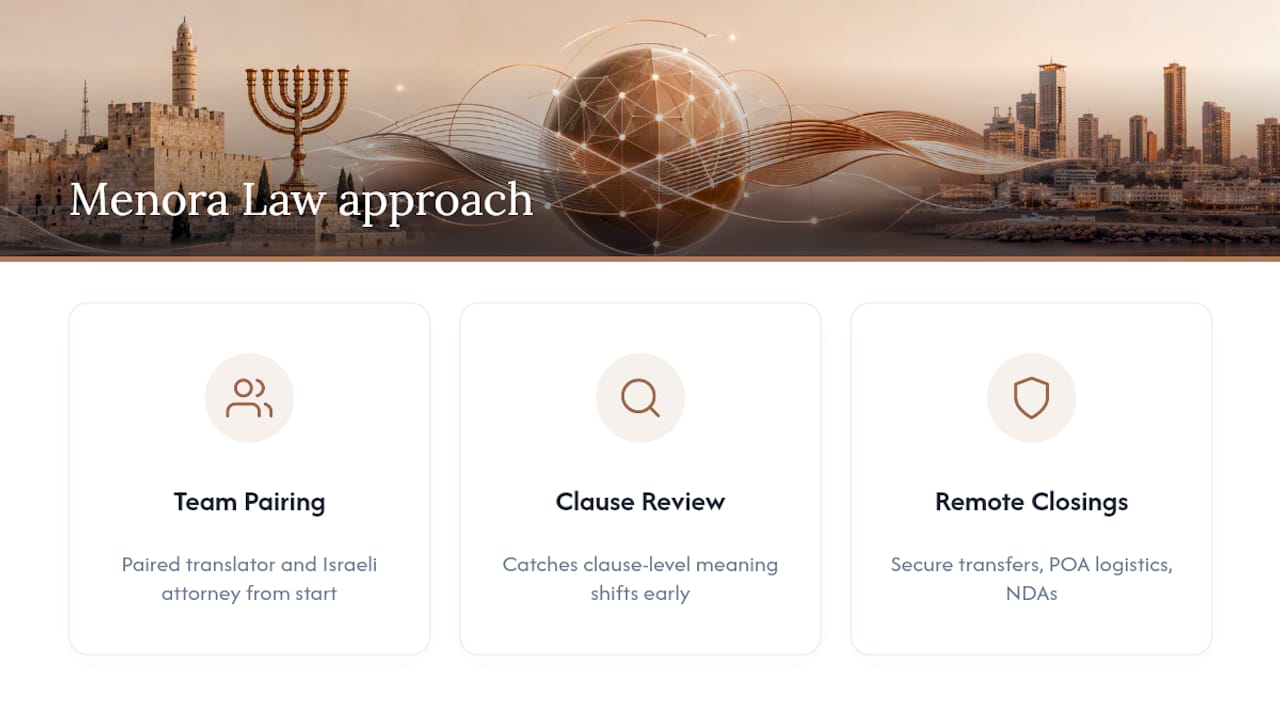
At Menora Law, every Hebrew–English contract translation engagement pairs a legal-specialist translator with a licensed Israeli attorney from the first page. The attorney does not simply review a finished translation; they work alongside the translator to catch meaning shifts at the clause level, before a mistranslation becomes a negotiating position.
One situation that illustrates why this matters: a foreign client received a Hebrew real-estate purchase agreement with a clause that appeared, in a rough translation, to be a standard deposit provision. Attorney review revealed it was structured as a penalty clause that would have forfeited the full deposit on a minor procedural delay, a risk the client had no way to identify from the translated text alone. The clause was renegotiated before signing.
Remote representation is fully workable for international clients. Menora Law handles secure document transfer, communicates across time zones, and manages power-of-attorney logistics so overseas clients can close or execute agreements without traveling to Israel. Confidentiality is maintained through signed NDAs, limited-disclosure teams, and secure file protocols on every matter.
Menora Law is ready to review your Israeli contract now
When a contract touches Israeli law, the stakes are too high for a translation without legal backing. Menora Law provides Hebrew–English contract translation combined with clause-by-clause Israeli-law review, redlines, and negotiation support, all handled remotely for international clients.
Whether you are a foreign buyer navigating イスラエルの不動産法, a foreign heir dealing with an estate matter, or a business reviewing a commercial agreement with an Israeli counterparty, Menora Law’s licensed Israeli attorneys are ready to start. Send your contract draft and deadline to receive an engagement estimate.
Visit メノラ法 to schedule a virtual consultation or submit your documents securely.
Sources
The sources below cover the primary Israeli statutes and best-practice guidance referenced throughout this article.
- Due Diligence Done Right: Legal Translations for Global M&A Deals | Business Law Today
- Israelnonresident
- Israellaw
- Arbitrationlaw
This article is general information, not a substitute for advice from a qualified lawyer. Consult a qualified legal professional about your own circumstances before acting on anything here.
よくある質問
What is Hebrew–English contract translation and legal review?
It is a service where a licensed Israeli attorney translates a Hebrew contract into English (or vice versa) and simultaneously provides clause-by-clause legal commentary on enforceability, statutory compliance, and negotiation risk under Israeli law.
Can a certified translator handle this without an attorney?
No. Translation without attorney review leaves parties exposed to interpretation disputes and enforceability gaps; only a licensed イスラエルの弁護士 can advise on statutory duties, mandatory protections, and negotiation strategy.
How long does the process take?
A simple commercial contract typically takes 3–5 business days. A real-estate purchase package involving apostille and power-of-attorney processing typically requires two to three weeks, depending on logistics.
Why does Israeli good-faith law matter for foreign clients?
Sections 12 and 39 of the Contracts (General Part) Law 1973 impose mandatory good-faith duties in negotiation and performance; courts can award damages for pre-contractual conduct, a risk most foreign parties do not anticipate.
How does Menora Law handle contracts for overseas clients?
Menora Law manages the full engagement remotely, including secure document transfer, bilingual redlines, legal commentary, and power-of-attorney logistics, so international clients can review and execute Israeli contracts without traveling to Israel.


 English
 Afrikaans
 العربية
 বাংলা
বাংলা Čeština
 简体中文
简体中文 Nederlands
 Suomi
Suomi Français
 Deutsch
 עִבְרִית
 हिन्दी
 Magyar
 Italiano
 日本語
日本語 한국어
한국어 Polski
 فارسی
فارسی Português do Brasil
 Русский
 Español de México
 Українська