
If you plan cross-border biotech R&D with an Israeli partner, your agreement must put IP division, commercialization rights and Israel-based manufacturing obligations in writing before you apply for Innovation Authority support. Pilot programs often default IP ownership to the Israeli applicant, so verify the rules early. Engage Israeli counsel before signing a letter of intent or submitting a funding application, since the statutory transfer and manufacturing rules are not easy to undo once a grant is approved.
TL;DR:
- Innovation Authority applications require an LOI covering work division, IP allocation, and commercialization rights; pilot programs may assign IP to the Israeli applicant.
- R&D backed by government funds generally requires manufacturing in Israel, and moving production abroad needs Research Committee approval to avoid royalties or grant repayment.
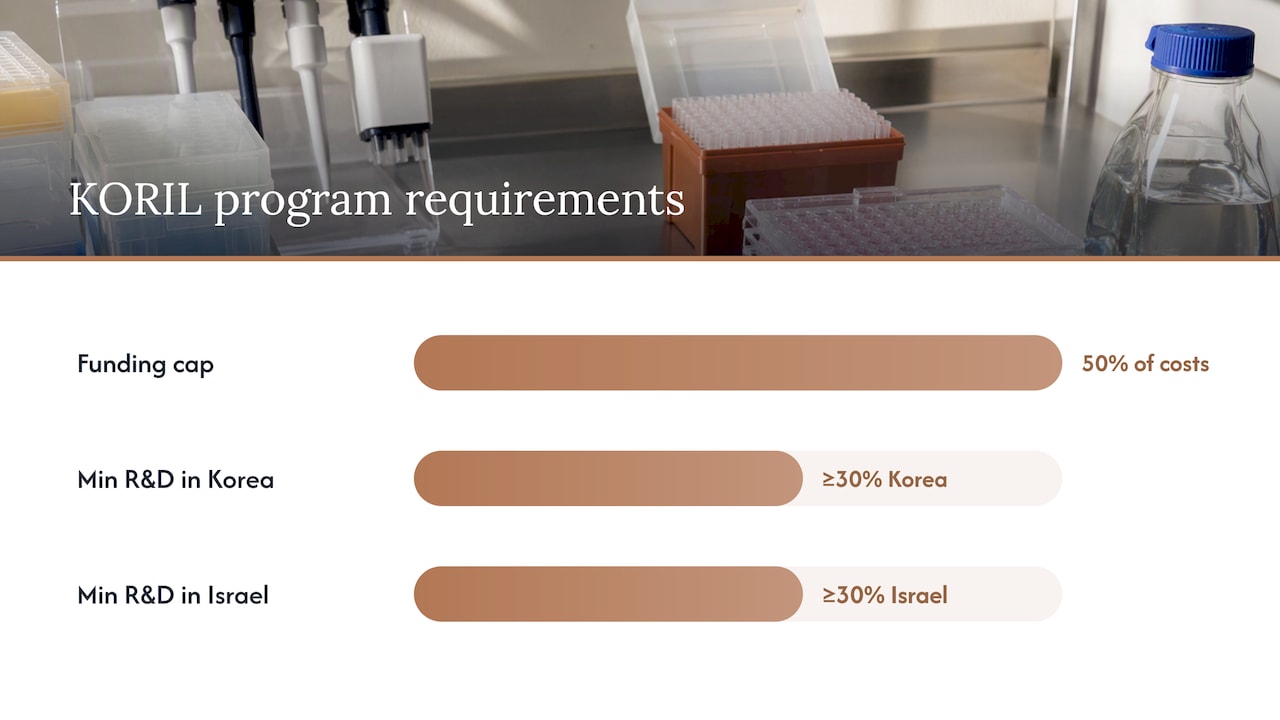
- KORIL offers up to $2 million or 50% of eligible costs; each country must perform at least 30% of R&D, and IP terms precede final paperwork.
- Early stage startups without proven technology should keep research and licensing terms separate, while academic spinouts can tie a license option to validated results.
What collaboration agreements typically cover and who signs them
Biotech R&D deals involving Israel take several contractual forms, and picking the wrong one early creates friction later. A research collaboration agreement governs joint experimental work. A memorandum of understanding sets out intent before parties commit to binding terms. A pilot agreement covers validation testing, often with narrower scope than a full joint development deal. A joint development and license agreement combines R&D execution with rights to commercialize the output.
The parties on the Israeli side are not always the company you expect. Industrial applicants work alongside academic technology transfer offices such as Ramot (Tel Aviv University) or BIRAD (Bar-Ilan University), and sometimes within national consortia that pool several companies and research institutions.
Commercial goals typically include:
- Running design-make-test-analyze (DMTA) cycles with shared data access.
- Validating a pilot before committing to full-scale development.
- Securing access to clinical sites, biobanks or proprietary datasets held by an Israeli institution such as Sheba Medical Center.
Key Israeli legal and funding rules that change how you draft
Two bodies of rules shape how a biotech R&D agreement with an Israeli partner has to be written: Innovation Authority program conditions and the statutory encouragement law.
Innovation Authority calls for international R&D and pilot collaborations require a signed letter of intent that documents division of work, IP allocation and commercialization rights before a grant moves forward, and pilot programs may default IP ownership to the Israeli applicant unless the parties negotiate otherwise. That default catches many foreign partners off guard, because they assume joint ownership is standard when it is not automatic in pilot structures.
について Law for the Encouragement of Industrial Research, Development and Innovation (1984) generally requires that products developed with government-supported R&D be manufactured in Israel. Moving production abroad requires approval from the Research Committee, and that approval is negotiated, not automatic. Non-compliance can trigger royalty obligations or repayment of the original grant.
Before you apply, confirm:
- The LOI covers work division, IP allocation and commercialization rights.
- Your manufacturing plan matches the statutory in-Israel requirement, or you have budgeted time for Research Committee review.
- Your application includes the documentation the funding program requires for eligibility, not just a project description.
The fact that matters here: the Research Committee’s approval authority means a foreign partner cannot simply assume manufacturing flexibility once a grant is in place.
Practical LOI and agreement checklist: clauses and procedural items to secure before application
A well-drafted letter of intent does most of the heavy lifting before the parties ever reach a binding agreement. We recommend working through these steps in order.
- Define division of work. State which party performs which R&D tasks and milestones.
- Set provisional IP allocation. Name who owns what pending the final agreement, and flag any trademark process or pilot-default rules that apply.
- Assign commercialization responsibilities. Clarify who leads sales, regulatory filings and distribution once development succeeds.
- Document contributions. Separate cash contributions from in-kind work (lab time, equipment, personnel) and note how each counts toward funding eligibility.
- Plan for approvals. Build in time for Research Committee review if manufacturing or IP transfer outside Israel is possible.
- Draft background IP and foreground IP clauses. Keep clear which prior knowledge stays with its original owner and which new output is shared or allocated.
- Address improvement rights. State who owns incremental improvements made during the collaboration.
- Set field-of-use limits. Define the market or application scope the license covers, and specify exclusive versus non-exclusive terms.
- Add payment and royalty triggers. Tie payments to commercialization milestones, not just signature dates.
- Run export control checks. Confirm the technology is not subject to restrictions before finalizing transfer terms.
- Confirm bank and grant compliance. Verify the Israeli applicant’s banking and reporting setup satisfies the funder’s disbursement conditions.
Pro Tip: Treat the LOI as a binding roadmap, not a formality. Vague LOI language is the single most common reason agreements need renegotiation after a grant is approved.
How program participation and bilateral funds affect deal structure
Bilateral programs add their own layer of requirements on top of the general Innovation Authority rules, and they shape the deal before a single clause is drafted.
KORIL, the Korea-Israel R&D Foundation, funds joint projects up to $2 million or up to 50% of qualifying costs, and requires that at least 30% of actual R&D work happen in each country. A signed IP and commercialization agreement must be submitted before the final grant paperwork, known as the CPFA, is signed. That sequencing matters: you cannot wait until after approval to settle IP terms.
Pilot programs carry a different risk than full R&D programs. If commercialization is the end goal, negotiate licensing rights into the agreement from the start rather than relying on the pilot’s default ownership position.
When coordinating applications across two jurisdictions:
- Confirm each country’s funder requires a matching dual application from the partner.
- Align timelines so neither side’s funding decision stalls the other.
- Budget work-share percentages to satisfy both programs’ onshore requirements simultaneously.
Research agreement vs license agreement: sequencing and practical decision rules
Mixing research funding terms with licensing commitments too early is one of the most common drafting mistakes in these deals. Keeping the two documents separate reduces ambiguity: a research agreement governs execution and funding compliance, while a license agreement, signed later, governs commercialization once results justify it.
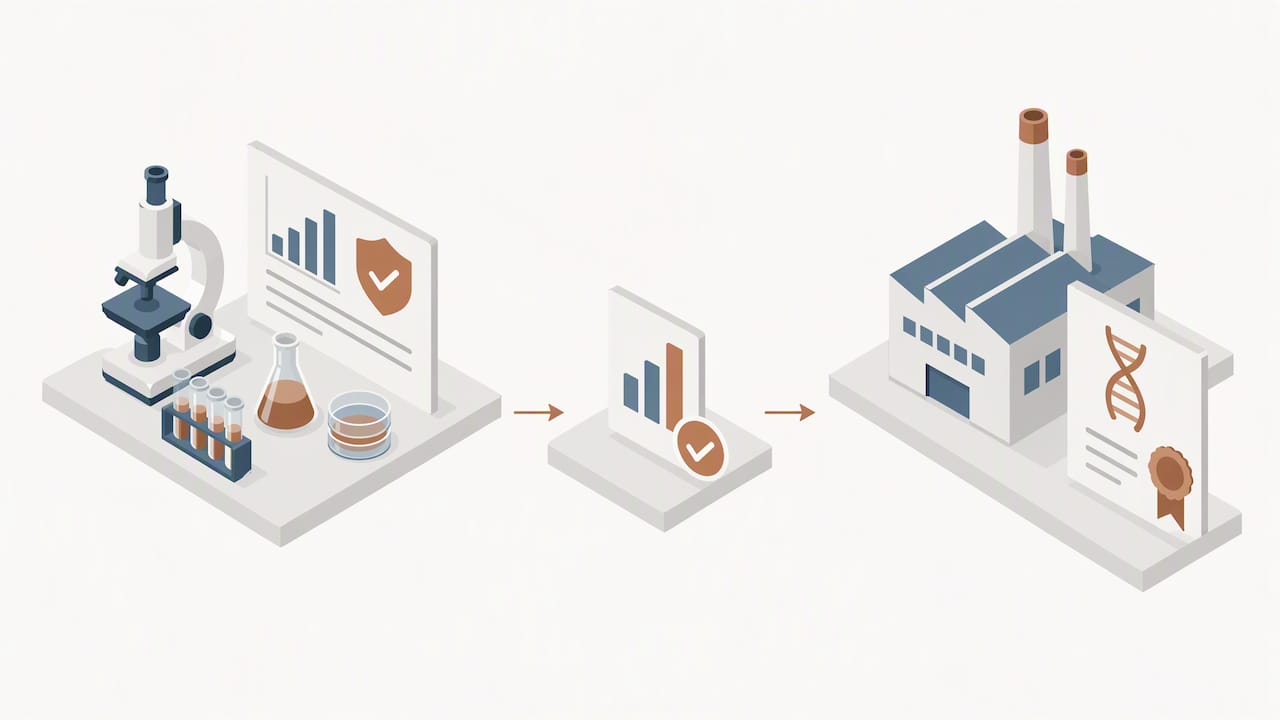
That said, some projects benefit from a milestone-triggered license option written into the research agreement itself, which converts into a binding license only after a defined technical milestone is met.
A simple way to decide:
- Early-stage startups without proven technology: keep research and license terms fully separate.
- Academic spinouts working with a TTO: use milestone triggers tied to validated results.
- Multinational partners with established commercialization paths: negotiate license terms in parallel, but sign them as a distinct document.
Menora Law perspective: when to hire counsel, typical negotiation fixes, and what we do for clients
We see the same pattern repeat: parties bring counsel in after the LOI is signed, when the IP default and manufacturing terms are already locked in. The better timing is before the LOI, while the division of work and commercialization terms are still negotiable.
The fixes we apply most often are not complicated, but they are easy to miss without Israeli legal experience: defining improvement rights precisely instead of leaving them implied, staging IP assignment with royalty triggers tied to milestones rather than fixed dates, and carving out export provisions that are explicitly subject to Research Committee approval rather than assumed.
We coordinate with Israeli applicants, academic technology transfer offices and funding bodies without requiring travel to Israel.
— Menora Law
How Menora Law can help with your biotech R&D agreement
We assist partners and companies preparing for Innovation Authority applications, focusing on Israeli law, since that is the legal framework that governs these grants and transfers.
Our support on biotech R&D matters includes:
- Drafting and negotiating LOIs that satisfy Innovation Authority documentation requirements.
- Structuring background IP, foreground IP and improvement rights clauses before terms get locked in.
- Coordinating Research Committee submissions for manufacturing or IP transfer approvals.
- Drafting license agreements separate from research funding terms to protect commercialization rights.
We handle intake, document review and bilingual paperwork remotely, with on-site representation in Israel when necessary. If you are preparing an application or already negotiating terms with an Israeli partner, visit メノラ法 to book a consultation before you sign anything binding.
よくある質問
Do I need a signed LOI before applying for Innovation Authority funding?
Yes. Innovation Authority calls require a signed letter of intent that documents division of work, IP allocation and commercialization rights before a grant moves toward approval. Submitting an application without this groundwork typically causes delays or rejection.
Who owns the IP in an Innovation Authority pilot program?
Pilot programs often default IP ownership to the Israeli applicant unless the parties negotiate a different arrangement in the agreement. Foreign partners expecting joint ownership should raise this during LOI drafting, not after the pilot concludes.
How does KORIL funding work for joint Israel-Korea biotech projects?
KORIL funds joint projects up to $2 million or up to 50% of qualifying costs, and requires at least 30% of actual R&D work to take place in each country. A signed IP and commercialization agreement must be submitted before the final grant paperwork is signed.
Can I move manufacturing outside Israel after receiving a grant?
Only with approval from the Research Committee under the 1984 R&D encouragement law. Moving production without that approval can trigger royalty obligations or repayment of the grant, so this should be planned for during drafting, not after the fact.
When should I notify the Research Committee about an IP or manufacturing transfer?
As early as the transfer becomes a realistic possibility, ideally while drafting the agreement rather than after a grant disburses. Committee approval is negotiated case by case, and building in time for review avoids last-minute compliance problems.
Sources
- Innovation Authority — International R&D and pilot collaborations 2026 (English)
- Knesset legislative archive — Law for the Encouragement of Industrial Research, Development and Innovation (1984) and amendments


 English
 Afrikaans
 العربية
 বাংলা
বাংলা Čeština
 简体中文
简体中文 Nederlands
 Suomi
Suomi Français
 Deutsch
 עִבְרִית
 हिन्दी
 Magyar
 Italiano
 日本語
日本語 한국어
한국어 Polski
 فارسی
فارسی Português do Brasil
 Русский
 Español de México
 Українська