
TL;DR:
- Israeli competition law, governed by the Economic Competition Law 5748-1988, regulates restrictive arrangements, monopolies, concentration groups, and mergers in Israel. The Israel Competition Authority enforces the law through fines, criminal prosecutions, and civil remedies, with a focus on preventing harm to competition and the public. International clients must conduct careful compliance assessments, as the law applies broadly and enforcement is aggressive.
What is Israeli competition law and how does it work?
Israeli competition law is governed primarily by the Economic Competition Law 5748-1988, the statute that establishes the rules for free market competition across Israel. This law regulates four main categories of conduct: restrictive arrangements, monopolies, concentration groups, and mergers. The Israel Competition Authority (ICA) enforces the law through administrative fines, criminal prosecutions, and civil remedies. For international clients, understanding these basics is the first step toward operating legally and confidently in the Israeli market.
The law’s core goal is to prevent harm to competition and to the public. It does this by prohibiting anticompetitive agreements between businesses, controlling the behavior of dominant firms, and requiring advance approval for significant mergers. Exemptions exist, but they are narrow and conditional.
Core elements of the Economic Competition Law 5748-1988:
- Restrictive arrangements: Any agreement between businesses where at least one party restricts itself in a way that may reduce competition.
- Monopoly control: A firm controlling more than 50% of a relevant market is subject to strict conduct rules.
- Concentration groups: Groups of competitors collectively holding over 50% market share can be regulated as a unit, even without a formal merger.
- Merger control: Acquisitions above defined thresholds require mandatory notification and ICA approval before closing.
- Enforcement tools: The ICA can impose administrative fines, refer matters for criminal prosecution, and seek civil remedies through the Competition Tribunal.
- Exemptions: Certain vertical agreements, IP licensing arrangements, and joint ventures may qualify for statutory or block exemptions, subject to conditions.
Key definition: あ restrictive arrangement is any agreement between business parties in which at least one of them restricts itself in a way that may decrease competition in the market, whether between the contracting parties or between any one of them and a third party.
The law was originally modeled on EU competition law, with US antitrust principles later influencing its application, particularly in merger reviews and unilateral conduct cases. That dual heritage makes Israeli competition law familiar in structure but distinctive in its enforcement priorities and unique legal constructs.
How the Israel Competition Authority enforces competition rules
について Israel Competition Authority is the primary regulator responsible for enforcing the Economic Competition Law. It operates under the leadership of the Director General, who holds broad powers to investigate, sanction, and issue directives to businesses operating in Israel.
The ICA’s core functions include:
- Conducting investigations into suspected anticompetitive conduct.
- Reviewing merger notifications and approving, conditioning, or blocking transactions.
- Issuing directives to monopolists and concentration group members.
- Conducting market studies and publishing enforcement guidelines.
- Advising government ministries on competition implications of proposed legislation and public tenders.
- Pursuing both administrative and criminal enforcement actions.
The ICA’s current enforcement policy favors administrative fines over criminal prosecution for non-cartelistic offenses such as illegal vertical arrangements, abuse of dominant position, and failure to comply with data requests. Criminal enforcement remains available and is actively used for cartel conduct. The ICA has also released draft guidelines on how it calculates financial sanctions, with the most critical factor being the likely effect of the offense on competition.
In 2024, the ICA imposed the maximum possible financial sanction of approximately ILS111 million (over USD30.5 million) on Strauss Group Ltd. for gun-jumping violations during a merger process. That figure signals how seriously the ICA treats procedural compliance, not just substantive violations.

Restrictive arrangements and monopoly control under Israeli law
Restrictive arrangements
A restrictive arrangement exists when at least one party to a business agreement restricts itself in a way that may reduce competition. Israeli law applies two tests. The substantive test asks whether the arrangement is likely to harm competition. The per se test treats certain restrictions, including price-fixing, market allocation, and quantity restrictions, as automatically constituting a restrictive arrangement regardless of their actual effect on competition.
Vertical agreements, such as supplier-distributor relationships, are generally assessed under the substantive test rather than the per se presumptions. Exemptions are available for certain vertical arrangements, IP licensing agreements, joint ventures, and intragroup agreements, but each exemption carries market share thresholds and conditions that require careful legal review. Parties to an illegal restrictive arrangement face criminal, administrative, and civil sanctions.
Monopoly control
Under Israeli law, a firm is a monopoly when it controls more than 50%18/en/pdf) of the total supply or acquisition of an asset or service in a relevant market. A monopoly is a matter of legal status, meaning the obligations apply regardless of whether the Director General has formally declared the firm a monopoly.
Prohibited conduct for monopolists includes:
- Unreasonable refusal to deal with customers or suppliers.
- Predatory pricing designed to eliminate competitors.
- Price discrimination that gives certain customers or suppliers an unfair advantage.
- Tying, where a transaction on one product is conditioned on purchasing another.
- Charging unfair or excessive prices.
The Director General can issue directives to a monopolist to prevent harm to competition or the public. In a more serious case, the Competition Tribunal can order the monopolist to divest assets.
A notable enforcement example: in November 2021, the Director General notified YBP Pharma that it was considering imposing an administrative fine of 8 million shekels on the company, plus individual fines of 614,450 shekels on each of its two officeholders, after finding that YBP Pharma had set an excessive price for a medication used to treat an incurable disease, at a level hundreds of times higher than the price of a comparable medication used for the same purpose in prior years. This marked the first time the ICA initiated administrative fine proceedings against a monopolist for excessive pricing.
Concentration groups
Israel’s concentration group18/en/pdf) framework is one of the most distinctive features of its competition law. The Director General can declare that a group of competitors collectively holding more than 50% of a market constitutes a concentration group, even if those competitors have not merged and operate independently. Once declared, the ICA can impose remedies such as prohibiting long-term contracts, restricting information exchanges, or requiring divestiture of minority holdings. This construct is particularly relevant in Israel’s financial and retail sectors.
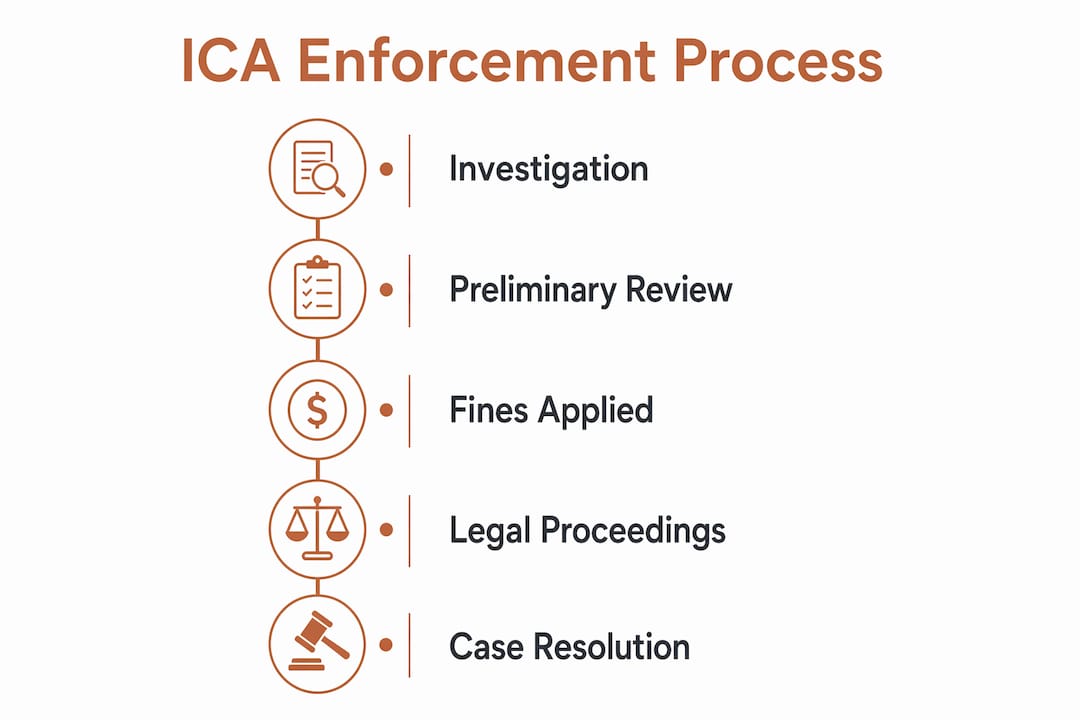
Merger control in Israel: when notification is required and what happens next
When does merger control apply?
Merger control under Israeli law applies to a broad range of transactions. Mandatory notification is required18/en/pdf) when a transaction involves the acquisition of a company’s principal assets or the acquisition of more than 25% of its outstanding shares, voting rights, rights to appoint directors, or dividend rights. A merger must be notified to the ICA if at least one of three thresholds is met: a turnover threshold, a monopoly threshold, or a merger-to-monopoly threshold.
Failure to notify exposes all parties to criminal, administrative, and civil sanctions. The ICA has recently scrutinized even passive holdings below 25%, treating certain minority investments as prohibited restrictive arrangements.
The merger review process
The ICA has an initial 30-day period to review a notified merger, subject to extensions. In practice, reviews for complex transactions have grown considerably longer. The ICA can approve the merger unconditionally, approve it subject to conditions, or block it entirely if there is a reasonable risk that the merger would significantly harm competition or the public.
Key steps in the merger control process:
- Pre-notification: Parties assess whether thresholds are met and prepare the notification file.
- Filing: The notification is submitted to the ICA with required financial and market data.
- Initial review (30 days): The ICA conducts a preliminary assessment and may request additional information.
- Extended review: For complex transactions, the ICA issues detailed information requests to the parties and third parties.
- Decision: The ICA approves, conditions, or blocks the merger.
- Post-decision compliance: If conditions are imposed, parties must implement and report on them.
| Stage | Typical timeline | ICA action |
|---|---|---|
| Initial review | 30 days | Preliminary assessment |
| Extended review | Several months | Detailed information requests |
| Final decision | Variable | Approval, conditions, or block |
| Post-decision | Ongoing | Compliance monitoring |
The ICA’s merger review procedures have grown longer and more exhaustive in recent years, with companies receiving increasingly broad requests for information, including from third parties, even for relatively minor transactions.
What international clients need to know: Menora Law’s perspective
Foreign businesses entering the Israeli market often underestimate how broadly Israeli competition law applies. The ICA scrutinizes minority investments and import operations18/en/pdf) with a rigor that surprises clients accustomed to other jurisdictions. Passive holdings below the standard 25% notification threshold are not automatically safe. The ICA has imposed sanctions on banks for minority holdings in a fintech company it viewed as a competitor, resulting in a consent decree involving tens of millions of shekels on two banks combined.
Practical priorities for international clients:
- Conduct a competition law audit before entering any Israeli joint venture, distribution agreement, or acquisition.
- Assess whether your market position, or that of your Israeli partner, could trigger monopoly or concentration group scrutiny.
- Build merger notification timelines into transaction planning, accounting for the ICA’s extended review periods.
- Maintain clear and complete records of all communications with Israeli business partners to demonstrate compliance.
- Engage Israeli competition counsel early, not after a transaction closes or an investigation begins.
Pro Tip: When the ICA opens an investigation or requests information, respond promptly and completely. Delayed or incomplete responses are treated as aggravating factors in fine calculations, and the ICA’s guidelines explicitly weight the likely effect of the offense on competition as the most critical factor in determining sanction levels.
Israeli competition law applies unique provisions that have no equivalent elsewhere in the world, including Section 31f governing direct importers and the concentration group framework for oligopolistic markets. International clients who rely on compliance standards from other jurisdictions often find themselves exposed to risks they did not anticipate.
Menora Law works with international clients to map their Israeli exposure before it becomes a problem. Whether you are structuring a distribution agreement, planning an acquisition, or responding to an ICA inquiry, early legal guidance from counsel who knows Israeli competition law is the most effective way to protect your position.
If you are operating in Israel or considering a transaction that touches the Israeli market, コンタクト Menora Law for a consultation. The firm provides cross-border legal support for clients who need Israeli legal representation without being physically present in Israel.
How does the merger notification and approval process actually work?
The merger notification process in Israel is formal and sequential. Parties cannot close a notified transaction until the ICA has granted approval. Filing a notification without complete and accurate information can itself trigger sanctions, so preparation matters as much as timing.
After filing, the ICA typically issues a first round of questions within the initial 30-day window. For transactions with any competitive complexity, a second or third round of requests is common. Third parties, including competitors, customers, and suppliers, may be contacted by the ICA for market data. Throughout this process, the parties are expected to respond fully and within the deadlines the ICA sets.
The ICA’s decision can take one of three forms: unconditional approval, conditional approval with behavioral or structural remedies, or an objection that blocks the transaction. Conditional approvals often require ongoing reporting obligations that last for years after closing. Parties who proceed without approval, or who implement merger provisions before approval is granted, face the gun-jumping rules that resulted in the ILS111 million sanction against Strauss Group in 2024.
What are your rights and obligations during an ICA investigation?
Parties under ICA investigation have both procedural rights and substantive obligations. The ICA has broad powers to demand documents, financial records, and testimony. Failure to comply with a data request is itself an offense subject to administrative fines, separate from any underlying competition violation.
At the same time, parties retain the right to legal representation throughout the investigation. Counsel can participate in meetings with ICA staff, review the allegations before a final decision is issued, and submit written responses. The ICA is required to give parties an opportunity to be heard before imposing administrative sanctions, a process known as a hearing.
Attorney-client privilege applies to communications with Israeli-licensed counsel, protecting legal advice from disclosure. However, the scope of privilege in competition investigations has been the subject of litigation, and parties should not assume that all internal communications are protected. Proactive, transparent engagement with the ICA, guided by experienced counsel, consistently produces better outcomes than a defensive posture.
Recent landmark cases that illustrate how enforcement works
Several cases from 2024 and 2025 show how the ICA’s enforcement priorities translate into real consequences.
Strauss Group gun-jumping: The Commissioner imposed the maximum financial sanction of approximately ILS111 million on Strauss Group for implementing merger agreement provisions before receiving ICA approval. The case established that gun-jumping enforcement in Israel is aggressive and that the maximum sanction is not theoretical.
Neema fintech case: Two Israeli banks were sanctioned ILS40 million combined under a consent decree for holding minority stakes in Neema, a fintech company the ICA viewed as a competitor. The ICA characterized the minority holdings as a prohibited restrictive arrangement. The sanction was reduced because the banks divested their holdings as part of the settlement.
Food and retail indictments: The ICA filed criminal indictments against supermarket chains and their executives following an extensive investigation. The charges included traditional collusion and violations of the Food and Pharma Sectors Law, as well as attempted collusion through public statements, a novel theory of liability.
Ofer Avenir importer case: The ICA pursued an official scooter importer under Section 31f for actions that allegedly led a foreign manufacturer to cut off a parallel importer. The case illustrates how Section 31f creates liability for conduct that would not be regulated at all in most other jurisdictions.
Judicial criticism of ICA priorities: In case 2299/24, State of Israel v. Mor, the Israeli Supreme Court questioned whether the ICA was prioritizing enforcement resources appropriately, noting that the alleged conduct did not sit at the core of competition law. In case 30218-10-24, Wet Naps Ltd. v. the Insolvency Commissioner, a court criticized the ICA’s delayed decision on an insolvent company acquisition. These cases signal that the ICA’s procedural pace is drawing scrutiny from the judiciary.
How does Israeli competition law compare to other jurisdictions?
Israeli competition law draws from both the EU and US models but applies them in ways that are distinctively its own. Understanding those differences is practical knowledge for any international client.
Compared to EU competition law: Israel’s framework closely mirrors the EU’s structure, with prohibitions on anticompetitive agreements and abuse of dominance that parallel Articles 101 and 102 of the Treaty on the Functioning of the European Union. However, Israel’s concentration group concept has no direct EU equivalent. The EU addresses oligopolies primarily through merger control and sector inquiries, while Israel can regulate an oligopolistic cluster as a single regulatory unit without any merger having occurred.
Compared to US antitrust law: The US relies heavily on the rule of reason for vertical restraints and applies a high threshold for monopolization claims, requiring proof of exclusionary conduct. Israel’s per se presumptions for price-fixing and market allocation align with US law, but Israel’s monopoly threshold of 50% market share is a bright-line rule, whereas US monopolization law focuses more on conduct than on market share alone. The ICA’s willingness to pursue excessive pricing claims also contrasts sharply with US antitrust doctrine, which generally does not treat high prices as an antitrust violation.
Section 31f and parallel imports: The provision targeting direct importers who restrict parallel imports has no equivalent anywhere else in the world, according to practitioners who have reviewed it across jurisdictions. This makes Israeli compliance genuinely novel for international distributors and franchise operators.
Enforcement intensity: Israeli competition law, while inspired by European and US models, is distinctively proactive with aggressive enforcement, especially in the food and retail sectors. The ICA’s willingness to pursue criminal indictments against executives, impose maximum administrative fines, and scrutinize passive minority holdings places it among the more interventionist competition regulators globally.
For international clients, the practical takeaway is that Israeli competition compliance cannot be assumed from familiarity with EU or US rules. The legal framework for foreign investors in Israel requires specific local knowledge, not just a translation of international compliance programs.
Key Takeaways
Israeli competition law, governed by the Economic Competition Law 5748-1988 and enforced by the Israel Competition Authority, applies broadly to restrictive arrangements, monopolies, concentration groups, and mergers, with enforcement intensity that regularly surprises international clients.
| Point | Details |
|---|---|
| Primary statute | The Economic Competition Law 5748-1988 governs all competition matters in Israel, enforced by the ICA. |
| Monopoly threshold | A firm controlling more than 50% of a relevant market is subject to strict conduct rules and ICA directives. |
| Merger notification | Acquisitions of more than 25% of shares or principal assets require mandatory ICA notification before closing. |
| Maximum sanction | The ICA imposed approximately ILS111 million on Strauss Group in 2024 for gun-jumping, the maximum possible fine. |
| Unique Israeli construct | Section 31f and the concentration group framework have no direct equivalent in EU or US competition law. |
よくある質問
What is the Economic Competition Law 5748-1988?
The Economic Competition Law 5748-1988 is Israel’s primary competition statute, regulating restrictive arrangements, monopolies, concentration groups, and mergers, and granting the Israel Competition Authority powers to enforce compliance through administrative fines and criminal prosecution.
When must a merger be notified to the ICA?
A merger must be notified when a transaction involves acquiring more than 25% of a company’s shares, voting rights, or principal assets, and at least one of three thresholds, turnover, monopoly, or merger-to-monopoly, is met.
What qualifies as a monopoly under Israeli law?
A firm is a monopoly when it controls more than 50% of the total supply or acquisition of an asset or service in a relevant market, making it subject to conduct rules regardless of whether the Director General has formally declared it a monopoly.
What is a concentration group and why does it matter?
A concentration group is a group of competitors collectively holding more than 50% of a market that the ICA can regulate as a unit, even without a merger, allowing the ICA to impose remedies on oligopolistic markets in a way that has no direct equivalent in EU or US law.
Can international businesses face ICA enforcement for conduct outside Israel?
Yes. Israeli courts have held that the Economic Competition Law applies extraterritorially when a restrictive arrangement has a significant, direct, and foreseeable impact on competition in Israel, making global cartel participants and international distributors potential targets of ICA enforcement.


 English
 Afrikaans
 العربية
 বাংলা
বাংলা Čeština
 简体中文
简体中文 Nederlands
 Suomi
Suomi Français
 Deutsch
 עִבְרִית
 हिन्दी
 Magyar
 Italiano
 日本語
日本語 한국어
한국어 Polski
 فارسی
فارسی Português do Brasil
 Русский
 Español de México
 Українська