
A trust under Israeli law is a legal relationship in which a trustee holds or manages assets for a beneficiary or a defined purpose, not a tax shelter or a simple ownership shortcut. Setting one up creates binding duties: recordkeeping, annual accounting, and in many cases tax or beneficial-ownership reporting to Israeli authorities. We work with foreign clients and trustees on exactly this kind of arrangement, and this guide walks through what the law requires and how to get it right.
TL;DR:
- A trust usually begins when control of assets transfers to the trustee, not when the deed is signed; registrable property also needs registry notice.
- Trustees must provide annual accounts, keep assets separate, and respond to Tax Authority requests within 90 or 120 days, depending on the request.
- Foreign settlors should confirm Israeli tax classification before funding, because Israeli assets or resident parties can bring a foreign trust into Israel’s tax net.
- A trust does not replace probate: Israeli estate assets generally enter the trust only after, or alongside, an inheritance order.
- Banks conduct anti money laundering checks on trustees and beneficiaries, so prepare notarized identification, source of funds evidence, and beneficiary declarations before onboarding.
What the Trusts Law 1979 requires
について Trusts Law 1979 defines a trust as a relationship in which a trustee is bound to hold or act on property for the benefit of a beneficiary or for a particular purpose. That definition shapes everything else: trust assets, and any income or growth they generate, remain trust property and must stay separate from the trustee’s personal holdings.
A trust can be created in one of three ways:
- By operation of law, where a statute itself establishes the trust relationship.
- By contract between a settlor and trustee, setting the terms in writing.
- By a formal written deed, known as a כתב הקדש, which is the standard route for charitable or public endowments.
The statute also limits what a trustee can do. Self-dealing, meaning a trustee benefiting personally from trust property, is prohibited unless the trust terms allow it. Courts retain the power to give directions to a trustee, resolve disputes, or relieve a trustee of liability when they acted in good faith. These baseline rules apply whether the trust holds an apartment in Tel Aviv, a family business, or inherited funds waiting for distribution.
When a trust makes sense for managing Israeli assets
Trusts are not the default tool for every situation, but a few scenarios come up often enough to be worth naming. Families buying Israeli real estate for shared use sometimes place the property in trust so one relative does not hold sole legal title. Parents or grandparents use trusts to hold assets for minors until they reach an age set in the trust deed. Public and charitable endowments, structured as a הקדש, serve donors who want ongoing control over how their gift is used.
- Holding Israeli real estate for family use without giving one person sole legal ownership.
- Protecting inheritance or gifted assets for minors until a set age or milestone.
- Structuring a charitable or public endowment (הקדש) with defined purposes.
- Coordinating cross-border estate plans where a trust interacts with an Israeli probate or inheritance order.
A trust does not replace a probate order when assets pass through an estate. If Israeli property or accounts are tied up in inheritance proceedings, the trust structure usually comes after, or alongside, the inheritance order rather than instead of it.
Pro Tip: Check your tax residency status before funding a trust with Israeli assets. The structure that works for an Israeli resident can create unexpected reporting duties for a US-based settlor or beneficiary.
How to set up a trust in Israel: a step-by-step checklist
Setting up a trust to hold Israeli assets follows a fairly predictable sequence, though the details shift depending on whether the assets include real estate, securities, or business interests.
- Draft the trust instrument. Write a trust deed or contract naming the settlor, trustee or trustees, beneficiaries, the trustee’s powers, and the terms governing distributions and duration.
- Decide on a public endowment structure if relevant. A הקדש requires a written instrument, which can be a standalone deed or part of a will, and the Trusts Law sets special registrar and reporting duties for public trusts.
- Notarize key documents. Identity documents, powers of attorney, and the trust deed itself often need notarization, particularly when the settlor or trustee signs from outside Israel.
- Mark the trust’s start date. A trust typically begins when control over the assets actually transfers to the trustee, not merely when the deed is signed.
- Annotate registrable assets. Where the trust holds land or another registrable asset, the relevant registry needs notice so the trustee’s control is reflected on record.
- Complete bank onboarding. Banks apply anti-money-laundering due diligence to both trustees and beneficiaries, so have notarized identification, proof of the source of funds, and beneficiary declarations ready in advance.
- File required tax notices. Recent amendments set statutory windows, including 90-day and 120-day submission timelines, for trustees responding to requests from the Tax Authority.
Before meeting a bank or the Tax Authority, trustees generally need:
- Certified copies of the trust deed and any amendments.
- Notarized identification for the trustee, settlor, and named beneficiaries.
- A written statement of the source of the trust’s funds or assets.
Trustee duties, accounting, and mandatory reporting
A trustee’s job goes well beyond holding title. The Trusts Law sets a statutory standard: trustees must preserve, manage, and develop trust assets in good faith and with the same care a reasonable person would apply to their own affairs. That standard applies whether the trustee manages a rental property or a portfolio of securities.
Trustees also owe beneficiaries specific, ongoing obligations:
- Provide an annual accounting of the trust’s assets, income, and expenses.
- Supply beneficiaries with reasonable information about the trust when requested.
- Avoid self-dealing or any transaction that benefits the trustee at the beneficiaries’ expense.
- Keep trust property legally separate from personal assets at all times.
Courts can step in to give directions, resolve disputes between trustees and beneficiaries, or relieve a trustee of liability if the trustee acted in good faith despite an error.
Recent amendments add a compliance layer on top of these core duties. Statutory changes phased in with certain obligations starting January 1, 2026 require trustees to maintain documentation consistent with accepted accounting principles and to identify controlling parties when the Tax Authority requests it, with response windows generally set at 90 or 120 days depending on the type of request.
A short compliance checklist helps trustees stay ahead of enforcement risk:
- Keep accounting records current enough to respond to a Tax Authority request within the statutory window.
- Document who controls the trust and keep that information ready for disclosure.
- Respond to bank and tax inquiries promptly rather than waiting for a formal demand.
How we advise foreign clients and trustees
We regularly work with overseas property owners, trustees, and heirs who need an Israeli trust structured correctly from the start. Common requests include drafting a trust deed for a family-owned apartment, advising on trustee appointments for minors’ inheritances, and coordinating the reporting trail between a trust, its bank, and the Tax Authority.
Because many clients live abroad, we handle deed drafting, bank liaison, and tax notice preparation remotely, with on-site consultations available when a matter calls for it. At a first consultation, we typically ask clients to bring the asset’s title documents, any existing trust or will language, and identification for every proposed trustee and beneficiary. That groundwork shortens the path from first call to a properly filed, bank-ready trust.
Tax treatment of trusts in Israel beyond reporting
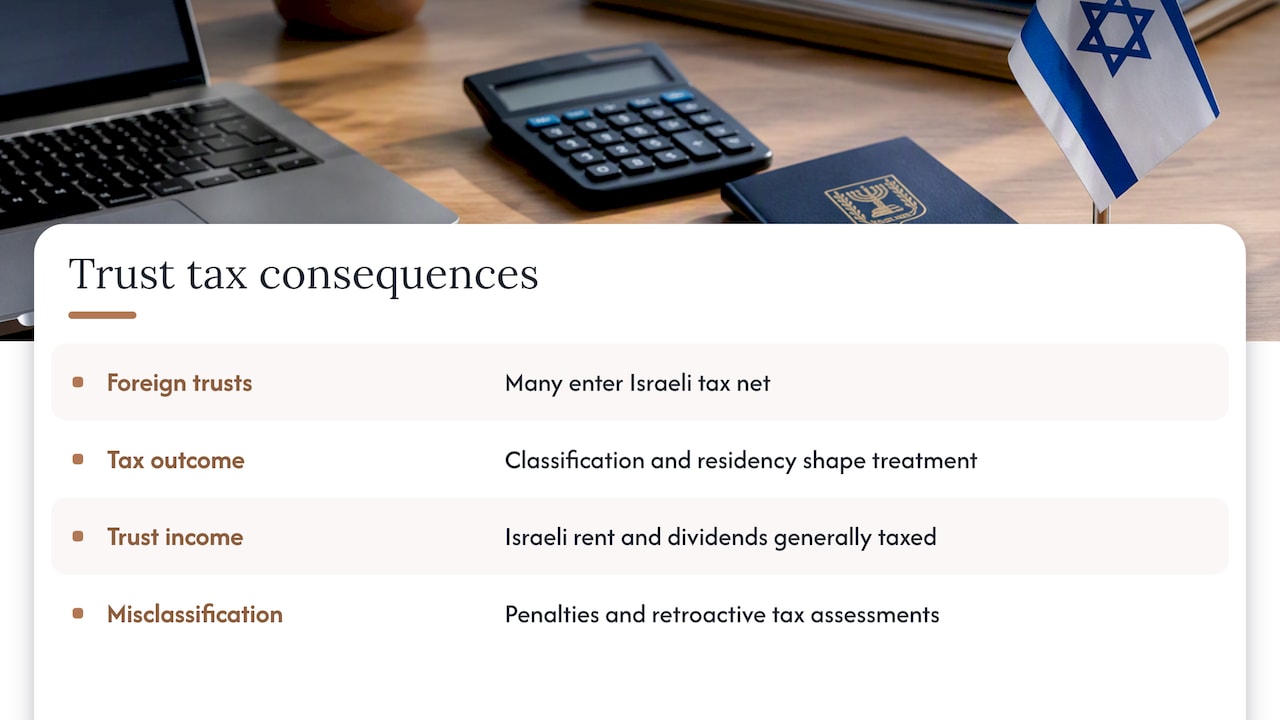
Reporting duties are only part of the picture. Trusts with Israeli ties can also carry inheritance and income tax consequences depending on how the trust is classified and where the settlor and beneficiaries are considered tax resident. Foreign settlors often assume a trust structure that works well in their home country will be recognized the same way in Israel, and that assumption causes real problems. Israeli tax law was amended to bring many foreign trusts into the Israeli tax net, which means a trust that looked purely foreign on paper can still generate Israeli tax exposure.
Income generated by trust assets, whether rental income from an Israeli apartment or dividends from Israeli securities, is generally taxed based on the trust’s classification and the residency of the parties involved rather than treated as automatically exempt. Misclassifying a trust, or failing to notify the Tax Authority of its structure within the required timeframe, can trigger penalties and retroactive tax assessments rather than the clean treatment the settlor expected.
Because classification drives the tax outcome, this is an area where getting advice before funding the trust matters more than fixing it afterward. A trust set up without attention to its tax classification can end up costing a family far more than the legal fees it saved.
Ending a trust: termination and distribution of assets
A trust in Israel ends according to the terms set out in its deed, whether that means a fixed date, a beneficiary reaching a certain age, or the fulfillment of the trust’s stated purpose. Termination does not happen automatically just because an informal understanding among the family changes.
When a trust is wound up, the trustee’s job is to distribute the remaining assets to the beneficiaries named in the deed, following whatever allocation formula or conditions the document specifies. If a public endowment, or הקדש, is annulled, the law allows a court to redirect the remaining assets to another public purpose rather than letting them revert to private hands. Courts also retain the authority to order a transfer of trust property when a trust is dissolved under unusual circumstances, which gives beneficiaries a legal backstop if a trustee resists a legitimate distribution.
Before any distribution, a careful trustee confirms that outstanding tax filings and accounting obligations are current, since unresolved reporting issues can delay a bank’s willingness to release funds or re-register property out of the trust’s name.
Trusts versus wills and companies in Israel
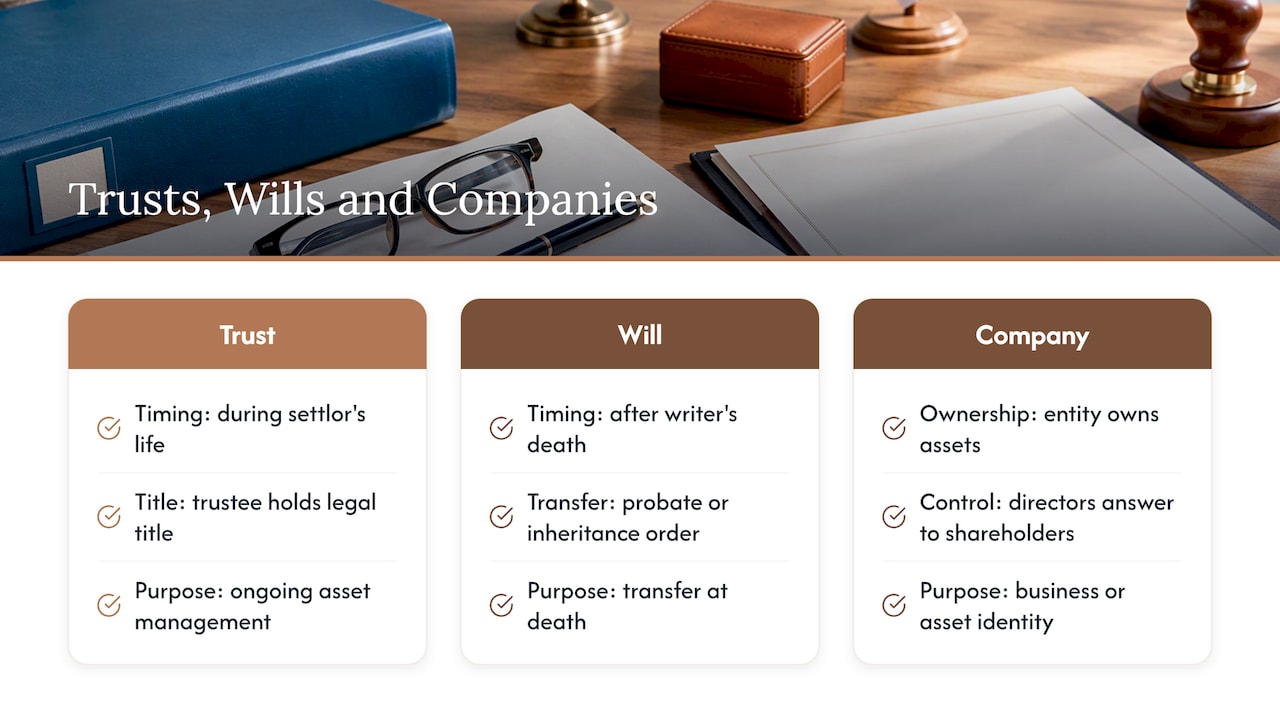
A trust, a will, and a company solve different problems, even though people sometimes use them interchangeably. A will transfers assets after death through probate or an inheritance order, and it only takes effect once the person who wrote it has died. A trust can operate while the settlor is alive, holding and managing assets for a beneficiary’s benefit in real time, which makes it useful for minors, family property arrangements, or ongoing charitable giving.
A company creates a separate legal entity that owns assets in its own name and is managed by directors accountable to shareholders. A trust, by contrast, has no separate legal personality. The trustee personally holds legal title while owing fiduciary duties to the beneficiaries, which means trust assets are generally shielded from the trustee’s own creditors but the structure itself does not exist as an independent entity the way a company does.
Choosing between these tools depends on timing and purpose: a will for transfer at death, a trust for ongoing management during life, and a company for operating a business or holding assets that need their own legal identity.
Who can serve as a trustee under Israeli law
The Trusts Law does not require a trustee to hold a specific professional license, but it does hold every trustee, whether an individual, a lawyer, or a corporate trust company, to the same statutory standard of good faith and reasonable care. That standard is the real qualification bar: a trustee who manages assets carelessly or favors their own interests over the beneficiaries’ can face court intervention or personal liability.
In practice, families often choose a trustee based on a combination of trustworthiness, financial literacy, and availability, since the role involves ongoing accounting and communication with beneficiaries. For trusts holding Israeli real estate or securities, a trustee with some familiarity with Israeli banking and tax procedures saves time, since onboarding and reporting steps are easier to navigate for someone who has done them before.
Appointing a professional trustee, such as a lawyer experienced in Israeli trust administration, is common for cross-border families where no single relative lives close enough to Israel to handle banking and registry matters directly. Courts can also remove or replace a trustee who fails to meet the statutory standard, which gives beneficiaries recourse if a trustee is unresponsive or mismanages the assets.
What protections beneficiaries have under Israeli trust law
Beneficiaries are not passive bystanders under the Trusts Law. They have a statutory right to receive an annual accounting from the trustee and to request reasonable additional information about how the trust is being managed. If a trustee refuses reasonable disclosure, a beneficiary can bring the matter to court.
Trust property also carries a built-in protection: because trust assets must be kept separate from the trustee’s personal estate, they are generally shielded from the trustee’s own creditors. That separation matters in practice, since it means a trustee’s financial troubles should not put a beneficiary’s inheritance or gift at risk.
Beneficiaries can also petition a court if a trustee engages in self-dealing, mismanages assets, or acts outside the powers granted in the trust deed. Courts have the authority to give directions, order corrective action, or replace a trustee altogether when the statutory duties are not being met.
Our take on getting trust advice right
The biggest mistake we see is treating an Israeli trust as a paperwork exercise instead of an ongoing legal relationship with real reporting deadlines attached. Foreign settlors in particular tend to focus on getting the deed signed and assume the hard part is over. The hard part, in our experience, is what happens afterward: the annual accounting, the bank’s due diligence refresh, the Tax Authority notice that shows up two years later asking for documentation the trustee never kept.
Conventional advice often treats trust creation and tax compliance as separate projects handled by separate advisors. That split causes the exact problem the recent reporting amendments were designed to catch: trustees who can prove they hold valid trust documents but cannot produce the accounting trail a tax or bank inquiry demands. If you take one thing from this guide, let it be this: build your recordkeeping system at the same time you sign the trust deed, not after the first request for information arrives.
— Menora Law
How we can help you set up or manage an Israeli trust
We draft trust deeds, advise trustees on their statutory duties, and liaise directly with Israeli banks and the Tax Authority so clients abroad are not left guessing about deadlines or documentation. Whether you are structuring a trust to hold Israeli real estate for family use, coordinating a trust with an inheritance case for heirs abroad, or need a trustee appointed for a minor beneficiary, we handle the drafting, the bank onboarding, and the tax reporting from a single point of コンタクト. Because most trust and estate clients live outside Israel, we work remotely by default and schedule on-site consultations when a matter calls for it, so clients are not stuck booking flights to move their cases forward.
Reach out through メノラ法 to start a consultation on your trust or estate matter.
This article is general information, not a substitute for advice from a qualified lawyer. Consult a qualified legal professional about your own circumstances before acting on anything here.
よくある質問
What is a trust under Israeli law?
A trust is a legal relationship in which a trustee holds or manages assets for the benefit of a beneficiary or for a defined purpose, as set out in the Trusts Law 1979. It can be created by law, by contract, or by a written deed, and the trustee must keep trust assets separate from personal property.
Does a trust replace the need for a will or probate order in Israel?
No. A will and probate order transfer assets after death, while a trust can manage assets during the settlor’s lifetime for a beneficiary’s benefit. The two often work together, particularly when Israeli assets pass through an inheritance order before being placed in trust.
How long does a trustee have to respond to a Tax Authority report request?
Recent statutory amendments set response windows of either 90 or 120 days depending on the type of request, with certain obligations phasing in from January 1, 2026. Trustees who keep current accounting records are better positioned to meet these deadlines without delay.
Can a foreign trust be recognized or taxed in Israel?
A foreign trust can still carry Israeli tax exposure if it holds Israeli assets or involves Israeli-resident parties, since Israeli tax law was amended to bring many foreign trusts into scope. Settlors should confirm classification before assuming a foreign structure is automatically exempt.
What should I bring to a first meeting about setting up an Israeli trust?
Bring the title documents for any assets the trust will hold, identification for the proposed trustee and beneficiaries, and any existing will or trust language that touches those assets. Having this ready lets your lawyer draft the deed and start bank onboarding without unnecessary back and forth.
Sources
- Judgments
- Knesset legislative PDF — statutory amendments and transitional rules
- Knesset compilation of Trusts Law provisions (PDF)
- Legal500 intelligence: Israel changes affecting foreign trusts


 English
 Afrikaans
 العربية
 বাংলা
বাংলা Čeština
 简体中文
简体中文 Nederlands
 Suomi
Suomi Français
 Deutsch
 עִבְרִית
 हिन्दी
 Magyar
 Italiano
 日本語
日本語 한국어
한국어 Polski
 فارسی
فارسی Português do Brasil
 Русский
 Español de México
 Українська