
TL;DR:
- An Israeli Power of Attorney is a notarized document enabling an agent to act on behalf of a principal in legal and administrative matters within Israel. Proper authentication, precise legal language, and Hebrew translation are essential for the PoA to be accepted by Israeli authorities, banks, and courts, especially in cross-border inheritance cases. Utilizing a durable PoA like Yipui Koach Matmish provides long-term protection against incapacity, but banks may still require in-person verification despite full authentication.
An Israeli Power of Attorney (PoA) is a notarized legal document that authorizes a designated agent to act on behalf of a principal in legal and administrative matters within Israel. For families managing cross-border inheritance, this document is not optional. It is the legal key that allows an overseas heir or property owner to have a trusted representative appear before Israeli courts, banks, and the Land Registry (Tabu) without traveling to Israel. Understanding the Israeli power of attorney explained in full means knowing its requirements, its limits, and how to use it correctly from day one.
What are the requirements for a valid Israeli power of attorney?
A valid Israeli PoA is not simply a signed letter of authorization. It must meet specific formal requirements before any Israeli authority will accept it.
For foreign principals, the process starts at home. You sign the PoA before a licensed notary in your country of residence. That notarization alone is not enough. The document must then receive an Apostille certificate under the Hague Convention, or be verified through the Israeli consulate in your country. Authentication is mandatory for all foreign documents intended for use before Israeli courts, banks, and the Land Registry. Without it, the document is legally invisible in Israel.
The language and content of the PoA matter just as much as the authentication. Israeli courts and registrars require all foreign documents, including PoAs, to be accurately translated and reflect Israeli legal terminology. A generic template downloaded from the internet will almost certainly fail. Incorrect or generic PoA forms often result in rejection by Israeli banks or registrars due to lack of precise legal language matching the specific asset or authority.
The key formal requirements are:
- Notarization by a licensed notary in the principal’s home country
- Apostille certificate under the Hague Convention, or Israeli consulate verification
- Precise legal wording tailored to the specific matter, such as inheritance, property sale, or bank account access
- Certified Hebrew translation prepared by a qualified translator
- Correct identification of the principal, agent, and the specific Israeli assets or proceedings covered
Pro Tip: Ask your izraelski prawnik to draft the PoA text before you visit your local notary. This way, the wording is already correct for Israeli legal standards, and you avoid having to redo the document after authentication.
How does an Israeli PoA work in cross-border inheritance cases?
The practical power of a PoA in inheritance matters is significant. Once properly executed, your appointed agent can act fully on your behalf before Israeli courts, government offices, and financial institutions. You do not need to be physically present for most of the process.
Here is how the PoA functions step by step in a typical inheritance scenario:
- Filing the succession or probate application. The agent submits the application to the Israeli Registrar of Inheritance Affairs or the Family Court, depending on whether a will exists. Foreign wills and PoAs require validation under Israeli law before assets can be accessed. Israeli courts issue a Succession Order or Probate Order that legally unlocks the estate.
- Managing estate assets. Once the court order is obtained, the agent can manage bank accounts, collect funds, and handle property registered in the deceased’s name at the Land Registry.
- Signing property documents. If the estate includes real estate, the agent signs transfer deeds and submits filings to the Tabu on your behalf.
- Coordinating with Israeli banks. The agent presents the authenticated PoA to the relevant bank branch and requests access to the estate accounts.
- Completing the distribution. The agent carries out the court-approved distribution of assets to the heirs.
Ten izraelski prawnik acting under the PoA carries real legal responsibility. Israeli lawyers acting under PoA assume critical liabilities, including compliance with anti-money laundering (AML) rules, tax filings, and title verification. This is not a passive role. The lawyer is the legal spine of the entire process.
One important limitation deserves attention. Even with a fully authenticated PoA, Israeli banks may require a brief in-person verification of the agent’s authority for AML compliance before releasing funds. Bank protocols vary by institution, and some are stricter than others. Your izraelski prawnik should prepare you for this possibility in advance.
“In cross-border transactions, the izraelski prawnik is the spine of the deal, ensuring compliance with Israeli law and protecting the client’s interests under PoA.” — Foreign Buyers Close Remotely Israel
For a detailed breakdown of the probate process, Menora Law’s guide on the Israeli probate order process covers each step with clarity.
What types of power of attorney exist under Israeli law?
Israeli law recognizes several types of PoA, and choosing the right one for your situation makes a real difference. The three most relevant types for cross-border inheritance and property matters are the regular PoA, the durable PoA, and the ongoing PoA known in Hebrew as Yipui Koach Matmish.
| Type | Duration | Survives Incapacity | Best Use Case |
|---|---|---|---|
| Regular PoA | Defined or open-ended | No | Short-term transactions, property sales |
| Durable PoA (Yipui Koach Matmish) | Up to 5 years | Yes | Long-term estate management, overseas principals |
| Ongoing PoA | Renewable | Yes | Continuous management of Israeli assets from abroad |
Ten Israeli lasting power of attorney (Yipui Koach Matmish) is a long-term notarized document valid for up to five years. It remains valid even if the principal loses mental or physical capacity. This feature makes it the preferred instrument for Israelis living abroad or for foreign nationals who own Israeli property and want continuous protection.
A regular PoA, by contrast, becomes void the moment the principal is incapacitated. For a family managing a parent’s Israeli estate while that parent is ill, a regular PoA can fail at exactly the wrong moment. Foreign PoAs do not automatically cover Israeli assets. Failing to prepare an Israeli-specific instrument can leave local assets legally frozen if the principal becomes incapacitated.
Revocation of any PoA type requires a formal written notice delivered to the agent and, in most cases, filed with the relevant authority. Renewal of a Yipui Koach Matmish before its five-year expiry is straightforward but must be handled proactively. Waiting until it lapses creates gaps in authority that can delay inheritance proceedings significantly.
Pro Tip: If you are managing Israeli assets from abroad over a multi-year period, request a Yipui Koach Matmish from the start. The extra preparation time is minimal compared to the protection it provides if your circumstances change.
For more on how durable PoAs work for overseas clients, Menora Law’s dedicated resource on Israeli durable power of attorney provides a thorough explanation.
How to execute and use an Israeli PoA from overseas
Executing a valid Israeli PoA from abroad is a process with clear steps. Skipping or rushing any one of them creates problems that can take months to fix.

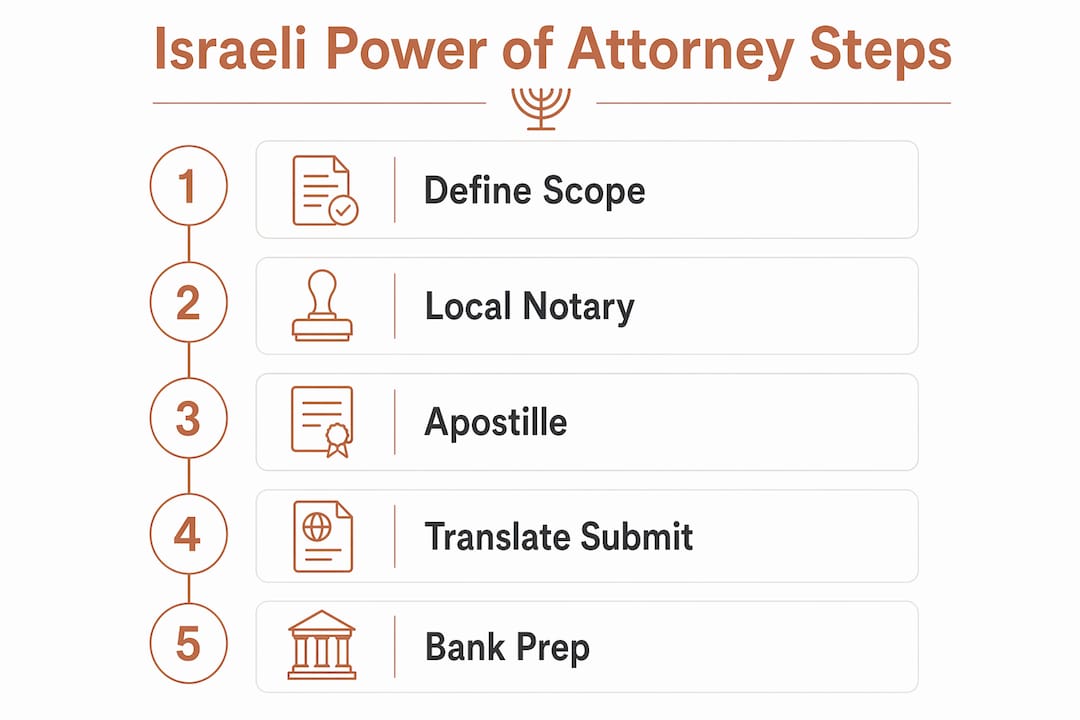
Step 1: Define the scope with your Israeli lawyer
Before you sign anything, work with an Israeli-licensed lawyer to define exactly what powers the agent needs. A PoA cannot be a one-size-fits-all document. It must be customized for specific assets and legal matters, such as inheritance proceedings versus a property sale. Your lawyer drafts the text in Hebrew with the precise legal language required by Israeli authorities.
Step 2: Sign before a local notary
Take the drafted PoA to a licensed notary in your country. The notary witnesses your signature and certifies the document. This step must happen in person. Remote online notarization is not universally accepted by Israeli authorities, so confirm the format with your izraelski prawnik before proceeding.
Step 3: Obtain the Apostille or consulate verification
After notarization, the document goes to the relevant government authority in your country for an Apostille stamp. If your country is not a signatory to the Hague Convention, the document must be legalized through the Israeli consulate. This step can take days or weeks depending on your location, so plan ahead.
Step 4: Translate and submit to Israeli authorities
A certified Hebrew translation is attached to the authenticated PoA. Your izraelski prawnik then submits the full package to the relevant authority, whether that is the Registrar of Inheritance Affairs, the Land Registry, or a specific bank branch.
The key documents typically submitted alongside the PoA include:
- Certified copy of the principal’s passport
- Death certificate of the deceased (in inheritance cases), with Apostille
- Certified Hebrew translations of all foreign documents
- The Succession Order or Probate Order once issued by the Israeli court
Step 5: Prepare for bank-specific requirements
Israeli banks maintain highly individualized AML compliance protocols. Even with a fully authenticated PoA, some banks require the agent to appear in person for identity verification before releasing estate funds. Your izraelski prawnik should kontakt the specific bank in advance to understand its requirements and prepare the necessary documentation. This preparation prevents delays that can stretch for weeks.
Remote management is possible for the full probate and succession filing process. However, banking access may require additional steps depending on the institution.
For families buying Israeli property through a PoA, Menora Law’s guide on buying land in Israel as a foreigner covers the real estate side of this process in detail.
Key Takeaways
A correctly prepared and authenticated Israeli Power of Attorney is the single most important document for managing cross-border inheritance or property matters in Israel without traveling.
| Point | Details |
|---|---|
| Authentication is non-negotiable | Every foreign PoA must be notarized and carry an Apostille or consulate verification to be valid in Israel. |
| Generic forms cause rejections | Israeli banks and registrars reject PoAs that lack precise legal language tailored to the specific asset or proceeding. |
| Durable PoA protects against incapacity | The Yipui Koach Matmish remains valid for up to five years and survives the principal’s incapacity. |
| izraelski prawniks carry real liability | The attorney acting under PoA is responsible for AML compliance, tax filings, and title verification. |
| Banks may still require in-person steps | Even a fully authenticated PoA does not guarantee fully remote bank access due to individual AML protocols. |
What we have learned from handling Israeli PoAs for overseas families
At Menora Law, we have worked with families across multiple countries who arrived at the same painful realization too late. They had a PoA. It just was not the right one.
The most common mistake is not laziness. It is confidence. Families assume that a PoA prepared for one purpose, say, a property sale, will work equally well for probate proceedings. It does not. Israeli courts and the Land Registry look at the specific language of the document. If the wording does not explicitly authorize the actions being taken, the document is rejected. The process stops. Months of work can unravel in a single administrative review.
We have also seen families underestimate the banking piece. Israeli banks are not obstructionist by nature, but their AML compliance is genuinely strict and varies from branch to branch. We prepare our clients for this from the first conversation. We kontakt the bank before submitting anything, confirm what they need, and build that into the timeline. That preparation alone has saved clients weeks of frustration.
The other thing worth saying plainly: the izraelski prawnik acting under your PoA is not just a messenger. That lawyer is legally accountable for every filing, every representation, and every document submitted on your behalf. That accountability is a feature, not a burden. It means you have a professional with real skin in the game managing your family’s assets. Choose that person carefully.
If you are managing an Israeli estate from abroad, the Israeli inheritance law guide for families is a strong starting point for understanding the full legal framework before you begin.
— Menora Law
How Menora Law helps families manage Israeli PoAs from abroad
Managing an Israeli inheritance from overseas is genuinely complex. The legal requirements are specific, the authorities are strict, and the stakes for your family are high.
Menora Law works exclusively in Israeli law, with a practice built around international clients who need reliable, knowledgeable representation in Israel. The team handles the full PoA process from drafting precise legal language to coordinating with Israeli courts, banks, and the Land Registry on your behalf. Whether you need a durable PoA for long-term estate management or a targeted instrument for a specific probate filing, Menora Law provides the legal clarity your family deserves. Start with the 2026 Israeli inheritance law guide Lub kontakt Menora Law directly to discuss your situation.
FAQ
What is an Israeli Power of Attorney?
An Israeli Power of Attorney is a notarized legal document that authorizes an agent to act on behalf of a principal in legal, financial, and administrative matters within Israel. It is required for managing inheritance, property, and court proceedings remotely.
Does a foreign PoA work in Israel automatically?
No. Foreign PoAs must be notarized, authenticated by Apostille or Israeli consulate verification, and translated into Hebrew before Israeli courts, banks, or the Land Registry will accept them.
What is the Yipui Koach Matmish?
The Yipui Koach Matmish is Israel’s durable power of attorney. It is valid for up to five years and remains effective even if the principal loses capacity, making it the preferred instrument for overseas principals managing Israeli assets long-term.
Can I manage an Israeli inheritance entirely from abroad using a PoA?
The probate and succession filing process can be managed fully remotely through a properly authenticated PoA. Some Israeli banks, however, may require the agent to appear in person for AML verification before releasing estate funds.
Why do Israeli banks sometimes reject a valid PoA?
Israeli banks maintain individualized AML compliance protocols. Even a fully authenticated PoA may not satisfy a specific bank’s internal requirements. Your izraelski prawnik should contact the bank in advance to confirm what additional documentation or verification steps are needed.


 English
 Afrikaans
 العربية
 বাংলা
বাংলা Čeština
 简体中文
简体中文 Nederlands
 Suomi
Suomi Français
 Deutsch
 עִבְרִית
 हिन्दी
 Magyar
 Italiano
 日本語
日本語 한국어
한국어 Polski
 فارسی
فارسی Português do Brasil
 Русский
 Español de México
 Українська