
TL;DR:
- Most property in Israel is leasehold because the land is mainly owned by the state or quasi-state entities and leased via long-term agreements. Buyers typically acquire leases of 49 or 98 years, which function similarly to ownership if titles and conditions are clear, but the land remains under government or organizational control. The Israeli land system is rooted in laws and historical policies that prohibit outright sale; proper due diligence and legal checks are essential for reliable property transactions.
Most property in Israel is leasehold because the vast majority of land is held by state or quasi-state bodies and administered through long-term public leases rather than private sale. The three bodies responsible are the State of Israel, the Jewish National Fund (JNF), and the Development Authority. All three are managed administratively by the Israel Land Authority (ILA). This arrangement is not accidental — it flows directly from the Basic Law: Israel Lands, which prohibits the outright sale of state land and mandates that it be leased instead.
For most buyers, this means they acquire a long-term lease — typically 49 or 98 years — rather than full ownership of the land beneath their home. In day-to-day life, that distinction rarely surfaces. Leasehold apartments are bought, sold, mortgaged, and inherited much like freehold properties. The differences show up in specific situations: ILA consent requirements, capitalization status, and renewal mechanics. Before signing anything, buyers should pull a Tabu (land registry) extract, confirm the ILA lease file, and get an Israeli real estate lawyer involved early. Menora Law works with international buyers on exactly these checks.
Key facts at a glance:
- Most of Israel’s land is state or quasi-state owned
- Administered by the Israel Land Authority (ILA) under the Basic Law: Israel Lands
- Typical lease terms: 49 years (renewable) or 98/99 years
- Title records split between Tabu (land registry) and ILA administrative files
- Leasehold functions like ownership for most purposes when title, permits, and ILA conditions are clean
What leasehold and freehold actually mean in Israeli law
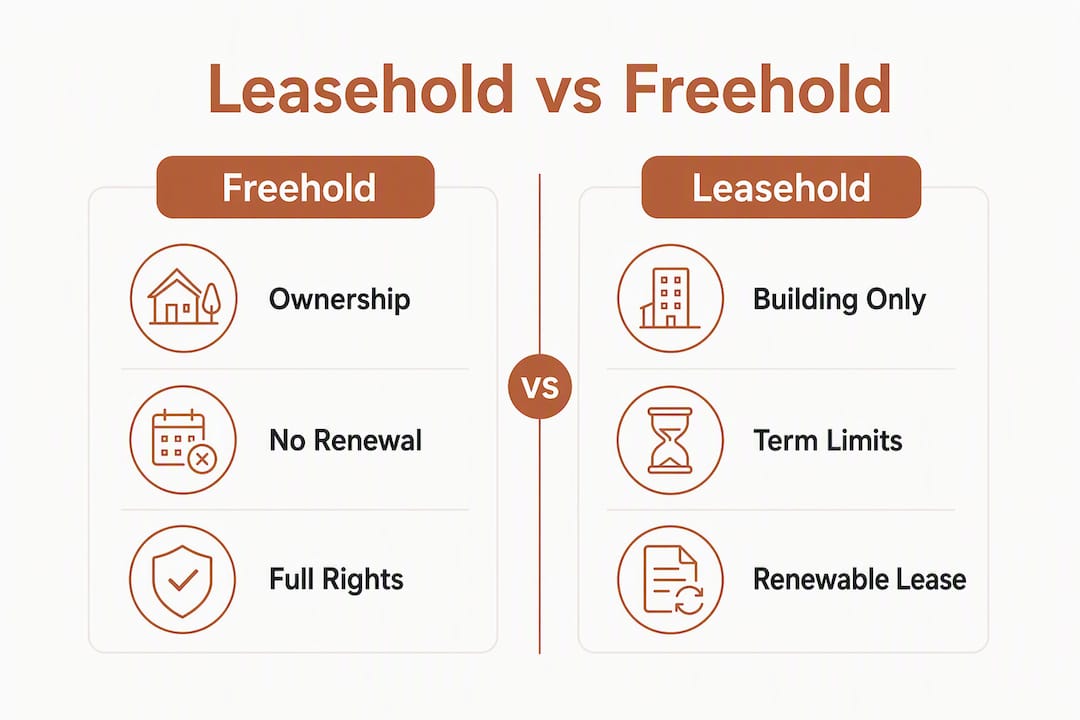
In Israeli legal terms, freehold is called baalut — full ownership of both the land and the building on it. The owner holds an absolute title registered in Tabu. Leasehold (chochira) means the buyer acquires a long-term contractual right to use and occupy the land, while the ILA (on behalf of the state, JNF, or Development Authority) retains underlying ownership.

The practical difference matters most at the edges. A freehold owner can sell, mortgage, subdivide, or build without seeking a landowner’s consent. A leaseholder generally has those same rights — but certain actions (adding floors, changing use, subdividing a plot) may require ILA approval, and the lease itself carries an expiry date that freehold does not.
| Dimension | Freehold (Baalut) | Leasehold (Chochira) |
|---|---|---|
| What you own | Land and building | Building rights; land stays with ILA/JNF |
| Lease length | Perpetual | Typically 49 or 98/99 years |
| Transfer restrictions | None (standard conveyancing) | May require ILA/JNF consent depending on capitalization |
| Registration record | Tabu only | Tabu (rights) + ILA administrative file |
| Resale and mortgage impact | Straightforward | Lenders accept clean leases; short remaining term raises flags |
| Buyer protections and checks | Standard title search | Tabu extract + ILA lease copy + capitalization confirmation |
Two quick examples illustrate where this plays out. An apartment in a Tel Aviv high-rise on ILA land is almost always leasehold — the buyer owns the apartment unit and holds a long-term lease on the land. An apartment on privately owned land (rare, but it exists) is freehold. In agricultural communities like moshavim or kibbutzim, the leasehold structure is even more pronounced, with additional restrictions on who may hold the lease.
Pro Tip: Always ask whether a lease is “capitalized” or “uncapitalized” before you proceed. A capitalized lease — one where ground fees have been prepaid — typically transfers without fresh ILA consent, which speeds up the sale and reduces transaction friction considerably.
Who actually owns the land in Israel, and why
The short answer is: the state, and it has been that way by deliberate policy for over a century.
The three bodies that hold Israel’s land
- Państwo Izrael — holds the largest share of public land, administered through the ILA
- Jewish National Fund (JNF) — a quasi-public body that acquired land through donations and purchases, primarily before and after statehood; its land is leased exclusively and cannot be sold
- Development Authority — holds land transferred from various sources after 1948, also administered by the ILA
The Basic Law: Israel Lands, adopted in 1960, is the constitutional anchor. It declares that lands belonging to the State, the Development Authority, or the JNF shall not be transferred by sale and must instead be administered — meaning leased — under law. That single provision is why leasehold dominates Israeli real estate.
How history produced this system
The leasehold structure did not emerge from the 1960 Basic Law alone. Several historical layers contributed:
- Ottoman land law — the Ottoman tapu system categorized most land as state-owned (miri), with private parties holding use rights rather than full title. This created a cultural and legal precedent for state retention of land.
- British Mandate practices — the British administration maintained Ottoman categories and added its own land registration system, reinforcing the idea that much of the land was crown (state) property.
- Early Zionist land policy — the JNF, founded in 1901, adopted a policy of acquiring land and leasing it rather than selling it, to keep land in collective Jewish ownership in perpetuity.
- 1948 and the Development Authority — after Israel’s establishment, land from various sources was transferred to the Development Authority, adding another large block of non-transferable public land.
- 1960 Basic Law — codified all of the above into constitutional law, prohibiting sale and mandating leasehold administration.
- 21st-century reforms — Knesset legislation has since created pathways for selective privatization, allowing some leaseholders to acquire ownership under specific conditions.
The result: most land in Israel is state or quasi-state owned, which is why a buyer purchasing almost any urban apartment is almost certainly acquiring a leasehold interest rather than freehold title.
How leases actually work: terms, capitalization, and financing
Typical lease lengths and renewal
The ILA issues leases in two common configurations. The first is a 49-year lease with an option to renew for an additional 49 years, giving an effective term of up to 98 years. The second is a 98/99-year lease issued as a single term. Which applies depends on the specific file, the land category, and the policy in effect when the lease was originally granted.
Renewal is not automatic in a legal sense, but in practice the ILA has consistently renewed leases for residential properties. The risk of non-renewal is real in theory — particularly for agricultural or non-residential land — but urban residential leaseholders have strong legal protections and a long track record of renewal.
Capitalized vs. uncapitalized leases
This distinction is the one that most often surprises buyers. A capitalized lease is one where the lessee has prepaid the ground fees for the full lease term. The practical effect: capitalized leases can typically be transferred without fresh ILA consent, which makes the sale process cleaner and faster. Banks also treat them more favorably.
An uncapitalized lease means ground fees are still owed or the lease has not been fully prepaid. Transferring such a lease usually requires ILA approval and may involve payment of a capitalization fee at the time of sale. This adds a step, a cost, and sometimes a delay.
| Lease Type | Ground Fees | ILA Consent on Transfer | Bank Mortgage Acceptance | Common in Practice |
|---|---|---|---|---|
| Capitalized (49 or 98 yr) | Prepaid | Usually not required | Generally accepted | Most urban apartments |
| Uncapitalized | Ongoing or unpaid | Required | Subject to lender review | Older files, some agricultural |
| Freehold (Baalut) | None | Not applicable | Standard | Private land (rare, ~7%) |
How leases appear on title documents
Tabu (the Israel Land Registry, formally the Land Registration Bureau) records the registered rights — the lease itself, any mortgages, and encumbrances. The ILA holds a separate administrative file that contains the lease agreement, consent history, and any conditions attached to the file. Both records matter. Tabu tells you what rights are registered; the ILA file tells you what conditions govern those rights.
For buyers considering Israeli real estate transactions, understanding both records is not optional. A clean Tabu extract with an encumbered ILA file can still create problems at closing.
How transfers and resale work for leasehold properties
Selling a leasehold property in Israel follows the same basic conveyancing steps as any property sale, with one additional layer: ILA or JNF involvement where the lease requires it.
When ILA consent is required
Not every transfer triggers a formal ILA consent process. For capitalized leases on standard residential properties, the transfer often proceeds without it. Consent becomes relevant in these situations:
- The lease is uncapitalized and fees remain outstanding
- The property involves a change of use (residential to commercial, for example)
- The buyer wants to add building rights or subdivide the plot
- The land is JNF-administered (JNF has its own consent and eligibility rules)
- The lease contains specific conditions tied to the original grant
Common fees and consent items
- Capitalization fee — payable if converting an uncapitalized lease at the time of sale
- Transfer fee — a percentage of the transaction value, payable to the ILA in some cases
- Building rights fee — if the buyer intends to add floors or expand the footprint
- Change-of-use fee — applicable when the intended use differs from the lease category
Mortgage and valuation implications
Israeli banks and mortgage lenders are well-acquainted with leasehold property. For a clean leasehold title — capitalized lease, no pending ILA conditions, clear Tabu — lenders treat the property much like freehold for financing purposes. The issues that give lenders pause are a short remaining lease term, unresolved ILA conditions, or an uncapitalized lease where the capitalization cost is uncertain.
Market pricing already reflects the leasehold structure. Because the vast majority of Israeli urban property is leasehold, there is no systematic discount for leasehold versus freehold in most city markets. Discounts appear at the margins: a lease with fewer than 30 years remaining, a property with pending planning disputes, or a file with unresolved ILA conditions.
Pro Tip: Before signing a purchase agreement, ask the seller for the full ILA consent history and any outstanding conditions on the file. A lease agreement review by an izraelski prawnik at this stage can surface conditions that would otherwise only appear at closing.
How to confirm whether a property is leasehold or freehold
This is the practical part. Whether you are buying from abroad or in person, the verification process follows a clear sequence.
Step-by-step title confirmation checklist
- Obtain a Tabu extract — request a current extract from the Israel Land Registry (Tabu) for the specific parcel. This shows registered ownership, lease rights, mortgages, and encumbrances. The extract is the starting point for any title review.
- Request the ILA lease copy — ask the seller or the ILA for the full lease agreement, including any addenda and the original grant conditions. This document governs what the lessee can and cannot do.
- Confirm capitalization status — verify in writing whether the lease is capitalized. The ILA can confirm this; so can the lease document itself. Do not rely on the seller’s verbal representation.
- Check planning permits — obtain copies of all building permits and confirm that the structure as built matches the approved plans. Unauthorized additions are common and can create ILA complications.
- Run a mortgage and charge search — confirm through Tabu that no undisclosed mortgages, liens, or charges are registered against the property.
- Review ILA consent history — ask for documentation of any prior ILA approvals, conditions, or correspondence on the file. This reveals whether the ILA has flagged any issues.
- Confirm remaining lease term — calculate the remaining term and assess whether it is sufficient for your intended use and for mortgage purposes.
What overseas buyers need to know
For buyers outside Israel, document retrieval is manageable but requires planning. Tabu extracts can be requested remotely through the Israel Land Registry portal. ILA records require either direct kontakt with the ILA or authorization through a local representative. Documents in Hebrew will need certified translation. A power of attorney granted to an izraelski prawnik allows them to retrieve documents, sign on your behalf, and manage the process without you needing to travel.
Menora Law handles all of these steps for foreign buyers purchasing property in Israel, including remote document retrieval, certified translation coordination, and ILA liaison.
Pro Tip: Do not rely on the seller’s agent to pull these records. Your lawyer should obtain the Tabu extract and ILA documents independently, directly from the source, so there is no question about their currency or completeness.
Policy debates, controversies, and the push toward privatization
The leasehold system has not been without criticism, and it has evolved significantly since the 1960 Basic Law was enacted.
Allocation controversies
The JNF’s land allocation rules have drawn sustained criticism from human rights organizations. Because JNF land was acquired for the benefit of Jewish communities, its leasing policies have historically restricted eligibility in ways that exclude Arab citizens of Israel. Human Rights Watch and Israeli NGOs have documented these restrictions and their discriminatory effects on access to land and housing for Arab citizens. The Israeli Supreme Court has addressed some of these issues, and the ILA has modified certain tender procedures in response, though the underlying JNF mandate remains contested.
Reforms toward freehold transfers
Legislators have increasingly recognized demand for full ownership, and the Knesset has enacted measures that allow leaseholders to acquire title in many cases. The key developments:
- Early 2000s reforms — initial legislation enabling ILA to offer ownership transfers to urban residential leaseholders under defined conditions.
- ILA ownership acquisition service — the ILA now operates a formal service for leaseholders to request acquisition of ownership rights, sometimes at no cost depending on the land category and policy decision.
- Selective privatization policy — Knesset legislation has created pathways for transferring certain ILA-managed lands to private ownership, particularly for urban residential properties.
- Ongoing debate — proposals to expand privatization further remain politically contested, with advocates citing housing affordability and opponents citing public interest in retaining state land.
For current leaseholders, the practical implication is that conversion to freehold may be available and, in some cases, offered at low or no cost. It is not mandatory — some leaseholders elect to remain lessees to avoid the administrative steps involved in the transfer.
Pro Tip: If you are offered a conversion from leasehold to freehold, read the transfer conditions carefully before accepting. The offer may carry conditions — on use, on building rights, or on future transfers — that affect the value of what you are acquiring. An izraelski prawnik should review the terms before you sign.
How Menora Law helps international buyers and heirs with leasehold issues
Navigating Israeli leasehold property from abroad is manageable with the right legal support. Menora Law provides Israeli real estate legal services specifically structured for international clients, covering every stage of the title confirmation and transaction process.
Services for leasehold property matters
- Tabu and ILA record retrieval — obtaining current extracts and lease documents directly from the registry and ILA, independently of the seller
- Capitalization status confirmation — reviewing the lease file and obtaining written confirmation from the ILA on capitalization and consent requirements
- Lease review and due diligence — analyzing the full lease agreement, conditions, and consent history for risks that affect the transaction
- ILA and JNF consent management — preparing and submitting consent applications where required, and liaising with ILA officers on the client’s behalf
- Conversion assistance — advising on and managing the process of converting a leasehold to freehold where available and beneficial
- Mortgage liaison — coordinating with Israeli lenders on title documentation and lease status to support financing approval
- Remote representation — acting under power of attorney for overseas clients who cannot travel to Israel for the transaction
Client benefits
- English-speaking legal team with direct experience in ILA procedures and Israeli land law
- Remote representation via power of attorney, so you do not need to be in Israel to complete a transaction
- Fast communication across time zones, with clear updates at each stage
- Experience working with Israeli banks, mortgage lenders, and the ILA on leasehold transactions
For non-resident buyers, the process of confirming title and managing ILA requirements is significantly smoother with a lawyer who knows the system and can act locally on your behalf.
Before contacting Menora Law, prepare the following documents if you have them: the property address and parcel number (gush/helka), any existing Tabu extract, the draft or signed purchase agreement, and any ILA or JNF correspondence you have received.
Key Takeaways
Israel’s leasehold system exists because the Basic Law: Israel Lands prohibits the sale of state land, and approximately 93% of the country’s land is held by state or quasi-state bodies administered by the Israel Land Authority.
| Point | Details |
|---|---|
| State land dominance | Roughly 93% of Israel’s land is state or quasi-state owned, making leasehold the default for most buyers. |
| Legal foundation | The Basic Law: Israel Lands (1960) prohibits sale of state land and mandates long-term leasing instead. |
| Typical lease terms | Most leases run multi-decade terms, often close to half a century or around a century; capitalization status determines transfer friction. |
| Buyer checklist | Obtain a Tabu extract, ILA lease copy, capitalization confirmation, and planning permits before committing. |
| Prawo Menory | Menora Law provides title due diligence, ILA consent management, and remote representation for international buyers. |
Leasehold in Israel is usually not a deal-breaker — but the details matter
From Menora Law’s experience working with international buyers and heirs on Israeli property, the leasehold structure rarely derails a transaction on its own. The vast majority of urban apartments sit on ILA land with capitalized leases, clean Tabu records, and no pending ILA conditions. For those properties, the practical experience of ownership is indistinguishable from freehold.
Where things get complicated is in the details. A client once came to us mid-transaction on a Tel Aviv apartment where the seller had represented the lease as fully capitalized. When we pulled the ILA file independently, we found an outstanding condition from a prior building addition that had never been formally closed out by the ILA. Resolving it added three weeks and a modest fee to the process — but catching it before closing, rather than after, saved the client from inheriting a title problem that would have surfaced at their own eventual resale.
The leasehold system is not a reason to avoid Israeli property. It is a reason to do the title work properly, with a lawyer who knows where to look.
Ready to confirm title on an Israeli property?
Menora Law gives international buyers a direct line to Israeli real estate expertise, without the need to be on the ground in Israel. The firm’s real estate legal services cover the full scope of leasehold due diligence: Tabu extracts, ILA lease review, capitalization checks, consent management, and mortgage coordination. For buyers who are still in the research phase, the firm’s guide for foreign buyers covers the practical steps from offer to closing.
To get started, prepare your property’s parcel details (gush and helka numbers), any documents you have already received from the seller or agent, and a summary of your timeline. Menora Law’s team responds promptly and works across time zones to keep your transaction moving. Kontakt Menora Law today to schedule a consultation and get a clear picture of what you are actually buying.
This article provides general legal information about Israeli property law and is not a substitute for professional legal advice. Confirm current rules and your specific situation with a qualified izraelski prawnik before taking action.
Useful sources
For readers who want to go directly to the primary legal texts and official guidance:
- Basic Law: Israel Lands — the constitutional text prohibiting sale of state land; the legal foundation for the entire leasehold system. Essential reading for anyone who wants to understand the statutory basis.
- Israel Land Authority (ILA) official site — the ILA’s own portal covering lease administration, consent procedures, and ownership acquisition services.
- ILA ownership acquisition service — the ILA’s guide to requesting conversion from leasehold to freehold, including eligibility conditions and the cases where transfer is offered at no cost.
- Israel Land Registry (Tabu) — the official portal for requesting Tabu extracts and understanding what is registered against a property.
- Human Rights Watch — Discrimination in Land Allocation — a detailed report on access and eligibility issues in JNF and ILA land allocation, relevant to understanding the policy controversies around the leasehold system.
FAQ
Why is most property in Israel leasehold rather than freehold?
Because roughly 93% of Israel’s land is held by state or quasi-state bodies, and the Basic Law: Israel Lands prohibits its sale, requiring it to be administered through long-term leases instead.
Can a foreign national buy property in Israel?
Yes. Israel generally permits foreign nationals to purchase property, including leasehold interests. The process involves standard conveyancing plus ILA checks, and overseas buyers typically use a power of attorney to authorize an izraelski prawnik to act on their behalf.
Who owns the most land in Israel?
The State of Israel holds the largest share, followed by the Jewish National Fund (JNF) and the Development Authority. All three bodies’ lands are administered by the Israel Land Authority, accounting for roughly 93% of the country’s total land area.
What is the difference between a capitalized and uncapitalized lease in Israel?
A capitalized lease has had its ground fees prepaid, allowing transfers to proceed without fresh ILA consent. An uncapitalized lease requires ILA approval and often a capitalization payment at the time of sale, adding cost and time to the transaction.
Does leasehold status affect getting a mortgage in Israel?
For most urban residential properties with clean, capitalized leases and clear Tabu records, Israeli banks accept leasehold title for mortgage purposes. Lenders scrutinize short remaining lease terms, unresolved ILA conditions, and uncapitalized leases more carefully.
Recommended
- Umowa najmu w Izraelu; 5 łatwych wskazówek od izraelskiego prawnika
- How To Sign A Lease Agreement And Rent Property In Israel | Menora Law
- Israeli Lawyer Tips: How To Easily Buy Land In Israel As A Foreigner According To Land Law In Israel? | Menora Law
- Property Rights In Israel For Non-Residents: 2026 Guide

 English
 Afrikaans
 العربية
 বাংলা
বাংলা Čeština
 简体中文
简体中文 Nederlands
 Suomi
Suomi Français
 Deutsch
 עִבְרִית
 हिन्दी
 Magyar
 Italiano
 日本語
日本語 한국어
한국어 Polski
 فارسی
فارسی Português do Brasil
 Русский
 Español de México
 Українська