
Cross-Border Israeli Legal Matters Explained for International Clients
When you’re managing legal matters in Israel from abroad, the gap between what you expect and what Israeli law actually requires can cost you time, money, and legal standing. Coordinating cross-border Israeli legal matters means working across multiple jurisdictions, legal cultures, and procedural timelines simultaneously. Whether you’re handling an inheritance, purchasing property, or maintaining compliance with Israeli regulatory requirements, the process demands more than a basic understanding of local law. It requires structured coordination between qualified legal professionals in each relevant country.
Key Takeaways
| Point | Details |
|---|---|
| Prepare documentation early | Gather all required documents before engaging Israeli courts or authorities to avoid costly delays. |
| Tabu registration is mandatory | Signing a purchase contract does not transfer legal ownership; formal Land Registry registration is required. |
| Appoint Israeli legal counsel first | Engaging qualified Israeli counsel before any filing or transaction prevents jurisdictional missteps. |
| Inheritance requires court involvement | Israeli succession matters involve procedural steps through Israeli courts, even for foreign heirs. |
| Arbitration offers enforcement advantages | Cross-border disputes resolved through arbitration benefit from international enforcement frameworks. |
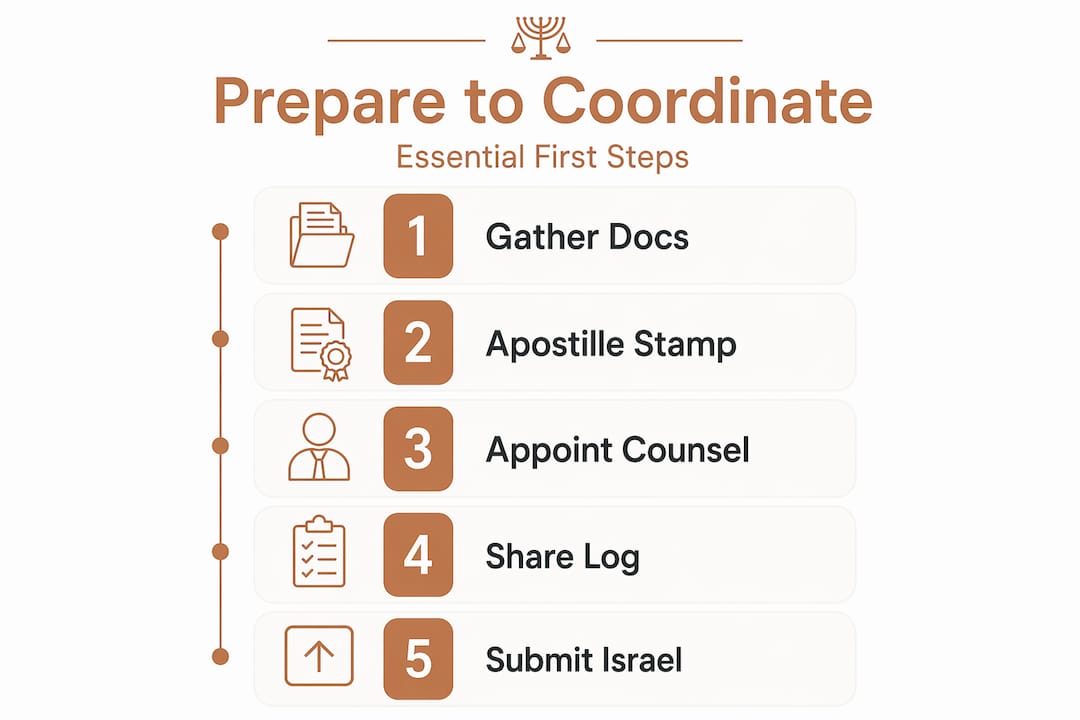
Coordinating cross-border Israeli legal matters: what to prepare first
Before any legal process begins, you need a clear picture of which Israeli laws apply to your situation and which parties must be involved. Israeli law distinguishes sharply between different legal domains. Inheritance is governed primarily by the Succession Law of 1965, real estate transactions fall under the Land Law of 1969, and commercial compliance involves a separate set of regulatory frameworks. Knowing which domain applies to your case determines which courts, authorities, and documentation requirements you will face.
The following parties are typically involved in cross-border Israeli legal coordination:
- Israeli licensed attorney: Required for filing court documents, representing clients before Israeli authorities, and advising on local law
- Foreign legal counsel: Handles jurisdiction-specific requirements in your home country, including document authentication and local court filings
- Certified translator: All documents submitted to Israeli courts or authorities must be in Hebrew or accompanied by certified translations
- Notary public: Required for powers of attorney and certain transactional documents executed abroad
- Israeli tax authority representative: Relevant for inheritance tax assessments and real estate purchase tax filings
The table below outlines the core prerequisites for the three main areas of cross-border Israeli legal coordination:
| Legal Area | Key Israeli Law | Required Parties | Core Documentation |
|---|---|---|---|
| Herança | Succession Law, 1965 | Israeli attorney, foreign counsel, translator | Will, death certificate, heir identification |
| Real estate purchase | Land Law, 1969 | Israeli attorney, notary, tax authority | Purchase agreement, passport, tax filings |
| Compliance and enforcement | Various regulatory codes | Israeli attorney, foreign counsel | Contracts, court orders, arbitration awards |
Coordinating between jurisdictions simplifies legal processes and helps avoid costly errors that arise from mismatched procedural expectations.
Pro Tip: Obtain an apostille on all foreign-issued documents before sending them to Israel. Israeli authorities require apostille certification for foreign public documents under the Hague Convention, and missing this step can delay your case by weeks.
Handling inheritance and succession across borders
Inheritance matters involving Israeli assets or Israeli heirs abroad are among the most procedurally demanding areas of cross-border legal coordination. The process does not move quickly, and it rarely moves without direct involvement from Israeli courts.
Here is the standard sequence of steps for coordinating an Israeli inheritance matter from abroad:
- Obtain and authenticate the death certificate. The death certificate must be translated into Hebrew and apostilled if issued outside Israel.
- Locate and verify the will. If the deceased left a will registered in Israel’s Inheritance Registrar, your Israeli attorney can retrieve it. Foreign wills require authentication and may need to be recognized by an Israeli court.
- File an application with the Inheritance Registrar or Family Court. Depending on whether there is a valid will, the application goes either to the Inheritance Registrar (for uncontested matters) or to the Family Court (for contested estates or complex cases). Multiple legal steps including filing claims and court approvals are required under Israeli law.
- Appoint an executor or administrator. The court may appoint an executor to manage the estate during proceedings. If you are a foreign heir, your Israeli attorney can act as your legal representative throughout this process.
- Coordinate asset transfer with foreign counsel. Once the Israeli court issues a probate order or succession order, your foreign counsel handles recognition of that order in your home jurisdiction if assets or heirs are located abroad.
- Complete tax filings. Israel does not impose inheritance tax, but real estate assets transferred through inheritance may trigger purchase tax assessments or capital gains considerations on future sale.
The most common coordination failure in inheritance matters is the timing gap between Israeli court proceedings and foreign legal requirements. Israeli courts move on their own schedule, and foreign counsel often underestimate how long Israeli probate proceedings take. Plan for a minimum of six to twelve months for straightforward uncontested matters, and longer for contested estates.
Pro Tip: Keep a shared documentation log accessible to both your Israeli attorney and your foreign counsel. Duplicate requests, missed deadlines, and conflicting filings are most often caused by communication gaps between legal teams, not by legal complexity itself.
Real estate transactions for foreign buyers in Israel
Purchasing Israeli property from abroad involves a defined legal sequence, and skipping or misunderstanding any stage creates real risk. The most consequential misunderstanding foreign buyers carry into Israeli real estate transactions is the belief that signing a purchase contract establishes ownership. It does not. Contract signing does not transfer legal title; formal registration in the Land Registry (Tabu) is the only act that creates legal ownership under Israeli law.

The transactional stages and responsible parties are as follows:
| Stage | Description | Responsible Party |
|---|---|---|
| Due diligence | Title search, encumbrance check, zoning verification | Israeli attorney |
| Reservation and deposit | Initial payment to secure the property | Buyer, Israeli attorney |
| Purchase agreement signing | Binding contract with seller, including payment schedule | Israeli attorney, notary |
| Purchase tax filing | Buyer’s tax declaration to Israeli tax authority | Israeli attorney |
| Payment and bank guarantee | Staged payments with buyer protection instruments such as bank guarantees for off-plan purchases | Bank, Israeli attorney |
| Tabu registration | Formal ownership registration in the Land Registry | Israeli attorney, Land Registry |
Registration timelines vary significantly. For new construction projects, Tabu registration takes 3 to 12 months after delivery, depending on developer obligations and project complexity. For resale properties with clear title, registration can be completed within weeks of payment.
Foreign buyers should also be aware of the following coordination requirements:
- Power of attorney must be executed in your home country, notarized, apostilled, and sent to your Israeli attorney before any filings can proceed
- Purchase tax rates differ for foreign residents compared to Israeli citizens, and your attorney must file the correct declaration within 60 days of signing
- Currency transfers from abroad require documentation of source of funds, which your bank and Israeli attorney will coordinate
For a detailed breakdown of the steps involved in buying property in Israel, reviewing a structured guide before you begin will save you significant time.
Managing compliance and enforcement across jurisdictions
Cross-border compliance involving Israeli law presents a distinct set of coordination challenges that go beyond paperwork. When legal obligations span two or more countries, the question of which jurisdiction’s rules take precedence, and how decisions made in one country are recognized in another, becomes the central legal problem.
Jurisdictional overlap is particularly common in commercial disputes, regulatory investigations, and enforcement of foreign judgments. Israel is a party to a number of bilateral and multilateral treaties that govern recognition of foreign judgments, but the process is not automatic. Cross-border enforcement requires formal recognition proceedings in the relevant jurisdiction, and Israeli courts apply their own standards for recognizing foreign decisions.
Arbitration has become the preferred resolution mechanism for many international parties dealing with Israeli counterparts. Arbitration awards benefit from the New York Convention, which Israel has ratified, offering a more predictable enforcement framework than pursuing foreign court judgments through Israeli civil courts.
Recommended best practices for cross-border compliance coordination include:
- Retain Israeli counsel who has direct experience with international regulatory matters, not just domestic litigation
- Establish a clear communication protocol between your Israeli and foreign legal teams at the outset of any compliance matter
- Document all cross-border communications and legal decisions in writing, as Israeli courts and authorities will expect a clear paper trail
- Address potential conflicts of law early, particularly in areas like data protection, employment, and financial services where Israeli and foreign regulations may impose conflicting obligations
- Monitor Israeli regulatory updates actively, as compliance requirements in areas like anti-money laundering and corporate governance have evolved significantly in recent years
Common challenges and how to avoid them
Even well-prepared clients encounter friction in cross-border Israeli legal coordination. Understanding where the process typically breaks down lets you address problems before they become delays.
The most frequent source of trouble is the assumption that legal processes in Israel will mirror those in the client’s home country. They rarely do. Israeli courts have their own procedural rules, filing deadlines, and standards for acceptable documentation. A document that satisfies a U.S. court may be rejected by an Israeli court for technical reasons that your Israeli attorney would have anticipated.
Language and legal culture also create real friction. Legal correspondence in Israel is conducted in Hebrew, and even when parties communicate in English, the underlying legal concepts do not always translate directly. Terms like “beneficial ownership” or “trust” carry different legal meanings under Israeli law than they do under common law systems.
Pro Tip: Schedule a joint call between your Israeli attorney and your foreign counsel at the start of every major legal matter. Thirty minutes of aligned expectations at the beginning prevents months of misaligned effort later.
A practical checklist for avoiding the most common coordination failures:
- Confirm that all powers of attorney are properly apostilled before sending to Israel
- Verify that your Israeli attorney has filed all required tax declarations within statutory deadlines
- Request written status updates from your Israeli attorney at regular intervals, not just when you ask
- Confirm Tabu registration status independently after your attorney reports completion
- Keep copies of all court filings, orders, and official correspondence in both languages
My perspective on what actually makes the difference
I’ve observed enough cross-border Israeli legal matters to say with confidence that the single factor separating smooth cases from protracted ones is how early qualified Israeli counsel gets involved. Not how experienced the foreign attorney is. Not how organized the client is. The Israeli attorney’s early involvement.
What I’ve seen repeatedly is that clients engage foreign counsel first, spend months preparing documentation under foreign legal standards, and then discover that Israeli requirements are fundamentally different. The documentation has to be redone. Timelines slip. Costs rise. The frustration is real, and it is almost always avoidable.
The other pattern I’ve noticed is a genuine disconnect in expectations around legal ownership. Clients who have purchased real estate in common law countries expect that signing a contract means they own the property. Under Israeli law, that assumption is wrong in a way that has real consequences. Until Tabu registration is complete, the buyer does not hold legal title. I’ve seen clients make financial decisions based on assumed ownership that the law does not yet recognize.
What actually works is treating Israeli legal coordination as a collaborative project with defined milestones, not a service you hand off and wait for. Clients who stay engaged, ask for regular updates, and maintain direct communication with their Israeli attorney consistently get better outcomes. Patience matters too. Israeli legal processes move at their own pace, and pushing for shortcuts rarely produces them.
— Menora Law
How Menora Law supports your cross-border legal needs
Menora Law specializes in Israeli cross-border legal services for international clients managing inheritance, real estate, and compliance matters from abroad. The firm’s attorneys bring deep knowledge of Israeli law combined with direct experience working alongside foreign legal teams across multiple jurisdictions. Whether you are an heir dealing with an Israeli estate, a foreign buyer purchasing Israeli property, or a business managing regulatory compliance across borders, Menora Law provides personalized legal strategies tailored to your specific situation.
The firm’s multilingual capabilities and established relationships with Israeli courts and authorities mean that your matter is handled with both legal precision and practical efficiency. For inheritance matters specifically, Menora Law’s Israeli inheritance law guidance covers the full procedural path from initial filing through final asset transfer. For real estate, their team coordinates every stage from due diligence through Tabu registration. Contato Menora Law today to discuss your cross-border Israeli legal matter with an attorney who understands both sides of the process.
Perguntas frequentes
What does coordinating cross-border Israeli legal matters involve?
It involves managing legal processes across two or more jurisdictions where Israeli law applies, including inheritance, real estate transactions, and compliance matters. Qualified Israeli legal counsel and coordination with foreign attorneys are both required.
Do foreign heirs need an Israeli attorney for inheritance matters?
Yes. Israeli inheritance proceedings require filings with the Inheritance Registrar or Family Court, and foreign heirs must be represented by a licensed Israeli attorney throughout the process.
Does signing a purchase contract give you legal ownership of Israeli property?
No. Contract signing does not transfer legal title under Israeli law. Legal ownership requires formal registration in the Land Registry (Tabu), which can take months after the transaction closes.
How are foreign judgments enforced in Israel?
Foreign judgments are not automatically recognized in Israel. They require formal recognition proceedings before an Israeli court, which applies its own standards for enforcement. Arbitration awards covered by the New York Convention offer a more direct enforcement path.
How long does Tabu registration take for new construction in Israel?
Registration typically takes between 3 and 12 months after property delivery, depending on the complexity of the project and whether the developer has fulfilled all legal obligations required before registration can proceed.


 English
 Afrikaans
 العربية
 বাংলা
বাংলা Čeština
 简体中文
简体中文 Nederlands
 Suomi
Suomi Français
 Deutsch
 עִבְרִית
 हिन्दी
 Magyar
 Italiano
 日本語
日本語 한국어
한국어 Polski
 فارسی
فارسی Português do Brasil
 Русский
 Español de México
 Українська