
Yes, you can enforce a registered trademark in Israel, and the law gives you real tools to do it. Owners of registered marks can pursue civil remedies like injunctions and damages, plus criminal penalties for counterfeiting, under the Trade Marks Ordinance (New Version), 5732-1972. The first move matters most: preserve your evidence and get Israeli legal counsel involved right away.
TL;DR:
- Trademark owners can enforce their rights in Israel through civil and criminal actions, with quick documentation and legal counsel being critical initially.
- Courts consider multiple factors such as visual, phonetic, and conceptual similarities, along with sales channels and customer type, to determine infringement.
- Civil remedies include injunctions, damages, and the destruction of infringing goods, while criminal penalties can reach up to 1.5 million shekels in fines and imprisonment.
- Enforcement timelines are predictable, with evidence preservation in the first week and interim relief typically granted within one month if urgency is demonstrated.
- International clients can pursue enforcement remotely, with legal representation covering all steps from initial assessment to customs coordination, without the need for physical presence.
Five immediate actions to protect and preserve your case
Once you spot infringement, what you do in the first days shapes everything that follows. Courts and the Registrar respond to well-documented cases, so move quickly and methodically.
- Document every instance of the infringing use with screenshots, URLs, invoices, and product samples, and note the date and time on each.
- Search the Israel Trademark Register to confirm your own registration details and check whether the infringer has filed anything similar.
- Preserve physical and digital evidence and start a basic inventory of the infringing goods you have found so far.
- Contato an Israeli IP lawyer without delay and ask specifically about interim relief options available to you.
- If the infringing goods cross borders, have your lawyer notify Israel Customs and coordinate inspection requests before shipments clear.
Pro Tip: Save your evidence to a dated folder the same day you find it. A gap between discovery and documentation can weaken your position if the case ends up before a judge.
What Israeli law says about infringement and where cases are heard
Trademark protection in Israel rests on the Trade Marks Ordinance (New Version), 5732-1972, which is the country’s primary statute governing registration and enforcement. Registration grants you exclusive statutory rights to use the mark for the goods or services it covers, and the Registrar of Trademarks at the Israel government trademark department maintains the official register and oversees filing and opposition procedures.
Under Israeli law, infringement occurs when someone uses a mark that is identical or confusingly similar to your registered trademark on identical or similar goods or services, creating a likelihood that consumers will be deceived, according to a WIPO summary of Israeli trademark law. Israeli courts do not stop at a side-by-side comparison. The Supreme Court applies a multi-factor test that weighs visual and phonetic similarity, the nature of the goods, the type of customer, the sales channels involved, and any conceptual overlap between the marks, as outlined in a Chambers and Partners practice guide on Israeli trademark law. No single factor decides the case. Judges look at the overall impression a reasonable consumer would form.
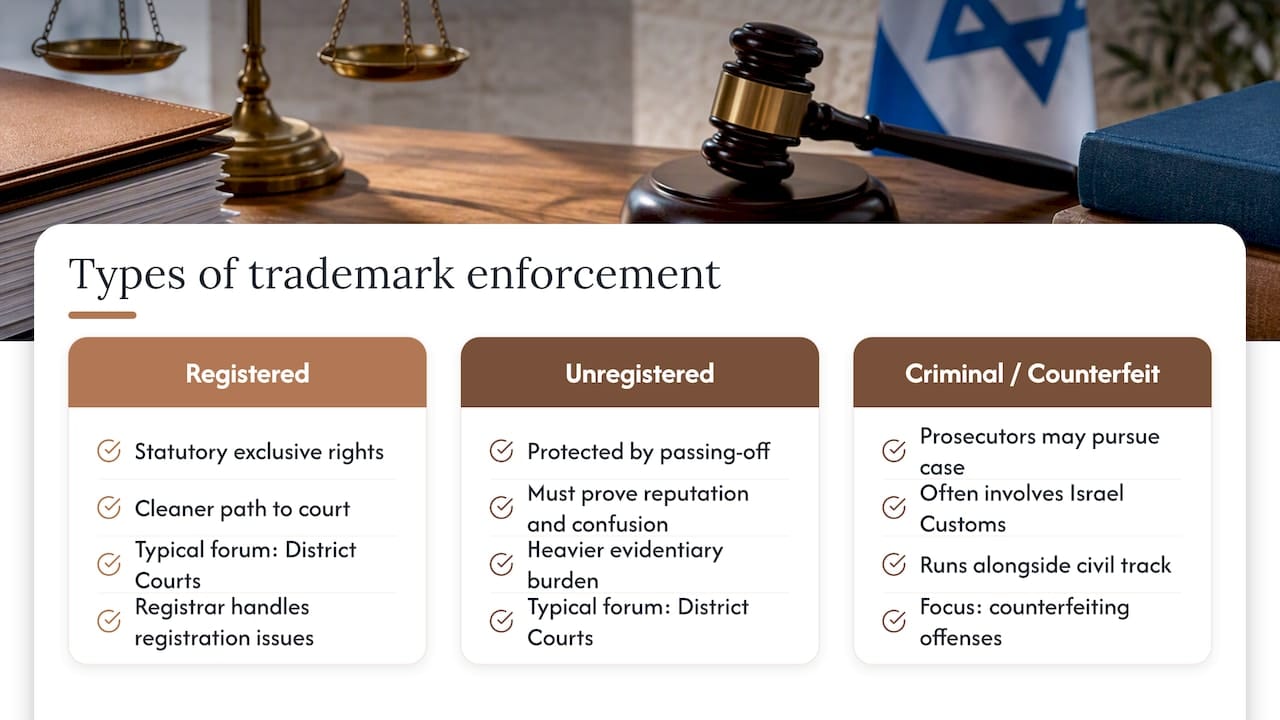
It also helps to understand the difference between registered rights and unregistered claims. A registered mark gives you a clean statutory path to court. An unregistered mark can still be protected under passing-off principles, but that route generally asks you to prove reputation and consumer confusion from scratch, which takes more time and evidence. Civil claims for infringement typically go to the District Courts, while disputes over whether a mark should be registered, opposed, or canceled go through the Registrar. Criminal cases involving counterfeiting bring prosecutors and, often, Israel Customs into the picture alongside the civil track.
Civil and criminal remedies available to trademark owners
Israeli law gives rights holders a real range of tools, and the right choice depends on how fast you need to act and how much damage has already occurred.
- Interim relief, including ex parte orders granted before the other side is notified, injunctions, asset attachment, and search and seizure orders, is available when a court is satisfied that urgent action is needed to prevent further harm.
- Final civil remedies include permanent injunctions, an accounting of the infringer’s profits, damages, delivery up or destruction of infringing goods, and an award of legal costs.
- In limited cases, Israeli law allows compensation without the need to prove actual financial loss, which can matter when damages are hard to quantify.
- Criminal sanctions for counterfeiting can include imprisonment and substantial fines, with corporate fines potentially doubled for company defendants, according to the WIPO summary of Israeli trademark law.
Fines for counterfeiting under Israeli law can reach into the hundreds of thousands of shekels, with reporting citing figures as high as 1.5 million shekels and doubled fines for corporate offenders, according to the WIPO trademark summary for Israel. That exposure is one reason counterfeiters often settle rather than fight a criminal referral.
Israel also runs coordinated enforcement across agencies. Customs can detain suspected counterfeit imports at the border, and a dedicated IP enforcement structure links customs, prosecutors, and civil courts, based on a WIPO enforcement survey covering Israel.
A realistic timeline and what drives your legal costs
Enforcement in Israel tends to follow a predictable arc, even though every case has its own wrinkles. Knowing the stages helps you budget time and money before you commit to a strategy.
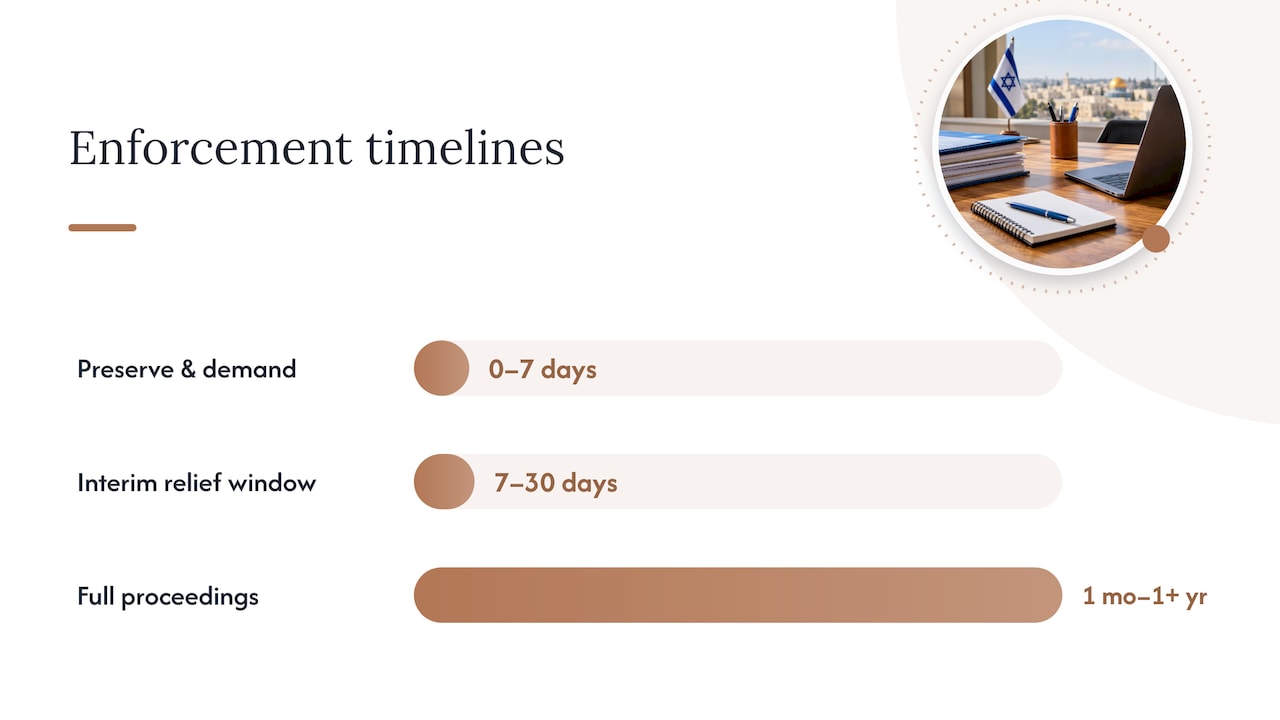
- Preserve evidence and send a demand letter within the first zero to seven days after you discover the infringement.
- Expect a window of roughly seven to thirty days if you are pursuing interim relief, since courts move faster when urgency is demonstrated.
- Full proceedings, or a negotiated settlement, commonly run from one month to over a year depending on complexity and how the other side responds.
Your strongest evidence package includes the registration certificate, proof of first use, marketing spend records, sales data, marketplace listings showing the infringing goods, and any communications with the infringer. Cost drivers include how urgently you need a hearing, how broad the seizure request is, whether you need expert or forensic reports, and whether the goods involved cross international borders.
Pro Tip: If imports are involved, loop in customs coordination early. Waiting until goods have already cleared the border removes one of your fastest enforcement options.
Settling out of court versus taking the case to trial
Litigation is not always the right answer, and Israeli practice leaves plenty of room for negotiated outcomes. Common settlements include licensing arrangements, phased rebranding schedules that give an infringer time to transition away from your mark, limited-use agreements tied to specific goods or territories, and occasional cross-licenses.
Any settlement should include clear territorial and industry limits, quality control provisions, a termination clause triggered by breach, and enforcement mechanisms that let you act quickly if the other side does not comply. One caution worth flagging: co-existence agreements between private parties do not bind the Israel Trademark Office, and the Registrar retains administrative discretion over registration decisions, per the Chambers and Partners practice guide. Weigh the cost of litigation against market disruption, how enforceable the deal will actually be in Israel, and reputational exposure before deciding whether to settle or push forward to court.
Our take on protecting a trademark from abroad
Legal services can be handled remotely, with on-site consultations available when a case calls for it. The clients who fare best are the ones who registered early and kept an eye on their market, since a documented history of use and monitoring gives a court far less room for doubt. Bring your registration certificate, evidence of infringement, and a clear timeline to your first consultation, and we will map out whether customs coordination or a criminal complaint should be part of your strategy.
— Menora Law
How Menora Law helps you enforce your rights in Israel
International rights holders often assume Israeli enforcement means flying in and navigating an unfamiliar court system alone. It does not. Clients can be represented throughout the entire process, from initial assessment through customs coordination, without requiring physical presence in Israel.
Trademark enforcement work typically includes:
- A legal assessment of infringement claims and registration strength.
- Guidance on preserving evidence and drafting demand letters.
- Filing for interim injunctions when urgent relief is needed.
- Litigation representation before the District Courts or the Registrar.
- Customs notifications and coordination for infringing goods crossing into the country.
- Negotiated licensing or settlement agreements as alternatives to trial.
If you are a rights holder outside Israel dealing with infringement, reach out through Lei Menora with your registration details and a summary of what you have found. We will tell you plainly what your options are and how fast we can move.
Sources
For readers who want to check the underlying law directly, these are the primary sources behind this guide:
- Trade Marks Ordinance (New Version), 5732-1972 — WIPO Lex
- Israel government trademark department pages
- Trade Marks & Copyright 2026 – Israel | Chambers and Partners
This article is general information, not a substitute for advice from a qualified lawyer. Consult a qualified legal professional about your own circumstances before acting on anything here.
Perguntas frequentes
What counts as trademark infringement under Israeli law?
Infringement happens when someone uses a mark identical or confusingly similar to your registered trademark on the same or similar goods or services, in a way likely to deceive consumers. Israeli courts weigh visual, phonetic, and conceptual similarity along with the type of customer and sales channel involved.
Can I get emergency relief before a full trial in Israel?
Yes, Israeli courts can grant interim relief, including ex parte orders issued before the other party is notified, when urgency is shown. This can include injunctions, asset attachment, or search and seizure orders while the main case proceeds.
What penalties apply to trademark counterfeiting in Israel?
Counterfeiting can carry criminal penalties including imprisonment and significant fines, with fines potentially doubled for corporate defendants, according to the WIPO summary of Israeli trademark law. Civil remedies like damages and destruction of goods can also apply alongside or instead of criminal charges.
Do I need to be in Israel to enforce my trademark there?
No, Menora Law represents international clients throughout Israeli enforcement matters remotely, with on-site consultations available when needed. You do not need to travel to Israel to pursue civil or criminal remedies against an infringer.
How long does trademark enforcement typically take in Israel?
Initial evidence preservation and demand letters usually happen within the first week. Interim relief, when pursued, tends to move within seven to thirty days, while full proceedings or settlement negotiations can run from one month to over a year depending on complexity.

 English
 Afrikaans
 العربية
 বাংলা
বাংলা Čeština
 简体中文
简体中文 Nederlands
 Suomi
Suomi Français
 Deutsch
 עִבְרִית
 हिन्दी
 Magyar
 Italiano
 日本語
日本語 한국어
한국어 Polski
 فارسی
فارسی Português do Brasil
 Русский
 Español de México
 Українська