
A combination deal (עסקת קומבינציה) exchanges part of a landowner’s rights for construction services instead of cash, and Israeli law treats that exchange as a taxable sale. For a foreign landowner, this means a filing clock starts the day the contract is signed. Before giving up any rights, you need tax planning in place and contractual guarantees locked into the agreement.
TL;DR:
- Both parties must report the deal within 30 days of signing; foreign owners need certified home country residency evidence to seek capital gains tax relief.
- Base your share on an independent licensed appraisal, projected unit prices, construction costs, and the developer’s expected margin; compare the residual value with the apartments offered.
- Require bank guarantees covering promised units, stage land transfers by construction milestone, and retain title rights until the apartments are registered in your name.
- Check land classification and title before signing: foreign participation is generally allowed, but lease restrictions or unresolved inheritance can block a transfer.
- Developers often finance construction by preselling their units, so stalled sales can delay building; verify the developer’s Israeli track record before committing.
How a combination deal works under Israeli law
In a typical structure, you transfer a defined share of your land rights to a developer, who in turn builds apartments on the remaining share and hands some of them back to you instead of paying cash. The split varies by project, but owners typically keep part of the finished units while the developer takes the rest to sell and fund construction.
Developers usually finance the build by presales of their own share of units, which is exactly where the risk sits for you: if those sales stall, construction can stall with them. Title and registration are often phased, so your legal rights to the land may not fully convert into rights over finished apartments until specific milestones are met.
Under the Government of Israel, Real Estate Taxation Law 5723-1963 is the statute that frames this barter as a sale of land rights, which is why tax liabilities attach immediately, even though no cash changes hands.
- Land rights transfer to the developer in exchange for construction value, not money.
- Developers typically fund the build through sales of their own unit allocation.
- Registration of the owner’s finished units is often staged across construction milestones.
Working out your fair share of the deal
Before agreeing to a split, run the numbers yourself by following due diligence practices in real estate investing. The core inputs are the land’s current value, the projected sale price per finished unit, the estimated construction cost per unit, and the developer’s expected margin.
- Estimate your land’s market value using a licensed appraiser’s figure, not the developer’s offer.
- Multiply the projected number of units by their expected sale price to get total project value.
- Subtract estimated construction costs and a reasonable developer margin to see what’s left for you.
- Compare that residual value to the number and size of apartments you’re being offered.
As an illustrative example only, a plot can be valued at several million NIS, with a developer planning multiple units whose total projected sales less construction costs and margin leaves a residual value that should roughly equal the owner’s share in apartments.
Pro Tip: Ask for indexation clauses tied to construction cost inflation and a price floor, so a market downturn doesn’t quietly shrink your share.
Tax rules and the forms you must file
A combination deal creates two simultaneous tax events: you, as the seller, face capital gains tax (מס שבח) on the land rights you give up, and the developer faces purchase tax on what they acquire. The tax base is generally measured by the value of the construction services you receive in exchange for your land share.
Under Section 73 of the Real Estate Taxation Law, both sides must declare the transaction to the Israel Tax Authority within 30 days of signing, regardless of whether money actually changed hands. Missing that window can trigger penalties, so the deadline deserves attention from day one.
- Form 7000 is the standard declaration for many real estate sales.
- Forms 7000b and 7002 apply to specific tax situations and need attachments like contract copies and title deeds.
- These forms inform the tax assessor’s calculation of liabilities.
Foreign residents do not receive an automatic exemption from capital gains tax. Qualifying for relief typically requires certified residency evidence from your home country’s tax authority, reviewed through the Israel Tax Authority’s declaration process.
We help clients assemble residency evidence, negotiate tax-related advances before signing, and prepare the correct 7000-family filing on time.
The real risks and the securities that protect you
The biggest threats in a combination deal are developer insolvency, construction delays, registration failures, and liens attached to the project that surface after you’ve already signed away land rights.
- Developer insolvency can leave a project half built with no clear path to completion.
- Delays push back when you receive your apartments and when related tax events crystallize.
- Registration failures can leave your promised units legally unsecured for years.
- Undisclosed liens on the land or project can complicate your eventual title.
The fix is to demand specific securities before you sign, not after. Insist on bank guarantees covering the value of your promised units, phased transfers tied to construction milestones rather than a single handover at the end, performance bonds, and retention of certain title rights until your apartments are fully registered in your name.
Pro Tip: Verify the developer’s standing and project history in Israel before negotiating anything else, since a guarantee is only as strong as the company backing it.
Contract clauses foreign owners should insist on
A combination deal contract is where most of your protection either gets built in or gets left out. Before signing, work through these points:
- Exact apartment specifications: size, finishes, floor plan, and a clear defects remedy process with deadlines.
- Acceptance criteria defining what “complete” means before you’re obligated to accept delivery.
- Registration sequencing that ties each stage of your title transfer to a completed construction milestone.
- Remedies for breach, including liquidated damages and step-in rights if the developer defaults.
- Escrow or guarantee-backed payment structure, plus clear indemnities covering VAT and tax exposure.
- A dispute resolution mechanism, such as arbitration, specified in advance rather than left to chance.
If you can’t be in Israel for signing, a properly drafted power of attorney lets your lawyer execute documents on your behalf. For a broader look at contract red flags specific to foreign signers, see our checklist on Israeli contractor agreements.
What a realistic timeline looks like
Most combination deals move through four phases, and each one carries its own paperwork deadlines.
- Due diligence and valuation: typically several weeks to confirm land value, title status, and developer background before any contract is signed.
- Permits and construction start: timing depends on municipal planning approval, which can add months before groundbreaking.
- Mid-build milestones: partial registration or guarantee releases are often tied to completion percentages.
- Final handover and registration: your apartment transfers formally once construction and inspections are complete.
Tax declarations under forms 7000, 7000b, and 7002 are due within 30 days of signing, not at handover, so the clock starts long before you see a finished building. For a closer look at how remote due diligence timelines work for foreign owners, our guide to remote property due diligence walks through the sequence in detail.
How we support foreign landowners through the process
Before signing anything, we ask clients for a short set of documents: proof of tax residency, a title search on the land, background on the proposed developer, and draft bank guarantee language to review.
From there, we work entirely by remote engagement. You upload documents through secure channels, we respond within agreed turnaround windows, and we handle the Israeli-side filings, including the 7000-family forms, directly with the tax authority. Most engagements begin with a document review and an initial risk assessment, followed by contract negotiation support once we understand your position. Clients abroad never need to travel to Israel for this work to move forward.
Who can legally take part in a combination deal
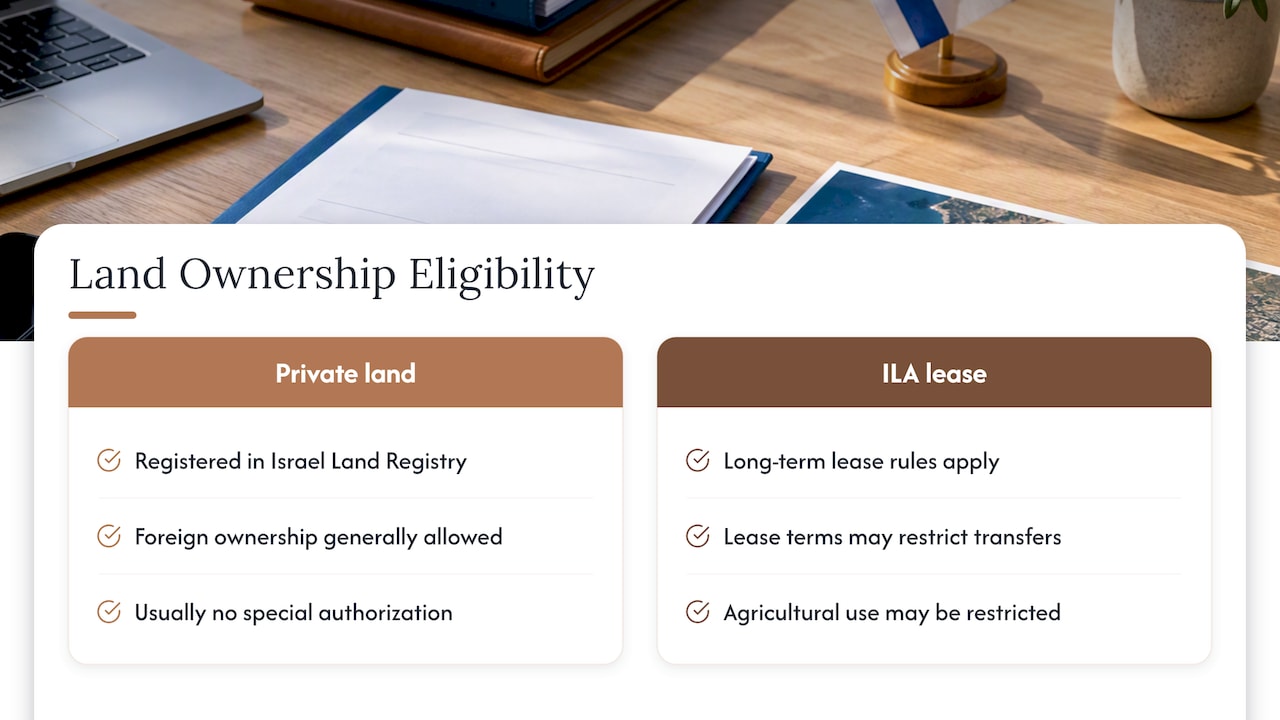
Foreign nationals can own land in Israel and enter combination deals in most circumstances, but eligibility depends on the type of land and its registered status. Privately owned land, registered in the Israel Land Registry, generally allows foreign ownership and participation in these transactions without special authorization.
Land leased from the Israel Land Authority carries different rules, since much of Israel’s land remains under long-term lease rather than private freehold, and foreign nationals may face additional requirements or restrictions depending on the lease terms and the land’s classification. Agricultural land, in particular, often carries use restrictions that affect whether a combination deal for residential construction is even permitted.
Before entering a combination deal, we confirm the land’s registration category and whether any lease conditions apply, since this determines what you can legally agree to with a developer. A deal structured on land you don’t have clear standing to transfer is a deal that can unravel in court, regardless of how favorable the terms look on paper.
Foreign ownership itself is not the barrier most people assume it to be. The actual restrictions tend to sit in the land’s legal classification, prior lease commitments, or inheritance history, which is why a title and status check should always come before contract negotiation, not after.
Approvals foreign investors need before proceeding
Foreign investors generally do not need special government authorization simply to enter a combination deal, but several practical approvals still apply depending on the land and the transaction structure.
If the land is leased from the Israel Land Authority, transferring or restructuring rights as part of a combination deal may require the Authority’s consent, since the lease terms often restrict how those rights can be assigned to a developer. Municipal planning approval is also required for the construction itself, independent of who owns the land, and this approval process can take considerably longer when the proposed building exceeds existing zoning for the parcel.
Foreign owners sometimes assume their nationality triggers a separate approval track. It generally does not. What matters is the land’s classification and the project’s planning status, which apply the same way regardless of the owner’s country of residence. Where currency controls or banking documentation come into play, Israeli banks may request additional verification for funds moving internationally, which is a banking requirement rather than a government permit.
We review the land’s lease and zoning status early in every engagement, as approval requirements often surface in the fine print of a lease agreement rather than in a separate application process.
Municipal charges and planning rules after the deal
Once your combination deal results in new apartments registered in your name, you become responsible for the ongoing municipal charges attached to those units, most notably arnona, the local property tax assessed by the municipality based on unit size, location, and use classification.
Foreign ownership does not change the arnona rate itself, but it can affect practical administration: payment notices are sent to the registered address, and a foreign owner without a local representative can miss deadlines simply due to distance. Setting up local payment arrangements or a power of attorney for municipal correspondence avoids this.
Planning regulations apply identically to local and foreign owners, but the combination deal process itself often depends on local zoning changes, since developers frequently pursue a betterment process to increase buildable density before construction starts. That process can trigger its own municipal betterment levy, separate from your personal tax obligations, and it’s worth clarifying in the contract who bears that cost.
Managing currency transfers during the deal
Combination deals rarely involve large cash transfers from you, since the payment takes the form of construction services rather than money. Still, related costs, professional fees, tax advances, or guarantee deposits, often do require moving funds internationally, and that’s where currency risk and banking friction show up.
Israeli banks apply anti-money laundering checks to incoming international transfers, and foreign-sourced funds typically require documentation showing their origin before a bank will process them without delay. Planning this in advance, rather than scrambling when a deadline is close, avoids holding up a filing or a guarantee payment.
Exchange rate movement between your home currency and the shekel can also affect the real cost of fees or advances paid over a multi-month or multi-year construction timeline. Locking in transfer timing around major milestones, rather than converting everything at once, is one practical way clients manage this exposure. We help clients prepare the documentation Israeli banks expect for incoming transfers, which keeps funds moving without unnecessary delay.
Inheritance and combination deals on inherited land
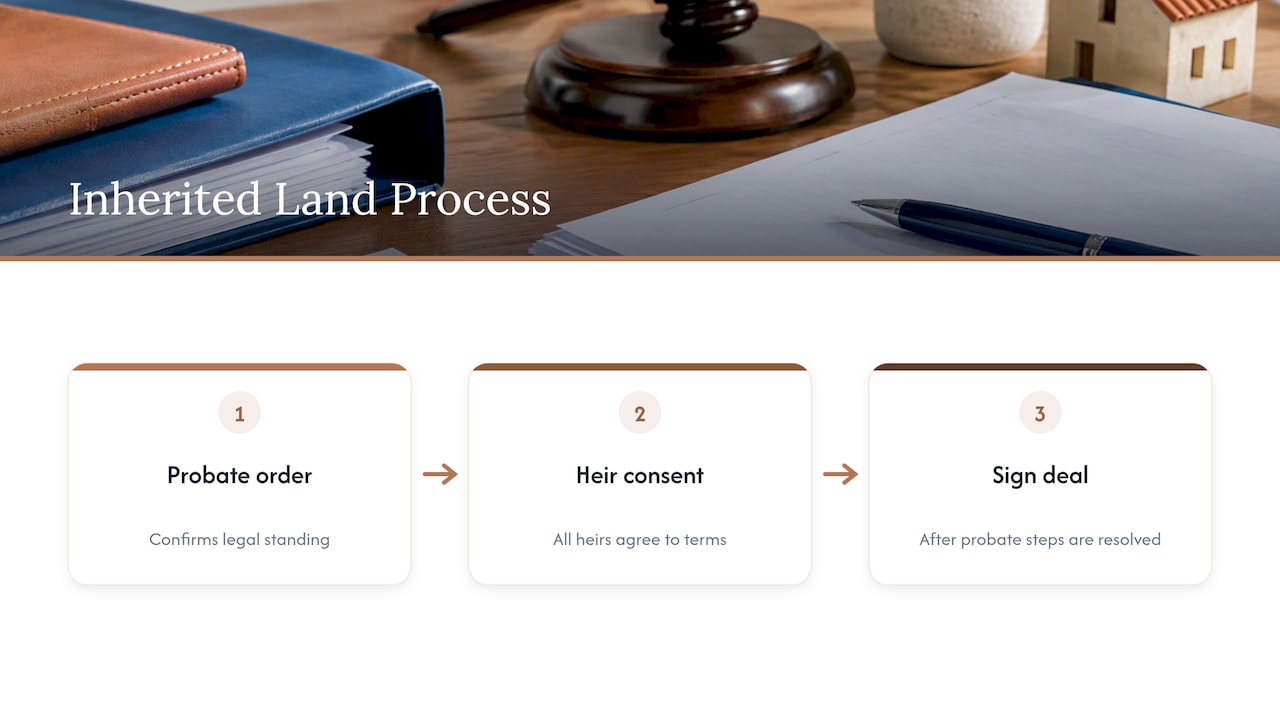
When the land involved in a combination deal came to you through inheritance, an extra layer of Israeli legal process usually needs to be resolved first. Before you can validly sign as the land’s owner, you typically need a probate order or inheritance order from the relevant Israeli authority, confirming your legal standing to act on the estate’s property.
If multiple heirs inherited the land jointly, all heirs generally need to agree to the combination deal’s terms, since no single heir can unilaterally commit shared land to a construction agreement without the others’ consent. This becomes more complex when heirs live in different countries, which is common among foreign-owned Israeli land passed down across generations.
We often see cases where inherited land sits unused for years precisely because heirs abroad never completed the Israeli probate steps needed to establish clear title. Resolving that first, before any developer discussion begins, protects you from signing a contract that a court could later unwind for lack of proper standing. If your land is part of an estate still working through Israeli succession, our guide on unlocking Israeli assets after a cross-border death walks through the steps heirs abroad typically need to take.
Why specialist Israeli counsel matters here
We have experience guiding clients through complex, multi-stage Israeli legal matters and know that combination deals require careful contract review. Remote representation and fast response channels mean you never have to be in Israel to protect your position.
— Menora Law
How we help you move forward with confidence
We prepare and review real estate contracts, handle the tax filings a combination deal requires, and represent clients entirely remotely from wherever you’re based. If you’re holding land in Israel and weighing a developer’s offer, our team can step in at any stage, from early valuation checks through final registration.
- We draft and negotiate combination deal contracts.
- We prepare and file the required Israeli tax declarations and forms.
- We coordinate entirely by remote channels, so you never need to travel to Israel.
To get started, gather your title documents, any existing developer proposal, and proof of your tax residency, then reach out through our primary services page to begin a review.
This article is general information, not a substitute for advice from a qualified lawyer. Consult a qualified legal professional about your own circumstances before acting on anything here.
Perguntas frequentes
What exactly counts as a combination deal in Israel?
A combination deal is an arrangement where a landowner transfers part of their land rights to a developer in exchange for finished apartments instead of cash. Israeli law treats this barter as a taxable sale of land rights, which is why it carries the same filing obligations as a cash transaction.
Do foreign owners pay the same capital gains tax as Israeli residents?
Foreign owners are subject to capital gains tax (מס שבח) on a combination deal just like Israeli residents, with no automatic exemption simply because of foreign status. Qualifying for any available relief usually requires certified residency documentation reviewed through the official Israel Tax Authority declaration process.
How soon must the transaction be declared to the tax authority?
Both the seller and the developer must declare the transaction within 30 days of signing, using the appropriate form from the 7000 family depending on the tax route. This deadline applies even though no cash changes hands in a combination deal.
What happens if the developer doesn’t finish the project?
This is the core risk in any combination deal, which is why bank guarantees, phased transfers tied to construction milestones, and retained title rights until completion are standard protections to negotiate before signing. Verifying the developer’s track record in Israel before committing reduces this risk further.
Can heirs abroad sign a combination deal on inherited Israeli land?
Heirs generally need a completed Israeli probate or inheritance order establishing clear title before signing, and if multiple heirs are involved, all typically must agree to the deal’s terms. Resolving inheritance status first avoids a contract that could later be challenged for lack of proper legal standing.

 English
 Afrikaans
 العربية
 বাংলা
বাংলা Čeština
 简体中文
简体中文 Nederlands
 Suomi
Suomi Français
 Deutsch
 עִבְרִית
 हिन्दी
 Magyar
 Italiano
 日本語
日本語 한국어
한국어 Polski
 فارسی
فارسی Português do Brasil
 Русский
 Español de México
 Українська