
TL;DR:
- Claiming an Israeli inheritance from abroad is possible without traveling if you obtain a succession or probate order and work with qualified legal counsel under a notarized, Apostilled power of attorney. The process involves identifying assets, gathering certified documents, and filing through the Registrar of Inheritance Affairs, which provides a legally recognized order for asset transfer. Most cases conclude within 40 to 50 days, with no inheritance tax in Israel, but proper documentation and proactive follow-up are essential to prevent delays and ensure timely asset release.
Yes, you can claim an inheritance in Israel from abroad. The legal key is obtaining a succession order (tzav yerusha) or a probate order (tzav kiyum tzava) from the Registrar of Inheritance Affairs (Rasham HaYerushot) and instructing an Israeli attorney under a notarized, Apostilled power of attorney. You do not need to fly to Israel in most cases. What you do need is the right documents, certified correctly, and qualified Israeli counsel who knows how to move a file through the Registrar, the banks, and the Israel Land Registry without it stalling.
Here are the first four steps to take right now:
Identify every Israeli asset you know about: bank accounts, real estate, pension funds, insurance policies, business interests.
Gather your core documents: death certificate, your passport, and proof of your relationship to the deceased (birth or marriage certificate).
Apostille those documents in your country and arrange certified Hebrew translations.
Engage an Israeli inheritance attorney, such as Menora Law, and sign a power of attorney so they can file with the Registrar on your behalf.
The Israel Tax Authority (Mas Hachnasa) may also be involved after the order is issued, particularly if banks request a tax clearance letter before releasing funds. Knowing that up front saves weeks of confusion later.
Which types of Israeli assets can you claim from abroad?
Under the principle of lex situs, assets are governed by the law of the country where they are physically located. That means Israeli law applies to every asset situated in Israel, regardless of where the deceased lived or died. Before you file anything, you need to know what you are actually claiming.
The most common asset categories foreign heirs encounter:
- Bank and brokerage accounts: Israeli banks freeze accounts immediately upon notification of death. No funds move until a court-issued succession or probate order is presented. Accounts dormant for seven years may have been transferred to the Accountant General under the Unclaimed Assets Law; heirs can still recover those funds, but the process involves a separate formal application.
- Real estate: Privately owned property is registered in the Land Registry Bureau (Tabu). State-leased land is administered by the Israel Lands Authority (Minhal). Both require separate registration steps after the inheritance order is issued; the order alone does not transfer title automatically.
- Pension funds and provident plans: Israeli pension providers have their own compliance procedures and typically require the succession or probate order plus identity verification before releasing accumulated funds.
- Life insurance payouts: Policies with named beneficiaries may bypass the estate process entirely, but policies payable to “the estate” require the full inheritance order.
- Securities and brokerage accounts: Held at Israeli brokerages or through Israeli custodians; released only after the order and identity checks are complete.
- Corporate shares and business interests: Require additional corporate documents and, in some cases, shareholder agreement review before transfer.
- Unclaimed assets held by the Accountant General: If a bank account went dormant before the death, the funds may already sit with the Accountant General. Recovery requires a formal application on top of the standard inheritance process.
A practical starting point is to search the deceased’s name in Israeli bank records and the Tabu registry. An Israeli attorney can run those searches on your behalf using a power of attorney, which is often the fastest way to build a complete asset picture before filing.

Who qualifies as a legal heir under Israeli succession law?
The answer depends on whether the deceased left a valid will. Israeli succession law offers two distinct paths, and the one that applies to your situation determines both the documents you need and the timeline you should expect.
When there is no will: succession order
Without a will, the estate is distributed according to the Israeli Inheritance Law of 1965. The priority order runs: spouse and children first (sharing equally, with the spouse receiving at least half), then parents, then siblings, and then more distant relatives. To claim assets under this path, heirs must file for a tzav yerusha (succession order) with the Registrar of Inheritance Affairs. The Registrar, not a court, handles most straightforward intestate cases, which keeps the process faster than full litigation.
When there is a will: probate order
A valid will overrides the default statutory order. Heirs or executors apply for a tzav kiyum tzava (probate order) to validate the will and establish legal authority over the estate. The will’s contents then govern distribution.
Foreign wills present an added layer. A will drafted abroad and valid under the laws of the country where it was made can generally be recognized in Israel under Sections 136–140 of the Israeli Inheritance Law. However, the Registrar or Family Court will often require a certified Hebrew translation and a legal opinion on foreign law, which is an expert affidavit explaining to the Israeli authority that the will is valid under the relevant foreign jurisdiction’s rules. That extra step can push the file to Family Court and extend the timeline considerably.
Confirming your legal standing before filing is the single most important preliminary step. Menora Law routinely confirms heir status for overseas clients remotely, reviewing the family structure and the deceased’s documents before any application is submitted.
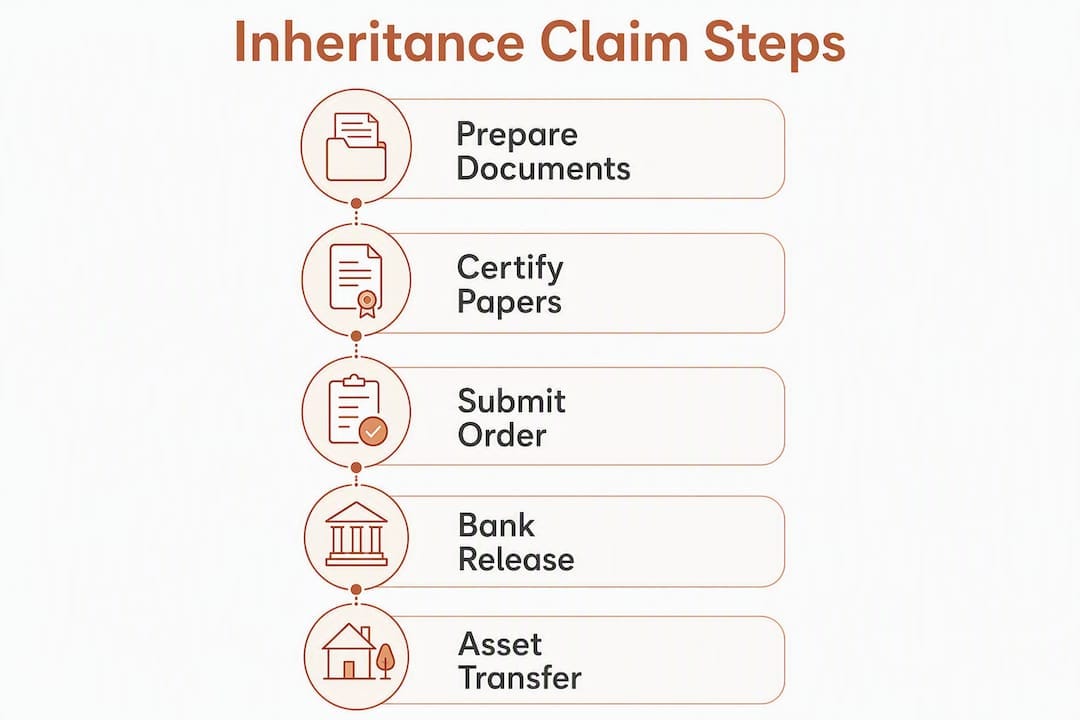
How to claim an inheritance in Israel from abroad, step by step
The Registrar of Inheritance Affairs is the central authority that issues the succession or probate order. That order is the legal document banks, the Tabu, pension providers, and other institutions accept before releasing or transferring assets. Everything below flows from obtaining it.
Identify and locate Israeli assets. Compile every account number, property address, pension provider name, and insurance policy you know about. Your Israeli attorney can run formal searches with the Tabu registry and contato banks using a power of attorney to identify accounts you may not know exist.
Collect and Apostille your documents. The core set includes: original death certificate (Apostilled), your passport (notarized copy), proof of relationship (birth or marriage certificate, Apostilled), and the original will if one exists. Every document issued outside Israel must carry an Apostille from the competent authority in the issuing country.
Arrange certified Hebrew translations. Every foreign-language document must be accompanied by a certified Hebrew translation. Use a certified translator; the Registrar will reject uncertified translations.
Sign and Apostille a power of attorney. The POA authorizes your Israeli attorney to file the application, handle publication, receive the order, present it to banks and the Tabu, and sign registration forms on your behalf. Sign it before a local notary, then Apostille it. Some heirs use the Israeli consulate in their country for notarization, which can simplify the authentication chain.
Attorney files with the Registrar and arranges publication. By law, notice of the application must be published in a daily Israeli newspaper and the Official Gazette (Yalkut HaPirsumim). This publication window, typically 14 days, allows creditors or undisclosed heirs to come forward.
Registrar review and possible referral. The Registrar’s legal team reviews the file. When the deceased or heirs are foreign residents, the file is often forwarded to the Representative of the Attorney General for review. The Registrar typically issues a succession order within 40 days when the submission is complete; files referred to the Attorney General’s Representative may take around 50 days or longer. Proactive follow-up by your attorney is the most effective way to prevent the file from stalling in that review loop.
Issuance of the digital order. Once approved, the Registrar issues a digital order and distributes it to relevant government ministries, banks, and insurance companies. Your attorney should still retain certified copies, because some institutions insist on locally certified paperwork or additional identification before completing payment or registration.
Present the order to banks, Tabu, and pension providers. Your attorney presents the order and certified copies to each institution. Banks will conduct their own internal compliance review at this stage.
Obtain tax clearance if required. Israeli banks commonly request an Ishur Mas (tax clearance letter) from the Israel Tax Authority before releasing funds. Your attorney coordinates this step.
Transfer or register assets and close the estate. For bank accounts, funds are released to the heirs’ designated accounts once compliance is satisfied. For real estate, the attorney registers the inheritance at the Tabu or, for state-leased land, with the Israel Lands Authority. If the heirs intend to sell the property, title must be registered in the heirs’ names before any sale contract can be signed.
Pre-filing checklist to hand your attorney or consular notary:
- Apostilled death certificate + certified Hebrew translation
- Notarized passport copies for all applicants
- Apostilled birth/marriage/adoption certificates + translations
- Original will (if any) + certified Hebrew translation
- Signed and Apostilled power of attorney
- List of known Israeli assets with account numbers and addresses
- Israeli ID number (mispar zehut) of the deceased, if available
What documents do you need, and how do you certify them?
Getting the document authentication right before filing is the single most effective way to avoid months of delay. The Registrar will not process an incomplete or improperly certified file, and every round-trip to fix a document adds weeks.
Full document list:
- Death certificate: Original, Apostilled by the issuing country’s competent authority, plus a certified Hebrew translation.
- Original will (if applicable): Submitted as-is, with a certified Hebrew translation. Foreign wills may also require a legal opinion on foreign law.
- Passport copies for all applicants: Notarized; some institutions also require Apostilles on notarized copies.
- Birth, marriage, or adoption certificates: Apostilled and translated into Hebrew. Adoption certificates must reflect a court-finalized adoption to be recognized for inheritance purposes.
- Power of attorney: Signed before a local notary, Apostilled, and translated into Hebrew. The POA should explicitly authorize the attorney to file with the Registrar, handle publication, receive the order, present it to banks and registries, and sign Tabu registration forms.
- Israeli ID number of the deceased (mispar zehut): If you have it, include it. If not, your Israeli attorney can often locate it through official channels.
- Asset list and account numbers: Not a certified document, but a clear, organized list speeds up bank and registry searches.
- Corporate documents: If business interests are part of the estate, include articles of incorporation, shareholder registers, and any relevant agreements, translated and notarized.
How to apostille correctly:
The Apostille is issued by the competent authority in the country that issued the document, not the country where you live. For a document issued in the United States, the Secretary of State for the relevant state typically issues Apostilles. Confirm the correct authority for each document’s country of origin before submitting.
Translation guidance:
Translations must be done by a certified Hebrew translator. Attach the translation directly to the original document and include the translator’s certification statement. The Registrar may request additional certification of the translator’s credentials in complex cases.
Pro Tip: The most common causes of multi-month delays are Apostilles obtained from the wrong authority and translations that lack the translator’s formal certification statement. Menora Law provides clients with a document-by-document checklist that specifies the exact authority and format required for each item before anything is sent.
Do you need to travel to Israel to claim an inheritance?
In most cases, no. Foreign heirs rarely need to travel to Israel if they provide properly Apostilled documents and a clear power of attorney. An Israeli attorney acting under a POA can complete the Registrar filing, handle publication, obtain the digital order, and present certified copies to banks and the Tabu, all without the heir setting foot in Israel.
What the POA must cover
A well-drafted POA for inheritance purposes should explicitly authorize the attorney to:
- File the succession or probate application with the Registrar
- Arrange and pay for newspaper and Official Gazette publication
- Receive the inheritance order on the heir’s behalf
- Present the order to banks, pension providers, and insurance companies
- Sign Tabu registration forms and related conveyancing documents
- Instruct property sales or rental arrangements if the heir authorizes it
A narrow or vaguely worded POA creates problems at the bank or Tabu stage, where institutions may refuse to act without specific authorization language.
When travel may still be required
Some Israeli banks, particularly for large transfers involving foreign nationals, request in-person identity verification. If the estate involves a contested hearing before the Family Court, personal attendance may be required. Heirs who want to make real-time decisions about selling a property sometimes prefer to be present for negotiations, though this is a preference rather than a legal requirement.
Pro Tip: Menora Law uses video-identity verification and coordinates with Israeli consulates in the client’s country to handle notarization and identity checks remotely wherever possible. For the vast majority of straightforward estates, clients complete the entire process without traveling.
What are Israel’s tax rules on inheritance, and what should you report?
Israel does not impose an inheritance or estate tax. Israel abolished its estate tax in 1981, and there is no Israeli “death tax” on the value of assets you inherit. This applies to both residents and non-residents inheriting Israeli assets.
That said, there are practical compliance steps that arise after the order is issued.
Israeli banks commonly require an Ishur Mas (tax clearance letter) from the Israel Tax Authority before releasing funds. This is not an inheritance tax; it is a confirmation that the deceased had no outstanding tax liabilities that would encumber the estate. Your Israeli attorney requests this letter as part of the post-order process. The documents the Israel Tax Authority or banks typically ask for at this stage include:
- The succession or probate order
- Identity documents for all heirs
- Source-of-funds statements where large transfers are involved
- The deceased’s Israeli tax identification number
One important boundary: Menora Law advises on Israeli law only. What you owe in your country of residence when you receive inherited funds is a separate question entirely, and one you should take to a qualified tax advisor in your home country. Reporting obligations for foreign inheritances vary by jurisdiction, and the rules can be complex. Get that advice before funds are transferred.
Common delays foreign heirs face, and how to avoid them
Most problems in Israeli inheritance claims are predictable and preventable. Here is what actually causes files to stall, and what to do about each one.
- File referred to the Representative of the Attorney General. When the deceased or heirs are foreign residents, the Registrar often forwards the file for state review. This is procedural, not a sign of a problem, but it adds time. The fix is proactive follow-up by your Israeli attorney, who can monitor the file’s status and push for timely review.
- Missing or incorrect Apostilles. An Apostille from the wrong authority, or a document that needed an Apostille but didn’t get one, sends the file back to square one. Prepare a document-by-document authentication checklist before anything is submitted.
- Untranslated or improperly certified translations. The Registrar requires certified Hebrew translations for every foreign-language document. A translation without the translator’s formal certification statement will be rejected.
- Unknown accounts or missing account numbers. If you don’t know all the deceased’s Israeli accounts, your attorney can run formal bank searches. Do this before filing so the order covers all known assets.
- Creditor claims. The publication period exists precisely to allow creditors to come forward. If a creditor files a claim, the estate cannot be distributed until it is resolved. Your attorney should review the deceased’s known liabilities before filing and advise on how to handle any claims that surface.
- Tabu title complications. Some older Israeli properties are not fully registered in the Tabu, or carry encumbrances. A title search before filing reveals these issues early, when they are easier to address.
- Foreign will with formal discrepancies. A will that is valid under foreign law but does not meet Israeli formal requirements may require a legal opinion on foreign law and a Family Court hearing. Identify this issue at the outset, not after filing.
- Competing claimants. If another person asserts heir status, the matter moves to the Family Court. Engage an attorney immediately if you learn of a competing claim.
Red flags that require immediate legal involvement: a competing claimant appears, the will has formal discrepancies under Israeli law, the state asserts an interest in the assets, or the estate involves business interests with other shareholders.
What timelines and costs should you realistically expect?
Timelines vary by case complexity, but the ranges below reflect typical experience for straightforward international estates.
| Step | Typical time range | Who handles it |
|---|---|---|
| Document gathering and Apostille | 2–6 weeks | Heir, with attorney checklist |
| POA notarization and Apostille | 1–2 weeks | Heir (local notary or consulate) |
| Filing and publication period | 2–3 weeks | Israeli attorney |
| Registrar review (standard file) | ~40 days from complete submission | Registrar |
| Registrar review (AG referral) | around 50 days or longer | Registrar / AG’s office |
| Probate/succession order issuance | 2–4 months typical; 6+ months if contested | Registrar or Family Court |
| Bank processing after order | 2–6 weeks | Bank compliance + attorney |
| Tabu registration or property sale | Variable; weeks to several months | Attorney / conveyancer |
Cost factors to budget for:
- Attorney fees: Menora Law offers an initial fixed-fee intake covering document review, heir status confirmation, and a timeline estimate. Subsequent work (filing, bank follow-up, Tabu registration) is typically structured as itemized fees by task rather than open-ended hourly billing, which gives international clients predictable costs.
- Translation and Apostille costs: Charged per document. A typical estate involves five to ten documents requiring both steps.
- Publication fees: Required by law; your attorney arranges and pays these on your behalf and invoices you.
- Tabu registration fees and municipal taxes: Apply if real estate is being registered or sold; amounts depend on property value and municipality.
- Tax clearance coordination: Your attorney’s time to obtain the Ishur Mas; no separate government fee in most cases.
The cleaner your documents are at the point of filing, the shorter and cheaper the process. Incomplete files that require multiple rounds of correction are the primary driver of extended timelines and additional attorney time.
How Menora Law helps non-resident heirs from start to finish
Menora Law is an Israeli law firm with an international client focus, built specifically for situations like yours: assets in Israel, heirs abroad, and a process that needs to move efficiently without requiring you to relocate temporarily to Tel Aviv.
The firm’s remote-first service model covers the full inheritance workflow:
- Initial consultation and heir status confirmation: Menora Law reviews the family structure, the deceased’s known assets, and the applicable legal path (succession or probate) before any filing is made.
- Document checklist and authentication coordination: Clients receive a document-by-document checklist specifying exactly what to Apostille, where, and in what format. Menora Law coordinates certified Hebrew translations through trusted translators.
- POA facilitation: The firm prepares the power of attorney document and guides clients through notarization and Apostille in their home country, or via the Israeli consulate if preferred.
- Filing and publication: Menora Law files the application with the Registrar of Inheritance Affairs, arranges newspaper and Official Gazette publication, and monitors the file through the review process.
- Registrar follow-up and AG liaison: When files are referred to the Representative of the Attorney General, Menora Law follows up proactively to prevent the file from stalling.
- Presentation to banks, pension providers, and the Tabu: After the order is issued, Menora Law presents certified copies to each institution, coordinates the Ishur Mas where required, and manages the compliance process through to fund release or title registration.
- Post-order asset management: If heirs want to sell an inherited property, Menora Law coordinates the Tabu registration and can refer clients to trusted real estate professionals for the sale itself.
Menora Law’s Israeli inheritance law guide e international heir asset claim resource provide deeper reading on specific procedural questions. The firm’s attorneys are experienced with cross-border file management, communicate in English, and respond quickly to client inquiries, which matters when you are coordinating across time zones.
Key Takeaways
Claiming an Israeli inheritance from abroad is fully achievable without traveling to Israel, provided you obtain the correct succession or probate order from the Registrar of Inheritance Affairs and work with qualified Israeli counsel under a properly executed power of attorney.
| Point | Details |
|---|---|
| The order is everything | Banks, the Tabu, and pension providers will not release assets without a Registrar-issued succession or probate order. |
| Documents must be Apostilled and translated | Every foreign document needs an Apostille from the correct authority and a certified Hebrew translation before the Registrar will accept the file. |
| Registrar timing | A complete, correct file typically results in an order within 40 days; AG referrals extend this to around 50 days or more. |
| No Israeli inheritance tax | Israel does not impose an estate or inheritance tax; however, banks often require an Ishur Mas (tax clearance letter) before releasing funds. |
| Menora Law handles it remotely | Menora Law manages the full process for non-resident heirs: filing, publication, bank follow-up, and Tabu registration, without requiring travel. |
What we have seen, and what we think matters most
Most people who contato us about an Israeli inheritance are dealing with two things at once: grief, and a bureaucratic process in a language they don’t speak, in a country they may not know well. That combination can make the whole thing feel impossible before it even starts.
Here is what we want you to know: the process is manageable. It has clear steps, a defined authority (the Registrar), and a predictable outcome when the documents are right. The cases that drag on for years are almost always ones where the file was submitted incomplete, or where no one was actively following up with the Registrar or the Attorney General’s office. That is exactly what qualified Israeli counsel prevents.
What we have also noticed is that heirs sometimes wait too long to act, assuming the process will be too complicated or expensive to be worth it. That delay can cost them. Dormant accounts transfer to the Accountant General after seven years of inactivity. Properties left unregistered after an inheritance order can create title complications that make future sales difficult. The sooner you start, the cleaner the outcome.
Ready to start your Israeli inheritance claim?
Menora Law works with non-resident heirs worldwide to handle Israeli inheritance claims from start to finish, without requiring you to travel. The intake process is straightforward: a remote consultation to review your situation, confirm your heir status, and outline the documents you need to gather.
Once engaged, Menora Law moves quickly. The firm confirms heir status, compiles and authenticates the document packet, prepares and files the POA, submits the application to the Registrar, arranges publication, follows up through the review process, and presents the order to banks and the Tabu when it is issued. If the estate includes real estate you want to sell, Menora Law handles the Tabu registration and coordinates the sale process.
To get started, visit Menora Law’s Israeli inheritance law guide ou schedule a remote consultation directly. The first conversation costs you nothing and gives you a clear picture of what the process looks like for your specific situation.
Useful sources and official links
These are the primary sources used in this guide and the best places to go for official forms, procedures, and government guidance.
- Registrar of Inheritance Affairs (Rasham HaYerushot) — Israeli Government Portal: The official service page for requesting an inheritance order online, including application requirements, publication rules, and digital order distribution. Start here for official procedural guidance.
- Israel Tax Authority (Mas Hachnasa): For information on tax clearance letters (Ishur Mas) and the deceased’s tax standing. Relevant after the inheritance order is issued.
- PwC Worldwide Tax Summaries — Israel Individual Taxes: Authoritative summary of Israel’s tax position on inheritance and estate matters, confirming the absence of an inheritance or estate tax.
- Inheriting Israeli bank accounts: Guide for foreign heirs: Detailed procedural guide covering bank freezes, document requirements, Apostille rules, and the Accountant General’s role in dormant accounts.
- Menora Law — Israeli Inheritance and Succession Law Guide: Menora Law’s comprehensive guide for foreign residents and heirs, covering the full process from heir status to asset transfer.
- Menora Law — International Heir Israeli Asset Claim Guide: Firm resource focused specifically on international heirs, with procedural detail and guidance on starting a remote case.
- Menora Law — FAQ on Inheritance in Israel: Quick answers to the most common questions about Israeli inheritance law, reviewed by Israeli attorneys.
Perguntas frequentes
Does Israel charge an inheritance tax on assets left to foreign heirs?
No. Israel abolished its estate tax in 1981 and does not impose an inheritance or estate tax on assets transferred to heirs, whether they are residents or non-residents. Israeli banks may still require a tax clearance letter (Ishur Mas) before releasing funds, but this confirms the deceased’s tax standing rather than imposing a new tax on the inheritance itself.
Do I have to report a foreign inheritance to tax authorities in my home country?
Reporting obligations for inherited foreign assets vary by country of residence and are outside the scope of Israeli law. Consult a qualified tax advisor in your country before funds are transferred to understand any applicable reporting requirements.
Do I need to travel to Israel to claim an inheritance there?
In most cases, no. Foreign heirs rarely need to travel if they provide properly Apostilled documents and a clear power of attorney. An Israeli attorney acting under a POA can file with the Registrar, handle publication, receive the order, and present it to banks and the Tabu on your behalf. Travel may be required for contested hearings or certain in-person bank identity checks.
What happens to Israeli bank accounts if no heir claims them?
Under the Unclaimed Assets Law, accounts with no activity for seven years are transferred to the Accountant General. Heirs can still recover those funds, but the claim requires a formal recovery application in addition to the standard inheritance order process. Acting promptly after a death avoids this complication.
How long does it take to receive an Israeli inheritance order?
A complete, correctly submitted file typically results in a succession order within approximately 40 days from the Registrar. Files referred to the Representative of the Attorney General may take around 50 days or longer. Contested cases or those involving foreign wills that require Family Court review can extend the timeline significantly. After the order is issued, banks typically complete their processing within a few weeks.


 English
 Afrikaans
 العربية
 বাংলা
বাংলা Čeština
 简体中文
简体中文 Nederlands
 Suomi
Suomi Français
 Deutsch
 עִבְרִית
 हिन्दी
 Magyar
 Italiano
 日本語
日本語 한국어
한국어 Polski
 فارسی
فارسی Português do Brasil
 Русский
 Español de México
 Українська