
Foreign residents who sell property in Israel generally owe Mas Shevach, Israel’s capital gains tax, on the profit from that sale. The main way to reduce or avoid it is the single-residence exemption under section 49A, which requires proof you own no residential apartment in your country of residence. Start gathering that proof and appoint an Israeli tax representative well before you sign a sale agreement.
TL;DR:
- Foreign residents must prove no residential property in their country of residence to qualify for exemptions, requiring proper apostille and translation of documents.
- The standard Israeli capital gains tax rate for non-residents is 25%, but rates can vary based on acquisition date and specific circumstances, so confirmation is necessary.
- Appointing an Israeli tax representative and obtaining a reduced withholding certificate before closing can significantly improve cash flow and avoid large, delayed refunds.
- Only individuals qualify for the section 49A single-residence exemption; companies cannot claim this benefit, which impacts structuring decisions before purchase.
- Proper filing, documentation, and early planning are essential to avoid penalties, interest, or complications in future transactions with the Israel Tax Authority.
What Is Mas Shevach and Who Has to Pay It?
Mas Shevach is Israel’s tax on the appreciation in value of real estate rights between purchase and sale. The taxable event is the sale itself, not ownership. It applies whether you’re an Israeli citizen living in Tel Aviv or an American who inherited an apartment in Netanya and has never set foot in the country.
The taxable base is the sale price minus the indexed purchase price and recognized expenses, things like brokerage fees, legal costs, and documented renovations. Israel taxes gains on real estate located within its borders regardless of who owns it or where they live. This is source-based taxation, and it stands in contrast to how the United States, for example, generally taxes based on citizenship or residence. If the asset is Israeli land or an Israeli apartment, the gain is Israeli-source income, full stop, and the Tax Authority’s rate guidance sets the standard rate for non-residents at 25% of the real profit.
Who Counts as a Foreign Resident for Israeli Tax Purposes?
The Israel Tax Authority doesn’t just take your word for it. It applies a center-of-life test alongside day-count thresholds to determine where you actually live, weighing where your family resides, where your permanent home sits, and where your main economic activity happens. Spending fewer than 183 days a year in Israel helps your case, but it isn’t automatically decisive on its own.
Proving foreign residency for exemption purposes means assembling a paper trail, and the Tax Authority’s residency guidance spells out what officials expect to see. In practice, you’ll typically need:
- A tax residency certificate from your home country’s tax authority
- Utility bills or a lease agreement showing your primary residence abroad
- Travel records (passport stamps, flight records) supporting your day count
- Proof you don’t own a residential apartment in your country of residence
Every document from outside Israel usually needs an apostille and a certified Hebrew translation before the Tax Authority will accept it. This is where most delays happen. Foreign-issued residency certificates get rejected when they arrive uncertified or improperly translated, forcing sellers to restart the process while a closing date looms.
Pro Tip: Order your apostille and translation the moment you decide to sell, not after you’ve found a buyer. Certification can take weeks, and a rushed or rejected document is the single biggest reason foreign sellers end up paying full tax upfront and chasing a refund later.
What Exemptions Can Foreign Residents Claim?
The single-residence exemption under section 49A is the exemption most foreign sellers should examine first. It applies when the property being sold is your only residential apartment, and for foreign residents, it carries an extra hurdle: you must prove you own no residential apartment in your country of residence. An American who owns a home in Florida and an apartment in Jerusalem generally won’t qualify. An American who rents in Los Angeles and owns only the Jerusalem apartment often will.
Other exemption routes worth knowing:
- Inheritance exemption: If you inherited the apartment from someone who would have qualified for the exemption themselves, and the apartment meets the statutory conditions, you may claim it under the same framework.
- Partial exemption: If you only meet the residency or ownership conditions for part of the holding period, you can often claim a proportional exemption rather than losing it entirely.
- Split calculations: Sellers whose residency status changed during ownership sometimes need a split calculation, apportioning the gain between resident and non-resident periods. Legislative guidance supports this kind of apportionment in exceptional cases.
None of these exemptions apply automatically. You claim them, and the Tax Authority verifies them, which is exactly why the documentation stage matters so much.
How Is Mas Shevach Calculated, and What Rate Applies?
The calculation starts with your sale price and works backward. Subtract the indexed original purchase price (adjusted for inflation since you bought), then subtract recognized costs: legal fees, brokerage commissions, purchase tax, and documented capital improvements like a renovation or an added room. What’s left is the real gain.
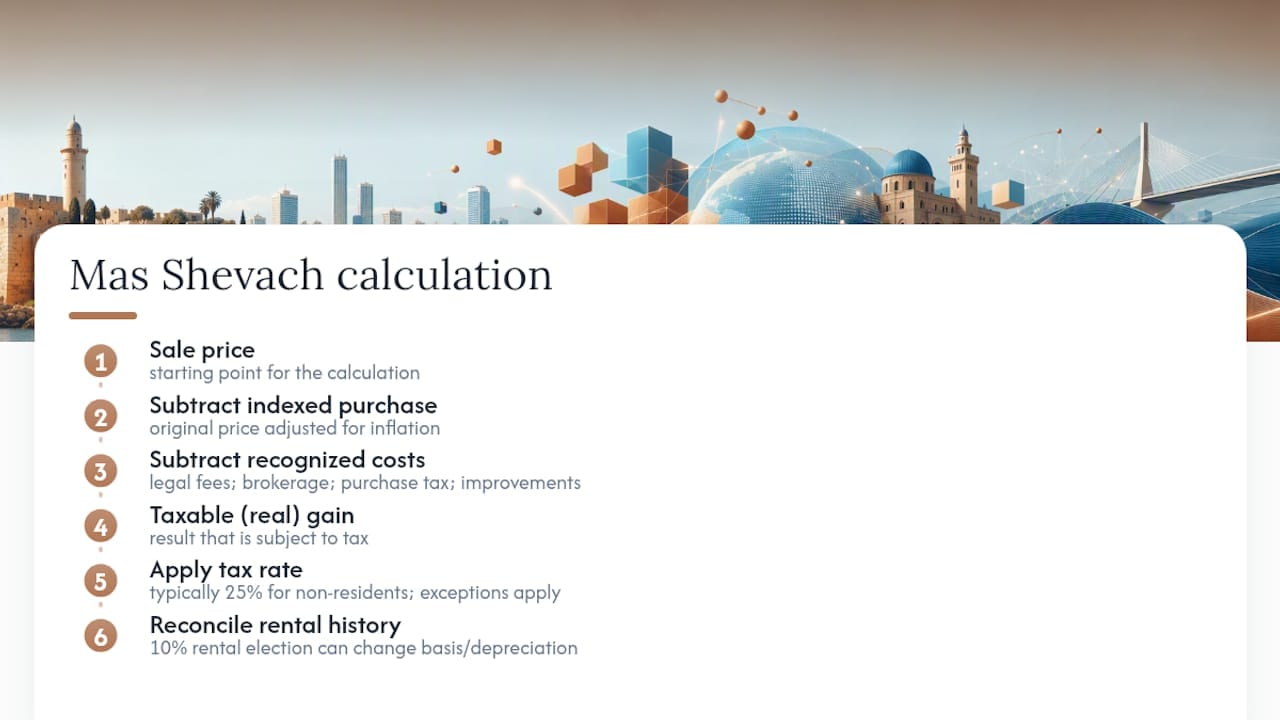
For most non-residents, that real gain is taxed at 25%. Different rates can apply in specific situations, such as property purchased before certain legislative changes, so it’s worth confirming your exact acquisition date against current rules rather than assuming the standard rate applies automatically.
If you rented the property under the 10% flat rental tax track before selling, that election can affect your cost basis and the depreciation calculation used at sale. Reconcile your rental history with your sale numbers before you file, because a mismatch here is a common source of disputes with the Tax Authority.
How Do You File and Pay Mas Shevach as a Foreign Seller?
Buyers and their attorneys in Israel are required to withhold tax from the sale proceeds by default, and without an approved reduction, that withholding often lands at a steep rate, a withholding rate can default to a high percentage when no representative has been appointed and no exemption has been pre-approved. Getting ahead of this is the single most useful thing a foreign seller can do.
- Appoint an Israeli tax representative. An accountant or attorney licensed to act before the Tax Authority can request a withholding reduction on your behalf before the sale closes.
- Open a file with the Israel Tax Authority. Your representative submits your residency documents and requests a reduced withholding certificate.
- File the Mas Shevach return. This is typically due within 30 to 60 days of the sale, depending on the transaction type, along with payment of any tax owed.
- Request a withholding reduction or exemption approval before closing, not after, since retroactive corrections mean waiting for a refund.
- Respond to any Tax Authority assessment or appeal if the initial filing is challenged or the exemption is only partially approved.
Pro Tip: If your representative can secure a reduced withholding certificate before the closing date, you avoid tying up a large chunk of your sale proceeds for months while you wait for a refund. That single step often matters more to your cash flow than the exemption itself.
Can Foreign Residents Legally Reduce Their Mas Shevach Bill?
Spreading the gain, known as prisasat shevach, allows you to allocate the taxable gain across the years you held the property rather than taxing it entirely in the year of sale. For sellers who held a property for many years, this can sometimes reduce the marginal tax burden, particularly when income varies significantly year to year.
Beyond spreading, the most reliable way to lower your bill is documenting every deductible cost:
- Brokerage and legal fees from both the purchase and the sale
- Purchase tax paid at acquisition
- Receipted renovations and capital improvements (not routine maintenance)
- Mortgage-related costs in specific circumstances
Be wary of aggressive planning schemes promising to eliminate the tax entirely. Israeli tax law rewards documentation, not shortcuts, and the safest path is thorough paperwork paired with qualified counsel who knows what the Tax Authority actually accepts.
How Menora Law Supports Foreign Sellers Through the Process
Lei Menora handles the parts of this process that trip up most foreign sellers: collecting and certifying residency evidence, liaising directly with the Israel Tax Authority, and filing appeals when an exemption is only partially granted. For clients abroad, that usually starts with a remote consultation to review your documents and ownership history before you sign anything.
Typical first steps include a document checklist tailored to your country of residence and an early read on whether your exemption claim is likely to hold up. Managing cross-border filings from Los Angeles to Tel Aviv is routine work here, not a special case.
Do Individuals and Companies Face Different Mas Shevach Rules?
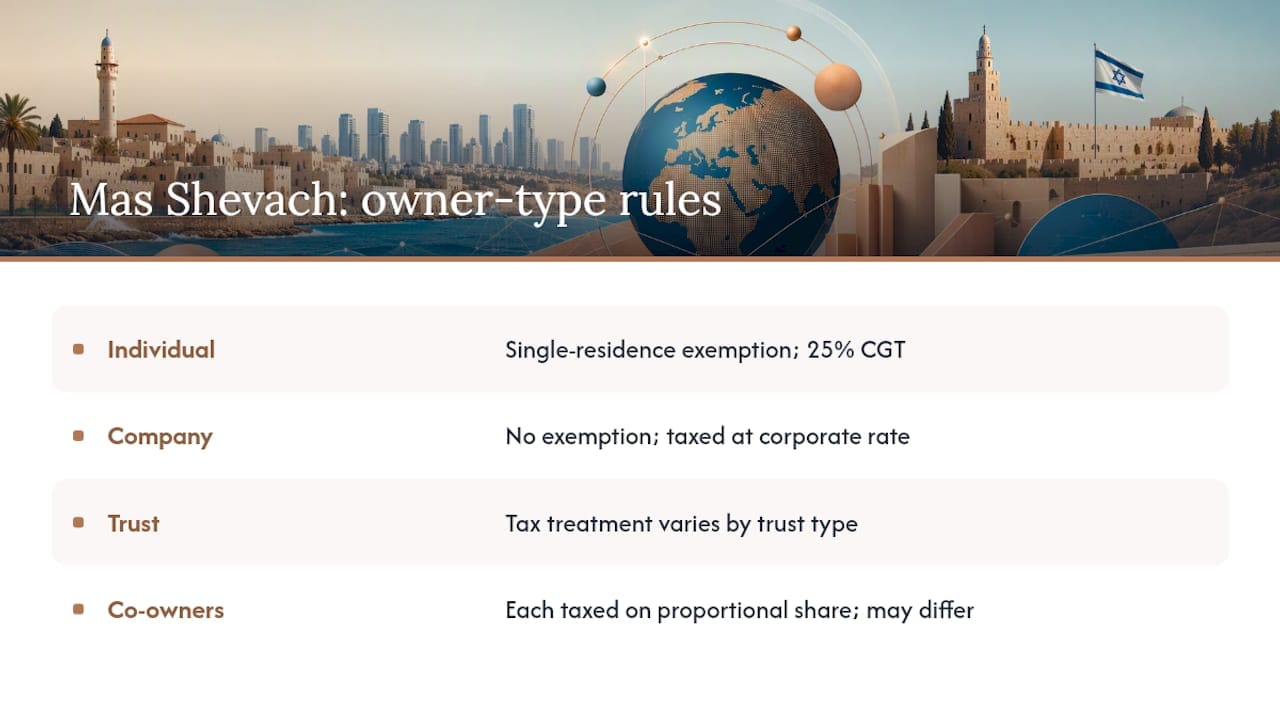
The rules diverge sharply depending on whether the seller is a private individual or a corporate entity, and this trips up more foreign owners than you’d expect. The single-residence exemption under section 49A is only available to individuals. A foreign company holding Israeli real estate, even a single-purpose holding company owned by one person, cannot claim it. Every dollar of gain a corporate seller realizes is taxable, generally at the corporate tax rate rather than the 25% individual capital gains rate.
This matters enormously for structuring. Some foreign investors buy Israeli property through a foreign or Israeli holding company for liability or estate-planning reasons, not realizing it forecloses the exemption entirely. If you’re weighing whether to hold Israeli real estate personally or through an entity, that decision should happen before you buy, not after you’re trying to sell.
Trusts add another layer of complexity. A trust holding Israeli property may be taxed differently depending on whether it’s revocable, who the beneficiaries are, and where the settlor resides, and Israeli trust taxation rules can be genuinely intricate for cross-border structures. Partnerships and multiple co-owners face their own wrinkle: each owner is generally assessed individually on their proportional share of the gain, which means one co-owner might qualify for an exemption while another, who owns a home abroad, doesn’t. That split calculation has to be documented carefully, and it’s exactly the kind of case where a generic online calculator gets it wrong. Anyone holding property jointly with family members, especially across different residency statuses, should get a professional assessment of how each owner’s share will actually be taxed before assuming the same exemption applies to everyone on the deed.
What Forms and Reports Do Foreign Sellers Need to File?
Every property sale in Israel triggers a reporting obligation to the Israel Tax Authority, and foreign residents face a few extra layers on top of the standard filing. The core form is the Mas Shevach declaration (commonly referenced as Form 6111 or the applicable capital gains declaration for real estate), filed through the Tax Authority’s real estate taxation system, typically by your appointed representative rather than you personally from abroad.
Alongside the gain declaration, foreign sellers claiming the section 49A exemption must submit their residency proof package as part of the same filing: the apostilled tax residency certificate, translated supporting documents, and a formal declaration that you hold no residential apartment in your country of residence. If you’re claiming a partial exemption because your residency status changed mid ownership, you’ll need supplemental documentation showing the dates that shift occurred.
There’s also a separate reporting track if the property was rented before the sale. If you used the 10% flat rental tax election, that election history needs to reconcile with the capital gains filing, since the Tax Authority cross-references rental declarations against the sale file. A mismatch between what you reported as rental income and what your sale filing shows as cost basis is one of the more common triggers for a follow-up inquiry.
If you’re a resident of a country with a tax treaty with Israel, you may need additional documentation to support a treaty-based position, particularly if you intend to credit Israeli tax paid against your home-country liability. That’s worth confirming with a representative early, since treaty relief isn’t automatic just because a treaty exists.
What Happens if You Don’t Comply?
Missing a Mas Shevach filing deadline, or filing inaccurately, carries real financial consequences, not just paperwork annoyance. Late filing typically triggers interest and linkage differentials on any unpaid tax, calculated from the original due date, which means the longer a filing sits unresolved, the more expensive it gets.
Beyond interest, the Tax Authority can impose penalties for late filing and, in more serious cases, for filing that materially misrepresents the sale price, the cost basis, or your residency status. If withholding wasn’t properly reduced before closing and you failed to file the follow-up return, you may find a significant portion of your sale proceeds tied up indefinitely, since the Tax Authority has little incentive to release funds when there’s no completed filing on record.
There’s also a practical consequence many foreign sellers don’t anticipate: an open, non-compliant Mas Shevach file in Israel can complicate future transactions. If you plan to buy Israeli property again, receive an inheritance, or handle any other matter requiring a clean tax record with the Israel Tax Authority, an unresolved prior filing can slow things down considerably. Getting professional help isn’t about avoiding scrutiny; it’s about making sure the filing is right the first time so it never becomes a lingering problem years later.
What Menora Law’s Clients Get Wrong Most Often
Three mistakes come up again and again: appointing a tax representative too late, submitting documents without proper apostille or translation, and assuming the single-residence exemption applies without checking the country-of-residence condition. Here’s the checklist we give every foreign seller before they list a property:
- Get your tax residency certificate from your home country
- Apostille and translate every foreign document
- Appoint an Israeli tax representative
- Open your file with the Israel Tax Authority
- Request a withholding reduction before closing
- Schedule a consultation before you sign a sale agreement
— Menora Law
Menora Law: A Real Estate Tax Case Review for Foreign Sellers
Selling property in Israel from abroad shouldn’t mean guessing whether your paperwork will hold up or watching a third of your proceeds get withheld at closing. Lei Menora handles document validation, Mas Shevach filings, and representation before the Israel Tax Authority for clients who never need to set foot in the country to get it done right.

The process starts with a remote case review: send over your ownership history, residency situation, and target sale timeline, and Menora Law will tell you plainly whether the section 49A exemption is realistic for your case or whether a partial exemption or spreading strategy fits better. From there, a licensed representative handles the Tax Authority filing, requests a withholding reduction before your closing date, and manages any follow-up correspondence or appeal if the assessment comes back different than expected. If your situation also touches inherited property, Menora Law’s Israeli inheritance guidance covers how that overlaps with capital gains exposure on a sale. Start with a virtual consultation and get a straight answer on your exposure before you sign anything.
This article is general information, not a substitute for advice from a qualified financial advisor. Consult a qualified financial professional about your own circumstances before acting on anything here.
Perguntas frequentes
Do foreign residents always pay 25% Mas Shevach?
For most non-residents, the real gain is taxed at 25%, though different rates can apply depending on acquisition date and specific circumstances, so confirm your exact case with a representative.
Can I claim the exemption if I own a home in the US?
Generally no. The section 49A exemption requires proof you own no residential apartment in your country of residence, so owning a home in the US typically disqualifies you.
How long does residency certification take?
It varies by country, but apostille and certified translation can take several weeks, so start the process as soon as you decide to sell.
What withholding rate applies if I don’t appoint a representative?
Without a representative and an approved reduction, withholding at closing can run as high as 35%, according to practical guidance on foreign resident rental and sale taxation.
Can a company claim the same exemption as an individual seller?
No. The section 49A single-residence exemption is only available to individuals, not corporate entities, regardless of how the property is structured.
Can Menora Law handle my Mas Shevach filing remotely?
Yes. Menora Law manages residency documentation, Tax Authority filings, and appeals for clients abroad through remote consultations.

 English
 Afrikaans
 العربية
 বাংলা
বাংলা Čeština
 简体中文
简体中文 Nederlands
 Suomi
Suomi Français
 Deutsch
 עִבְרִית
 हिन्दी
 Magyar
 Italiano
 日本語
日本語 한국어
한국어 Polski
 فارسی
فارسی Português do Brasil
 Русский
 Español de México
 Українська