
TL;DR:
- Israeli legal document translation requires certification by an authorized notary and often an Apostille for international use. Selecting a translator with legal expertise and confirming requirements early prevents delays, errors, and costly rework. Proper adherence to procedural steps ensures legal validity and smooth acceptance in Israeli courts and institutions.
Israeli legal document translation is the process of converting legal documents from a foreign language into Hebrew, or from Hebrew into another language, so those documents are legally valid and admissible in Israeli courts and institutions. This is not a simple language exercise. It requires certified notarization, precise legal terminology, and sometimes additional authentication steps like an Apostille certificate. Whether you are dealing with a contract, a will, a power of attorney, or a marriage certificate, understanding how this process works saves you time, money, and serious legal headaches.
What is Israeli legal document translation and what makes it different?
Israeli legal document translation is a formal, regulated process. Israeli courts require that foreign language legal documents be translated into Hebrew and certified by a notary before they are admissible in civil, criminal, family, or commercial cases. That applies to contracts, affidavits, powers of attorney, and court judgments, among others.

What makes this process different from general translation is the dual requirement: linguistic accuracy and legal certification. A bilingual speaker cannot simply translate a contract and hand it to a court. The translation must be certified by an authorized professional. Without that certification, the document has no legal standing in Israel.
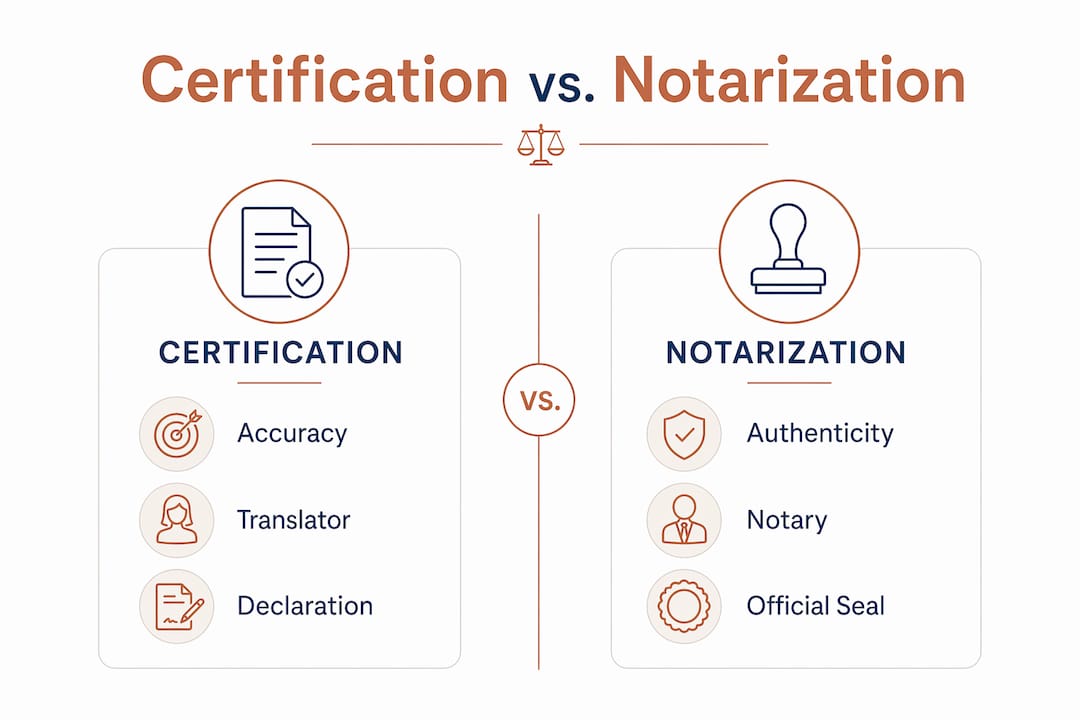
The term most commonly used in the industry is “certified legal translation” or “notarized translation.” Both phrases describe the same core requirement: a qualified translator produces the translation, and an authorized Israeli notary certifies its accuracy. Knowing this distinction matters when you are communicating with translators, law firms, or government offices.
What are the certification and notarization requirements for Israeli legal document translation?
Certification and notarization are not the same thing, and confusing them causes real problems. A certified translation means a qualified translator attests that the translation is accurate and complete. A notarized translation goes one step further: an Israeli notary, who is a senior lawyer authorized to certify documents, reviews and stamps the translation to confirm its authenticity.
Notarization is mandatory for most legal documents submitted to Israeli courts, government ministries, and official institutions. There are limited exceptions. Documents in English, French, and Russian may sometimes be accepted without a notarized translation, depending on the institution and the context. That said, you should never assume an exception applies without confirming it directly with the receiving body.
When is an Apostille also required?
Many clients fall into what experienced practitioners call the Apostille trap. They assume notarization is enough, but apostille certification is often required after notarization for documents to be accepted by international or government bodies. An Apostille is a separate certificate issued by a government authority that authenticates the notary’s signature and seal for use abroad.
The Apostille requirement adds a step that many people overlook until their documents are rejected. Skipping it is one of the most common and costly mistakes in cross-border legal matters.
Here is a summary of the typical certification steps:
- Confirm the receiving body’s requirements before starting any translation.
- Hire a qualified legal translator with knowledge of Israeli law and the source language.
- Submit the translation to an Israeli notary for certification and stamping.
- Obtain an Apostille if the document will be used outside Israel or if the receiving institution requires it.
- Check ministry approval requirements for specific documents like marriage certificates.
Pro Tip: Always call or email the receiving institution before you begin. Ask specifically whether they require a notarized translation, an Apostille, or both. Getting this wrong at the start costs far more to fix than it costs to ask.
Who should perform Israeli legal translations and what qualifications matter?
The translator you choose directly affects the legal outcome. Professional firms perform strict quality control and use translators with legal backgrounds to avoid errors in legal terminology and phrasing. A translator who is fluent in Hebrew but unfamiliar with Israeli contract law will produce a translation that reads well but fails legally.
Legal translation requires two distinct skills: mastery of both languages and a working knowledge of the legal system in both jurisdictions. Terms like “power of attorney,” “probate order,” or “affidavit” carry specific legal meanings that do not always have direct Hebrew equivalents. A translator without legal training may choose a word that is linguistically close but legally wrong.
Why literal translation fails in legal contexts
Good Hebrew legal translation sometimes requires rewording to be legally clear and readable rather than a direct literal translation. English syntactic structure does not produce high legal register in Hebrew. A sentence that is grammatically correct in English, translated word for word, can read as awkward or ambiguous in Hebrew legal writing. Judges and clerks notice this, and it can undermine the document’s credibility.
This is not a minor stylistic concern. Ambiguous phrasing in a translated contract or will can lead to disputes, delays, or outright rejection by a court.
How to vet a legal translator
Use these criteria when selecting a translator for Israeli legal documents:
- Legal background: The translator should have formal training in law or extensive experience with Israeli legal texts.
- Language pair specialization: Choose someone who specializes in your specific language pair, not a generalist.
- References and samples: Experienced legal translators recommend requesting translation samples and choosing based on recommendations, not lowest price.
- Familiarity with Israeli institutions: The translator should know which terms Israeli courts and ministries recognize.
- Collaboration with notaries: The best translators work regularly with Israeli notaries and understand the certification process end to end.
Pro Tip: Provide your translator with a glossary of key terms specific to your document. If your contract uses a defined term like “Escrow Account,” tell the translator how you want that term rendered consistently throughout. This reduces revisions and keeps the document legally coherent.
What types of documents require translation for Israeli legal use?
Document translations vary based on their use: court submissions, governmental use, business contracts, and personal matters each require different levels of formality and authentication. The table below summarizes the most common document types, their typical translation requirements, and the certification level usually needed.
| Document type | Translation required | Certification level |
|---|---|---|
| Contracts and agreements | Hebrew translation required for court use | Certified and notarized |
| Affidavits | Full Hebrew translation required | Notarized |
| Powers of attorney | Full Hebrew translation required | Notarized, sometimes Apostille |
| Court judgments | Hebrew translation required for enforcement | Certified and notarized |
| Marriage certificates | Hebrew translation required | Notarized plus ministry approval |
| Birth certificates | Hebrew translation required | Certified and notarized |
| Wills and testaments | Hebrew translation required | Notarized |
| Business registration documents | Hebrew translation for government filings | Certified and notarized |
Marriage certificates deserve special attention. Israeli marriage certificates must be approved by the Ministry of Religious Affairs prior to receiving an Apostille. Submitting for an Apostille without that ministry approval results in rejection. This is a procedural step that surprises many foreign clients.
Consistent spelling of names, dates, and document numbers across the original and translated documents is critical for legal acceptability. A discrepancy as small as a middle name abbreviation between your passport and a translated birth certificate can cause a document to be flagged or rejected. Always cross-check every identifying detail before submitting.
For clients dealing with cross-border Israeli legal matters, the document type and its intended use determine the full authentication path. A will used in an Israeli inheritance proceeding has different requirements than the same will submitted to a foreign government agency.
How to get a legal document translated and certified for Israeli use
Getting this right the first time requires a clear sequence of steps. Skipping or reordering them is the most common cause of delays and extra costs.
Identify the receiving body and confirm their requirements. Early identification of the receiving body greatly reduces time, cost, and errors. Контакт the court, ministry, or institution directly and ask for their exact translation and authentication requirements in writing.
Select a qualified legal translator. Use the vetting criteria described above. Confirm the translator has experience with Israeli legal documents and your specific document type.
Provide complete source documents. Give the translator clean, legible copies of every page, including stamps, seals, and signatures. Incomplete documents lead to incomplete translations.
Review the draft translation. Before notarization, review the translation for accuracy in names, dates, and key terms. Corrections after notarization require the entire process to restart.
Submit to an Israeli notary for certification. The notary will review the translation, compare it to the original, and apply their official stamp and signature. This step makes the translation legally valid in Israel.
Obtain an Apostille if required. If the document will be used outside Israel or if the receiving institution requires it, submit the notarized translation to the appropriate government authority for an Apostille certificate.
Check for ministry approvals. For documents like marriage certificates, confirm whether ministry approval is needed before the Apostille step.
Verify digital Apostille acceptance. Some institutions now accept digital Apostilles issued under the e-APP system of the Hague Conference on Private International Law. Others still require a paper original.
Pro Tip: Ask the receiving institution whether they accept a digital Apostille before you pay for a physical one. Digital Apostilles are faster and cheaper, but not every institution has updated its procedures to accept them.
Timeline expectations vary. A straightforward notarized translation typically takes three to seven business days. Adding an Apostille or ministry approval can extend the process by one to three weeks. Plan accordingly, especially if you are working toward a court deadline or a property closing.
For clients managing Israeli legal proceedings without being present in the country, these timelines matter even more. Remote coordination requires clear communication and early starts.
Key Takeaways
Certified legal translation for Israeli use requires notarization by an authorized Israeli notary, and many documents also require an Apostille certificate, making early verification of the receiving body’s requirements the single most important step in the process.
| Point | Details |
|---|---|
| Notarization is mandatory | Most legal documents for Israeli courts must be certified by an authorized Israeli notary. |
| Apostille is a separate step | Notarization alone is not enough for many international or government uses; an Apostille is often also required. |
| Translator qualifications matter | Choose a translator with a legal background, not just language fluency, to avoid costly terminology errors. |
| Document type determines the path | Marriage certificates, wills, and contracts each follow different certification and approval requirements. |
| Verify requirements first | Confirming the receiving institution’s exact needs before starting saves time, money, and avoidable rejections. |
What working with Israeli legal translations has taught us
The most consistent mistake we see is clients treating translation as the last step rather than the first conversation. They get a document translated, pay for notarization, and then discover the receiving institution requires an Apostille they did not know about. The notarization is valid, but the process has to continue, and the timeline has already slipped.
The second pattern we see regularly is choosing a translator based on price. Legal translation is not a commodity. A low-cost translator with no legal background will produce a document that looks correct but uses terminology that Israeli courts or registries do not recognize. Fixing that after the fact costs more than getting it right the first time.
There is also a subtler issue that does not get enough attention: readability. A translation that is technically accurate but reads awkwardly in Hebrew raises questions. Judges and clerks are human. A document that reads naturally and clearly carries more weight than one that reads like it was processed mechanically. The best translators understand that their job is not just accuracy. It is producing a document that works in its destination legal environment.
For foreign clients dealing with Israeli inheritance matters, property transactions, or family law cases, the translation process is often the first real encounter with how different Israeli legal practice is from what they know at home. Getting that first step right sets the tone for everything that follows. Working with a law firm that understands both the legal substance and the procedural requirements is the most reliable way to avoid the traps that catch most first-time clients.
— Menora Law
Menora Law and Israeli legal document matters
Menora Law works with individuals and businesses around the world who need reliable guidance on Israeli legal matters, including the translation and certification of legal documents.
Whether you are handling an Israeli inheritance case, a property transaction, or a cross-border contract, Menora Law provides direct, experienced counsel from attorneys who know Israeli law and work with international clients every day. The firm handles remote consultations and communicates clearly across time zones, so distance is not a barrier. If you need to understand what your documents require, which certifications apply, or how to move a legal matter forward in Israel, Menora Law is the right place to start. Контакт the firm directly to get clear answers and a plan that fits your situation.
Часто задаваемые вопросы
What documents require certified translation for Israeli courts?
Contracts, affidavits, powers of attorney, and court judgments all require certified notarized translation to be admissible in Israeli civil, criminal, family, and commercial proceedings.
Is notarization the same as an Apostille in Israel?
No. Notarization certifies the translation’s accuracy through an authorized Israeli notary. An Apostille is a separate certificate required for documents used internationally or by certain government bodies, and it is obtained after notarization.
Can documents in English be used in Israeli courts without translation?
Sometimes. Documents in English, French, and Russian may be accepted without notarized translation in limited contexts, but this depends on the institution. Confirming directly with the receiving body before submitting is always the right approach.
How long does the translation and certification process take in Israel?
A standard notarized translation takes roughly three to seven business days. Adding an Apostille or ministry approval, such as for marriage certificates, can extend the total process by one to three weeks.
Why does translator selection matter so much for Israeli legal documents?
Translators with legal backgrounds prevent errors in terminology and phrasing that can affect court rulings or cause document rejection. A linguistically fluent but legally untrained translator often produces work that fails in practice, even when it reads correctly on the surface.


 English
 Afrikaans
 العربية
 বাংলা
বাংলা Čeština
 简体中文
简体中文 Nederlands
 Suomi
Suomi Français
 Deutsch
 עִבְרִית
 हिन्दी
 Magyar
 Italiano
 日本語
日本語 한국어
한국어 Polski
 فارسی
فارسی Português do Brasil
 Русский
 Español de México
 Українська