
TL;DR:
- Foreign beneficiaries have full inheritance rights under Israel’s Succession Law, 1965, regardless of their residence or nationality. They must secure a separate Israeli probate order for assets located within Israel, even if foreign court orders exist. Using a notarial will can significantly reduce the risk of disputes and challenges.
Foreign beneficiary Israeli will rights are defined by Israel’s Закон о наследовании 1965 года., which governs every estate in Israel regardless of the owner’s nationality or the heir’s country of residence. If you live outside Israel and stand to inherit Israeli assets, you hold enforceable legal rights under Israeli law. Those rights do not disappear because you live abroad, because the will was drafted in another country, or because you have never set foot in an Israeli courtroom. The Succession Law, 5725–1965, applies to all Israeli assets even when the deceased and the heirs are both foreigners. Understanding exactly how that law works is the first step toward protecting what you are entitled to.
What are foreign beneficiary Israeli will rights under Israeli law?
Foreign beneficiaries hold the same inheritance rights as Israeli nationals under the Succession Law, 5725–1965. The law does not create a separate, lesser category for non-resident heirs. What it does create is a specific set of procedural requirements that foreign heirs must satisfy before those rights translate into actual assets.

Israel takes a broad and flexible approach to recognizing foreign wills. A foreign will is valid under Israeli law if it meets the formal requirements of any one of the following jurisdictions: the place where the will was made, the testator’s domicile, the testator’s nationality, or the location of the property itself. This is called the “lex situs” rule for real estate. Meeting the standard of just one of these jurisdictions is enough.
That flexibility matters enormously in practice. A will drafted in Germany, the United Kingdom, or Canada does not need to replicate Israeli formalities word for word. If it was valid where it was signed, Israel will generally recognize it. The key is proving that validity through the correct Israeli legal process.
Israeli inheritance law also recognizes several types of wills: handwritten wills, witnessed wills, notarial wills, and oral wills made under specific circumstances. For foreign beneficiaries, the type of will involved directly affects how straightforward the probate process will be. The notarial will, known in Hebrew as the Tzava’a Bifnei Rashut, carries the strongest evidentiary weight and is the least likely to face a legal challenge.
Pro Tip: If the deceased held Israeli assets and you are a beneficiary of a foreign will, do not assume the foreign probate order covers those assets. Israel requires its own separate probate process for any assets located within its borders.
Key formal validity criteria for foreign wills in Israel
- The will complies with the formal requirements of the country where it was executed.
- The will complies with the law of the testator’s domicile at the time of execution or at death.
- The will complies with the law of the testator’s nationality.
- The will complies with Israeli law directly.
- For real property, the will complies with the law of the location of that property.
What legal rights and protections do foreign heirs have in Israel?
Foreign heirs receive full substantive protection under Israeli inheritance law. The Succession Law treats nationality as irrelevant to the question of entitlement. A foreign national named in a valid Israeli will has the same claim to the estate as an Israeli citizen named in the same document.
When no will exists, Israeli statutory intestacy rules apply. These rules distribute assets according to a fixed hierarchy: spouse, children, parents, siblings, and more distant relatives. Foreign nationals fall into this hierarchy in exactly the same position as Israeli nationals. If you are the deceased’s child and there is no will, you inherit under Israeli law regardless of your passport.
Obtaining your inheritance requires a formal court order. Foreign heirs must apply to the Registrar of Inheritance Affairs for either a probate order (when a will exists) or an inheritance order (when there is no will). These are the two primary legal instruments that authorize the transfer of Israeli assets to heirs. Without one of these orders, banks, land registries, and other institutions will not release assets.
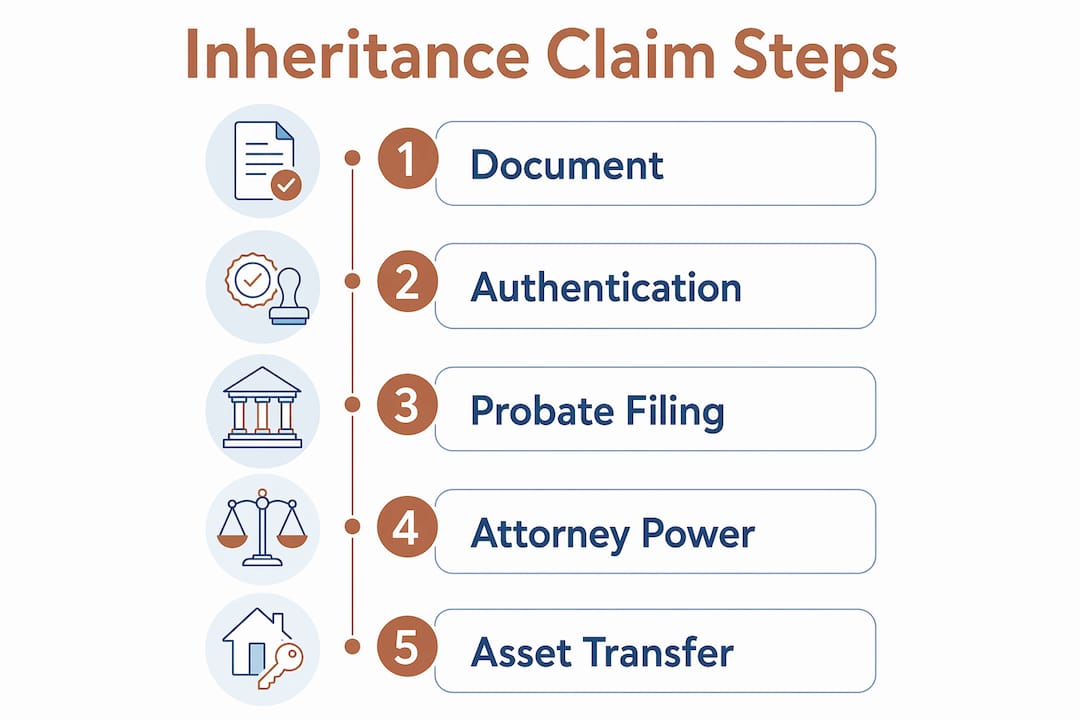
The process for foreign heirs follows these steps:
- Obtain the original will and the death certificate of the deceased.
- Have all foreign documents translated into Hebrew by a certified translator.
- Authenticate documents with an apostille from the relevant foreign authority.
- File the application with the Registrar of Inheritance Affairs in Israel.
- Publish a public notice of the application, giving potential objectors a chance to respond.
- Receive the probate or inheritance order after the waiting period and any hearings.
Foreign heirs who cannot travel to Israel can appoint an Israeli attorney through a power of attorney to handle every step of this process remotely. The power of attorney must be notarized and, in most cases, apostilled. Menora Law regularly handles the full probate process on behalf of overseas clients without requiring them to appear in Israel.
Pro Tip: Grant your Israeli attorney a broad power of attorney that covers probate filings, bank account closures, property transfers, and tax filings. A narrow power of attorney often creates delays when unexpected steps arise during estate administration.
How do foreign beneficiaries claim inheritance in Israel step by step?
The procedural path for a foreign beneficiary claiming Israeli assets is specific and sequential. Missing a step or submitting incomplete documents causes delays that can stretch the process by months.
The application to the Registrar of Inheritance Affairs is the central filing. This office sits within the Israeli court system and has jurisdiction over all inheritance matters in Israel. The Registrar reviews the application, issues a public notice, and either grants the order or refers contested matters to a family court judge.
Required documents for foreign beneficiaries
- The original foreign will (or a certified copy).
- The death certificate of the testator.
- Notarized Hebrew translations of all foreign documents.
- Apostille authentication for all foreign public documents.
- A formal Foreign Legal Opinion confirming the will’s validity under the law of the relevant foreign jurisdiction.
- Proof of the applicant’s identity and relationship to the deceased.
- A list of all known heirs and their контакт details.
The apostille requirement deserves special attention. Israel is a signatory to the Hague Apostille Convention. Documents issued in other signatory countries must carry an apostille stamp from the competent authority in that country. Documents from non-signatory countries require legalization through the Israeli consulate. Authorities may waive translation requirements for wills written in English, though this is not guaranteed and should not be assumed.
The Foreign Legal Opinion is a document prepared by a licensed attorney in the country where the will was made. It confirms that the will meets the formal validity requirements of that country’s law. Israeli authorities rely on this opinion to satisfy themselves that the foreign will is genuine and enforceable.
| Document | Purpose | Authentication Required |
|---|---|---|
| Foreign will | Establishes testamentary intent | Apostille or consular legalization |
| Death certificate | Confirms testator’s death | Apostille or consular legalization |
| Hebrew translation | Makes documents readable to Israeli authorities | Notarized by certified translator |
| Foreign Legal Opinion | Confirms validity under foreign law | Signed by licensed foreign attorney |
| Power of attorney | Authorizes израильский юрист to act | Notarized and apostilled |
Israel does not recognize foreign probate court orders for Israeli assets. A grant of probate issued in the United Kingdom, a letters testamentary from a foreign court, or any equivalent foreign instrument does not substitute for an Israeli probate order. Israeli courts require independent proceedings to validate and enforce any foreign will for assets located in Israel. This is one of the most common misconceptions foreign heirs bring to the process.
What challenges do foreign beneficiaries face under Israeli wills?
Foreign heirs face a distinct set of obstacles that Israeli heirs rarely encounter. Recognizing these challenges early gives you the best chance of avoiding them.
The most common challenges include:
- Will validity disputes. Other heirs may challenge a foreign will on grounds of improper execution, lack of testamentary capacity, or undue influence. Israeli courts assess foreign wills against the formal validity criteria described above, but disputes still require legal representation and can delay the process significantly.
- Translation and authentication delays. Documents sourced from multiple countries often arrive with inconsistent formatting, missing apostilles, or translations that do not meet Israeli court standards. Each correction adds weeks to the timeline.
- Multi-jurisdictional tax complications. Israeli estates may trigger tax obligations in Israel and in the beneficiary’s home country simultaneously. Israel does not impose inheritance tax, but capital gains tax may apply when inherited property is later sold. Foreign heirs should obtain tax advice in both jurisdictions before completing the estate.
- Objections from other heirs. Any person with a legal interest in the estate can file an objection during the public notice period. Objections based on claims of undue influence or incapacity are the most common and the most disruptive.
- Language and procedural barriers. Israeli probate proceedings are conducted in Hebrew. All filings, correspondence, and hearings require Hebrew fluency or qualified legal representation.
The notarial will (Tzava’a Bifnei Rashut) is considered the gold standard in Israeli estate law. It is authenticated by an authorized official, carries superior evidentiary weight, and is rarely overturned. For any testator with foreign beneficiaries, a notarial will dramatically reduces the risk of a successful challenge.
Menora Law’s approach to these challenges is direct. The firm prepares complete document packages before filing, coordinates with foreign attorneys on Legal Opinions, and monitors the public notice period to respond to objections immediately. Speed and preparation are the two factors that most reliably prevent delays from compounding. For heirs dealing with will disputes in Israel, early legal intervention is the single most effective protective step.
Mutual wills add another layer of complexity for some foreign heirs. Under Section 8a of the Израильский закон о наследстве, mutual wills between partners create interdependent obligations that affect the order of inheritance and the ability to cancel or modify the will after one partner dies. Foreign heirs named in a mutual will need to understand these constraints before filing any claim.
Key Takeaways
Foreign beneficiaries hold full inheritance rights under Israel’s Succession Law, 5725–1965, and must obtain a separate Israeli probate order to access any Israeli assets regardless of foreign court orders.
| Point | Details |
|---|---|
| Equal rights for foreign heirs | Israeli law grants foreign beneficiaries the same inheritance rights as Israeli nationals. |
| Broad will validity rules | A foreign will is valid in Israel if it meets the formal requirements of any one of several relevant jurisdictions. |
| Separate Israeli probate required | Foreign probate orders do not apply to Israeli assets; a local Israeli order is mandatory. |
| Power of attorney enables remote probate | Foreign heirs can appoint an Israeli attorney to handle the full process without traveling to Israel. |
| Notarial will reduces disputes | The Tzava’a Bifnei Rashut carries the strongest evidentiary weight and is the least vulnerable to challenge. |
What Menora Law has learned from handling cross-border Israeli estates
Working with foreign heirs on Israeli estates over many years has shown us one consistent pattern: the heirs who face the fewest problems are the ones who act early and document everything. The heirs who struggle are usually the ones who assumed that a foreign probate order, a translated will, or a phone call to an Israeli bank would be enough to move things forward. It is never that simple.
The most persistent misconception we encounter is that Israeli inheritance law will simply defer to whatever the foreign court decided. It does not. Israel’s probate system is independent, and every estate with Israeli assets requires its own Israeli process. Foreign heirs who understand this from the start save themselves months of frustration.
We also see foreign beneficiaries underestimate the value of the notarial will. When a testator with foreign heirs uses a standard handwritten or witnessed will, the door to challenges opens wider. The notarial will closes that door. If you are advising a family member in Israel who wants to leave assets to foreign heirs, the notarial will is the single most protective step they can take.
The practical reality of cross-border estate administration is that it requires coordination across time zones, legal systems, and languages simultaneously. Menora Law handles that coordination directly. Clients abroad receive clear updates, fast responses, and a legal team that understands both the Israeli system and the pressures of managing an estate from a distance.
— Menora Law
How Menora Law helps foreign beneficiaries with Israeli inheritance cases
Foreign heirs dealing with Israeli estates need a legal team that knows the Israeli probate system from the inside and communicates clearly from abroad.

Menora Law handles the full scope of Israeli inheritance matters for overseas clients: probate order applications, certified Hebrew translations, apostille coordination, Foreign Legal Opinions, and court filings. The firm represents foreign beneficiaries through a power of attorney, so clients rarely need to travel to Israel. For heirs ready to take the next step, Menora Law’s 2026 Israeli inheritance guide covers the legal framework in detail. Контакт Menora Law directly for a consultation on your specific estate situation.
Часто задаваемые вопросы
What rights does a foreign beneficiary have under an Israeli will?
A foreign beneficiary has the same inheritance rights as an Israeli national under the Succession Law, 5725–1965. Nationality does not reduce or alter entitlement to assets named in a valid Israeli will.
Does a foreign will automatically apply to Israeli assets?
A foreign will does not automatically transfer Israeli assets. Israel requires a separate Israeli приказ о завещании to validate and enforce any will for assets located within its borders, regardless of foreign court decisions.
What documents does a foreign heir need to file in Israel?
Foreign heirs must submit the original will, a death certificate, notarized Hebrew translations, apostille authentication, and a Foreign Legal Opinion confirming the will’s validity under the relevant foreign law.
Can a foreign beneficiary handle Israeli probate without traveling to Israel?
Yes. Foreign heirs can grant a power of attorney to an Israeli attorney who then manages all filings, hearings, and asset transfers on their behalf without requiring the heir’s physical presence.
What is the strongest type of will for foreign beneficiaries in Israel?
The notarial will, or Tzava’a Bifnei Rashut, is the strongest option. It is authenticated by an authorized official, carries superior evidentiary weight, and is rarely successfully challenged in Israeli courts.


 English
 Afrikaans
 العربية
 বাংলা
বাংলা Čeština
 简体中文
简体中文 Nederlands
 Suomi
Suomi Français
 Deutsch
 עִבְרִית
 हिन्दी
 Magyar
 Italiano
 日本語
日本語 한국어
한국어 Polski
 فارسی
فارسی Português do Brasil
 Русский
 Español de México
 Українська