
Yes, you can file a claim for an abandoned property in Israel if you can prove a legal right to it, whether as an heir, a former owner, or someone acting on their behalf. Your first move should be to search the General Custodian’s public lists, контакт its unit directly, or secure an inheritance order. Act quickly: statutory timelines govern when unclaimed assets transfer to the state.
TL;DR:
- The new legal deadline for claiming abandoned real estate in Israel will be shortened from 25 years to 15 years starting March 31, 2026, which reduces the window for recovery.
- Claimants must gather comprehensive documentation, including inheritance orders, death certificates, and current land registry extracts, often requiring apostilles and translations.
- Starting the search early by checking public lists and contacting the General Custodian costs nothing and can reveal whether a claim is viable before further legal steps.
- Court action is necessary only when ownership disputes arise, when the General Custodian denies a claim, or to halt imminent property transfer to the state.
- Non-real-estate assets generally transfer to the state after 10 years, but real estate faces a now-15-year limit, emphasizing the importance of acting swiftly before 2026.
What Israeli law calls an ‘abandoned asset’ and who manages it
Under the General Custodian Law (1978), an asset qualifies as abandoned when no one is authorized or able to act as its owner, or when the owner cannot be identified. This covers real estate, bank accounts, securities, and other property sitting without an active custodian. The General Custodian steps in to manage these assets and, where possible, return them to the rightful owners or heirs.
An “interested party” (מעונין) in these proceedings includes heirs, creditors, and anyone with a documented claim to the asset. This differs from an “estate without heirs,” where the state itself becomes the heir under separate succession rules, a much harder situation to reverse.
The General Custodian can often manage an asset administratively, without court involvement, but certain duties still apply:
- Publishing notices to alert potential owners or heirs before taking further action.
- Maintaining public lists so claimants can search for assets connected to family members.
- Escalating to court only when ownership is disputed or documentation is incomplete.
Your same-day checklist: who to contact and what to gather
Before you call anyone, get organized. Here’s the order that saves the most time for overseas claimants:
- Search the General Custodian’s public lists on gov.il using the last known owner’s full name and any known address or ID number.
- Контакт the Unit for locating and returning abandoned assets to confirm whether a matching record exists and ask what file number applies to it.
- Gather your identification documents, including a valid passport and any Israeli ID history for the deceased or original owner.
- Collect death certificates, wills, or probate documents already issued in your home country.
- Request a land registry (Tabu) extract if real estate is involved, since this confirms current registration status.
- Prepare a power of attorney authorizing local representation if you cannot travel to Israel for the process.
Pro Tip: Start the public list search even before you have every document ready. Confirming a match early tells you whether the claim is worth pursuing before you invest in translations and legalizations.
Proof and evidence the General Custodian and courts require
Documentation is where most overseas claims stall, not because the law is unclear, but because historic Israeli property records can be thin. If you’re claiming through inheritance, you’ll typically need an inheritance order (צו ירושה) or a certificate of probate (צו קיום צוואה) issued by an Israeli court, confirming your legal standing as heir or executor.
For real estate, a current Tabu extract establishes who holds registered title today. When the chain of title runs through records predating Israel’s modern registry, researchers sometimes need to consult archival title searches going back to Ottoman or British Mandate-era documentation. These older records were not always digitized, so tracing ownership can take real investigative work rather than a simple database lookup.
Everything you submit needs to hold up to Israeli procedural standards:
- Foreign death certificates require an apostille and a certified Hebrew translation.
- Civil registry documents proving family relationship (birth and marriage certificates) support your standing as an heir.
- A notarized power of attorney lets your Israeli representative act, file, and communicate with the General Custodian on your behalf.
- Original or certified copies are generally preferred over scanned documents when submitted to courts.
Remote evidence gathering is possible for nearly every step here, which matters if you’re managing a claim from abroad while working, raising a family, or simply unable to travel on short notice.
Why 2026 changes the math on waiting (statutory timelines explained)
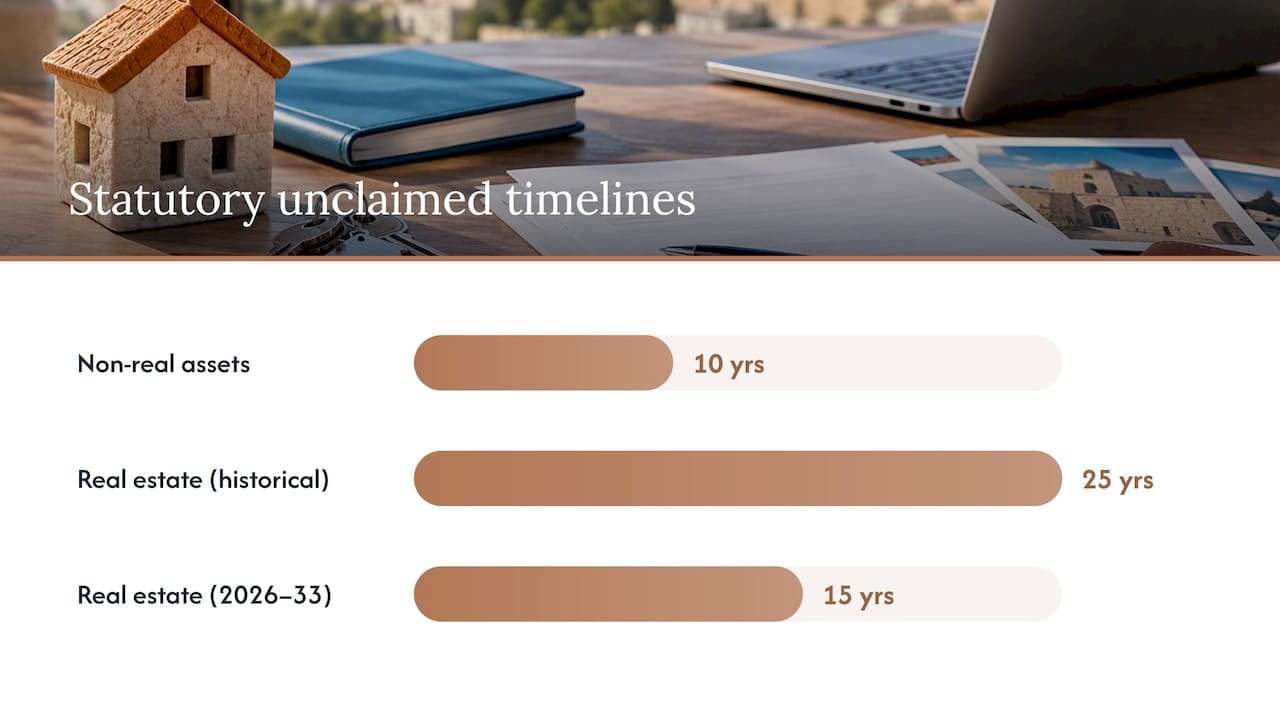
Timing is not a minor detail in these cases, it determines whether you still have a claim at all. Under the General Custodian Law, non-real-estate assets generally transfer to the state after 10 years of unclaimed management, while real estate has historically had a 25-year window.
A temporary amendment shortens that real estate window to 15 years for a seven-year period starting March 31, 2026, according to a recent analysis of the change. That means properties that might have had another decade of breathing room under the old rule now face transfer far sooner.
Before any transfer happens, the General Custodian must attempt to locate the owner, coordinate searches with other authorities, and publish formal notices. These steps take time, but they are not infinite. Management fees accumulate the longer an asset sits unclaimed, and those costs get deducted from whatever you eventually recover. Filing earlier simply costs less and carries less risk.
When administrative channels aren’t enough: court claims and remedies
Not every claim resolves through the General Custodian’s office alone. Court involvement becomes necessary when ownership is disputed, when the Custodian denies a request, or when you need to prevent an imminent transfer to the state. Common claims include:
- Declaratory ownership actions, asking a court to formally recognize your title or inheritance rights.
- Petitions to halt a pending transfer while your documentation is still being finalized.
- Appeals challenging a General Custodian decision you believe misapplied the law.
Magistrate’s Courts generally handle lower-value property disputes and straightforward probate matters, while District Courts take on more complex or higher-value real estate and inheritance litigation. Procedural steps typically involve filing a petition, serving the General Custodian as a respondent, and presenting documentary proof of your claim.
Even after a property transfers to the state, section 15(d) of the law preserves your right to later claim the property itself or its monetary value with interest, so a missed window does not necessarily mean a lost cause.
Costs, expected timeline ranges, and tax considerations
Here’s a realistic sequence for most claims:
- Initial list search and administrative request: typically weeks to a few months.
- Obtaining an inheritance order or probate certificate: usually weeks to several months, depending on court backlogs.
- Contested court proceedings: often months, sometimes stretching past a year for complex disputes.
Administration costs the General Custodian incurs while managing the asset, such as property upkeep or legal notices, are deducted from the final amount returned to you, as explained in detail by what it really costs to maintain an inherited vacant home. The longer an asset sits unmanaged, the larger that deduction tends to be.
On taxes: receiving an inheritance itself is not treated as taxable income in Israel, but selling inherited real estate afterward can trigger capital gains tax. Cross-border tax questions get complicated quickly, which is exactly the kind of planning we help clients work through before a sale closes.
Menora Law: how we work with international clients on abandoned-property claims
We handle end-to-end management of these cases, including securing inheritance orders, pursuing probate, conducting title and archival research, and corresponding directly with the General Custodian. Many clients complete the process without needing to travel to Israel.
For overseas heirs specifically, we manage document collection remotely, coordinate apostille certification, arrange certified translations, and, when historic title gaps demand it, commission on-the-ground investigations into regional land registry archives. Our structure exists to support clients living abroad who are managing property matters remotely while juggling careers and families. We built our process around that reality rather than asking clients to adapt to ours.
What actually determines whether you recover the asset
The biggest misconception we see is that abandoned property claims are mostly a documentation exercise. They’re not. Documentation matters, but timing decides outcomes far more often than paperwork quality does. A well-documented claim filed after a transfer deadline faces a much steeper, slower path than a thinner file submitted early.
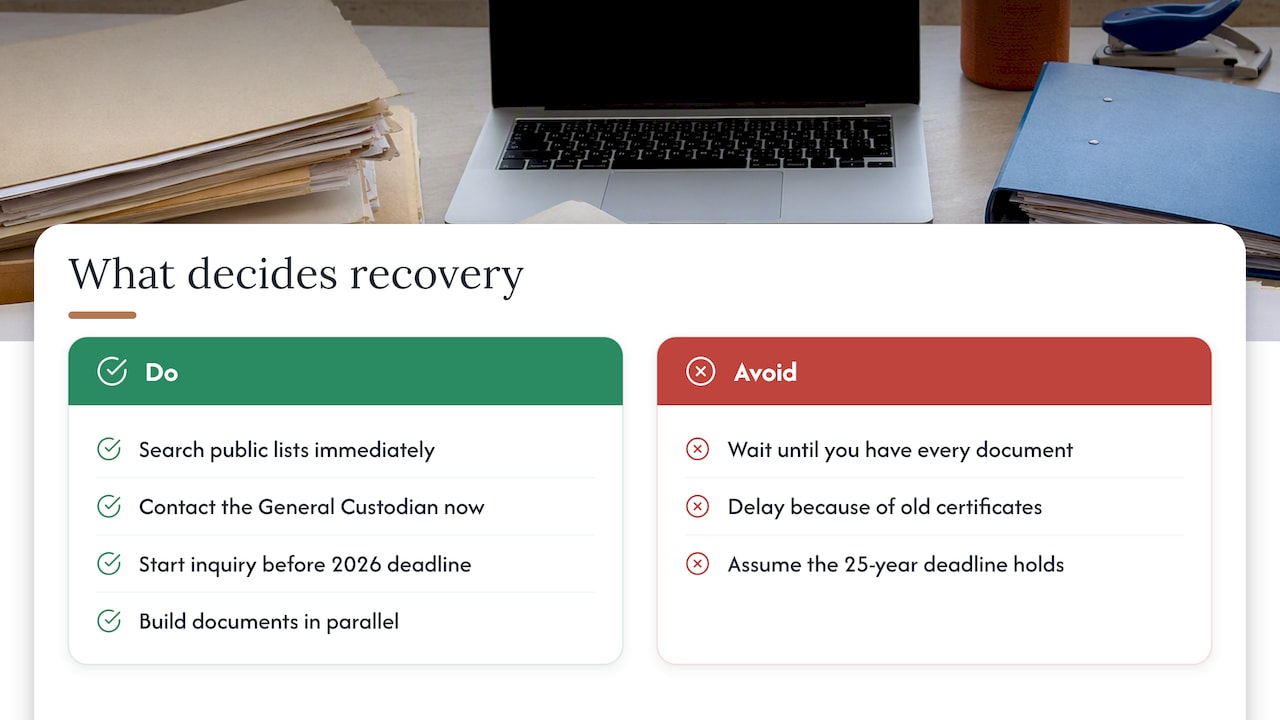
Conventional advice tends to focus heavily on “gather everything first.” We’d push back on that. Searching the public lists and making initial контакт with the General Custodian costs nothing and takes minutes, so there’s no reason to delay it while you track down a 40-year-old marriage certificate. Start the inquiry, then build your file in parallel.
The other thing worth saying plainly: the 2026 shortening of the real estate transfer window to 15 years is not a footnote. For families who assumed they had until the original 25-year mark, that assumption no longer holds for a seven-year stretch starting in 2026. If there’s any family property you’ve been meaning to look into, this is the year to stop meaning to.
— Menora Law
Get a case assessment for your Israeli property claim
If you suspect a family property in Israel may be sitting unclaimed, we can tell you quickly whether pursuing it makes sense. We work with heirs and former owners across the United States, handling everything remotely so you never need to travel for the process.
A typical first engagement includes:
- A document checklist specific to your situation and relationship to the property.
- A realistic timeline estimate based on whether the claim is administrative or likely to require court action.
- A straightforward fee outline before any work begins.
Visit our Menora Law services page to request a case assessment, or explore our dedicated guidance for heirs managing cross-border inheritance claims.
This article is general information, not a substitute for advice from a qualified lawyer. Consult a qualified legal professional about your own circumstances before acting on anything here.
Часто задаваемые вопросы
How do I check if I have an abandoned property claim in Israel?
Start by searching the General Custodian’s public lists using the last known owner’s name and identifying details. If a match appears, contact the Unit for locating and returning abandoned assets directly to confirm the file and next steps.
What documents do I need to claim an inherited property in Israel?
You’ll generally need an inheritance order or probate certificate, a death certificate with apostille and certified translation, proof of family relationship, and a current Tabu extract if real estate is involved. A power of attorney lets a local representative file on your behalf if you cannot travel.
What happens if I don’t claim the property in time?
Non-real-estate assets typically transfer to the state after 10 years of unclaimed management, while real estate faces a temporary 15-year window starting March 31, 2026, under a recent legal update. Even after transfer, section 15(d) allows you to later claim the property or its value with interest.
Can Menora Law help if I live outside Israel?
Yes, we represent clients remotely throughout the entire claim process, from document collection and translation to court filings and direct correspondence with the General Custodian. Overseas heirs typically never need to travel to Israel during the case.
Do I need a lawyer to file a claim with the General Custodian?
It’s not strictly required for simple administrative requests, but historic title gaps, contested ownership, or court escalation make professional representation valuable. Complex cases involving Ottoman or British Mandate-era records often require archival research that benefits from legal guidance.
Sources
- Gov
- General Custodian Law (Knesset PDF)
- Abandoned assets 2026 analysis (klikatnadlan)
- Abandoned property detection — legal overview (jpath)


 English
 Afrikaans
 العربية
 বাংলা
বাংলা Čeština
 简体中文
简体中文 Nederlands
 Suomi
Suomi Français
 Deutsch
 עִבְרִית
 हिन्दी
 Magyar
 Italiano
 日本語
日本語 한국어
한국어 Polski
 فارسی
فارسی Português do Brasil
 Русский
 Español de México
 Українська