
If a local planning committee in Israel has sent you a betterment levy assessment, the clock is already running. You generally have 45 days from the day the assessment reached you to appeal it, and the route you pick depends on what you are disputing: the charge itself or only the amount. At Menora Law, we handle Israeli property and tax matters for owners who live abroad, so you can file on time without flying in.
TL;DR
- The appeal deadline is 45 days from the day the assessment was brought to your knowledge, under Section 14(a) of the Third Addendum to the Planning and Building Law.
- You have three routes: an appeal to the Appeals Committee, a request for a deciding appraiser, or, for levies up to ILS 90,000, the agreed-assessment track added in November 2024.
- Filing an appeal does not freeze a sale or a permit by itself. You may need to pay part of the levy and post a bank guarantee.
- An overseas owner can run the whole process remotely through an Ізраїльський юрист, as long as the deadline is not missed.
What a betterment levy is, in plain terms
A betterment levy (hetel hashbacha in Hebrew) is a charge the local planning committee collects when a new plan, permit or exception raises the value of your land. Israel’s compulsory betterment charge is set at 50% of the increase in value, according to the Technion’s Platform of Experts in Planning Law.
The levy usually comes due when you realize your rights, for example when you sell, or when you ask for a building permit that uses the new rights. For many overseas owners, it shows up unexpectedly during a sale, when the buyer’s lawyer asks for a clearance from the local committee.
The committee sends you an assessment, called a shuma. That assessment is what you can challenge.
The 45-day deadline and when it starts
The deadline comes from Section 14(a) of the Third Addendum. As published in the Knesset’s consolidated statute text, an appeal against an assessment must go to the Appeals Committee for Compensation and Betterment Levies within 45 days from the day the assessment was brought to the debtor’s knowledge. The Tel Aviv-Yafo municipality gives the same 45 days for an appeal or a request to correct an assessment.
Two points matter for people abroad:
- The clock starts on receipt, not on the date printed on the letter. If the assessment went to an Israeli address, an agent or a relative, work out when it actually reached you or them, and keep proof.
- Valuation schedules are different. For a general valuation schedule (luch shuma) under Section 5, the deadline is one year from the day the schedule was displayed. The Appeals Committee chair may extend these periods for special recorded reasons, but you should never plan around an extension.
If you have just received a notice, the first step is to find the date it reached you and count 45 days from it. Then get the assessment, the appraisal behind it and the plan it relies on to someone who reads Hebrew planning documents.
Three ways to challenge a levy
The right route depends on what you are really disputing.
| Route | Best when | Where it goes | Time limit |
|---|---|---|---|
| Appeal to the Appeals Committee | You dispute that a levy applies at all, or you dispute the amount too | Appeals Committee for Compensation and Betterment Levies | 45 days from receipt |
| Deciding appraiser (shamai machria) | You accept the charge but dispute the amount | Chairman of the Council of Land Appraisers | 45 days from receipt |
| Agreed assessment (shuma muskelet) | You accept the charge, dispute the amount, and the levy is up to ILS 90,000 | The local committee | 45 days from receipt |
1. Appeal to the Appeals Committee
This is the broadest route. You can argue that no levy should apply, that the plan did not actually improve your property, that an exemption covers you, or that the valuation is wrong.
Case law shows why liability arguments matter. In a 2019 Supreme Court decision, the court held that the relevant date for testing the exemption for building or expanding a dwelling of up to 140 square meters is the day the plan was approved, not the day you realize the rights. That same source records a Tel Aviv administrative court ruling that a levy event arises only when the plan concretizes into a permit for the specific property. Details like these decide cases, and they are why a liability dispute needs a lawyer who knows how the committees apply them.
Per the Tel Aviv municipality, the committee sits at 18 HaMasger Street, Tel Aviv, and you can file there directly.
2. Deciding appraiser
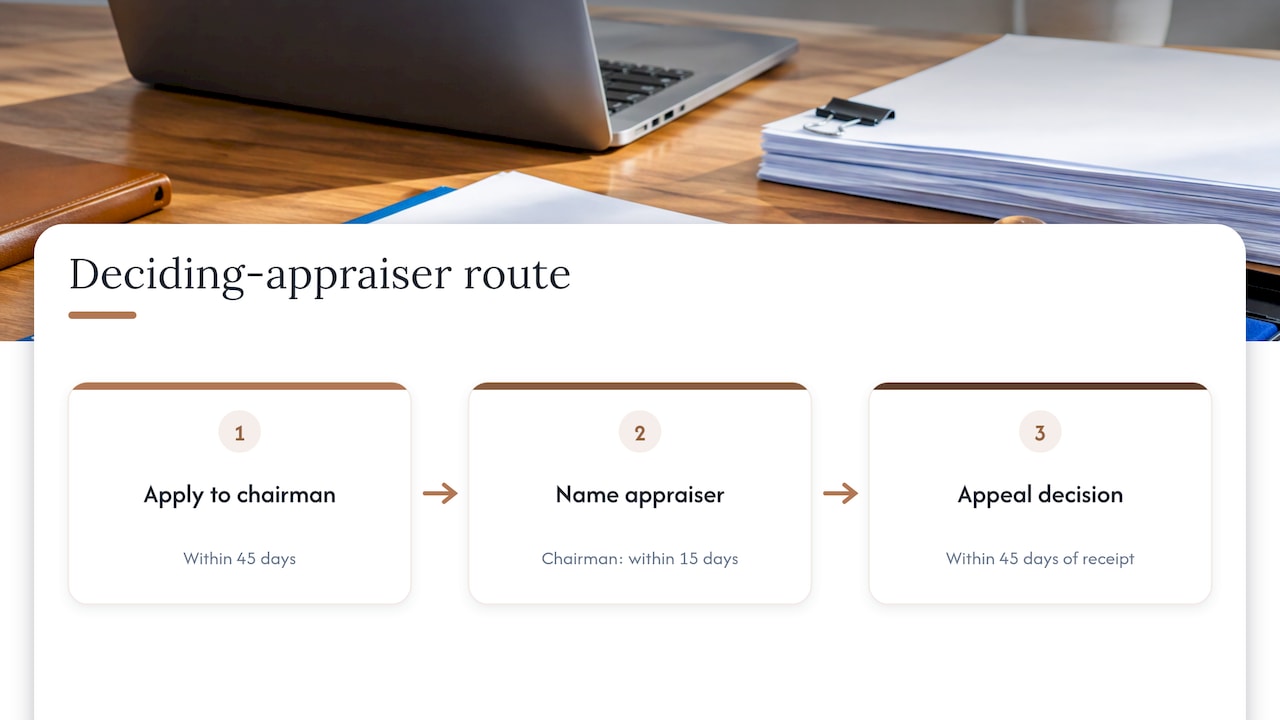
If you do not dispute the levy itself and only want a fair number, you can apply within the same 45 days to the Chairman of the Council of Land Appraisers to appoint a deciding appraiser. Under Section 14(b), the chairman has 15 days to tell the parties who the appraiser is. Either side can then appeal the appraiser’s decision to the Appeals Committee within 45 days of receiving it.
The appraiser’s fee follows a statutory scale tied to the disputed amount, plus VAT, and is normally split equally between the parties.
3. The agreed-assessment track for levies up to ILS 90,000
Amendment 157 to the Planning and Building Law was passed on 5 November 2024 and published on 7 November 2024. It added a faster path under Section 14(b1) for smaller levies. According to the Tel Aviv municipality, the conditions are:
- The levy does not exceed ILS 90,000.
- You attach a counter-appraisal from a real estate appraiser.
- No appeal or deciding-appraiser proceeding is already open.
- Your claims concern the amount, not whether you owe the levy.
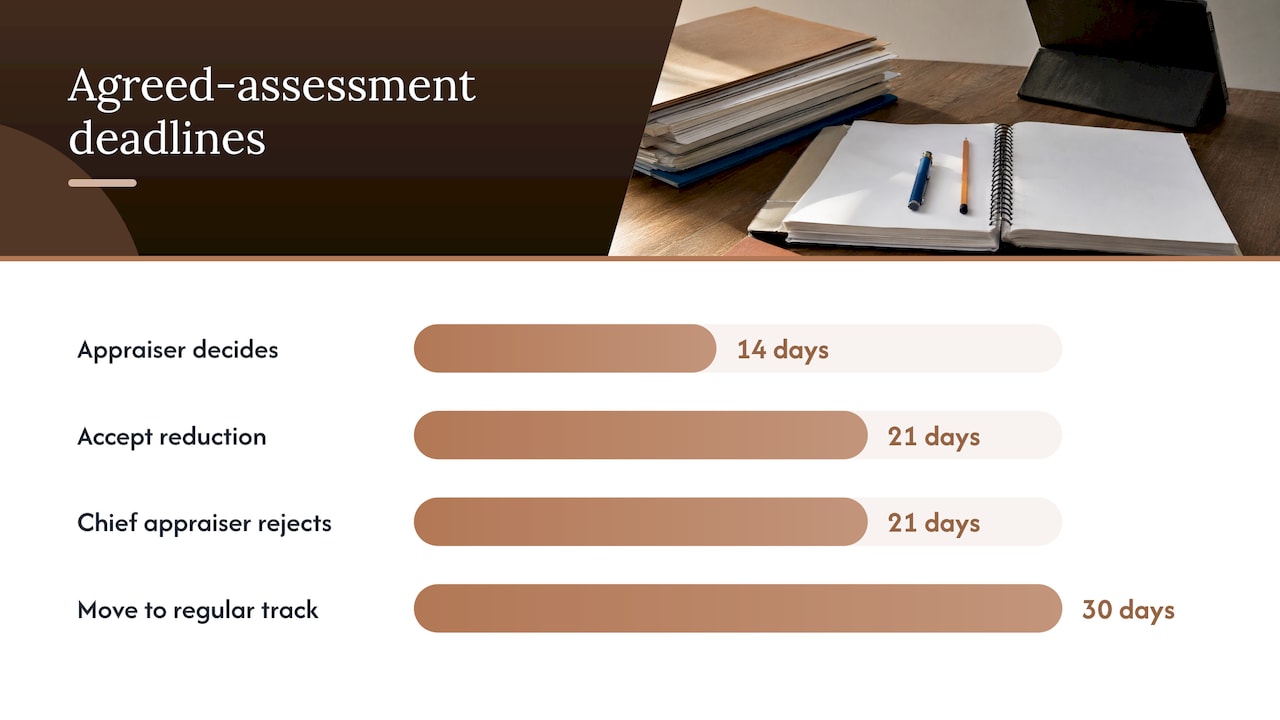
How it runs, per the statute: the committee’s appraiser has 14 days after the application is passed on to decide. You have 21 days to accept a reduced assessment. An accepted assessment then goes to the Chief Government Appraiser, who has 21 days to reject it, and if there is no response it is deemed approved. If the appraiser misses the deadline, does not reduce the levy, or you disagree with the reduction, you have 30 days to move to the regular procedures. Assessments issued before the law took effect stay under the old rules.
For a modest levy, this track can save time and fees. The catch is that you must choose it deliberately and file within the 45 days, with an appraisal ready.
Choosing the route: a worked example
Say you own an apartment in Netanya and inherited it from a parent. You plan to sell, and the buyer’s lawyer asks for a betterment clearance. The committee issues an assessment of ILS 70,000 based on a plan approved years ago.
- If you believe the plan never raised the value of this particular apartment, or an exemption applies, you appeal to the Appeals Committee on liability.
- If you accept that the plan applies but your appraiser puts the improvement much lower, the levy is under ILS 90,000, so the agreed-assessment track fits, with your counter-appraisal attached.
- If the numbers are larger, or the appraiser’s view is far from the committee’s, a deciding appraiser or a full appeal makes more sense.
The figures here are illustrative only. Your own assessment, the plan and your appraisal decide which route is right.
Paying while you appeal, and what happens to your sale
An appeal does not automatically stop a transaction. Under Section 14(h) of the Third Addendum, as shown in the statute text discussed in the Knesset committee, realization of rights is not delayed if you have paid the levy. For someone seeking a permit for their own or a relative’s home, filing an appeal does not delay the permit if they give a guarantee for the disputed amount.
The Tel Aviv municipality says that during the proceedings you can obtain a permit or Land Registry approval by paying half and providing a bank guarantee for the rest. Other municipalities set their own terms, so confirm the exact percentage with the committee that issued your assessment.
A few other points from the same municipal page matter if you sell from abroad:
- Report the transfer of rights, such as signing a sale agreement, to the local committee within 30 days of the realization to avoid added interest.
- The levy is indexed to the lower of the consumer price index or the construction inputs index, with interest from the realization date.
- Up to 50% of the amount can be paid in as many as six installments, secured by a bank guarantee.
Because a bank guarantee comes into play, plan for how you will arrange one from outside Israel. It is much easier to line this up before a closing date than during it.
Doing this from the US
The hard parts for an overseas owner are rarely the legal arguments. They are the logistics:
- Assessments often arrive at an old Israeli address, or reach a buyer or agent first.
- Appraisals, plans and committee decisions are in Hebrew.
- Committees and appeals bodies work on Israeli business days and in Israeli time.
- A signed power of attorney is usually needed so someone can file for you.
Ан Ізраїльський юрист working under a power of attorney can file, appear and follow up on your behalf, so you do not need to travel. If a levy is part of a larger sale or an inherited property, it also helps to see it alongside the tax picture. Our guide to real estate tax in Israel covers the other charges that tend to show up at the same moment, and our overview of what buyers and investors must know explains how these pieces fit into a transaction.
If the property came to you through an estate, the levy can also affect how and when assets are distributed. See our guide to Israeli probate and succession for that side of the process.
What to gather before you call a lawyer
A good first consultation moves fast when you bring the right papers. Send these if you have them:
- The assessment itself and the envelope or email showing when it arrived.
- The property’s block and parcel number (gush і chelka), or a recent land registry extract.
- Any permit, plan approval or building rights document the assessment mentions.
- A sale agreement or draft, if the levy was triggered by a sale.
- Any appraisal you already have.
With these, a lawyer can tell you within a short time which route fits and whether the 45 days leave room for an appraisal.
How we can help
Menora Law represents international clients in Israeli real estate transactions, contracts and tax matters, and we offer remote and on-site consultations so you do not have to travel to Israel. If you have an assessment in hand, контакт us through Закон Менори as early as you can, because the 45 days include the time you will need for an appraisal.

Our real estate team can review the assessment, explain which of the three routes fits, and handle the filing in Israel on your behalf.
Our perspective
Most overseas owners we speak with lose time, not arguments. The assessment sits in an old mailbox, or a buyer’s lawyer mentions it a few weeks into a sale, and suddenly the 45 days are half gone.
That is why we start every betterment levy matter the same way: confirm the receipt date, read the plan, and decide whether this is a question of liability or of amount. Those two questions point to different routes, and picking the wrong one costs weeks.
We work only under Israeli law, and we work with clients abroad every day. Remote representation, quick replies and a clear plan from the first call are what we aim for, so that you can focus on your property or your sale while we deal with the committee.
Закон Менори
Закон Менори
FAQ
How long do I have to appeal a betterment levy in Israel?
You have 45 days from the day the assessment was brought to your knowledge. For a valuation schedule, the period is one year from the day it was displayed. The Appeals Committee chair may extend the time for special recorded reasons, but you should not count on it.
Can I appeal if I only disagree with the amount?
Yes. You can ask for a deciding appraiser within the 45 days, or, if the levy is up to ILS 90,000, use the agreed-assessment track with a counter-appraisal from a real estate appraiser. Both are meant for cases where you accept the charge but dispute the figure.
Will an appeal stop my sale or building permit?
Not by itself. You may need to pay part of the levy and provide a bank guarantee for the rest to get a permit or Land Registry approval while the appeal is pending. The share required depends on the local committee, so confirm it early.
Do I need to be in Israel to appeal?
No. With a power of attorney, an Ізраїльський юрист can file and follow the case for you. The main task on your side is signing documents and getting the assessment and property papers to your lawyer quickly.
Sources
- Technion Platform of Experts in Planning Law: Israel
- Knesset consolidated text of the Planning and Building Law
- Tel Aviv-Yafo municipality: betterment levy
- Nevo: Supreme Court ruling on the Section 19©(1) exemption
- Amendment 157, Book of Laws, 7 November 2024
- Knesset committee document on Section 14(h) of the Third Addendum


 English
 Afrikaans
 العربية
 বাংলা
 Čeština
 简体中文
 Nederlands
 Suomi
 Français
 Deutsch
 עִבְרִית
 हिन्दी
 Magyar
 Italiano
 日本語
 한국어
 Polski
 فارسی
 Português do Brasil
 Русский
 Español de México
 Українська