
TL;DR:
- Attorney-client privilege in Israel is an evidentiary right belonging solely to the client that protects confidential communications with legal counsel. It lasts indefinitely, survives the legal relationship’s end, and applies equally to in-house counsel, but it can be waived or lost if third parties are involved or through client actions. Maintaining privilege requires deliberate control over communication participants, documentation, and channels, especially in complex legal contexts like inheritance or corporate matters.
Attorney-client privilege in Israel is defined as the legal right that protects confidential communications between a client and their lawyer from forced disclosure without the client’s consent. This protection is not a courtesy extended by the lawyer. It is a right that belongs entirely to the client. Whether you are managing an inheritance dispute, structuring a business deal, or handling litigation from abroad, understanding Israeli attorney-client privilege explained in practical terms is what separates a protected legal strategy from an exposed one. This article walks through the legal foundation, the limits, and the real-world steps you need to keep that protection intact.
What is the legal basis for attorney-client privilege in Israel?
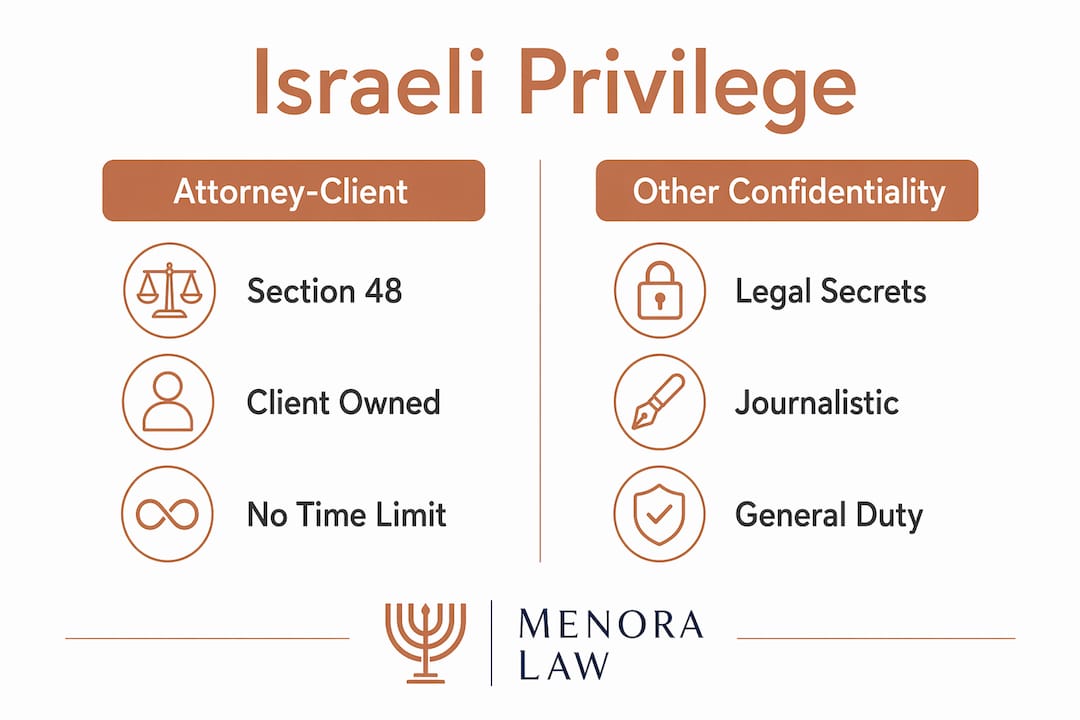
Attorney-client privilege in Israel is anchored in Section 48 of the Evidence Ordinance, which prevents a lawyer from disclosing client communications made within the scope of legal representation without the client’s explicit permission. This is the statutory bedrock. Every other rule about scope, waiver, and exceptions flows from this provision.
The privilege covers a broad range of communication types. Under Section 48, the following are protected:
- Verbal conversations between client and lawyer during consultations, whether in person or by phone
- Written documents prepared specifically for the purpose of obtaining legal advice
- Email exchanges and other electronic communications that fall within the scope of legal representation
- Legal advice itself, including the lawyer’s analysis, strategy recommendations, and risk assessments
One detail that surprises many clients is that privilege extends to in-house counsel under the same rules as external lawyers. Israeli courts have confirmed this through case law and the Ordinance’s provisions. If your company’s internal legal team advises on a contract or a regulatory matter, those communications carry the same evidentiary protection as advice from an outside firm.
Another important nuance: privilege survives termination of the legal relationship with no time limit. Even after a matter closes, the lawyer cannot be compelled to disclose what was discussed. This ongoing protection matters enormously in inheritance cases, where communications made years before a dispute arises may become relevant in court.
The distinction between attorney-client privilege and general professional confidentiality is worth clarifying. Confidentiality is an ethical duty the lawyer owes the client. Privilege is an evidentiary barrier that prevents courts from compelling disclosure. Both exist in Israeli law, but privilege is the stronger and more specific protection. Understanding Israeli legal confidentiality as a two-layer system, ethical duty plus evidentiary shield, gives you a clearer picture of what is actually protected in a courtroom.
When does privilege not apply or get lost?
Privilege is powerful, but it is not absolute. Israeli law recognizes several situations where the protection either never attaches or is lost entirely. Knowing these boundaries is just as important as knowing what privilege covers.
Advice to facilitate future crime. Privilege does not protect communications where the client sought legal advice to commit a future crime or use the lawyer as a tool for wrongdoing. The line between asking about legal risk and asking how to break the law can be blurry in practice, but courts draw it based on whether the purpose of the communication was to enable illegal conduct.
Third-party presence. Presence of third parties who are not part of the legal representation can cause privilege to lapse for that specific communication. This applies even to close relationships. If a business partner, family member, or friend sits in on a consultation without a clear legal reason to be there, the confidentiality of that conversation becomes uncertain.
Client waiver. The client controls privilege and can waive it. Waiver can be explicit, such as signing a consent form, or implicit. Implicit waiver happens when a client voluntarily discloses privileged content to a third party, references the communication in litigation, or otherwise acts in a way that is inconsistent with maintaining confidentiality.
Pre-existing documents. Documents existing outside the legal representation context are not automatically privileged just because a lawyer reviews them. A property deed, a bank statement, or a corporate resolution is not privileged simply because it was handed to a lawyer. What is protected is the lawyer’s advice about that document and the communication surrounding it.
Court override on necessity grounds. Privilege is relative, not absolute, in Israeli law. A court may override it in exceptional circumstances where the necessity of disclosure outweighs the interest in confidentiality. This is rare, but it is a recognized judicial power.
Pro Tip: If you are unsure whether a specific communication is privileged, treat it as if it is not until you have confirmed with your lawyer. It is far easier to protect privilege proactively than to recover it after a disclosure has already occurred.
How to preserve privilege in inheritance, business, and personal legal matters
Preserving attorney-client privilege requires deliberate habits, not just good intentions. Privilege can be lost if confidentiality is compromised, and clients must actively maintain privacy while legal teams map communication purpose and participants. Here is how to do that across the most common legal contexts.
Keeping communications clean and controlled
The single most effective step is limiting who participates in privileged communications. Every person added to a call, email thread, or meeting who is not part of the legal representation creates a potential gap in privilege. Before including anyone, ask your lawyer whether their presence is necessary for legal purposes.

Use dedicated channels for legal correspondence. Mixing legal advice emails with general business correspondence on a shared company account creates confusion about what is privileged and what is not. A separate email thread or folder labeled clearly for legal matters helps both you and your lawyer maintain a clean record.
Mark documents and communications clearly. When a document is prepared specifically to obtain legal advice, note that purpose explicitly. This documentation of intent becomes relevant if privilege is ever challenged in court.
Inheritance matters and privilege
Inheritance disputes are particularly sensitive because they often involve multiple family members, emotional dynamics, and communications that span years. Privileged exchanges in estate and trust matters deserve careful handling from the first consultation.
If you are an heir or executor consulting a lawyer about an estate, avoid discussing the substance of those conversations with other heirs or family members before the matter is resolved. Even well-intentioned sharing can constitute an implicit waiver. Keep a record of who attended each consultation and why their presence was legally necessary.
Corporate and business contexts
Corporate contexts increase the risk of privilege loss because multiple employees, executives, and departments often interact with legal counsel simultaneously. A deliberate legal workflow design is not optional in this environment. It is a necessity.
Businesses should conduct a privilege audit when preparing for litigation or discovery. This means reviewing all communications with legal counsel, identifying which ones are genuinely privileged, and segregating them from general business records. Legal teams should document the purpose of each communication and the participants involved.
Pro Tip: When managing cross-border Israeli legal matters, work with counsel who understands both the Israeli evidentiary framework and international confidentiality expectations. The intersection of jurisdictions creates additional complexity that requires coordinated legal strategy from the start.
How does Israeli privilege compare to other confidentiality protections?
Israeli law contains several overlapping confidentiality protections, and understanding how they differ helps you know exactly what protection you have in any given situation.
| Protection type | Legal basis | Scope | Strength |
|---|---|---|---|
| Attorney-client privilege | Section 48, Evidence Ordinance | Client-lawyer communications within representation | Strong evidentiary barrier; client-controlled |
| Legal secrets | Section 49, Evidence Ordinance | Communications prepared for legal advice | Strong; courts generally do not compel disclosure |
| Journalistic privilege | Case law and statute | Source protection for journalists | Narrower; evolving boundaries in Israeli courts |
| Professional confidentiality | Bar Association ethics rules | General duty of lawyer to client | Ethical duty; not a full evidentiary barrier |
Legal secrets under Section 49 of the Evidence Ordinance carry strong evidentiary rules that prevent courts from compelling disclosure of protected lawyer-client communications. This protection overlaps significantly with attorney-client privilege but applies specifically to communications prepared for legal advice purposes. In practice, the two protections often work together to shield the same set of documents and conversations.
Journalistic privilege exists in Israeli law but operates differently. It protects journalists from being compelled to reveal sources, but its boundaries have shifted through case law and remain less settled than attorney-client privilege. A client who speaks to both a journalist and a lawyer about the same matter should not assume the same level of protection applies to both conversations.
The key takeaway from this comparison is that attorney-client privilege is primarily an evidentiary tool. It does not prevent your lawyer from being asked about your communications. It prevents the court from forcing your lawyer to answer. That distinction matters when you are planning a legal strategy and need to understand what a court can and cannot access.
Key takeaways
Attorney-client privilege in Israel is a client-owned evidentiary right anchored in Section 48 of the Evidence Ordinance, and preserving it requires active management of who participates in legal communications and how those communications are documented.
| Point | Details |
|---|---|
| Privilege belongs to the client | Only the client can waive attorney-client privilege, not the lawyer. |
| Section 48 is the legal foundation | The Evidence Ordinance anchors privilege for all covered communications in Israel. |
| Third parties can break privilege | Including non-representative parties in legal communications risks losing protection for that exchange. |
| Privilege survives the legal relationship | Protection continues after a matter closes, with no time limitation under Israeli law. |
| Corporate contexts carry higher risk | Multiple participants in legal workflows require deliberate privilege management to avoid accidental waiver. |
Menora Law’s perspective on managing privilege in practice
From our experience working with international clients on Israeli legal matters, the most common privilege mistakes are not dramatic. They are quiet. A client forwards a lawyer’s email to a business partner “just to keep them in the loop.” A family member joins an inheritance consultation because they happened to be visiting. An executive copies the entire management team on a legal strategy memo. Each of these moments can quietly erode a protection that took significant effort to establish.
What we have found is that clients who treat privilege as an active responsibility, rather than a passive guarantee, almost never lose it accidentally. The practical steps are straightforward: limit participants, use dedicated channels, and ask your lawyer before including anyone new in a communication. The challenge is consistency, especially in high-pressure situations where speed feels more important than procedure.
For international clients managing Israeli legal matters from abroad, the risk of accidental waiver is actually lower in some ways because remote communication naturally creates cleaner documentation trails. But the jurisdictional complexity adds a different layer of risk. A communication that is privileged under Israeli law may not receive the same protection in another country’s legal proceedings. Clients handling cross-border Israeli legal matters should address this intersection explicitly with their counsel from the outset, not after a disclosure issue arises.
The other point worth making directly: privilege is not a shield for bad decisions. It protects honest legal strategy. Clients who try to use it to cover up wrongdoing or facilitate illegal conduct will find that Israeli courts are well equipped to identify and reject that misuse. The protection works best, and lasts longest, when it is used exactly as intended.
— Menora Law
Work with Menora Law to protect your legal rights in Israel
Menora Law provides trusted Israeli legal representation for individuals and businesses worldwide, with deep experience in the confidentiality rules that govern attorney-client communications under Israeli law.
Whether you are dealing with an inheritance dispute, a business transaction, or litigation involving sensitive communications, Menora Law offers strategic legal counsel tailored to your situation. The firm handles matters remotely for overseas clients, with fast communication and a clear understanding of how Israeli evidentiary rules apply to your case. Visit 梅诺拉法 to learn more about how the firm protects your legal interests in Israel. If your matter involves estate or succession issues, the firm’s inheritance law guidance is a practical starting point for understanding your rights and obligations.
常问问题
What is attorney-client privilege under Israeli law?
Attorney-client privilege in Israel is established by Section 48 of the Evidence Ordinance and protects confidential communications between a client and their lawyer from disclosure without the client’s consent. The privilege belongs to the client, not the lawyer, and covers conversations, documents, and emails made within the scope of legal representation.
Does privilege apply to in-house lawyers in Israel?
Yes. Israeli courts recognize privilege for both external and in-house counsel under the same evidentiary rules. Communications with an in-house legal team seeking legal advice carry the same protection as those with an outside firm.
Can attorney-client privilege be lost in Israel?
Privilege can be lost through client waiver, either explicit or implicit, through the inclusion of third parties not involved in the legal representation, or when the communication was made to facilitate future criminal conduct. Courts may also override privilege in exceptional circumstances on necessity grounds.
How long does attorney-client privilege last in Israel?
Attorney-client privilege survives the end of the legal relationship with no time limitation. Even after a matter concludes, the lawyer cannot be compelled to disclose what was discussed during the representation.
Is attorney-client privilege the same as general lawyer confidentiality?
No. Confidentiality is an ethical duty the lawyer owes the client under Bar Association rules. Attorney-client privilege is an evidentiary barrier that prevents courts from compelling disclosure. Both exist in Israeli law, but privilege provides the stronger legal protection in court proceedings.


 English
 Afrikaans
 العربية
 বাংলা
বাংলা Čeština
 简体中文
简体中文 Nederlands
 Suomi
Suomi Français
 Deutsch
 עִבְרִית
 हिन्दी
 Magyar
 Italiano
 日本語
日本語 한국어
한국어 Polski
 فارسی
فارسی Português do Brasil
 Русский
 Español de México
 Українська