
An international commercial lawsuit in Israel is a business dispute heard by an Israeli court where at least one side is outside the country, or where the contract, the money or the assets cross a border. Whether Israel is the right place to sue, how a foreign party gets served, what the court charges and how a judgment gets enforced all depend on Israeli procedure. This guide walks through each of those points in plain language, so you know what to expect before you speak with a lawyer.
TL;DR
- An Israeli court can hear a case against a foreign defendant if the contract says so, if the defendant is served inside Israel, or if the court grants leave to serve abroad because Israel is genuinely connected to the dispute.
- Raise any objection about jurisdiction or a foreign forum clause at the first opportunity. Waiting can cost you, literally, in a costs order.
- Filing fees for a money claim are a percentage of the amount claimed, so the size of your claim shapes your budget from day one.
- Arbitration only applies if the parties agreed to it, and Israel now has a dedicated law for international commercial arbitration.
- Foreign judgments can be enforced in Israel under a 1958 law with four conditions and a reciprocity rule.
What counts as an international commercial claim in Israel
Israeli law has no separate “international commercial court.” Your case goes through the regular civil courts, usually the Magistrate’s Court for smaller amounts and the District Court for larger ones. What makes a case “international” is the facts: a foreign supplier who never delivered, a distributor abroad who stopped paying, a shareholder dispute in a company with overseas investors, or an Israeli company that owes money to a counterparty on another continent.
In practice, these disputes tend to fall into a few families:
- Unpaid invoices and breach of supply or distribution agreements
- Disputes between founders, investors and shareholders in Israeli companies with foreign owners
- Technology, licensing and intellectual property agreements
- Real estate and development deals involving foreign buyers or sellers
- Enforcing a foreign judgment or arbitral award against an Israeli party or Israeli assets
The same legal questions come up in nearly all of them. Can the Israeli court hear it? Which law applies? How do you reach the other side? How do you protect your position while the case runs? And at the end, can you actually collect?
When an Israeli court can hear a dispute with a foreign party
Jurisdiction is the first gate, and it is where many cross-border cases are won or lost before anyone discusses the merits.
According to a survey of Israeli litigation practice by the International Association of Defense Counsel, jurisdiction over a foreign defendant can be established in three ways:
- A jurisdiction clause. The parties agreed in the contract that Israeli courts will hear disputes.
- Service within Israel. The statement of claim is served on the defendant while the defendant is in Israeli territory.
- Leave to serve outside Israel. The court permits service abroad when certain requirements are met, mainly that Israeli territory is relevant to the claim.
The third route is the one most overseas clients ask about. If you are suing a foreign company that signed a contract performed in Israel, delivered goods to Israel or held a bank account here, you would normally ask the court for permission to serve the claim abroad and explain the Israeli connection. That request is usually made together with the claim itself, so the way the claim is drafted matters.
The same survey notes that Israeli courts keep discretion to dismiss a claim at the threshold on grounds of forum non conveniens. Put simply, a judge can decide another country’s court is the more appropriate place. So the Israeli link has to be real and clearly presented, not just asserted.
Why the contract clause matters so much
If your agreement has a clause choosing Israeli courts, the jurisdiction question is usually straightforward. If it chooses a foreign court or arbitration instead, the defendant can raise it. And if there is no clause at all, the fight over where the case belongs can take months.
The contract is the cheapest place to solve this problem. Before you sign any agreement with an Israeli counterparty, have a lawyer check that the governing law, the forum and the dispute mechanism all point in the same direction. Our work in representing international companies in Israel often starts exactly there, at the drafting stage, long before anyone thinks about a lawsuit.
Governing law, forum clauses and the timing trap
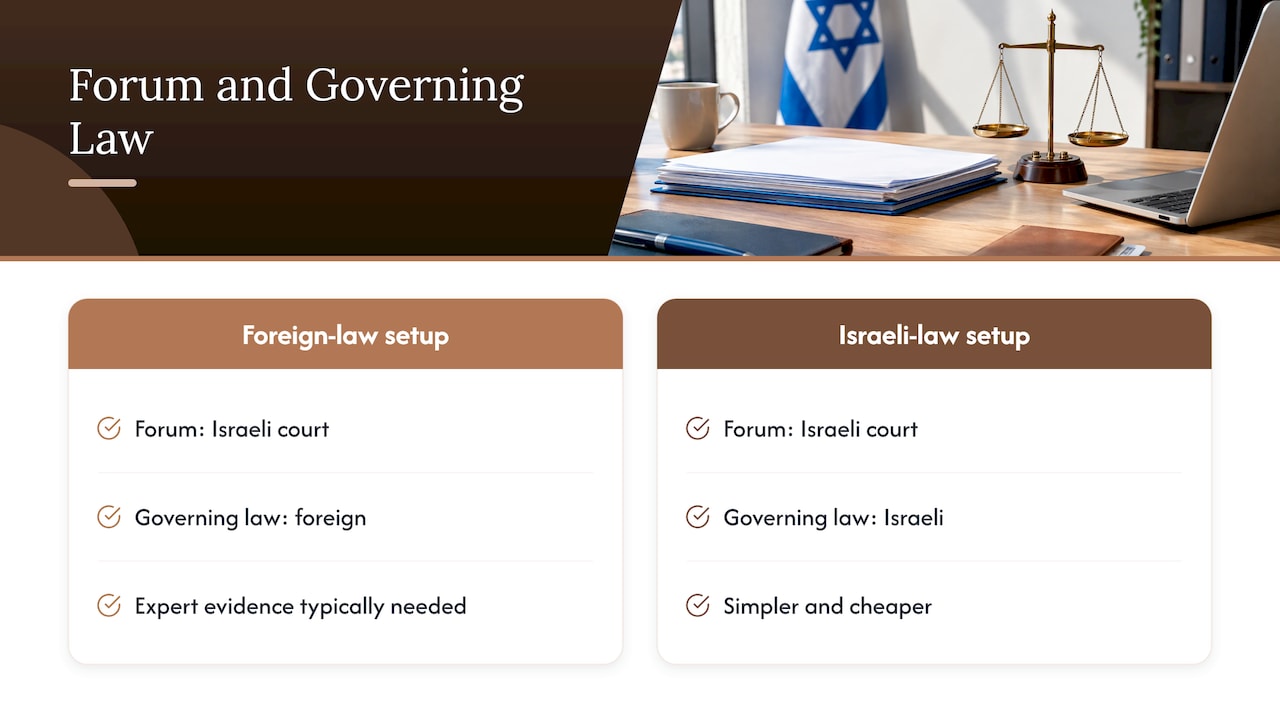
Two separate questions get confused all the time. One is where the case is heard. The other is which law decides it. An Israeli court can apply foreign law if the contract calls for it, but then that law becomes a matter of proof, and you will typically need expert evidence on its content. It is simpler, and cheaper, when the contract chooses Israeli law and Israeli courts together.
There is also a procedural trap. Under the Civil Procedure Regulations of 2018 (Regulation 29), a party who wants to argue lack of jurisdiction, a foreign forum clause or an inappropriate forum must raise that plea at the first opportunity after the statement of claim is filed. Failing to do so can lead to a costs order against that party.
For a defendant, this means you cannot sit back, file a defense on the merits and then argue later that the case belongs abroad. For a plaintiff, it means you should expect the objection early and prepare the answer in the claim itself.
How a case moves through an Israeli court
Every case is different, but the general path of a commercial claim looks like this.
- Case assessment and documents. Your lawyer reviews the contract, the correspondence, the invoices and the payment trail, and decides whether to file, negotiate first or send a formal demand letter.
- Statement of claim. The claim sets out the facts and the relief requested. Israeli rules on drafting are strict, and it is often hard to add new causes of action later without the court’s approval. A complete claim at the start saves trouble.
- Service on the defendant. In Israel, it is simple. Abroad, it needs leave and a method that works in the defendant’s country.
- Statement of defense and any counterclaim. The defendant responds, often raising jurisdiction objections and sometimes a counterclaim of its own.
- Pre-trial stage. The court holds a hearing to define the disputed issues. The parties exchange documents and may be encouraged to try mediation or settlement.
- Evidence. Witnesses submit written affidavits in advance and are then cross-examined at the hearing.
- Summations and judgment. The parties submit closing arguments in writing and the court issues its decision, which can be appealed.
Timelines vary a lot with the court, the complexity and how much the defendant contests. We prefer to tell clients honestly that a contested cross-border case is measured in months and often years, and that a good strategy uses that fact. Many disputes settle after a well-prepared claim lands, or after a freezing order focuses the other side’s attention.
Appearing remotely
Most overseas clients do not want to fly to Israel for every procedural step. Day-to-day work, such as reviewing drafts, giving instructions and approving strategy, can happen by phone, video and secure document sharing. Your lawyer appears for you at hearings. You may still be needed in person or remotely as a witness, and that is planned in advance. This is a core part of how Menora Law works with clients abroad.
Serving documents and gathering evidence abroad
Service on a foreign party is not a formality. A claim that is not properly served can be set aside or delayed, and a foreign defendant can later resist enforcement on the grounds that it never had proper notice.
Once you have leave to serve outside Israel, the method depends on the country where the defendant is located and on any treaties between that country and Israel. Documents may need to be translated and formally transmitted.
Evidence works in a similar way. Where a foreign court needs testimony from someone in Israel, the process runs through bilateral arrangements. For example, under the Israel-UK convention on taking evidence, letters of request for evidence in Israel go to the Director of Courts, and requests may be written in Hebrew, English, Arabic or French. That is one convention among several, and which one applies depends on the countries involved.
In the other direction, if your case is in Israel and the key documents or witnesses are abroad, plan early. Collect and preserve electronic records, get certified translations where Hebrew is required, and decide which witnesses can give evidence remotely.
Court fees and what the claim will cost
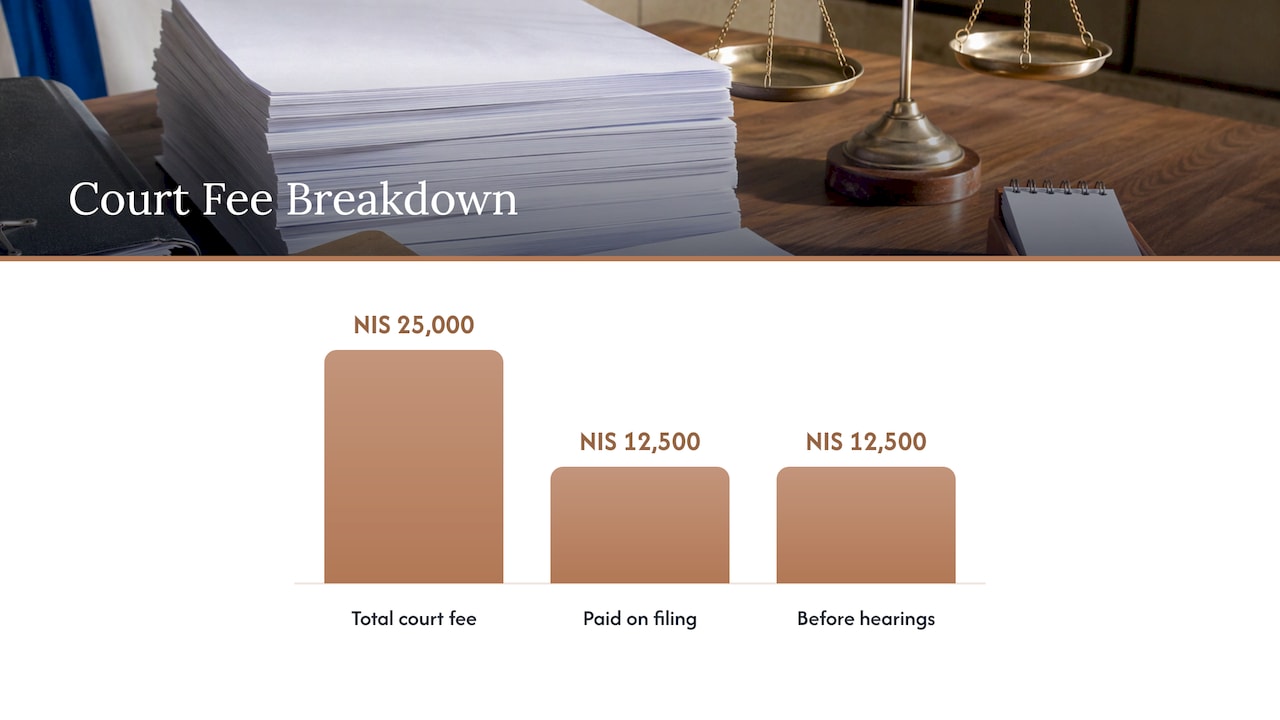
Israel charges court fees as a percentage of the amount claimed. According to the Courts (Fees) Notice for 2026, in effect from 1 January 2026, a claim for a fixed sum in the District Court costs 2.5% of the amount claimed, and 1% on the portion above NIS 28,580,660. Chambers’ 2026 guide to asset tracing in Israel adds that half the fee is paid when the claim is filed and the other half before the trial hearings begin.
Here is what that looks like for a claim of NIS 1,000,000:
| Item | Calculation | Amount |
|---|---|---|
| Total court fee | 2.5% of NIS 1,000,000 | NIS 25,000 |
| Paid on filing | Half of the fee | NIS 12,500 |
| Paid before hearings begin | Other half | NIS 12,500 |
This example covers court fees only. Legal fees, translation, expert witnesses and the cost of serving abroad are separate. Because the fee follows the claim amount, it is worth thinking carefully about exactly what you claim. An inflated figure raises your upfront cost, and a figure that is too low can limit what you can recover.
The court may also order the losing side to pay part of the winner’s costs, which is one more reason the early jurisdiction plea and a well-built claim matter.
Protecting your position: interim orders and freezing assets
Winning a judgment is of little use if the defendant’s assets are gone by the time you collect. Israeli law offers temporary remedies for this.
根据 Chambers’ 2026 asset tracing chapter on Israel, a motion for a temporary order is normally filed after, or together with, the statement of claim. In urgent cases it can be filed first, as long as the lawsuit follows within seven days or another period the court sets. The customary order for seizing assets is a temporary lien. The same source explains that a Mareva-type order can reach assets located abroad, because it is directed at a debtor who is within the jurisdiction and prohibits that person from disposing of assets, wherever they are.
These motions are fast-moving and fact-sensitive. Courts expect full and candid disclosure, and they often require a guarantee in case the order proves unjustified. If you suspect that a counterparty is moving money or property, speak to counsel before you send any demand letter, because the letter can tip off the other side.
Arbitration instead of court
Many international contracts send disputes to arbitration, and Israeli courts respect that choice. As the IADCLAW survey explains, no one is obliged to arbitrate under Israeli law unless the parties agreed to it, either in advance or after the dispute arose. Arbitration follows the Arbitration Law, and unless the parties agree otherwise, the arbitrator is not bound by the rules of evidence or by substantive law.
For cross-border business, there is a newer piece to know about. According to Chambers’ 2026 guide, the International Commercial Arbitration Law of 2024 adopted the UNCITRAL Model Law and allows the arbitral panel itself to grant interim relief in international commercial arbitrations, without a court petition. Ordinary arbitrations under the 1968 Arbitration Law still require a petition to the court under Section 16.
Here is a simple way to compare the two paths:
| Question | Israeli court | 仲裁 |
|---|---|---|
| How does it start? | Statement of claim, jurisdiction established as above | Only if the parties agreed to arbitrate |
| Interim relief | Motion to the court | Panel can grant it in international commercial arbitration under the 2024 law; a court petition is needed in ordinary arbitration |
| Rules of evidence and law | Procedural and substantive law apply | Arbitrator not bound unless the parties agree otherwise |
| Fees | Percentage-based court fees | Set by the arbitration terms agreed |
If your contract has an arbitration clause, check its wording with a lawyer before doing anything else. A badly drafted clause can create months of argument over whether it applies at all.
Enforcing a foreign judgment in Israel
Sometimes the case was already decided abroad, and you need to collect from an Israeli party or Israeli assets. That is handled under the Enforcement of Foreign Judgments Law of 1958. An Israeli court may declare a foreign judgment enforceable only if all of the following are true:
- The court that gave it was competent to do so under the laws of its own country.
- The judgment can no longer be appealed.
- Its content does not contradict Israeli law or Israeli public policy.
- It can be executed in the country where it was given.
The same law adds a reciprocity rule in Section 4. A judgment will not be declared enforceable if it was given in a country whose laws do not enforce Israeli judgments, unless the Attorney General asks for enforcement anyway. So when you are preparing a foreign case that you may later need to enforce here, it is worth confirming early that the foreign country’s rules allow recognition of Israeli judgments.
Once a judgment is declared enforceable, it is carried out through the Israeli enforcement system, which can reach bank accounts, property and other assets of the debtor.
Choosing the right strategy before you file
After years of working with overseas clients on Israeli matters, we see the same decisions shape the outcome of almost every cross-border dispute:
- Where to sue. Israel is the right forum when the defendant’s assets and the performance of the contract are here.
- When to freeze assets. Moving early on a temporary order can change the whole negotiation.
- Whether to settle. A strong claim, properly served, often leads to a business solution faster than a trial would.
- How to document. Contracts, emails, shipping records and bank transfers are your evidence. Preserve them now.
- Who handles it. Israeli procedure is unforgiving about form, and the case needs local counsel who writes and argues in Hebrew.
Our perspective
Overseas clients usually come to us after something has already gone wrong: a counterparty stopped paying, a partner went quiet, or a deal that looked solid on paper is now stuck. The first thing they need is clarity, not legalese.
We start by reading the contract and mapping where the dispute can be heard, where the other side’s assets are, and what a realistic result looks like. Then we give you a plan in plain English, with the Israeli law and procedure explained step by step.
Our approach is designed around one fact: you should not have to fly to Israel to protect your business here. We handle remote and on-site consultations, keep communication fast, and run the Israeli side of the case while you stay informed and in control of the key decisions.
Because our practice covers business law, corporate structuring, intellectual property, real estate and more, we see the whole picture of a dispute, not only the lawsuit. That helps us propose strategic solutions, whether that means a firm claim, a negotiated exit or a better contract going forward.
梅诺拉法
Work with Menora Law on your Israeli dispute
Menora Law is an Israeli law practice built around international clients. We prepare and manage matters for overseas companies, investors and individuals, including representing international and foreign companies in Israel, corporate structuring, mergers, intellectual property and real estate transactions. If you are weighing a claim or facing one, we can review your documents and explain your options in plain terms.

To discuss your case, reach out through our website. Tell us who the parties are, where the contract was performed and what you want to achieve, and we will tell you what the next step looks like.
常问问题
Can I sue an Israeli company without traveling to Israel?
Yes, in most cases. Your 以色列律师 files and conducts the case on your behalf, and routine instructions can be given remotely. You may be asked to give evidence as a witness, and that is arranged in advance, sometimes by video depending on what the court allows.
Can an Israeli court hear a case against a company based abroad?
It can if the contract grants jurisdiction to Israeli courts, if the defendant is served inside Israel, or if the court gives leave to serve abroad because Israel is relevant to the claim. The court can still decline if it finds another forum more appropriate, so the Israeli connection should be clearly set out.
What does it cost to file a commercial claim in Israel?
Court fees for a claim for a fixed sum in the District Court are 2.5% of the amount claimed, with 1% applying above NIS 28,580,660. Half is paid on filing and half before hearings begin. Legal fees, translations and service abroad are additional.
Is arbitration faster than going to court?
It depends on the case and the arbitration terms, so we avoid promising a timeline. What is clear is that arbitration only applies if the parties agreed to it. For international commercial arbitration, the 2024 law lets the panel itself grant interim relief.
Can a foreign judgment be enforced in Israel?
Yes, if an Israeli court declares it enforceable under the 1958 law. The judgment must come from a competent court, be final, be consistent with Israeli law and public policy, and be executable where it was given. Reciprocity with the foreign country is also required, with a narrow exception.


 English
 Afrikaans
 العربية
 বাংলা
 Čeština
 简体中文
 Nederlands
 Suomi
 Français
 Deutsch
 עִבְרִית
 हिन्दी
 Magyar
 Italiano
 日本語
 한국어
 Polski
 فارسی
 Português do Brasil
 Русский
 Español de México
 Українська