
The right legal representative in Israel is an Israeli-licensed attorney, confirmed in the Israel Bar Association’s public directory, who handles your type of matter regularly, communicates with you in your language and time zone, and puts scope, fees and reporting in a written engagement agreement. Everything else is detail, but the detail is what separates a smooth matter from an expensive one. This guide walks through each step, in the order you will actually face them.
It is written for people who live outside Israel, or who are new to the country, and who need someone to act for them here: heirs, property owners, investors, founders and families. If that is you, you can do most of the selection remotely.
TL;DR
- Only an Israeli-licensed attorney can provide legal services in Israel. Check the name in the Israel Bar Association directory before you share any documents.
- Match the attorney to the matter: inheritance, real estate, corporate and IP work each call for different day-to-day experience.
- If you are abroad, ask how consultations, signing and document handling work remotely, and who will actually answer your emails.
- Get the role, scope, communication plan and fee basis in a written engagement agreement before work starts.
- Prepare your documents and a short timeline before the first call. It saves time and makes the first consultation far more useful.
Who counts as a legal representative in Israel
In Israel, the legal profession is one group: advocates. According to a 2017 academic study of lawyer regulation in Israel, only advocates perform legal services, and there are no separate categories such as paralegals or legal assistants. The same paper notes that law firms may operate only as a sole practice, a partnership or a company in which all members and managers are lawyers.
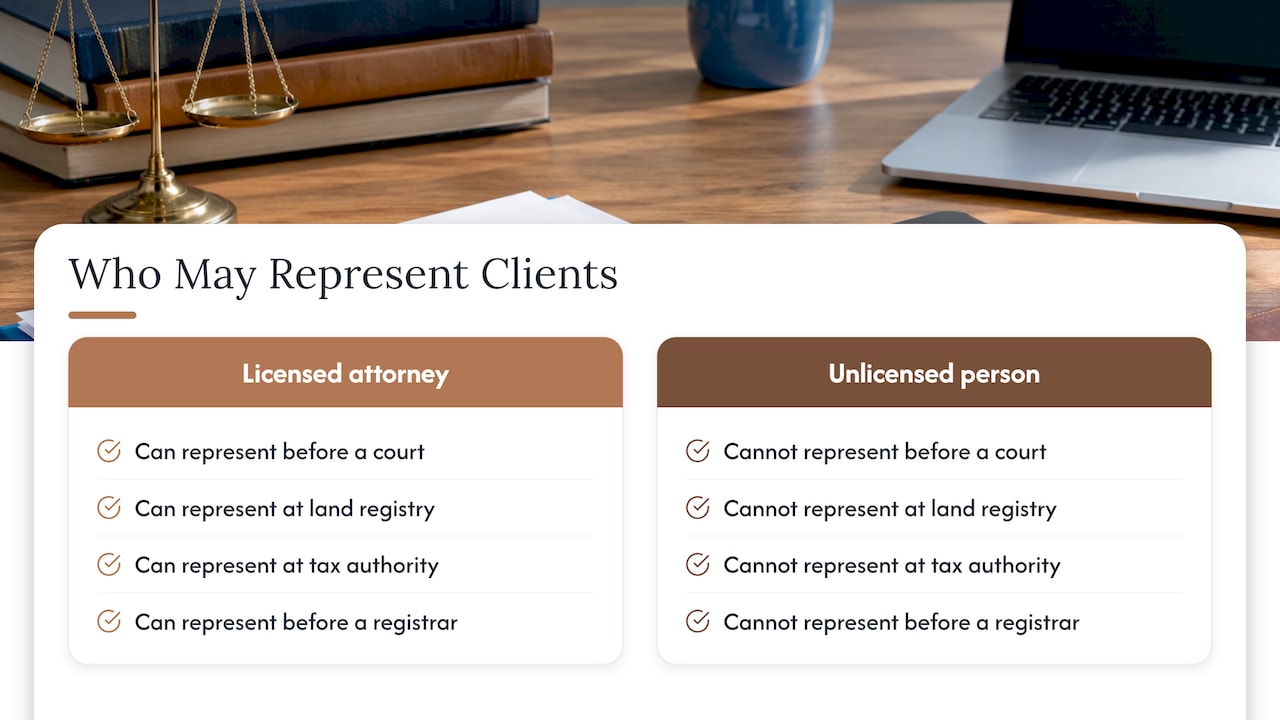
That has a practical meaning for you. When someone offers to “handle your legal matter” in Israel, whether a consultant, a real estate agent, an estate “facilitator” or a relative with connections, the question is always the same: is this person a licensed Israeli attorney? If not, they cannot represent you before a court, a land registry, a tax authority or a registrar in the way a lawyer can.
The Israel Bar Association is the statutory body behind the profession. Per the same study, it was established by the Israel Bar Association Law of 1961, membership is mandatory, and it oversees licensing and the disciplinary system. If you want a plain-language overview of what membership means for you as a client, see our page on Israeli Bar Association membership.
What about lawyers trained abroad?
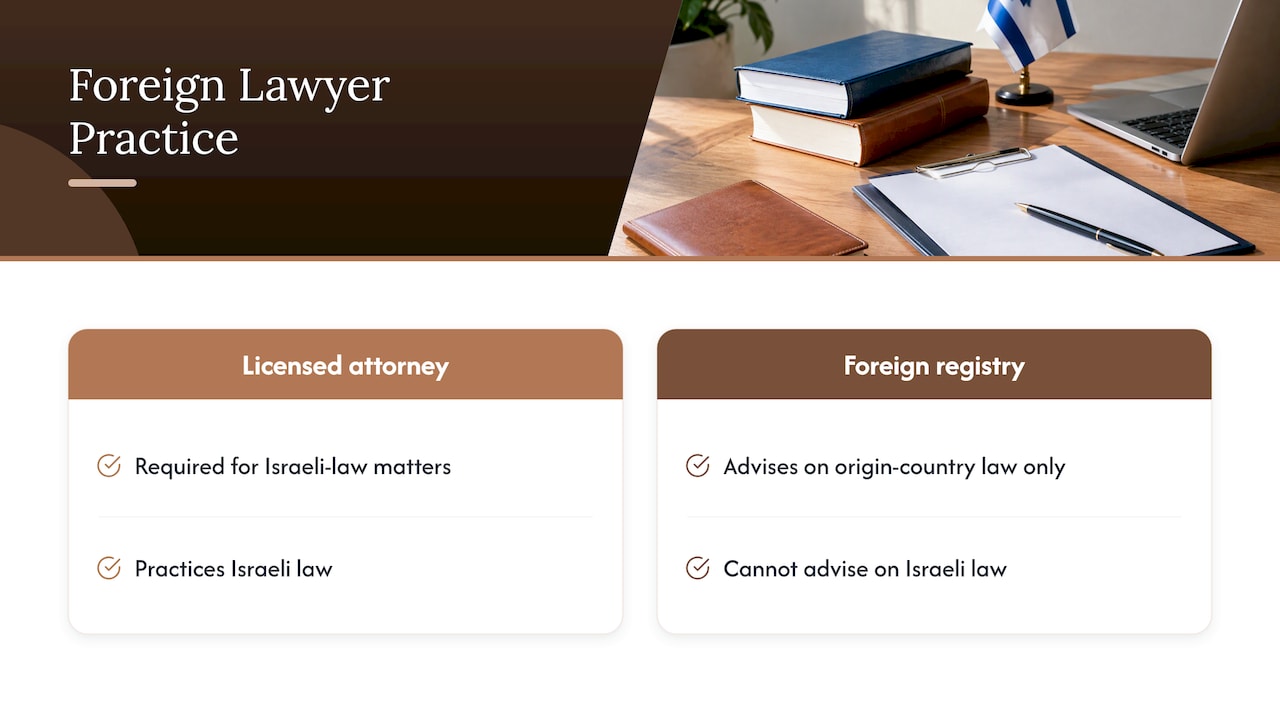
A lawyer qualified in another country is not automatically able to practice Israeli law. The Ministry of Aliyah and Integration’s page on regulated professions explains that licensing under the Bar Association Law, 5721-1961, includes examinations in Israeli law and an internship with a recognized Israeli attorney, with the route varying by length of experience abroad. The same page describes a Foreign Attorneys Registry: a registered foreign attorney may advise Israeli clients only on the law of their country of origin, not on Israeli law.
So if your matter is governed by Israeli law, as an Israeli estate, an Israeli property or an Israeli company is, you need an Israeli-licensed attorney. That is the core of what we do at Menora Law: Israeli law, for international clients.
Step 1: Verify the license before anything else
This takes five minutes and should come first, before you send a passport copy or a death certificate.
- Search the Bar directory. The Israel Bar Association’s lawyer directory lets you search by name, area of practice, city and language. According to the directory page, it lists only active lawyers with a valid license, and does not show lawyers who have been expelled, suspended, have resigned or whose membership lapsed.
- Read the profile. An individual profile, such as this sample lawyer page, shows the full name, the name in English, date of admission, areas of practice, whether the lawyer is qualified for a continuous power of attorney, and যোগাযোগ details. The date of admission is a quick way to see how long someone has been licensed.
- Check the suspended list. The Bar publishes a list of suspended lawyers. Suspended lawyers may not perform any action reserved for a lawyer under Section 20 of the Bar Association Law.
- Ask for the paperwork. ক Ynet consumer article on impostors recommends searching the Bar website by name and asking to see the original certificate of admission and a valid membership card with a photo.
If you cannot find the name
Don’t panic. Hebrew names are transliterated in several ways, and the directory itself says it is updated periodically from information provided by lawyers and may contain errors. Try alternative spellings, search by city, or search in Hebrew. If the name still does not appear, the directory page gives a Bar Association যোগাযোগ for clarifying a lawyer’s status, and a reputable attorney will not mind you asking.
Step 2: Match the attorney to your type of matter
“ইসরায়েলি আইনজীবী” is a very wide label. A litigator who spends his week in the labor courts is not necessarily the person you want drafting an inheritance petition, and a trademark specialist is not who you call about a land purchase. Use the directory’s area-of-practice field, then confirm in conversation that the matter you have is something the attorney handles regularly.
Here is what to look for, by type of matter.
| Your matter | What the representative should handle regularly | Questions worth asking |
|---|---|---|
| Inheritance and probate | Inheritance orders, wills, estate administration, family court proceedings | Do you work with heirs who live abroad? How do you handle documents signed outside Israel? |
| Real estate | Purchase and lease contracts, due diligence on title, registration, taxes | Who checks the registry and planning status? What happens between signing and registration? |
| Business and corporate | Company formation, structuring, mergers, share issues | Do you advise on structure before incorporation, or only file forms? |
| Intellectual property | Trademark, copyright and patent filings, including provisional patents | Who prepares the filing, and how are deadlines tracked for me? |
| Disputes | Court representation, negotiation, enforcement | Which court or forum would this go to, and what is a realistic sequence of steps? |
Inheritance and estate matters
Israeli succession has its own procedure. Generally, an heir needs an inheritance order or probate order from the competent authority before assets can be released, and contested or complex estates can end up in the family courts. If a relative has died leaving property, accounts or a home in Israel, you need an attorney who works with this process every week. Our guides on inheritance and estate law in Israel and the Succession Law of 1965 explain the framework before you make a call.
Real estate
Property work is detail-heavy: the contract, the registry, taxes, financing, the handover. A good real estate attorney reads the contract with you line by line and explains what you are signing. Before you speak to anyone, our overview of Israeli real estate law for buyers and investors and the 30 tips for buying in Israel will help you ask sharper questions. If you hold a foreign passport, read about buying land in Israel as a foreigner too.
Companies, startups and IP
If you are setting up a business, ask whether the attorney advises on the entity type and the structure, not only on filing the paperwork. Our guide to Israeli business entities shows why that choice matters early. For brands and software, look for someone who registers trademarks, copyrights and patents in Israel as a regular part of the practice. See also our copyright basics.
Step 3: Check cross-border experience and remote access
Working with a client abroad is a skill in itself. It is not just a matter of having a good Zoom account. These are the points that decide whether it goes smoothly.
- Language. The directory lets you filter by language, but a listed language is only a starting point. Have a short call and judge for yourself whether you understand each other, including on legal terms. A mistake in translation in an engagement agreement or a power of attorney is hard to fix later.
- Time zones. Ask when the attorney is available and how quickly emails are answered. Israel’s working week runs Sunday to Thursday, with Friday short and Saturday off, which affects overseas schedules. Agree on a response window up front.
- Remote consultations. You should be able to talk through your matter, review documents and make decisions without flying in. Our virtual consultation guide explains how this works in practice.
- Signing from abroad. Many Israeli procedures need documents to be signed in a specific form. Ask the attorney, before you sign anything, exactly how each document should be executed and certified where you are, and who will check it before it travels.
- Experience with people like you. An attorney who regularly works with heirs, owners and investors who live outside Israel will anticipate the problems: missing certificates, name differences between passports and Israeli records, and documents that have to be validated before an Israeli office accepts them.
- Continuous power of attorney. If you need someone to act on your behalf over time, the directory profile tells you whether a lawyer is qualified for a continuous power of attorney. Discuss the exact limits of any authority before you grant it.
On communication, a litigation-communications guide makes a point that applies to choosing counsel generally: clear communication between lawyer and client shapes how a matter develops, so pay attention to how the attorney communicates from your very first যোগাযোগ.
Step 4: Check trust, conduct and conflicts
The relationship between lawyer and client rests on trust and free communication between the two. That is how the Bar’s ethics committee frames it in issue 79 of its professional ethics bulletin, which also stresses that a lawyer’s conduct toward a client must be professional, balanced and respectful.
In practice, here is what you can check and ask:
- Does the attorney represent anyone else with an interest in your matter? This is the classic conflict in estates, where several heirs may want the same lawyer, and in companies, where founders and investors may have different interests. A careful attorney raises this themselves.
- What will stay confidential? Israeli law protects communications between a lawyer and client. Read about attorney-client privilege in Israel to know what to expect.
- Is there a complaint history? Lawyers in Israel are subject to the Bar’s disciplinary system, and the suspended list mentioned above is public. Checking it costs nothing.
A good attorney also says no, or says “this is outside my practice area”, when that is the honest answer. Treat that as a plus.
Step 5: Put the engagement in writing
Before work begins, you should have an engagement agreement, and it should be in a language you fully understand. It does not need to be long. It does need to cover these points.
- Role. Who is the client, and who is the attorney acting for? In an estate with several heirs, this matters a lot.
- Scope of work. List the tasks that are included, such as an inheritance order application, contract review and negotiation, a trademark filing, and those that are not, such as a later court appeal or a tax filing in another matter.
- Who does the work. Which attorney will handle your file, and who covers in their absence?
- Communication. Preferred channel, expected response time, how often you get status updates, and who is your day-to-day contact.
- Fees. Whether the fee is fixed per task, hourly or staged. Whether VAT is included. Which third-party costs, such as filing fees, translations and certifications, are charged on top of the attorney’s fee.
- Documents and authority. What you will sign, what the attorney may do in your name, and for how long.
- Ending the engagement. How either side can end it, and what happens to your documents when it does.
If an item above is vague, ask for it to be written clearly. Precision at this stage is cheap. Fixing a misunderstanding in the middle of a matter is not.
Step 6: Prepare before the first consultation
A focused first call can get you a real answer instead of a list of questions. Bring the following, scanned and organized.
- Identity documents. Passport, and any Israeli ID if you have one. Note any name differences across documents.
- The matter’s paper trail. For an estate: the death certificate, any will, a list of known assets and heirs. For property: the contract draft, registry extracts if you have them, correspondence with the seller. For a company: founder details, the planned activity, any investor term sheet. For IP: samples of the brand, product or code and the dates of first use.
- A one-page timeline. What happened, when, and what you want to happen next.
- Deadlines. Any date you were given by a court, a bank, a seller or an authority.
- Your questions. Include cost, timing and who will do the work.
- Other people involved. Co-heirs, partners, co-buyers or their lawyers, with contact details.
How to compare two or three candidates
Speak to at least two attorneys if the matter is large. Use the same short list with each.
| Criterion | What a good answer sounds like |
|---|---|
| License | Name found in the Bar directory, admission date visible, areas of practice match |
| Relevant experience | Regularly handles your kind of matter, can describe the steps without jargon |
| International clients | Has a clear process for signing and certifying documents from abroad |
| Communication | Clear response times, one named contact, updates without chasing |
| Fees | Basis explained, VAT and extra costs stated, put in writing |
| Strategy | Offers a plan and options, not only a quote |
Notice how each one makes you feel after the call. Did you understand what happens next? Did the attorney listen to your goals, not just to your documents? Those impressions usually predict the working relationship well.
Our perspective
Most of the clients who come to us from abroad are not worried about the law itself. They are worried about being far away, not knowing who is really handling their matter, and not being sure what is going on.
That is why we built Menora Law around international clients and Israeli law only. We represent clients in Israel and advise on Israeli law, and we offer remote consultations as well as on-site meetings abroad, so you do not have to fly in to get started.
Our approach is simple. We confirm the facts, explain the Israeli procedure in plain language, agree a strategy with you, and keep you updated so you never have to chase. Whether it is an inheritance order, a property purchase, a company setup or an IP filing, we want you to know the next step and why it is being taken.
When you are choosing a representative, pick the one who makes the process clear. That is the standard we hold ourselves to.
মেনোরা আইন
Working with Menora Law
Menora Law is an Israeli law practice for international clients. Our services include obtaining an Israeli inheritance order, estate administration and distribution, preparing, filing and modifying wills, real estate transactions and contracts, company formation and mergers, trademark, copyright and patent work, and legal support for startups and biotech companies. We work with clients remotely, and we meet clients abroad when that helps.
If you are ready to talk through your matter, contact Menora Law for a first conversation. Tell us what you need, send the documents you have, and we will tell you what the Israeli process looks like and what comes first.
FAQ
Can I hire an Israeli attorney without traveling to Israel?
Yes. Initial consultations, document review and many steps of a matter can be done remotely. Where a document must be signed in a particular form, your attorney should tell you in advance how to do it where you are. See our virtual consultation guide for how this works.
How do I know a lawyer is licensed in Israel?
Search their name in the Israel Bar Association directory. Per the directory, only lawyers with an active license are listed. If you cannot find the name, try other spellings or contact the Bar to clarify the lawyer’s status.
Can a lawyer from my home country represent me in Israel?
Not on Israeli law. According to the Ministry of Aliyah and Integration, a foreign attorney registered in Israel may advise Israeli clients only on the law of their country of origin. For an Israeli estate, property or company you need an Israeli-licensed attorney.
What should be in an engagement agreement?
At minimum: the attorney’s role, the scope of work, the person responsible for your file, how and how often you will communicate, the fee basis, what costs are extra, and how the engagement can end. Ask for it in a language you fully understand before work starts.
Do I need one lawyer for several matters?
Not necessarily, but it often helps to have one coordinating attorney. An estate may involve inheritance, real estate and tax questions at once, and one team that sees the whole picture can plan the steps in the right order.
Sources
- Regulation of Lawyers and Legal Services in Israel (Zer Gutman, 2017)
- Regulated professions and how to obtain a license (Ministry of Aliyah and Integration)
- Israel Bar Association lawyer directory
- Israel Bar Association sample lawyer profile
- Israel Bar Association list of suspended lawyers
- How to tell if a lawyer is an impostor (Ynet)
- Professional Ethics, issue 79 (Israel Bar Association)
- Litigation Communications: A Guide for Leaders and Counsel


 English
 Afrikaans
 العربية
 বাংলা
 Čeština
 简体中文
 Nederlands
 Suomi
 Français
 Deutsch
 עִבְרִית
 हिन्दी
 Magyar
 Italiano
 日本語
 한국어
 Polski
 فارسی
 Português do Brasil
 Русский
 Español de México
 Українська