
TL;DR:
- The Israeli Magistrate Court is the primary court for most civil and criminal cases, handling claims below NIS 2.5 million and offenses with sentences under seven years. It operates as the lowest tier in Israel’s judicial system, with a single judge presiding over cases, and decisions can be appealed to the District Court. Most disputes start here, and engaging proper legal representation is essential for effective navigation and enforcement.
The Israeli Magistrate Court is the primary court of first instance in Israel’s secular judicial system, responsible for handling most civil disputes and minor to mid-level criminal cases. If you are dealing with a legal matter in Israel, whether you live there or abroad, understanding what is Israeli magistrate court means understanding where most litigation actually begins. Governed by the Courts Law, 1984, this court handles criminal cases with potential sentences under seven years and civil claims below NIS 2.5 million. It is the court most Israelis and foreign litigants encounter first, and knowing how it works gives you a real advantage before you ever set foot in a courtroom.
What is the Israeli Magistrate Court?
The Israeli Magistrate Court, known in Hebrew as Beit Mishpat HaShalom, is the entry-level court in Israel’s three-tier judicial structure. It sits at the base of the hierarchy, below the District Court and the Supreme Court. Most civil and criminal litigation in Israel’s secular system begins here.
The court’s jurisdiction is defined precisely by law. It hears criminal cases subject to sentences under seven years and civil claims valued below NIS 2.5 million. That threshold covers the vast majority of everyday disputes, from contract disagreements to property damage claims. The court also handles certain landlord-tenant matters and some categories of family-related financial disputes.
Cases in the Magistrate Court are presided over by a single judge. There is no jury system in Israel. The judge hears evidence, reviews arguments, and issues a binding decision. This structure keeps proceedings focused and relatively efficient compared to multi-judge panels in higher courts.
Understanding the Israeli legal system’s key differences from other jurisdictions is the first step for any foreigner entering this process. The Magistrate Court is where that process most often starts.
What types of cases does the Israeli Magistrate Court handle?
The Magistrate Court’s jurisdiction covers two broad categories: civil matters and criminal matters. Each category has clear legal boundaries set by the Courts Law, 1984.
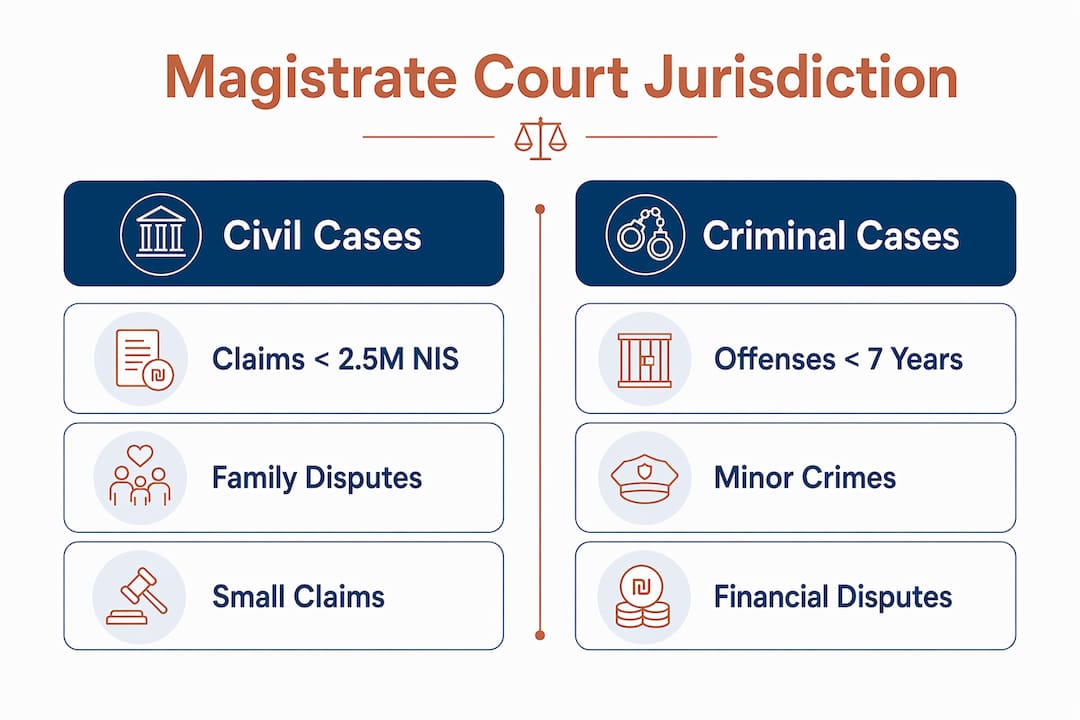
Civil jurisdiction
Civil cases in the Magistrate Court involve monetary claims below NIS 2.5 million. The types of disputes that fall within this range include:
- Contract disputes between individuals or businesses where the claimed amount is below the threshold
- Property damage claims arising from negligence or breach of duty
- Landlord-tenant disputes, including eviction proceedings and rent disagreements
- Debt collection actions where the outstanding amount falls within the court’s monetary limit
- Certain real estate disputes, particularly those involving possession rather than title
If a claim exceeds NIS 2.5 million, it moves to the District Court. The monetary threshold is not negotiable. A claimant cannot voluntarily reduce their claim just to access the Magistrate Court if the actual dispute value is higher.
Criminal jurisdiction
The Magistrate Court handles minor to mid-level criminal offenses, specifically those carrying a maximum sentence of less than seven years. This includes offenses such as petty theft, minor assault, traffic violations with criminal implications, and certain fraud cases below the severity threshold for District Court prosecution.
Serious crimes, including murder, major drug trafficking, and offenses carrying sentences of seven years or more, go directly to the District Court. The Magistrate Court’s criminal role is to relieve higher courts of the volume of everyday offenses that do not require the resources of a senior tribunal.
Pro Tip: If you are unsure whether your dispute falls within Magistrate Court jurisdiction, check the monetary value of your claim and the maximum sentence attached to the offense. Those two numbers determine where your case belongs.
The court also handles certain Israeli family law disputes involving financial components, though family status matters such as divorce and custody fall under the separate jurisdiction of religious courts in Israel.
How does the Israeli Magistrate Court fit within the Israeli court hierarchy?
Israel’s judicial system operates on three tiers. Understanding where each court sits tells you exactly what to expect at each stage of litigation.

| Court | Level | Primary Function | Appeals To |
|---|---|---|---|
| Magistrate Court | First instance | Civil claims under NIS 2.5M; criminal cases under 7 years | District Court |
| District Court | Second instance / first instance | Appeals from Magistrate Court; serious criminal and civil cases | Supreme Court |
| Supreme Court | Highest court | Final appeals; constitutional matters | No further appeal |
The Magistrate Court sits at the base of this structure. It is where most disputes enter the system. The District Court serves both appellate and residual trial court functions, meaning it reviews Magistrate Court decisions on appeal and also hears cases that fall outside the Magistrate Court’s jurisdiction from the start.
The Supreme Court, based in Jerusalem, sits at the top. It hears appeals from District Courts and also functions as the High Court of Justice for constitutional and administrative matters. Most litigants never reach the Supreme Court. Their case begins and ends at the Magistrate or District Court level.
Appeals from the Magistrate Court go to the District Court. The District Court reviews the lower court’s decision, and in most cases, the District Court’s ruling on appeal is final. This two-step process gives litigants a meaningful check on Magistrate Court decisions without requiring access to the Supreme Court.
For foreigners dealing with Israeli legal jurisdiction rules, knowing this hierarchy matters. A judgment from a Magistrate Court carries full legal weight and can be enforced. If you disagree with the outcome, the District Court is your next step, not the Supreme Court.
What is the typical procedure and timeline in the Israeli Magistrate Court?
The procedural flow in the Magistrate Court follows a structured path from filing to judgment. Knowing the stages helps you set realistic expectations.
Standard civil procedure steps
- Filing the claim: The plaintiff submits a statement of claim to the court, paying the relevant filing fee. The claim must specify the legal basis and the amount sought.
- Service on the defendant: The court arranges or the plaintiff arranges service of the claim on the defendant. For international parties, this step can take additional time.
- Statement of defense: The defendant files a written response within the court-set deadline, typically 30 days.
- Pre-trial hearing: The judge holds a preliminary hearing to identify the disputed issues, consider settlement, and set a timetable for evidence.
- Evidence stage: Parties submit written witness statements and documents. Oral cross-examination follows at a hearing.
- Summations: Both sides submit written legal arguments summarizing their positions.
- Judgment: The judge issues a written decision, typically within several months of the final hearing.
Criminal procedure steps
Criminal proceedings follow a similar structure but begin with an indictment filed by the prosecution. The defendant enters a plea, and if the matter is contested, the court holds an evidentiary hearing. The judge then issues a verdict and, if guilty, a separate sentencing decision.
Timeline
Civil proceedings in Magistrate Courts average approximately 10.9 to 11.2 months from filing to judgment. That is significantly faster than District Court civil proceedings, which tend to run longer due to the complexity of cases handled there. The shorter timeline reflects the Magistrate Court’s design as a court built for volume and accessibility.
Pro Tip: Filing complete and well-organized documents from the start reduces delays significantly. Incomplete submissions often trigger procedural objections that add months to a case.
For a full breakdown of the Israeli civil litigation process, including what to expect at each stage, Menora Law has published a detailed 2026 guide covering the entire process from first filing to enforcement.
| Stage | Approximate Duration |
|---|---|
| Filing to first hearing | 1–3 months |
| Evidence and hearings | 4–7 months |
| Summations to judgment | 2–3 months |
| Total (civil) | 10.9–11.2 months average |
Who are the judges in Israeli Magistrate Courts and how are they selected?
Magistrate Court judges are professional, salaried members of the Israeli judiciary. They are not elected and do not serve fixed political terms. Their appointment follows a formal process designed to prioritize legal expertise.
The Judicial Selection Committee
Judges are appointed by the Judicial Selection Committee, a body that includes:
- Justices of the Supreme Court, including the President of the Supreme Court
- Members of the Israeli Bar Association, representing the legal profession
- Government ministers, including the Minister of Justice
- Members of the Knesset (Israel’s parliament), appointed to the committee
The committee evaluates candidates on professional merit, legal experience, and judicial temperament. Candidates for Magistrate Court positions typically come from the ranks of practicing attorneys or legal academics with substantial experience.
Political influence and judicial independence
Recent years have seen debate in Israel about the balance between professional merit and political influence in judicial appointments. Shifts toward increased political influence over the selection process have raised questions about long-term judicial independence, particularly at the lower court levels where most litigants interact with the system.
Judicial independence at the Magistrate Court level is critical for fair trials. The appeals process to the District Court serves as the primary structural check on any individual judge’s decision. A litigant who believes a Magistrate Court judge made a legal error has a clear path to review.
The current debate over judicial selection in Israel is ongoing as of 2026. For foreign clients and international litigants, the practical takeaway is straightforward: Magistrate Court judges are trained legal professionals, and their decisions carry the full authority of Israeli law. The appeals process remains available and functional regardless of how the selection debate resolves.
How can individuals practically engage with the Israeli Magistrate Court system?
Engaging with the Magistrate Court is more accessible than many foreign litigants expect. The court system has defined procedures, and with proper legal representation, the process is manageable even from abroad.
Determine jurisdiction: Confirm that your claim falls within the Magistrate Court’s monetary or criminal threshold. A civil claim below NIS 2.5 million or a criminal matter carrying less than seven years belongs here.
Retain an Israeli attorney: Most litigants in Israel’s Magistrate Courts are represented by lawyers who handle filings, court appearances, and communications on their behalf. For international clients, this is not optional. Israeli court documents are in Hebrew, and procedural rules require precise compliance.
File the claim or respond to one: Your attorney prepares and files the statement of claim or defense. Filing fees apply and vary by claim amount. Your attorney calculates and pays these on your behalf.
Attend hearings or authorize representation: Israeli procedural rules generally allow an attorney to appear on a client’s behalf without the client being physically present. This is particularly relevant for overseas clients who cannot travel to Israel for every hearing.
Pursue an appeal if needed: If the Magistrate Court’s decision goes against you, your attorney files a notice of appeal with the District Court within the prescribed deadline, typically 45 days from the date of judgment. The District Court then reviews the record and hears arguments.
Enforce the judgment: A favorable Magistrate Court judgment is enforceable through Israel’s enforcement offices. Your attorney initiates enforcement proceedings if the opposing party does not comply voluntarily.
For those dealing with cross-border matters, serving legal documents internationally is a separate procedural step that requires specific compliance with Israeli rules and international conventions.
Key takeaways
The Israeli Magistrate Court is the defined entry point for most civil and criminal litigation in Israel, with clear jurisdictional thresholds that determine whether your case belongs there or in a higher court.
| Point | Details |
|---|---|
| Jurisdiction thresholds | Civil claims under NIS 2.5 million and criminal cases under 7 years belong in the Magistrate Court. |
| Single-judge structure | One judge presides over each case, with no jury system in Israel. |
| Average civil timeline | Civil proceedings average 10.9 to 11.2 months, faster than District Court cases. |
| Appeals path | Magistrate Court decisions can be appealed to the District Court within 45 days of judgment. |
| Legal representation | An Israeli attorney handles filings and hearings, including remote representation for overseas clients. |
Menora Law’s perspective on the Israeli Magistrate Court
Working with clients who are navigating the Israeli Magistrate Court from abroad has taught us one consistent lesson: the biggest mistakes happen before the case even starts. Clients often misjudge jurisdiction, file in the wrong court, or miss procedural deadlines because they assumed the Israeli system works like the legal systems they know from home. It does not.
The Magistrate Court is actually one of the more accessible parts of the Israeli judiciary. The timelines are reasonable, the procedures are defined, and a single judge means you get a clear, direct decision rather than a committee deliberation. For straightforward civil disputes or mid-level criminal matters, this court works efficiently when you approach it correctly.
What concerns us more is the current conversation around judicial selection. Increased political influence over who becomes a judge is a real development, and it deserves attention. For now, the appeals process to the District Court remains a solid safeguard. If a Magistrate Court decision seems wrong on the law, the District Court review is meaningful and accessible. We have used it successfully for clients on multiple occasions.
Our advice to anyone facing a Magistrate Court matter: get Israeli legal representation early, confirm your jurisdiction before filing, and do not assume you can manage the process remotely without professional help. The court is accessible, but it is not self-service.
— Menora Law
Menora Law’s support for clients in Israeli court matters
Menora Law works with clients across the world who need representation in Israeli courts, including the Magistrate Court. Whether you are filing a civil claim, responding to one, or appealing a decision, the firm handles the full process on your behalf.

From the first filing to final judgment, Menora Law manages court appearances, document preparation, and procedural compliance so you do not have to be in Israel to protect your interests. The firm also advises on related matters such as قانون ارث اسرائیل, which frequently intersects with court proceedings when estates are disputed. If you need a trusted Israeli attorney who communicates clearly and works efficiently across time zones, مخاطب Menora Law for a consultation.
سوالات متداول
What is the Israeli Magistrate Court in simple terms?
The Israeli Magistrate Court is the lowest-level court in Israel’s judicial system, handling civil claims under NIS 2.5 million and criminal cases with sentences under seven years. It is governed by the Courts Law, 1984, and is presided over by a single judge.
What cases go to the Israeli Magistrate Court?
Civil disputes below NIS 2.5 million and criminal offenses carrying less than seven years in prison go to the Magistrate Court. Examples include contract disputes, debt collection, minor assault, and certain property matters.
How long does a Magistrate Court case take in Israel?
Civil proceedings in the Israeli Magistrate Court average approximately 10.9 to 11.2 months from filing to judgment. Criminal cases vary depending on complexity and whether the defendant contests the charges.
Can a Magistrate Court decision be appealed in Israel?
Yes. Decisions from the Israeli Magistrate Court can be appealed to the District Court, typically within 45 days of the judgment. The District Court reviews the legal and factual record and issues a binding appellate decision.
Do I need an Israeli lawyer to appear in Magistrate Court?
Legal representation is not legally mandatory in all cases, but it is strongly advisable, especially for foreign clients. An Israeli attorney handles filings in Hebrew, manages court appearances, and ensures procedural compliance throughout the case.


 English
 Afrikaans
 العربية
 বাংলা
বাংলা Čeština
 简体中文
简体中文 Nederlands
 Suomi
Suomi Français
 Deutsch
 עִבְרִית
 हिन्दी
 Magyar
 Italiano
 日本語
日本語 한국어
한국어 Polski
 فارسی
فارسی Português do Brasil
 Русский
 Español de México
 Українська