
Israel can recognize a foreign will — but it will not act on it automatically. Under Section 65 of the Succession Law 1965, a will executed outside Israel is formally valid if it satisfies at least one of four legal tests tied to where it was made or the testator’s domicile. That said, Israeli banks, the Land Registry, and other institutions will not release or transfer assets based on a foreign probate order alone. You still need an Israeli Succession Order issued by the Registrar for Matters of Succession (Ministry of Justice) before anything moves.
If you are an overseas heir dealing with Israeli assets, here are three steps to take right now:
- Locate the original will (or a certified copy) and confirm it has been apostilled or legalized for use abroad.
- Arrange certified Hebrew translations of the will, the death certificate, and any foreign probate documents.
- مخاطب Israeli counsel or prepare a filing directly to the Registrar for Matters of Succession to begin the recognition process.
Menora Law handles this entire process remotely for overseas clients, from document review through Registrar submission.
Key Takeaways
Israel recognizes foreign wills under Section 65 of the Succession Law 1965, but an Israeli Succession Order from the Registrar for Matters of Succession is always required before Israeli institutions will release or transfer assets.
| Point | Details |
|---|---|
| Four formal-validity tests | A foreign will is valid in Israel if it meets the law of where it was made, domicile when made, domicile at death, or Israeli law. |
| Registrar timeline | A completed, apostilled, translated application typically produces a Succession Order within 40 days (50 days if referred to the Attorney General). |
| Foreign probate is not enough | Israeli banks and the Land Registry require an Israeli Succession Order; a foreign grant of probate has no automatic force over Israeli assets. |
| Most common formal defect | A bequest to a beneficiary who also witnessed the will may be voided under Israeli practice, even when valid abroad. |
| Menora Law remote intake | Menora Law reviews files remotely, prepares Registrar applications, and manages Israeli filings for overseas heirs end-to-end. |
What makes a will “foreign” under Israeli succession law?
A will is treated as foreign for Israeli succession purposes when it was executed outside Israel or drafted under a foreign legal system’s formalities, regardless of the testator’s nationality. The testator’s domicile at the time of signing, the country where the document was prepared, and the language and format of the instrument all factor into how Israeli authorities classify it.
Section 65 of the Succession Law 1965 applies four formal-validity tests. A foreign will passes if it meets the requirements of:
- The law of the place where it was made
- The law of the testator’s domicile at the time of signing
- The law of the testator’s domicile at the time of death
- Israeli law itself
Satisfying any one of these is enough for formal validity. The practical implication: a will properly executed in the United States, the United Kingdom, or anywhere else with standard witnessing and signing formalities will usually clear at least one test.
One additional option worth knowing is the international will created under the UNIDROIT Convention. This standardized form, signed before an authorized person and two witnesses, comes with a certificate that Contracting States treat as conclusive proof of formal validity. If the testator’s will was prepared as an international will with a proper UNIDROIT certificate, the formal-validity analysis at the Israeli Registrar becomes considerably simpler.
The legal framework that controls recognition in Israel
The Succession Law 1965 is the governing statute. It sets out both the formal-validity rules for foreign wills and the substantive rules that apply to Israeli-located assets regardless of what a foreign will says.
Formal validity is the threshold question: does the will’s execution meet the requirements of at least one of the four tests above? If yes, Israeli authorities will treat it as a valid instrument. If no, the will may be rejected or its bequests partially voided.
Substantive enforceability is a separate and sometimes harder question. Even a formally valid foreign will cannot override mandatory Israeli succession rules. For example, Israeli law imposes specific requirements around witnesses: a bequest to a person who also witnessed the will may be treated as void under Israeli practice, even when that arrangement was perfectly legal where the will was signed. Public-policy constraints can also limit what a foreign clause can accomplish with Israeli-located assets.
The UNIDROIT international will certificate addresses formal validity only. It does not override substantive Israeli rules or mandatory inheritance provisions. Heirs should understand that distinction clearly before assuming a UNIDROIT-certified will resolves every issue.
Step-by-step: how a foreign will is recognized and enforced in Israel
The recognition process runs through the Registrar for Matters of Succession, a division of the Israeli Ministry of Justice. Here is the standard filing sequence:
- Gather originals and certified copies. Obtain the original will or a court-certified copy. If a foreign court has already granted probate, get a certified copy of that order too.
- Apostille or legalize foreign documents. The death certificate, foreign probate order (if any), and the will itself must carry an apostille (for Hague Convention countries) or full consular legalization (for non-Hague countries).
- Obtain certified Hebrew translations. Every foreign-language document must be translated by a certified translator. The Registrar will not process untranslated materials.
- Assemble heir and executor identification. Passports, national IDs, and proof of relationship (birth certificates, marriage certificates) for all heirs and the executor.
- Prepare a power of attorney if an Israeli representative will file on your behalf. This document typically requires notarization in the country where it is signed.
- Submit the application to the Registrar. The Registrar publishes a notice of the application, opening a 14-day objection window during which any interested party may contest the filing.
- Await the Registrar’s decision. If no objection is filed and the documents are complete, the Registrar issues a digital Succession Order. If the matter is complex or contested, it may be referred to the Attorney General or transferred to the Family Court.
Document checklist:
- Original will or certified copy (apostilled)
- Foreign probate/grant of administration (if issued, apostilled)
- Death certificate (apostilled)
- Heir and executor identification documents
- Proof of relationship (birth, marriage, or divorce certificates)
- Certified Hebrew translations of all foreign-language documents
- Power of attorney for Israeli representative (notarized)
Timeline: The Registrar issues a digital Succession Order within a typical timeframe of several weeks of a completed submission, including the publication period. If the file is forwarded to the Attorney General, the order typically issues within 50 days. Contested matters referred to the Family Court take considerably longer, often several months. The digital order is then circulated electronically to relevant government ministries, banks, and insurers — no printed order is routinely issued.
Key point: Foreign probate orders are not self-executing in Israel. Even a grant of probate from a foreign court carries no automatic authority over Israeli-located assets. An Israeli Succession Order is always required before banks or the Land Registry will act.
Frequent problems when enforcing a foreign will in Israel — and how to avoid them
Most delays in the Israel foreign wills process trace back to a small set of recurring issues. Knowing them in advance can save weeks.

Beneficiary-witness conflicts are the single most common formal defect flagged in Israeli probate practice. A will witnessed by one of its own beneficiaries may result in that bequest being treated as void under Israeli rules, even when the arrangement was valid under the law of the country where the will was signed. This is not a minor technicality. It can eliminate a significant inheritance.
Missing apostilles or legalizations are the second most common cause of delay. A death certificate or foreign probate order without the correct apostille will be rejected at the Registrar. Obtaining apostilles retroactively from foreign authorities takes time, so it pays to confirm this before filing.
Uncertified translations are rejected outright. The translator must be certified, and the certification must accompany the translated document. A translation prepared by a family member or an uncredentialed service will not be accepted.
Domicile disputes arise when it is unclear which country the testator was domiciled in at the time of death. This matters because domicile determines which of the four formal-validity tests applies most naturally. If domicile is genuinely ambiguous, the Registrar may refer the matter to the Attorney General, adding time to the process.
Substantive conflicts with Israeli mandatory rules can partially invalidate a foreign will’s provisions. A clause that conflicts with Israeli public policy or mandatory succession rules may be severed from the rest of the will, reducing but not necessarily eliminating the bequest.
Banks and the Land Registry will not accept a foreign probate order as authority to release or transfer Israeli assets. This surprises many heirs who assume that a grant of probate from their home country is sufficient. It is not. An Israeli Succession Order is the only document these institutions will act on.
Pro Tip: Before submitting to the Registrar, have an وکیل اسرائیلی review the will specifically for beneficiary-witness conflicts and domicile clarity. Catching these issues before filing is far less costly than addressing them after a referral to the Attorney General or Family Court.
How an Israeli inheritance lawyer helps overseas heirs with remote representation
Handling an Israeli succession matter from abroad is entirely workable, but it requires a lawyer who understands both the Israeli procedural requirements and the practical realities of working across time zones and document systems.
An Israeli inheritance lawyer provides several concrete services in this context. On the legal analysis side, counsel reviews the will against the four formal-validity tests under the Succession Law 1965 and identifies any substantive conflicts with mandatory Israeli rules before filing. On the procedural side, counsel prepares and submits the Registrar application, coordinates certified Hebrew translations, and manages the apostille and legalization steps. After the Succession Order issues, counsel liaises directly with Israeli banks, the Land Registry, and other institutions to transfer assets to the heirs.
For overseas clients, Menora Law’s remote workflow is straightforward. Clients upload documents securely, sign a power of attorney in their home country (notarized locally), and Menora Law handles all filings and correspondence in Israel. Digital submission to the Registrar means there is no need for heirs to travel to Israel for an uncontested matter.
The single most important document to locate before your first call with counsel is the original will or a court-certified copy. Everything else in the process depends on confirming that document’s existence, language, and execution formalities. See Menora Law’s Israeli probate process guide for a fuller breakdown of what to expect at each stage.
Practical documents checklist and preparatory steps for heirs
Before contacting Israeli counsel or filing with the Registrar, assemble the following:
Primary documents:
- Original will or certified copy (with apostille if executed abroad)
- Foreign grant of probate or letters of administration, if issued (apostilled)
- Death certificate (apostilled)
- List of all known Israeli assets (bank accounts, real estate, company shares)
- Passports or national IDs for all heirs and the executor
- Birth, marriage, or divorce certificates establishing relationships to the testator
Administrative steps:
- Obtain apostilles from the relevant authority in the country where each document was issued (for Hague Convention countries) or arrange consular legalization (for non-Hague countries)
- Commission certified Hebrew translations of every foreign-language document
- Identify witnesses or translators who can verify signatures if the Registrar requests additional authentication
- Execute a power of attorney authorizing an Israeli representative to file on your behalf; this document must be notarized in the country where you sign it
A planning note: Practitioners sometimes recommend preparing a separate Israeli will for Israeli-located assets alongside a foreign will for assets elsewhere. This can reduce translation complications and domicile disputes, but it requires careful coordination to avoid conflicts between the two instruments, particularly around matrimonial property and domicile rules. It is not the right approach for every estate, and the decision should be made with Israeli counsel.
Typical timeline and where costs come from
Timeline summary:
The Registrar’s standard processing time is approximately 40 days from a completed submission, including the 14-day publication and objection period. If the file is referred to the Attorney General, expect an extended processing period. A contested matter that moves to the Family Court can take many months, depending on the complexity of the dispute and court scheduling.
Three factors most commonly extend the timeline: incomplete documents at submission, a beneficiary-witness conflict that requires referral, and domicile disputes that require additional evidence. Preparing a complete, apostilled, and translated file before submission is the most reliable way to stay within the standard 40-day window.
Cost categories:
- Translation and certification fees: Certified Hebrew translations of a multi-page will, death certificate, and foreign probate documents represent a meaningful cost. Rates vary by translator and document length.
- Apostille and legalization fees: Each document requiring an apostille carries a fee set by the issuing authority in the country of origin.
- Registrar filing fees: The Israeli Registrar charges a filing fee for succession applications. The exact amount depends on the nature of the application.
- Legal fees: Israeli counsel typically charges for document review, application preparation, Registrar correspondence, and post-order asset transfer work. Contested matters involving Family Court representation carry higher fees.
- Disbursements: Banks and the Land Registry may charge administrative fees for processing the Succession Order and transferring assets.
The most cost-effective path for most heirs is an uncontested Registrar application with a complete, properly apostilled, and translated file submitted at the outset. Gaps in the file that require follow-up correspondence or referral to the Attorney General add both time and cost.
How Menora Law supports overseas heirs in Israeli succession matters
Menora Law is an Israeli law firm focused on cross-border inheritance and remote representation for international clients. The firm handles the full range of Israeli succession work: legal analysis under the Succession Law 1965, Registrar applications, certified translation coordination, bank and Land Registry liaison, and Family Court representation when a matter is contested.
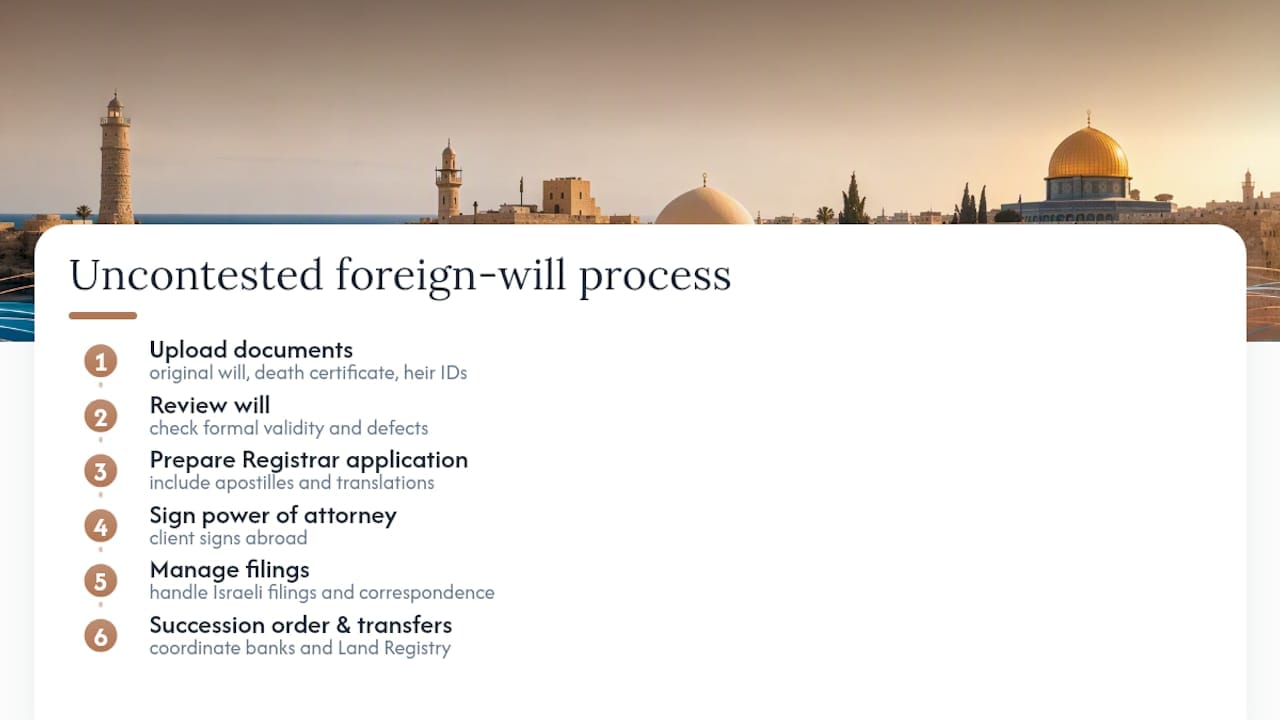
For a typical uncontested foreign will matter, the process looks like this: a client uploads their documents remotely, Menora Law reviews the will for formal-validity issues and identifies any defects before filing, and the firm then prepares and submits the complete Registrar application with apostilled documents and certified Hebrew translations. The client signs a power of attorney in their home country, and Menora Law manages all Israeli filings and correspondence from that point forward. When the digital Succession Order issues, Menora Law coordinates directly with Israeli banks and the Land Registry to complete the asset transfer.
Clients who مخاطب Menora Law with a complete set of documents — original will, death certificate, and heir IDs — typically receive an initial file assessment and a clear picture of next steps within a short turnaround. The firm’s international focus means fast communication across time zones is a standard part of the service, not an afterthought.
For a deeper look at Israeli inheritance and succession law as it applies to foreign heirs, Menora Law’s published guides cover the statutory framework in detail.
What we see most often — and one practical tip that makes a real difference
The pattern Menora Law sees most consistently in foreign will matters is this: heirs arrive with a foreign probate order in hand, assuming that document is sufficient to release Israeli assets. It is not. Israeli banks and the Land Registry will not act on a foreign grant, no matter how authoritative it looks. The Israeli Succession Order is the only instrument that unlocks Israeli-held assets, and obtaining it requires a proper filing with the Registrar.
The second most common issue is the beneficiary-witness conflict. A will that was perfectly valid where it was signed can still have a bequest voided under Israeli practice if a beneficiary also served as a witness. This is not always obvious from reading the will, and it is exactly the kind of issue that a pre-filing review catches before it becomes a problem at the Registrar.
Pro Tip: Locate the original will and confirm its apostille status before doing anything else. That single document drives every subsequent step, and discovering it is missing or unapostilled after you have already commissioned translations wastes both time and money.
Menora Law is ready to handle your Israeli succession matter remotely
Overseas heirs dealing with Israeli assets need an وکیل اسرائیلی, not a general international estate service. Menora Law provides exactly that: trusted Israeli legal expertise, remote representation from initial file review through final asset transfer, and direct access to the Registrar for Matters of Succession and the Family Court when needed.
The engagement process is simple. First, share your documents with Menora Law for an initial file review. Second, sign a retainer and execute a power of attorney in your home country. Third, Menora Law files with the Registrar, manages all Israeli correspondence, and coordinates the asset transfer once the Succession Order issues. No travel to Israel required for uncontested matters.
If you have a foreign will and Israeli assets to administer, the right next step is a conversation with Menora Law. Visit the firm’s Israeli inheritance law guide to understand the full framework, or مخاطب Menora Law directly to have your file reviewed.
Sources
The following primary sources are worth consulting directly as you prepare your filing:
- Request an inheritance order | The Guardian General and Director of Inheritance Affairs
- Foreign wills and cross-border succession: applicable law, EU Succession Regulation, matrimonial property regimes, administration and UK recognition — guidance for England and Wales – Legal Guidance – LexisNexis UK
- Naming Foreign Persons in Your Estate Planning Documents
This article is general information, not a substitute for advice from a qualified lawyer. Consult a qualified legal professional about your own circumstances before acting on anything here.
سوالات متداول
Can a foreign will be used directly in Israel without a local court order?
No. Even a formally valid foreign will requires an Israeli Succession Order from the Registrar for Matters of Succession before Israeli banks, the Land Registry, or other institutions will act on it.
How long does it take to get an Israeli Succession Order for a foreign will?
The Registrar typically issues a digital Succession Order within 40 days of a completed submission; if the file is referred to the Attorney General, the order usually issues within 50 days.
What happens if a beneficiary also witnessed the foreign will?
Under Israeli practice, a bequest to a person who also witnessed the will may be treated as void, even if that arrangement was valid under the law of the country where the will was signed. A pre-filing review by Israeli counsel can identify this issue before it reaches the Registrar.
Does Israel recognize an international will prepared under the UNIDROIT Convention?
An international will with a proper UNIDROIT certificate is designed to be recognized as conclusive of formal validity by Contracting States, which can simplify the Registrar’s analysis. It does not, however, override mandatory Israeli substantive succession rules.
Can Menora Law handle an Israeli succession matter entirely remotely?
Yes. Menora Law manages document review, Registrar applications, certified translations, and post-order bank and Land Registry coordination for overseas clients without requiring travel to Israel for uncontested matters.


 English
 Afrikaans
 العربية
 বাংলা
বাংলা Čeština
 简体中文
简体中文 Nederlands
 Suomi
Suomi Français
 Deutsch
 עִבְרִית
 हिन्दी
 Magyar
 Italiano
 日本語
日本語 한국어
한국어 Polski
 فارسی
فارسی Português do Brasil
 Русский
 Español de México
 Українська