
Yes, a power of attorney can authorize someone to manage your property in Israel, and for most day-to-day needs, either a standard notarized POA or an enduring (continuous) POA will get the job done. Routine management, collecting rent, paying bills, and signing leases all fall within normal authorized powers. Selling the property is different: that usually still needs court approval, though Amendment 21 now opens a faster administrative path through the General Guardian’s office. Whichever route you choose, the document only works if it’s signed before a licensed notary.
TL;DR:
- A power of attorney in Israel can handle routine property management tasks, but selling the property usually requires court approval unless updated under Amendment 21 for administrative approval.
- Enduring POAs remain valid if the owner becomes incapacitated, with many built-in safeguards such as spending caps and reporting requirements to prevent abuse.
- Notarization in Israel is mandatory and must be performed by a licensed notary who verifies capacity, voluntariness, and identity, with additional apostille or translation needed for overseas signing.
- Clarifying sale authority and setting strict limits or consultation clauses in the POA minimizes court involvement and reduces risks of disputes or misuse.
- Proper planning before drafting and notarizing the POA, including gathering necessary documents, can prevent costly mistakes, especially for international property owners.
What Can a Property POA Actually Authorize in Israel?
A standard notarized power of attorney takes effect the moment it’s signed and stays valid until you revoke it, become incapacitated, or die. An enduring (continuous) power of attorney is built differently. It’s designed to keep working even if you lose mental capacity later, and Israeli law lets you specify exactly when it kicks in, whether immediately or only upon a doctor’s determination of incapacity.
For property management, both instruments can authorize your agent to manage rental property with quick sales considerations:
- Lease the property and sign tenancy agreements on your behalf
- Collect rent and manage related bank transactions
- Pay property taxes, utility bills, and building maintenance fees
- Hire and pay contractors for repairs or renovations
- Handle correspondence with tenants, condo boards, or municipal authorities
What they don’t automatically cover is anything considered outside “ordinary management.” Selling the property, taking out a mortgage against it, or changing the registration at the Land Registry (Tabu) typically require either explicit authorization written into the document or a separate approval step. Smart drafting often includes a defined property list, monetary caps on what the agent can spend without check-in, and a clause requiring professional consultation before anything beyond routine upkeep. The government’s guide on continuous powers of attorney is explicit that an agent’s financial actions carry legal limits meant to protect the person who granted the power in the first place.
Selling Property Under a POA: Court Approval, Amendment 21, and What to Plan For
Here’s the baseline you should assume going in: selling real estate under a power of attorney has traditionally required court approval, especially once the principal can no longer confirm the sale personally. Courts exist to make sure the sale genuinely serves the property owner’s interests, not just the agent’s convenience.
Amendment 21 changed the practical reality for a lot of families. Under the update, many sale approvals for property held under a continuous power of attorney can now go through the General Guardian’s administrative office instead of a courtroom. Globes reports that this shift is meant to speed up approvals and cut costs for families managing an aging relative’s real estate from a distance, which matters enormously if you’re coordinating a sale from another country and every extra month means another mortgage payment or vacant unit.
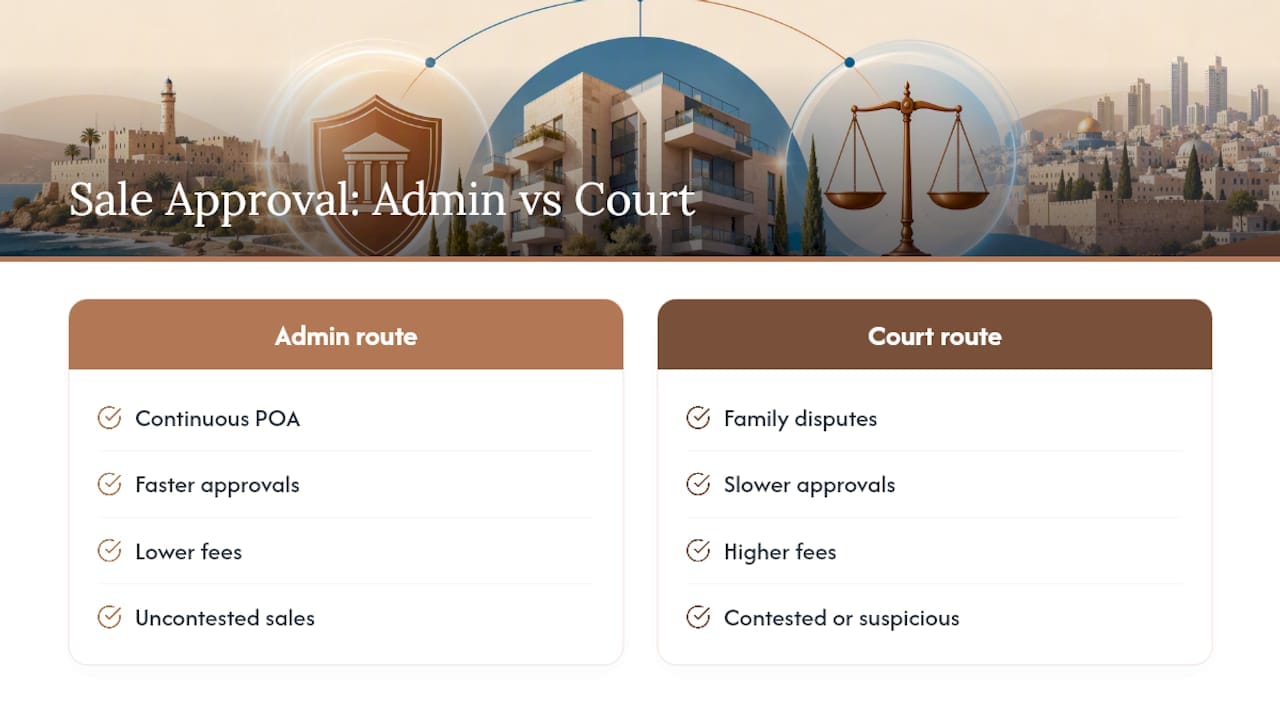
If you want sale authority built into the document, be specific. Practitioners commonly draft in conditions like a minimum acceptable sale price, a requirement that proceeds go into a designated account, or a clause requiring the agent to consult a named family member or lawyer before signing anything. Court involvement still tends to happen when there’s a family dispute, a competing claim on the property, or anything that looks like a suspicious transaction. Absent those red flags, the administrative path is increasingly realistic.
How Do You Legally Execute a Property POA in Israel?
Notarization isn’t a formality you can skip. A licensed Israeli notary has to confirm that you understand what you’re signing, that you’re acting voluntarily, and that you have the mental capacity to grant the authority. This step matters beyond the legal checkbox: a properly notarized document is much harder for anyone to challenge later on grounds of duress or incapacity.
- Choose your agent carefully. The person you appoint should not typically be the same lawyer who drafted the document for you, and they generally need to be an adult with full legal capacity.
- Sign before a licensed notary, who verifies identity, capacity, and voluntary consent, then applies the standard notarial certification.
- Deposit the enduring POA with the Ministry of Justice’s registrar if you’re using the continuous form, since deposit is part of what makes it effective when the time comes.
- Handle authentication if you’re abroad. An apostille or consular notarization is usually necessary for documents signed outside Israel, and Hebrew translation is often required for filing.
Pro Tip: If you live overseas, coordinate the apostille and translation before you sign, not after. Principals abroad routinely lose weeks waiting on paperwork that could have been queued up in advance.
Notary fees in Israel follow a regulated scale, and it’s worth confirming the current rate directly rather than relying on an old quote, since these numbers get updated periodically. For a deeper look at execution requirements for owners living outside Israel, see Menora Law’s guide to Israeli durable powers of attorney for U.S. residents.
Choosing an Agent and Building In Real Safeguards
The person you name as agent should be someone you’d trust with your bank password, not just your spare key. Beyond trust, look for basic competence with paperwork, physical presence in Israel or the ability to travel there when needed, and no financial stake in the property that could create a conflict of interest.
Good drafting does a lot of the protective work for you:
- Set clear monetary limits on what the agent can spend or transfer without additional sign-off
- Require periodic accounting, so the agent reports transactions on a set schedule
- Require joint signatures from two agents for high-value actions like a sale or mortgage
- Name a successor agent in case your first choice becomes unavailable
- Tie any major transaction to a check-in with a named lawyer or family member before it proceeds
Pro Tip: Naming co-agents for anything above a certain dollar threshold is one of the simplest ways to prevent unilateral mistakes, without slowing down routine rent collection or bill payments.
International owners often benefit from having a lawyer build these safeguards into the document from the start, rather than discovering a gap after something’s already gone wrong. Legal practices regularly work with clients who need bespoke language addressing multiple properties, multiple heirs, or agents living in different countries.
What to Prepare, and What It Actually Costs
Before you sit down with a notary, gather your ID or passport, the Tabu extract (title deed) for the property, any mortgage statements, current tenancy agreements, and the bank account details tied to the property. Having these ready shortens the drafting process considerably.
- Drafting the document with a lawyer, including the specific powers and any safeguards you want built in.
- Notarization, where the notary confirms capacity and voluntary consent.
- Deposit with the registrar, required for an enduring POA to take legal effect down the road, and available through the government’s continuous POA activation service.
- Approval for major transactions, if you’re planning ahead for a possible sale, either through the General Guardian’s administrative process or, in contested cases, through the courts.
Cost components typically include the notary’s fee (set on a regulated scale), the lawyer’s drafting fee, and, for a future sale, either administrative or court fees depending on which path applies. Add translation and apostille costs if you’re signing from abroad. Current fee amounts are worth confirming directly with gov.il or with your lawyer, since regulated fees are periodically revised.
Legal support services for drafting, notarization, and approval can be provided remotely.
If you’re managing property from another country, the paperwork alone can feel like the hardest part, before you even get to the legal decisions underneath it. Some legal services specialize in working with international clients who need a power of attorney drafted, notarized, and deposited correctly the first time, without flying to Israel.

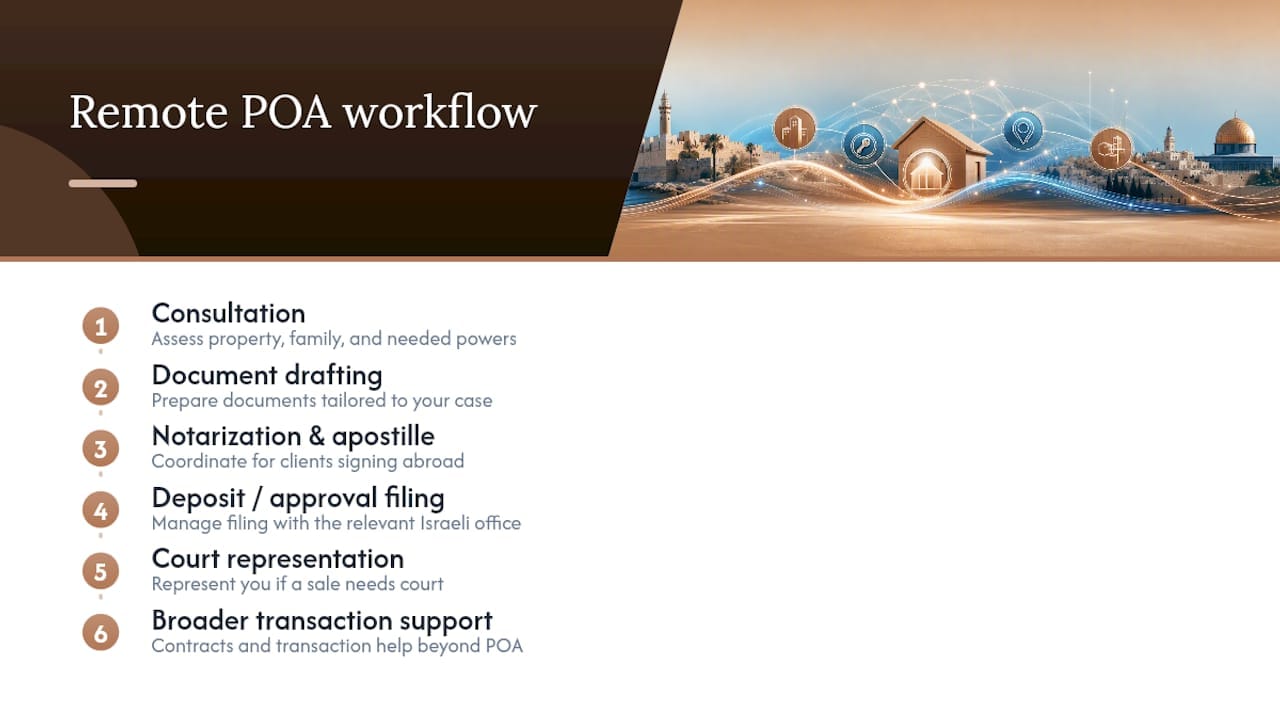
Menora Law’s remote workflow starts with a consultation to understand your property, your family situation, and what powers you actually need to grant. From there, the firm handles document drafting tailored to your case, coordinates notarization and apostille requirements for clients signing abroad, and manages the deposit or approval filing with the relevant Israeli office. When a sale requires court involvement rather than the administrative path, Menora Law provides representation so you’re not navigating an Israeli courtroom process from a different time zone. For property owners who also need broader transaction support, Menora Law’s real estate law services in Israel cover contracts and transactions beyond the power of attorney itself.
If you own property in Israel and need a document that actually holds up, whether that’s a straightforward management POA or one built for an eventual sale, reach out to Menora Law to schedule a consultation and get a checklist tailored to your situation.
Common issues with property POAs include powers written too broadly without caps or reporting requirements, and omitting sale authority because no one anticipated a sale. These problems can be avoided with early planning. International clients especially benefit from getting it right initially, as fixing a defective POA from overseas costs much more time than drafting it properly.
This article is general information, not a substitute for advice from a qualified lawyer. Consult a qualified legal professional about your own circumstances before acting on anything here.
Sources
For readers who want to go straight to the primary sources, the official government guide for agents under a continuous power of attorney covers scope and legal limits in detail. The service page for editing and depositing a continuous POA and the page on approval for financial transactions walk through the procedural mechanics. For the Amendment 21 update itself, Globes’ coverage explains what changed and why it matters for sale approvals.
سوالات متداول
Can a Power of Attorney Sell Property in Israel?
Yes, but selling real estate under a power of attorney normally requires court approval, since courts confirm the sale serves the property owner’s interests. Amendment 21 now allows many of these approvals to go through the General Guardian’s administrative office instead, which tends to be faster and less costly than the court process.
What’s the Difference Between a Standard and Enduring POA for Property?
A standard notarized POA takes effect immediately and ends if you lose capacity, while an enduring (continuous) POA is built to keep functioning if you become incapacitated later. Both can authorize property management tasks like leasing and rent collection, but only the enduring version plans for a future loss of capacity.
Does a Property POA Need to Be Notarized in Israel?
Yes, a licensed notary must verify your identity, mental capacity, and voluntary consent before the document is enforceable. The government’s guide to continuous powers of attorney treats notarization as central to protecting the person granting the power.
Can Someone Overseas Sign a Property POA for Israel?
Yes, but the document typically needs an apostille or consular authentication, plus a Hebrew translation for filing with Israeli authorities. Coordinating these steps in advance is the single biggest way to avoid delays for owners signing from abroad.
How Does Menora Law Help With Property Power of Attorney Matters?
Menora Law drafts tailored powers of attorney, coordinates notarization and apostille requirements for clients abroad, and handles deposit and approval filings with Israeli authorities. Current pricing for these services is available directly through Menora Law’s website.


 English
 Afrikaans
 العربية
 বাংলা
বাংলা Čeština
 简体中文
简体中文 Nederlands
 Suomi
Suomi Français
 Deutsch
 עִבְרִית
 हिन्दी
 Magyar
 Italiano
 日本語
日本語 한국어
한국어 Polski
 فارسی
فارسی Português do Brasil
 Русский
 Español de México
 Українська