
The main instruments delivering these tax benefits for the tech industry are preferred and technological-enterprise status, the section 20a R&D deduction, the Angel Law investor deduction, and section 102 equity taxation. Eligibility hinges on IP location, export share, and R&D headcount, and getting the paperwork wrong is the fastest way to lose the benefit. Legal firms work with companies and investors navigating exactly this terrain.
TL;DR:
- Companies must keep IP developed in Israel and document R&D activities precisely to maintain preferred technological enterprise status.
- Proper classification of technological income and continuous R&D payroll tracking are essential to avoid losing tax benefits during audits.
- Structuring option grants with correct timing, valuation, and elections is critical to securing favorable tax treatment for employee stock options.
- Early legal and tax planning, including IP ownership and company structure, significantly affects long-term eligibility for benefits and smooth exit processes.
- Foreign investors and expatriate employees should carefully manage documentation and treaty claims to optimize cross-border tax positions.
What Tax Benefits Exist for High-Tech Companies in Israel?
- 12% for a general preferred technological enterprise located outside a priority development zone.
- 7.5% for a technological enterprise located in a Priority Area A zone.
- 6% for certain large multinational-linked groups meeting stricter revenue and R&D criteria.
These reduced rates apply specifically to what the law defines as “technological income,” meaning revenue tied to eligible intellectual property and R&D activity, not ordinary business income earned elsewhere in the company. That distinction matters more than most founders realize: a company that mixes consulting revenue, licensing income, and product sales needs to separate those streams cleanly, because only the technological portion qualifies.
Numbers to know: a company earning 10 million ILS in technological profit pays roughly 600,000 ILS in tax at the 6% rate, compared with about 2.3 million ILS at the standard 23% rate. That gap, roughly 1.7 million ILS on a single fiscal year, is why proper classification of technological income is worth the accounting effort.
The Israeli high-tech tax benefits guide lays out the specific thresholds, and Ministry of Finance and Innovation Authority updates periodically adjust zone maps and qualifying criteria, so a rate that applied last year may not automatically carry forward.
Who Qualifies for Preferred Technological Enterprise Status?
Eligibility isn’t automatic, and the Israel Tax Authority checks these criteria closely before granting or renewing preferred status.
- IP location. The intellectual property generating the technological income must be developed and held in Israel, not licensed in from a foreign parent or transferred offshore after development.
- Export share. A meaningful percentage of revenue must come from exports, since the incentive is designed to reward companies competing internationally, not purely domestic operations.
- R&D headcount and payroll share. The company needs a defined share of employees, or of total payroll, dedicated to research and development, rather than sales, administration, or support functions.
- Ongoing substantiation. Authorities expect continuous documentation of R&D activity throughout the fiscal year, not a single year-end declaration.
The two most common ways companies lose eligibility are moving IP to a foreign entity mid-cycle and outsourcing core development work to contractors outside Israel. Both moves can trigger a reclassification of income that strips away the preferred rate retroactively. Keep signed R&D employment records, project logs tied to specific IP assets, and export invoices on file. Auditors ask for exactly this kind of paper trail when reviewing a claim.
How Does the R&D Tax Deduction Work Under Section 20a?
Section 20a of the Income Tax Ordinance lets an Israeli company deduct qualifying R&D expenses immediately in the year they’re incurred, instead of spreading that cost over several years. Qualifying categories typically include:
- Salaries for R&D staff working directly on eligible projects
- Lab equipment, testing infrastructure, and cloud computing costs tied to development
- Licensing fees for technology used in the R&D process
The 2026 framework layers a credit mechanism, sometimes called zchiyah, on top of the deduction option. Instead of just reducing taxable income, a credit reduces the tax bill directly, which can be worth more depending on the company’s profit position.
Credit vs. deduction: a deduction lowers taxable income; a credit lowers the tax owed directly. For a company still burning cash, the deduction may matter less than for a profitable one deciding between the two mechanisms.
Grants from the Innovation Authority add another layer. Grant funding doesn’t automatically disqualify a deduction or credit claim, but it changes how expenses get booked, so R&D accounting needs to track grant-funded costs separately from self-funded ones.
How Much Can Angel Investors Deduct Under the Angel Law?
Private investors backing eligible Israeli tech companies can deduct up to 5 million ILS from their taxable income in the year of investment under the Angel Law, one of the more generous individual tax benefits tied to the sector. The catch: the investment has to be held for at least three years, and the investee company has to meet its own eligibility bar, including caps on annual turnover and a genuine R&D focus rather than a shell entity.
Before wiring funds, investors should confirm and keep:
- Written proof the investee company meets the turnover and R&D thresholds at the time of investment
- A signed investment agreement specifying share class and amount
- Annual confirmation from the company that it continues qualifying activity during the holding period
- Records supporting the three-year hold, since an early exit can retroactively disqualify the deduction
Founders raising from angels should expect these documentation requests early. A company that can’t produce clean eligibility proof risks losing investors who were counting on the deduction to make the math work. Foreign investors evaluating common investor risks in Israeli startups should treat this documentation step as part of due diligence, not an afterthought handled after the wire clears.
Section 102 vs. Ordinary Income: Which Route Should Employees Choose?
Section 102 governs how employee stock options and RSUs get taxed, and the choice between the capital-gains route and the ordinary-wage route creates a meaningful gap in what an employee actually keeps. Under the capital-gains track, gains on qualifying options are typically taxed at a flat capital gains rate rather than at marginal income tax rates, which can run substantially higher for senior employees.
- The capital-gains route generally requires options to be held in trust for a minimum period before exercise and sale.
- The ordinary-income route taxes gains as salary, subject to regular payroll withholding and social security.
- The election must be made at the time options are granted, not adjusted later once the company’s valuation has moved.
Pro Tip: Employers should lock in the section 102 election and trustee arrangement before the first option grant goes out, not after employees start asking questions about their tax bill. Retroactive fixes are far harder than getting the structure right at grant date.
Getting this wrong at the company level, wrong trustee paperwork, missed election deadlines, inconsistent grant documentation, tends to surface at the worst possible time: during an acquisition, when buyers’ counsel reviews every option agreement line by line.
Practical Tax-Planning Checklist for High-Tech Companies
Securing these tax benefits for the tech industry isn’t a one-time filing exercise. It’s an ongoing discipline that shows up in how the company keeps its books.
- Review legal structure early. Confirm the entity holding IP, the entity employing R&D staff, and the entity generating revenue are aligned in a way that supports a clean preferred-status claim.
- Fix IP location and licensing terms. Document where IP was developed and make sure licensing agreements with any foreign parent don’t inadvertently shift ownership offshore.
- Separate technological income in the books. Tag revenue streams so technological income and ordinary income are auditable as distinct categories.
- Track R&D payroll and cloud costs continuously. Build accounting tags tied to specific projects and employees, not a lump R&D line filled in at year-end.
- Apply for preferred status before the annual return is due. Retroactive applications are harder to defend and invite closer scrutiny.
- Keep a standing document file. Export invoices, R&D employment contracts, project logs, and grant agreements should be organized and ready before an audit request ever arrives.
Pro Tip: Treat documentation as a living file updated quarterly, not a scramble every March. Tax authorities reviewing a preferred-status claim want to see activity substantiated across the fiscal year, and a file assembled two weeks before filing looks exactly like what it is.
Legal support is available for companies and investors through each of these steps, from structuring the entity relationships at formation to representation if the Tax Authority opens an audit or challenges a preferred-status claim. Clients typically bring incorporation documents, cap tables, prior tax filings, and existing IP agreements to an initial planning session so counsel can spot structural problems before they become audit findings.
Preferred Enterprise vs. Special Preferred Enterprise vs. Approved Enterprise
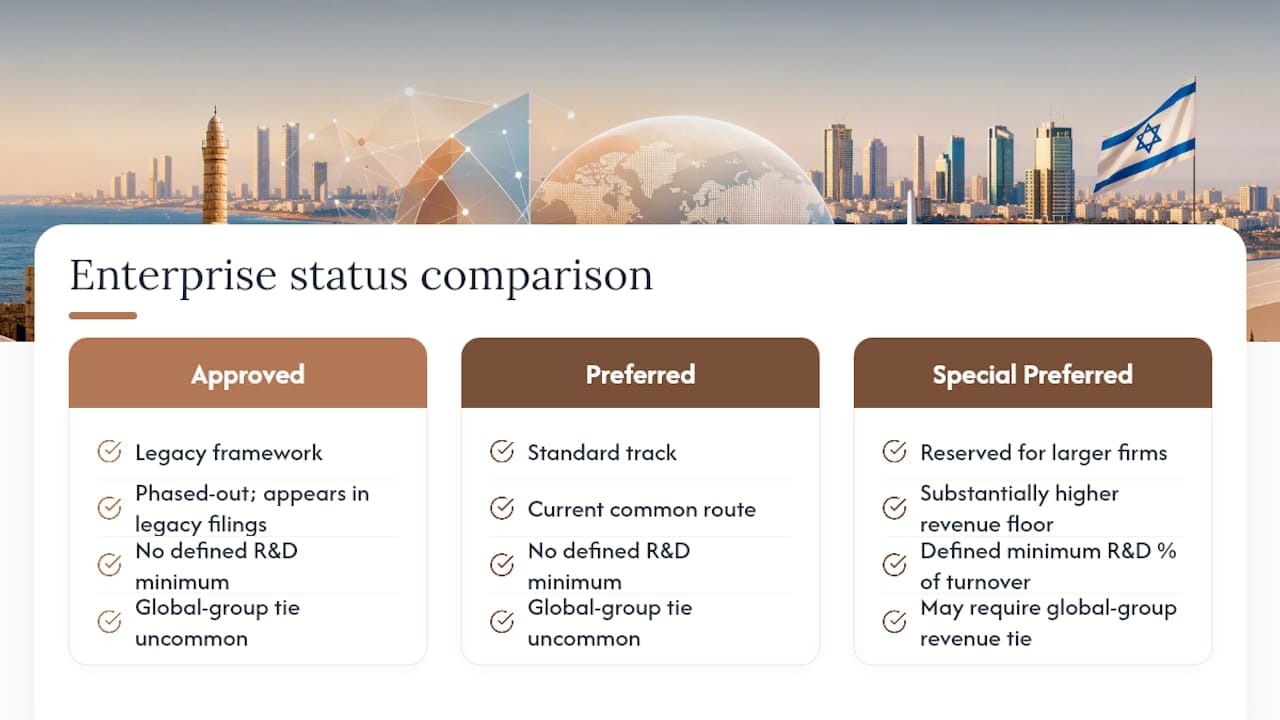
These three statuses aren’t interchangeable, and confusing them is a common mistake among founders reading older guidance.
Approved Enterprise was the older framework, largely phased out but still referenced in legacy filings and older investor agreements. Companies operating under grandfathered Approved Enterprise terms should confirm with counsel whether those terms still apply or have been superseded by newer preferred-status rules.
Preferred Enterprise status is the standard track most tech companies use today.
Special Preferred Enterprise status sits above that, reserved for larger companies meeting stricter criteria: typically a substantially higher revenue floor, a defined minimum R&D spend as a percentage of turnover, and often a requirement tied to global group revenue if the Israeli entity is part of a larger multinational structure.
The practical takeaway: a fast-growing company shouldn’t assume it automatically graduates from Preferred to Special Preferred status as revenue climbs. Each tier has its own application and its own documentation standard, and moving between them requires a fresh eligibility review rather than a simple notification to the tax authority.
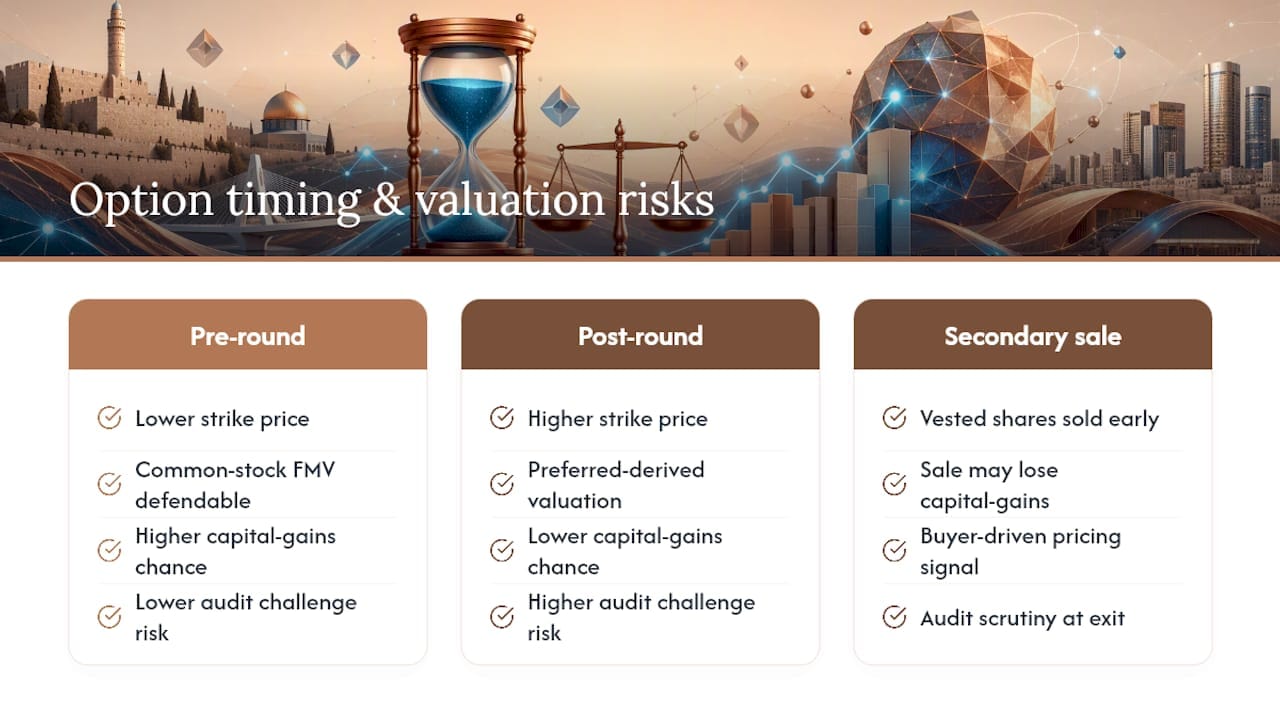
Stock Options Beyond Section 102: Timing and Valuation Issues
Section 102 covers the core framework, but real-world option plans raise questions the statute doesn’t answer directly. Timing of the grant date matters enormously: options granted before a funding round often carry a lower strike price and a more favorable valuation baseline for capital-gains treatment than options granted right after a round closes, when the company’s 409A-style valuation (or its Israeli equivalent) has just reset higher.
Valuation methodology is where many companies stumble. Israeli companies granting options need a defensible fair-market-value determination at grant date, not a number pulled from the last funding round’s headline valuation, which usually reflects preferred-share pricing rather than the common-stock value options are priced against. Using the wrong valuation baseline can understate the taxable spread at exercise or, worse, trigger a tax authority challenge years later when the company exits and the numbers get scrutinized.
Secondary sales and tender offers, increasingly common as Israeli companies stay private longer, create their own wrinkle: an employee selling vested shares in a secondary transaction before the standard holding period under section 102 may not qualify for the capital-gains route on that sale, even if the original grant would have qualified at a later exit. Founders structuring option pools should also think about acceleration clauses tied to acquisition, since accelerated vesting can compress option exercises into a single tax year, pushing an employee into a higher marginal bracket if the wage route applies instead of the capital-gains track. None of this is exotic, but it’s exactly the kind of detail that gets missed when option agreements are copied from a template instead of drafted around the company’s actual cap table and timeline. Reviewing a founders agreement alongside the option plan early tends to catch these mismatches before they become expensive.
How Do International Tax Treaties Affect Israeli High-Tech Companies?
Israel maintains tax treaties with dozens of countries, and for high-tech companies with foreign investors, foreign subsidiaries, or expatriate employees, these treaties determine whether income gets taxed twice or just once. A common scenario: a returning Israeli employee who spent years working for a US or European tech company and now holds equity or deferred compensation tied to that prior employer. The relevant treaty generally determines which country has primary taxing rights over that income and whether Israel grants a credit for tax already paid abroad.
For companies, the more pressing treaty question usually involves foreign investors receiving dividends or capital gains from an Israeli entity. Treaty provisions can reduce withholding tax on cross-border dividends, but only if the investor properly claims treaty benefits with the correct residency certification. Skipping that step means the Israeli company may withhold at the higher default statutory rate rather than the reduced treaty rate, leaving the investor to chase a refund later, a slower and more frustrating process than getting the paperwork right at the time of payment.
Expatriate employees relocating to Israel to join a high-tech company should also flag any foreign pension contributions, deferred stock units still vesting from a prior employer, or foreign-source investment income. Treaty rules and Israel’s own foreign-income reporting requirements interact in ways that aren’t always intuitive, particularly for someone who spent years building equity compensation under a different country’s tax system before moving. Getting a coordinated read on both sides of the border, rather than treating Israeli tax planning in isolation, prevents surprises when the expatriate employee eventually sells shares or receives a deferred payout.
What’s Changing in Israeli High-Tech Tax Policy Beyond 2026?
The 2025-2026 wave of reforms shares a common thread: officials are prioritizing predictability over short-term sweeteners. Joint statements from the Ministry of Finance and Innovation Authority stress regulatory certainty for investors and for returning high-tech employees, a signal that future changes are likely to refine verification and reporting requirements rather than introduce dramatically new rate tiers.
That shift matters for planning purposes. A company that can demonstrate sustained, well-documented Israeli activity, consistent R&D headcount, stable IP location, clean technological-income accounting, is better positioned to weather rule changes than one that scraped together eligibility for a single filing year. The direction of travel suggests tighter audit verification of ongoing compliance, not just eligibility at the point of application.
Expect more guidance clarifying how the credit mechanism applies to companies receiving both grant funding and R&D deductions in the same fiscal year, since that overlap has been a source of confusion for finance teams.
Do Individual High-Tech Employees Get Personal Tax Benefits?
Company-level incentives get most of the attention, but individual employees in Israeli high-tech have their own set of benefits worth understanding, separate from what their employer claims.
The most direct one is the section 102 capital-gains election discussed earlier, which can meaningfully reduce the effective tax rate on option and RSU gains compared with ordinary wage taxation. Beyond equity, some returning residents and new immigrants working in high-tech qualify for time-limited personal income tax reductions or exemptions on foreign-source income they held before relocating to Israel, a benefit designed to encourage skilled professionals to relocate for tech roles rather than remain abroad.
Employees receiving grants tied to R&D-designated roles should also confirm how their employer classifies their position internally, since headcount classification for company-level R&D thresholds sometimes intersects with how an individual’s compensation package gets structured for tax purposes. This isn’t automatic and depends heavily on individual residency history, prior country of employment, and the specific compensation instrument involved, so a blanket assumption that “high-tech employees get a tax break” oversimplifies a genuinely case-by-case determination.
The practical advice here is straightforward: an employee joining an Israeli high-tech company, especially one relocating from abroad or negotiating an equity-heavy offer, should get the compensation package reviewed before signing, not after the first vesting event triggers a tax bill that’s larger than expected. Small structuring decisions at the offer stage, like whether RSUs are structured to qualify under the capital-gains route, tend to compound significantly over a multi-year vesting schedule.
Common Compliance Pitfalls for Multinational Tech Firms in Israel
Multinational companies with an Israeli subsidiary or development center face a distinct set of risks that purely domestic startups don’t encounter as often.
Transfer pricing is the biggest one. When an Israeli R&D subsidiary bills a foreign parent for development services, the pricing has to reflect an arm’s-length standard, and tax authorities scrutinize these intercompany arrangements closely, particularly when the Israeli entity is claiming preferred technological enterprise status on income tied to IP that technically sits with the foreign parent. A poorly structured transfer-pricing arrangement can undermine the very technological-income classification the preferred rate depends on.
IP ownership across the group is the second recurring problem. If a multinational’s Israeli team does genuine, original development work but the resulting patents or software are automatically assigned to a US or European parent company under a standard employment agreement, the Israeli entity may not be able to claim the income tied to that IP as its own technological income, even though its engineers built it. Fixing this after the fact, once IP has already been assigned upstream for several years, is far harder than structuring ownership correctly from the first hire.
Payroll and R&D headcount reporting inconsistencies round out the common list. Multinationals sometimes report R&D headcount differently to the Israeli tax authority than to the parent company’s own internal metrics, which creates a discrepancy that surfaces during an audit. Keeping a single, consistent set of R&D employment records that both the Israeli filing and the parent company’s reporting rely on removes an entire category of audit risk. A business law review covering the group’s Israeli entity structure is worth doing before, not after, the first Israel Tax Authority inquiry arrives.
Why Early Structure Decisions Determine Tax Outcomes at Exit
The conventional wisdom treats high-tech tax benefits as something to sort out once a company is already generating revenue. That’s backwards. The companies that keep their preferred status cleanly through an acquisition are almost always the ones that got their IP ownership, R&D employment structure, and technological-income accounting right at formation, not the ones that patched things together during due diligence.
Legal experts have experience working with international founders and investors navigating the gap between what the statute promises and what actually survives an audit or an acquirer’s legal review. One pattern shows up repeatedly: a company structures its cap table and IP assignments cleanly from day one, keeps R&D payroll tagged and traceable, and applies for preferred status well before its first annual filing deadline. When that company later gets acquired, the buyer’s counsel reviews the technological-income classification and finds a clean paper trail rather than a scramble to reconstruct three years of documentation. The deal closes faster, and the seller keeps the tax benefit intact through the transaction instead of losing it to a last-minute reclassification dispute.
If you’re structuring a company, raising from angel investors, or planning an exit and want the tax benefits to survive scrutiny rather than collapse under it, review your setup with counsel who understands both the statute and how acquirers actually test it. A resource like Legal Israel: What Foreigners and Investors Must Know is a useful starting point before that first investor conversation.
— Menora Law
How Menora Law Helps You Secure and Defend Your Tax Position
International clients seek legal resources when Israeli tax structuring needs to hold up under real scrutiny, whether for preferred-status applications, investor due diligence requests, or Israel Tax Authority audits.

The firm supports companies, investors, and returning high-tech employees across the full arc of this process: reviewing legal structure and IP ownership before a preferred-status application goes in, advising angel investors on the documentation the Angel Law deduction requires, structuring section 102 option plans correctly at grant date, and representing clients if the Tax Authority challenges a technological-income classification. Menora Law works remotely with clients based abroad, so distance from Israel is never a barrier to getting Israeli legal representation handled properly and quickly.
Before an initial consultation, gather your incorporation documents, cap table, any existing IP or licensing agreements, and prior tax filings if the company has already been operating. If your situation touches broader corporate matters alongside tax structuring, the Business Law in Israel practice page outlines the full range of services available, and international clients can schedule a virtual consultation to get specific guidance on their structure without needing to travel to Israel first.
Sources
For readers who want to go straight to the primary material, these are the core references behind the rates and rules covered above.
- הטבות מס להייטק | מדריך המס הישראלי
- הטבות מס לסטארטאפ: מס חברות של 12% למפעל טכנולוגי
- Ministry of Finance / Innovation Authority joint announcement (2025)
سوالات متداول
What is the maximum corporate tax rate reduction for Israeli tech companies?
Qualifying technological enterprises can pay as little as 6% instead of the standard 23% corporate rate, with 7.5% and 12% tiers available depending on zone and company size.
Can foreign investors claim the Angel Law deduction?
The Angel Law deduction is generally structured for Israeli taxable income, so foreign investors should confirm their specific eligibility with counsel, since the 5 million ILS deduction and three-year holding requirement depend on investee-company criteria that need individual verification.
How does section 20a differ from the 2026 R&D credit?
Section 20a lets companies deduct qualifying R&D costs immediately against taxable income, while the 2026 credit mechanism reduces the tax bill directly at a rate roughly between 3% and 30% depending on activity and location.
What happens if a company moves its IP outside Israel?
Moving IP offshore or outsourcing core R&D work can trigger a loss of preferred technological enterprise status, since the reduced rates depend on IP being developed and held in Israel.
Does Menora Law help with tax structuring for high-tech companies?
Yes. Legal advisors offer services on Israeli tax structure, IP ownership review, preferred-status filings, and audit representation, working remotely with clients based outside Israel.


 English
 Afrikaans
 العربية
 বাংলা
বাংলা Čeština
 简体中文
简体中文 Nederlands
 Suomi
Suomi Français
 Deutsch
 עִבְרִית
 हिन्दी
 Magyar
 Italiano
 日本語
日本語 한국어
한국어 Polski
 فارسی
فارسی Português do Brasil
 Русский
 Español de México
 Українська