
Yes, an English-language contract can be valid and enforceable in Israel when it meets the ordinary elements of contract formation: offer, acceptance, and intent to create a binding relationship. The language you write it in generally does not affect its validity. The real risks come from statutory written-form requirements on certain transactions and from vague governing-law or jurisdiction clauses that leave enforcement up in the air.
TL;DR:
- English-language contracts are generally valid in Israel if they include clear offer, acceptance, and intent to create legal obligations, regardless of language.
- Naming Israeli law and jurisdiction in the contract significantly improves enforceability and reduces disputes over forum non conveniens.
- Statutory formalities, especially for real estate transactions, cannot be bypassed by English wording alone, making compliance critical for validity.
- Including clauses like severability, entire agreement, and clear governing law offers essential protection in case of disputes.
- Providing certified Hebrew translations and notarized signatures can prevent misunderstandings and strengthen enforceability in Israeli courts.
Does תוקף חוזה באנגלית בישראל depend on Israeli statute?
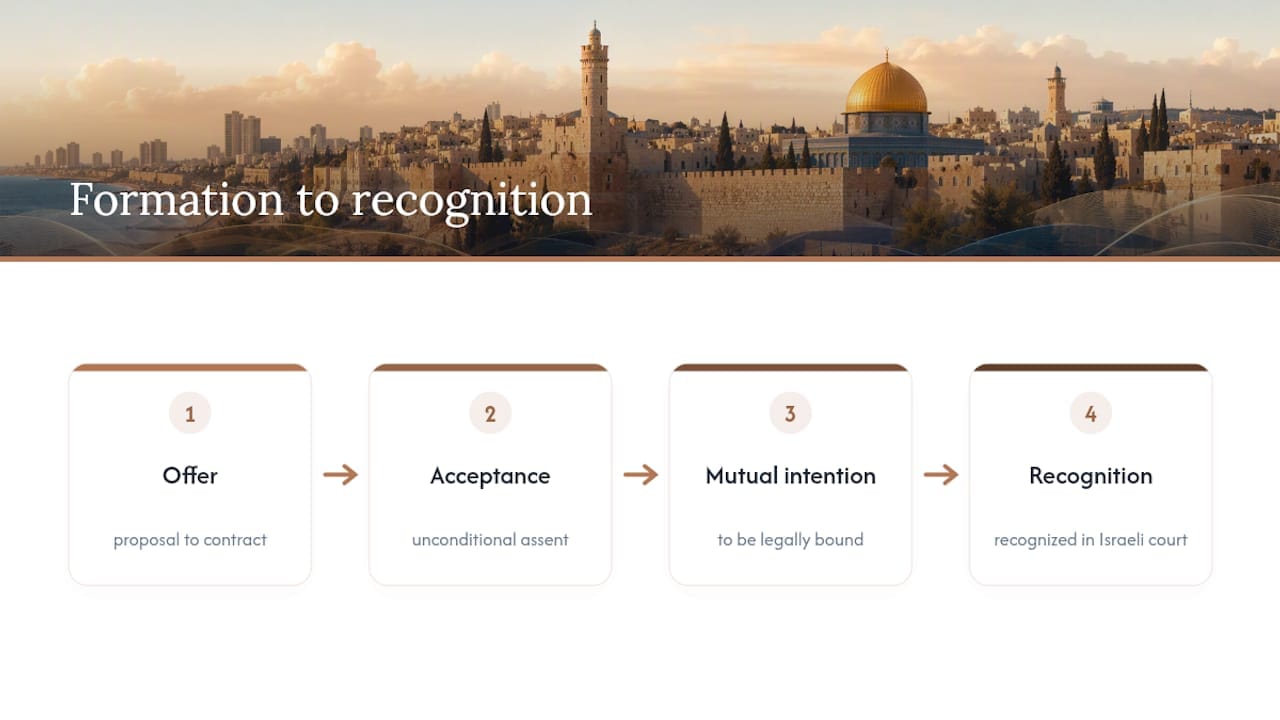
The question of תוקף חוזה באנגלית בישראל, or the validity of an English-language contract in Israel, starts with one statute: the Contracts (General Part) Law, 1973. This law lays out how a contract forms in Israel: an offer, an acceptance, and a mutual intention to be legally bound. Nothing in it requires Hebrew. Two parties, foreign or Israeli, can agree in English, sign in English, and have that agreement recognized in an Israeli court, provided the basic elements are present.
Freedom of contract runs deep in Israeli law, but it isn’t limitless. Agreements that violate public policy, involve illegal purposes, or clash with mandatory statutory rules won’t survive court scrutiny no matter what language they’re written in. Academic commentary on Israeli contract law traces how courts have applied these formation rules and adjusted their approach to interpretation over time, particularly around how much weight to give the literal text versus the parties’ actual intent, as discussed in the Israel Law Review.
Section 25 of the law addresses interpretation directly: when the parties clearly express a shared understanding of a contract’s terms, that understanding controls, even over the plain wording. When they disagree, courts look at the contract as a whole, the circumstances surrounding its signing, and the conduct of the parties afterward. This matters enormously for English contracts involving one Israeli and one foreign party, because the two sides sometimes walk away from a signing with different assumptions about what a clause means. A well-drafted contract closes that gap before it becomes a lawsuit.
Which clauses actually protect an English contract in Israel?
Getting the language right is only step one. The clauses inside the contract do most of the heavy lifting when a dispute lands in front of a judge or arbitrator.
Governing law and jurisdiction. Naming Israeli law and an Israeli forum removes a huge amount of guesswork if you want local enforcement. Skip this, and you risk a fight over which country’s courts even have the right to hear the case, a doctrine known as forum non conveniens. Clear governing-law language is consistently flagged as the single biggest practical risk factor in cross-border agreements, more than the choice of contract language itself, according to clause-drafting guidance from LawInsider.
Arbitration versus litigation. Arbitration clauses can work well for international deals, especially since arbitral awards move across borders more smoothly than court judgments once you pick a seat and confirm the enforcement path, as outlined in the same clause library.
Protective boilerplate. A few clauses consistently save contracts from unraveling entirely:
- Severability, so one bad clause doesn’t void the whole agreement
- Entire agreement, so side conversations don’t get treated as binding terms
- Limitation of liability and indemnities, spelling out who pays for what
- A clear language clause, saying explicitly which version controls if there’s a dispute
アン operational contract checklist from FindLaw covers most of these basics, and they hold up well under Israeli practice too.
Pro Tip: If you sign in English but expect enforcement in Israel, state plainly whether a Hebrew version exists and which one wins if they conflict. Silence on this point is where a lot of avoidable disputes start.
When does English wording alone not save a contract?
Some transactions in Israel require a specific written form by statute, and no amount of careful English drafting gets around that. Real estate transfers are the clearest example. If the statutory formality isn’t met, the transaction can be void, regardless of how clearly the parties expressed their intent in the contract text, per the Contracts (General Part) Law. Foreign buyers purchasing property should treat this as a hard line, not a formality to smooth over later. Our guide on reviewing Israeli real estate contracts as a foreign buyer walks through what that formality actually requires.
Contracts of adhesion, the standard-form agreements one side drafts and the other simply signs, get stricter judicial scrutiny in Israel, largely for consumer protection reasons. Courts pay closer attention to whether the weaker party genuinely understood what they signed.
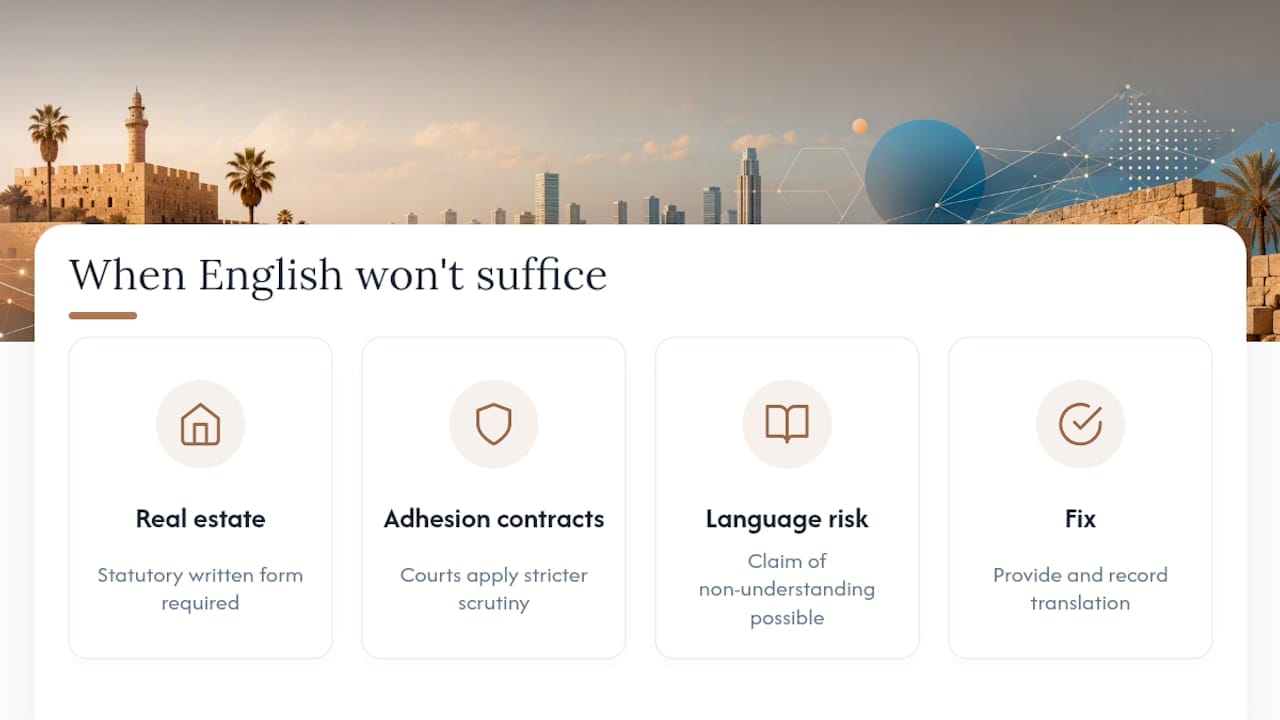
That leads to a separate risk: a party can sometimes challenge a contract by claiming they didn’t understand the English and no reasonable explanation or translation was offered. Courts evaluate this fact by fact, but it’s a real exposure. The fix is simple and cheap compared to litigation: provide a translation and document that you did.
How do you make an English contract safer in Israel?
- Write a deliberate language clause. State which version controls and pair it with a clear governing-law and jurisdiction choice, choosing an Israeli seat if you’ll need local remedies.
- Get a certified Hebrew translation or draft bilingually. Keep a dated record showing the translation was provided to every signing party.
- Notarize signatures where it matters and confirm signatory authority. Verify the person signing actually has the power to bind their company.
- Preserve your paper trail. Save the emails, drafts, and negotiation notes that show both sides understood the terms before signing.
- Consider arbitration with a defined seat. Have an enforcement plan ready before a dispute happens, not after.
- Treat real estate differently. Lean on the statutory formalities rather than assuming a well-written English clause covers you.
Pro Tip: Notarized translations don’t just satisfy a formality, they give you documentary proof later if someone claims they never understood what they signed. That single document can end a dispute before it starts.
For contracts that will be signed in both languages, our Hebrew to English contract translation and legal review guide breaks down how a bilingual version should be structured so both sides are protected.
What Menora Law checks in every English contract
When international clients bring us an English-language contract meant to operate in Israel, we run it through a specific set of checks: statutory traps that could void the agreement outright, whether the jurisdiction and governing-law language actually gets you the forum you want, and whether the translation and notarization plan will hold up if challenged later.
Deliverables typically include annotated clause-by-clause feedback, recommended governing-law and jurisdiction language, a translation and notarization plan, and, where needed, an enforcement strategy for Israeli courts or arbitration. Foreigners often assume jurisdiction is a minor detail; our guide on Israeli jurisdiction rules for foreigners shows why it’s usually the opposite.
We work with clients remotely, through video consultations and fast document turnaround, and represent them directly in Israeli courts or arbitration when a dispute actually arises. Distance from Israel shouldn’t mean distance from good legal protection.
Our take: language is rarely the real problem
Most people worry about the wrong thing. They assume an English contract is automatically shaky in Israel and spend their energy trying to get everything translated word for word, when the actual failure points are almost always governing law, jurisdiction, and proof of understanding. A contract can be written in flawless English and still fall apart in court because nobody specified which country’s courts have authority, or because one party can credibly claim they never grasped what they were agreeing to.
The conventional advice, “just get it translated,” treats the symptom, not the cause. Translation helps with the understanding problem, but it does nothing for a missing or vague jurisdiction clause. If you take one thing from this article, prioritize the governing-law and forum language first. Everything else, including the translation, matters, but it’s secondary to knowing which court will actually hear your case if things go wrong.
— Menora Law
Get your contract reviewed before it becomes a problem
Menora Law is the direct route for international clients who need an イスラエルの弁護士 to actually look at their contract, not just guess at its validity from abroad. We review English-language agreements for the statutory traps that void deals outright, fix vague jurisdiction language before it turns into a forum fight, and build a translation and notarization plan that holds up if someone later claims they didn’t understand what they signed.
A typical contract review starts with a remote consultation where we go through your document clause by clause, flag what’s risky, and give you specific rewrite language, not generic warnings. Most international clients get initial feedback within days, not weeks. If your contract touches property, our real estate law services in Israel cover the additional statutory formality that applies there. Ready to find out where your contract actually stands? Book a virtual consultation with an Israeli attorney and get a clear answer before you sign anything else.
Where to verify these legal points yourself
For readers who want to check the statutory language directly, the Knesset’s consolidated text of the Contracts (General Part) Law, 1973 is the primary source. Academic analysis of how courts apply and interpret it appears in the Israel Law Review, and broader comparative context on freedom of contract and statutory limits is available in this academic commentary.
This article is general information, not a substitute for advice from a qualified lawyer. Consult a qualified legal professional about your own circumstances before acting on anything here.
Sources
- Consolidated text of the Contracts (General Part) Law (Knesset PDF)
- Israeli Contract Law — Recent Trends and Evaluation (Israel Law Review, Cambridge Core)
- Comparative commentary on freedom of contract and statutory limits (academic paper)
- Governing law and jurisdiction clause guidance (LawInsider clause library)
- Contract terms checklist (FindLaw)
よくある質問
When is a contract considered formed under Israeli law?
A contract forms in Israel once there is a clear offer, an acceptance of that offer, and mutual intent to be legally bound, as set out in the Contracts (General Part) Law. Written form isn’t required for most agreements, though certain transactions like real estate are the exception.
Where can I get a contract translated into English or Hebrew?
Certified bilingual contract review and translation guidance is recommended for international clients, as detailed in our Hebrew to English contract guide; using a certified translator rather than a casual bilingual speaker is advisable for anything you plan to sign.
What does it mean for a contract to be legally valid?
A valid contract is one that meets the required elements of formation (offer, acceptance, intent) and doesn’t violate any statutory formality or public policy rule that would make it void or voidable.
What area of law governs contracts in Israel?
Contract law in Israel is governed primarily by the Contracts (General Part) Law, 1973, supplemented by specific statutes for transactions like real estate, consumer agreements, and employment.
Do I need a lawyer to review an English contract before signing in Israel?
You aren’t legally required to, but given how much enforcement outcomes hinge on governing-law and jurisdiction clauses, a review from a firm that practices Israeli law, like Menora Law, catches problems before they cost you a lawsuit.


 English
 Afrikaans
 العربية
 বাংলা
বাংলা Čeština
 简体中文
简体中文 Nederlands
 Suomi
Suomi Français
 Deutsch
 עִבְרִית
 हिन्दी
 Magyar
 Italiano
 日本語
日本語 한국어
한국어 Polski
 فارسی
فارسی Português do Brasil
 Русский
 Español de México
 Українська