
TL;DR:
- Israeli electronic signature law makes digital signatures legally enforceable for most civil and commercial transactions. Courts prioritize intent and authentication over signature form, treating electronic signatures as equivalent to handwritten ones when properly verified. Certain documents, like wills and real estate transfers, still require physical signatures and notarization.
Israeli electronic signature law is the legal framework that makes digital signatures binding and enforceable for most civil and commercial transactions in Israel. Established by the Electronic Signature Law of 2001, this framework defines three distinct levels of electronic signatures, each carrying different legal weight and security requirements. Understanding what is Israeli electronic signature law matters whether you are signing a lease from abroad, closing a business deal, or filing documents with Israeli authorities. Menora Law works with international clients every day who need to know exactly where digital signatures hold up and where they do not.
What is Israeli electronic signature law and how does it work?
Israeli electronic signature law is defined by the Electronic Signature Law 2001, which grants digital signatures legal recognition across most civil and commercial agreements. The law treats a valid electronic signature as functionally equivalent to a handwritten one, provided the signature meets the requirements for its category. This applies to employment contracts, non-disclosure agreements, leases, and most standard business documents.
The Standards Institute of Israel plays a central role in this framework. It accredits the certification authorities that issue digital certificates for higher-level signatures. Without accreditation from this body, a provider cannot legally issue secure or certified electronic signatures for official use in Israel.
The law also establishes that electronic records cannot be denied legal effect solely because they exist in digital form. That principle protects parties who sign contracts electronically from having those agreements challenged on purely technical grounds. The practical result is that electronic signatures are legally valid for nearly all common civil and commercial contracts in Israel, including employment, leases, and NDAs.
What types of electronic signatures does Israeli law recognize?
그만큼 Electronic Signature Law 2001 defines three levels of electronic signatures, each with different security requirements and legal weight.
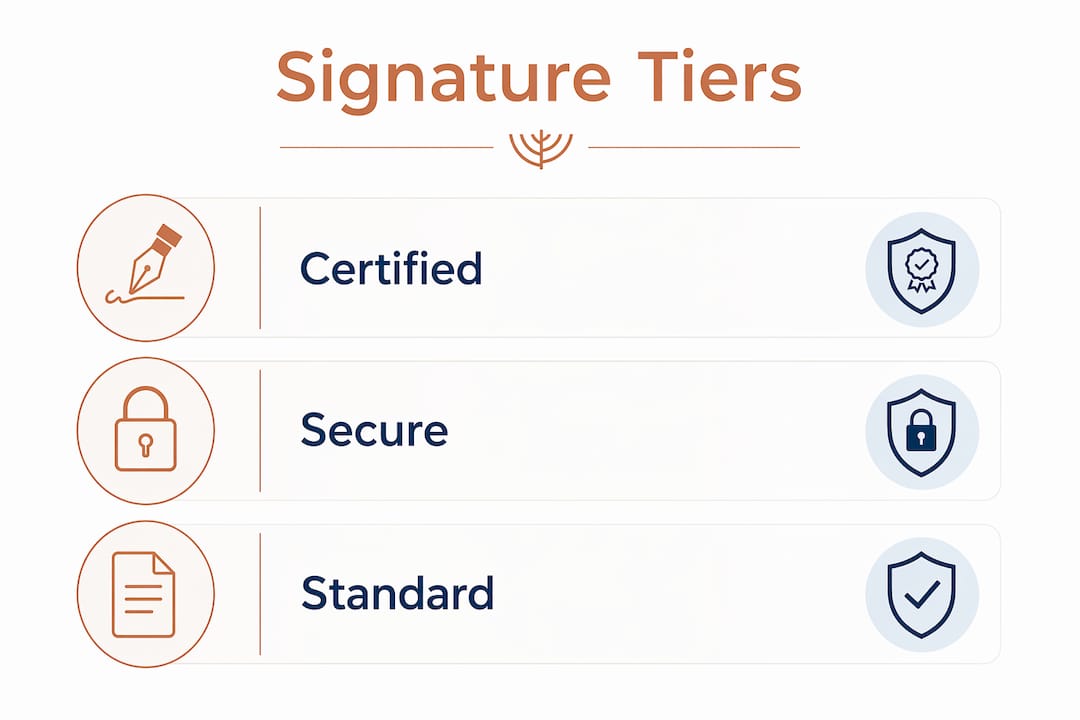
Standard electronic signatures
A standard electronic signature includes any digital mark that identifies the signer and indicates their intent to sign. This covers mouse-drawn signatures, typed names, scanned signature images, and click-to-agree checkboxes. These signatures are legally enforceable for the vast majority of everyday contracts. If you are signing an NDA, a freelance agreement, or a rental contract, a standard electronic signature is sufficient.
Secure electronic signatures
A secure electronic signature requires a digital certificate issued by an accredited provider. The certificate links the signature to a specific individual and confirms that the signed document has not been altered. This level is required for interactions with government agencies, tax authority filings, and certain court submissions. ComSign, certified by the Standards Institute of Israel, is one of the leading providers of secure electronic signatures for official transactions.

Certified electronic signatures
A certified electronic signature carries the highest legal assurance under Israeli law. It is legally equivalent to a handwritten signature and is issued by a trusted certification authority approved by the Standards Institute of Israel. This level applies to high-stakes legal documents, certain enforcement proceedings, and situations where the law specifically requires a signature of this grade.
| Signature type | Legal weight | Typical use cases |
|---|---|---|
| Standard | Valid for most contracts | Leases, NDAs, employment agreements |
| Secure | Required for official dealings | Tax filings, government submissions, court documents |
| Certified | Equivalent to wet-ink signature | High-stakes legal documents, enforcement proceedings |
Pro Tip: When in doubt about which signature level your transaction requires, choose one level higher than you think you need. The cost of upgrading is far lower than the cost of a voided agreement.
Which documents cannot be signed electronically in Israel?
Not every document qualifies for electronic signing under Israeli law. Certain legal acts require physical presence, witnesses, or notarization, and electronic signatures carry no legal weight for these transactions.
The exclusions exist because specific laws governing these documents require formalities that a digital process cannot replicate. A will, for example, must be signed in the presence of witnesses who can attest to the testator’s identity and mental capacity. A land registry transaction requires notarization and physical documentation filed with the Israel Land Authority.
| Document type | Why electronic signing is excluded |
|---|---|
| Real estate transactions (land registry) | Require notarization and physical filing with Israel Land Authority |
| Wills and testamentary documents | Require witnesses and physical presence under Israeli Succession Law |
| Durable powers of attorney | Require notarization and, in many cases, apostille |
| Adoption and guardianship documents | Require court supervision and physical formalities |
| Certain inheritance documents | May require certified signatures or traditional notarized forms |
Using an electronic signature on any of these documents does not just create a legal risk. It can void the transaction entirely. A will signed only electronically has no legal standing in Israel. A real estate transfer attempted without proper physical documentation will not be registered by the Israel Land Authority.
Inheritance documents present a nuanced situation. Some testamentary documents require a certified electronic signature at minimum, while others require traditional wet-ink formalities. If you are dealing with an Israeli estate from abroad, getting this distinction right is critical. You can read more about the broader framework in this guide to 이스라엘 상속법.
How do Israeli courts treat electronic signatures?
Israeli courts treat electronic signatures as functionally equivalent to handwritten signatures when the signature demonstrates clear identification and a genuine meeting of the minds between the parties. This judicial approach focuses on intent and authentication rather than the physical form of the signature.
A 2025 Magistrate Court decision reinforced this position directly. The court upheld the enforceability of electronically signed promissory notes, ruling that the electronic signature satisfied the legal requirements for identification and consent. That decision matters because promissory notes are enforcement instruments. Courts accepting them with electronic signatures signals a clear judicial direction.
“Israeli courts focus on the functional intent and authentication assurances of electronic signatures rather than formalistic signature methods, reinforcing practical enforceability. Judicial precedents continue to evolve Israeli digital signature law by emphasizing meeting of the minds and identification over form, helping clarify grey areas for negotiable instruments and enforcement proceedings.”
This judicial trend has real consequences for businesses and individuals. A contract signed electronically carries the same enforcement weight as one signed with pen and paper, provided the signature meets the applicable legal standard. Israeli authorities, including tax and enforcement bodies, accept electronically signed documents in proceedings where the signature type is appropriate.
Technology also plays a role in court acceptance. Audit trails, timestamps, IP address logs, and certificate-based authentication all support the authenticity of an electronic signature when challenged. Courts look at this evidence when assessing whether a signature is genuine.
Pro Tip: Always retain the full audit trail from your electronic signing platform. If a signature is ever disputed in an Israeli court, that trail is your primary evidence of authenticity and consent.
For clients managing Israeli legal proceedings without being present in the country, understanding this judicial framework is especially important. Remote representation depends on documents that Israeli courts will actually accept.
Practical steps for using electronic signatures correctly in Israel
Getting electronic signatures right in Israel requires more than just clicking a button. These steps apply whether you are an individual signing a single contract or a business managing hundreds of agreements.
Verify signer identity before the signature is applied. Confirm that the person signing is who they claim to be. For standard signatures, this may mean email verification. For secure or certified signatures, identity verification through the issuing certification authority is built into the process.
Obtain explicit consent to sign electronically. Both parties should agree that electronic signing is acceptable for the specific transaction. This consent can be captured within the signing platform itself or documented separately.
Match the signature type to the transaction risk. Standard signatures work for routine contracts. Government filings, tax submissions, and high-value agreements require secure or certified signatures from an accredited provider. Mismatching the signature level to the transaction is one of the most common compliance errors.
Use an accredited electronic signature provider. For secure and certified signatures, the provider must be accredited by the Standards Institute of Israel. Using a non-accredited provider for transactions that require accreditation renders the signature legally insufficient. Best practices for signature validity include verifying accreditation before selecting a provider.
Maintain document integrity after signing. The signed document should be stored in a format that prevents alteration. Any change to a signed document after execution breaks the chain of integrity and can invalidate the signature.
Keep complete audit trails. Retain records of who signed, when they signed, from which device or IP address, and what certificate was used. These records are your defense if a signature is ever challenged.
Avoid electronic signatures on excluded document types. Check whether the document falls into a category that legally requires a wet-ink signature. When in doubt, consult a qualified Israeli attorney before proceeding.
For lease agreements specifically, electronic signatures are valid under Israeli law for standard rental contracts, making remote signing a practical option for overseas clients renting Israeli property.
How does Israeli electronic signature law apply to international contracts?
Israeli electronic signature law applies to contracts governed by Israeli jurisdiction, regardless of where the parties are located. If the contract specifies Israeli law as the governing law, the Electronic Signature Law 2001 controls the validity of any electronic signatures on that document.
Cross-border contracts introduce additional complexity. A foreign counterparty signing an Israeli-law contract from abroad is bound by Israeli electronic signature requirements for that agreement. However, their home jurisdiction may impose its own requirements on the same document. Israeli electronic signature law applies principally to contracts under Israeli law, while foreign jurisdictions may add their own layers of compliance.
This dual-layer problem is most common in international business agreements, cross-border real estate transactions, and estate matters involving foreign heirs. A foreign heir signing an Israeli estate document electronically must satisfy both Israeli law and, potentially, the legal requirements of their own country.
For high-value or legally sensitive international agreements, professional legal advice is not optional. The consequences of getting the signature requirements wrong on a cross-border contract can include voided agreements, enforcement failures, and costly litigation. Menora Law assists international clients in coordinating cross-border Israeli legal matters, including ensuring that electronic signatures on Israeli-law documents meet all applicable requirements.
그만큼 Israeli legal system treats electronic and traditional signatures differently depending on the document type and the parties involved. Understanding those distinctions before signing is far less expensive than resolving a dispute after the fact.
Key Takeaways
Israeli electronic signature law creates a tiered, enforceable framework where the signature type must match the transaction’s legal requirements, and certain documents still require wet-ink formalities regardless of digital convenience.
| Point | Details |
|---|---|
| Three signature tiers | Israeli law recognizes standard, secure, and certified electronic signatures, each with distinct legal weight. |
| Accreditation is mandatory | Secure and certified signatures must come from providers accredited by the Standards Institute of Israel. |
| Key exclusions apply | Real estate, wills, powers of attorney, and adoption documents require physical signatures and cannot be signed electronically. |
| Courts favor functional equivalence | Israeli courts uphold electronically signed documents when identification and consent are clearly demonstrated. |
| Cross-border contracts need legal review | International agreements under Israeli law may face additional requirements from foreign jurisdictions. |
My perspective on where Israeli electronic signature law is heading
The judicial trend in Israel is unmistakable. Courts are moving away from formalistic arguments about signature method and toward a practical test: did the parties identify themselves, and did they genuinely agree? That shift benefits everyone who works across borders and cannot always appear in person to sign documents.
What I find most significant is the 2025 Magistrate Court ruling on promissory notes. Promissory notes are enforcement instruments. Courts accepting them with electronic signatures is not a minor procedural update. It signals that Israeli judges are ready to treat digital authentication as fully legitimate in financial and legal enforcement contexts.
The area that still trips people up is the exclusions list. Clients regularly assume that because electronic signatures are “generally valid,” they work everywhere. They do not. A will signed electronically in Israel is not a valid will. A real estate transfer attempted without physical notarization will not be registered. These are not edge cases. They are predictable failure points that cost clients real money and real time.
For international clients, the practical takeaway is this: electronic signatures make Israeli legal transactions far more accessible from abroad, but they do not eliminate the need for qualified legal guidance. Knowing which tier of signature you need, which documents still require physical formalities, and how Israeli courts will evaluate your agreement is the difference between a transaction that holds and one that falls apart under scrutiny.
Menora Law works with clients across the globe on exactly these questions. Remote representation, contract review, and compliance guidance for Israeli digital transactions are core parts of what we do.
— Menora Law
How Menora Law can help with Israeli electronic signature compliance
Menora Law provides legal guidance on Israeli electronic signature compliance for individuals and businesses operating from abroad.

Whether you need a contract reviewed for signature validity, guidance on which signature tier applies to your transaction, or representation in an Israeli legal proceeding, Menora Law offers remote consultations and full legal support without requiring you to travel to Israel. Clients dealing with estate matters will find that 이스라엘 상속법 intersects directly with electronic signature requirements, particularly for testamentary documents and estate administration. Menora Law’s team handles these intersections with the precision that complex cross-border legal matters demand. 연락하다 Menora Law to schedule a consultation and get clear answers for your specific situation.
자주하는 질문
Is an electronic signature legally valid in Israel?
Yes. Electronic signatures are legally valid for nearly all civil and commercial contracts in Israel under the Electronic Signature Law 2001, provided the signature type matches the transaction’s requirements.
What documents cannot be signed electronically in Israel?
Real estate transactions, wills, durable powers of attorney, and adoption or guardianship documents require physical signatures, witnesses, or notarization and cannot be executed electronically.
What is the difference between a secure and a certified electronic signature in Israel?
A secure electronic signature requires a digital certificate from an accredited provider and is used for government and official transactions. A certified electronic signature carries the highest legal assurance and is legally equivalent to a handwritten signature.
How do Israeli courts evaluate electronic signatures?
Israeli courts apply a functional equivalence test, focusing on whether the signature demonstrates clear identification and a genuine meeting of the minds. A 2025 Magistrate Court ruling upheld electronically signed promissory notes on this basis.
Do international contracts signed electronically comply with Israeli law?
Contracts governed by Israeli law are subject to the Electronic Signature Law 2001 regardless of where the parties are located. Foreign parties may also face additional requirements from their own jurisdictions, making legal review advisable for high-value cross-border agreements.


 English
 Afrikaans
 العربية
 বাংলা
বাংলা Čeština
 简体中文
简体中文 Nederlands
 Suomi
Suomi Français
 Deutsch
 עִבְרִית
 हिन्दी
 Magyar
 Italiano
 日本語
日本語 한국어
한국어 Polski
 فارسی
فارسی Português do Brasil
 Русский
 Español de México
 Українська