
TL;DR:
- A real estate contract in Israel, called a Heskem Rechisha, is a legally binding agreement that does not transfer ownership. Buyers must have the contract reviewed by a qualified lawyer before payment to prevent disputes, as the legal transfer occurs only after Tabu registration. Foreign buyers face higher taxes and unique risks, making thorough due diligence and professional legal support essential for a safe transaction.
A real estate contract in Israel, known as a Heskem Rechisha, is a legally binding purchase agreement that commits both buyer and seller to specific obligations before legal ownership ever transfers. This real estate contract review Israel guide exists because signing that document without proper legal review is one of the most expensive mistakes a foreign buyer can make. The Heskem Rechisha does not transfer ownership. Ownership only passes after registration in the Tabu, Israel’s land registry, which can take months or longer. Understanding that gap, and what protects you inside it, is the foundation of every safe property purchase in Israel.
What are the key components of an Israeli real estate contract?
Israeli real estate contracts are drafted to favor the seller by default. That is not speculation. Contracts heavily favor sellers, so careful legal review is the buyer’s primary defense. Every clause you accept without review is a clause that works against you if a dispute arises.

Core clauses every buyer must understand
A standard Heskem Rechisha contains several sections that carry significant legal weight:
- Property description. The contract must identify the property precisely, including lot number, building permit status, and any registered encumbrances. Vague descriptions create disputes at registration.
- Payment schedule. Israeli contracts typically break payments into stages tied to construction milestones or agreed dates. Missing a payment deadline can trigger penalty clauses that favor the seller.
- Delivery date and delay penalties. The contract sets a handover date and specifies what happens if the seller misses it. Penalty clauses must be symmetrical. If the seller faces penalties for late delivery, the buyer should face equivalent penalties for late payment, and vice versa.
- Buyer and seller obligations. Each party’s responsibilities must be spelled out clearly, including who pays which taxes, who handles permit clearances, and who coordinates with the municipality.
- Remedies for breach. The contract defines what happens if either party fails to perform. Weak breach remedies leave buyers with limited recourse.
Pro Tip: Ask your lawyer to flag every clause where the seller’s obligation is vague or where the buyer’s liability is capped lower than the seller’s. These asymmetries are the most common source of disputes.
Contract language matters as much as content. Most Israeli contracts are written in Hebrew. Foreign buyers who rely on informal translations risk misreading critical terms. A qualified Israeli real estate lawyer provides a full review in your language and flags terms that carry different legal weight than their literal translation suggests.
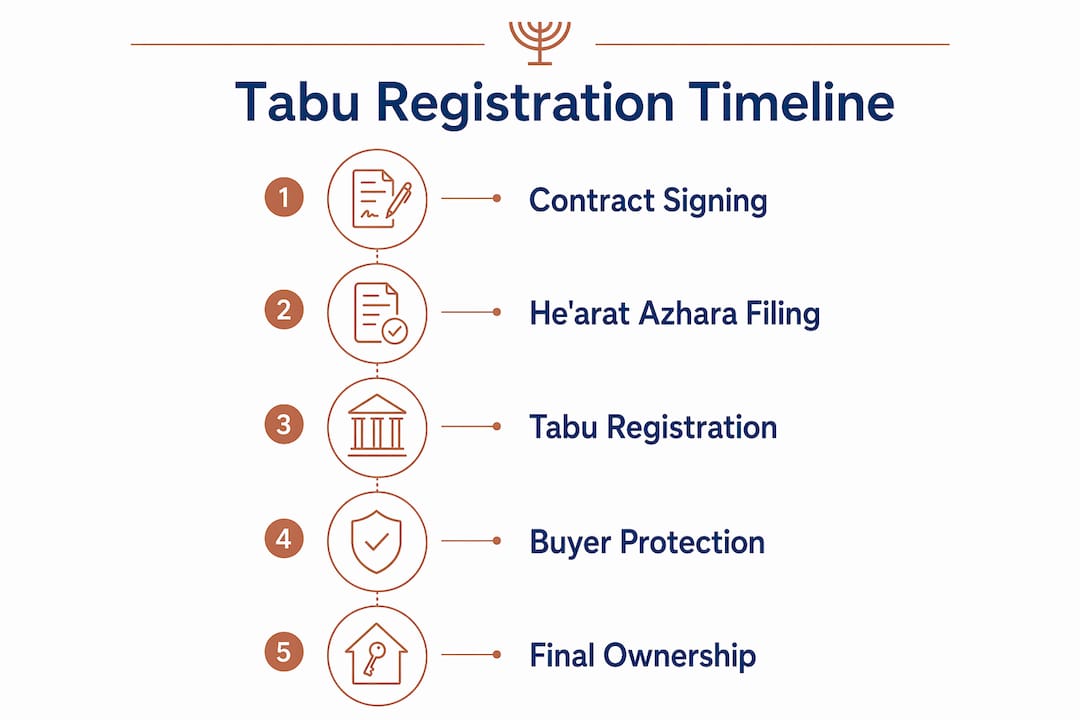
How does Israeli property ownership work, and what is the Tabu?
Legal ownership of property in Israel transfers only upon Tabu registration, not upon signing the purchase agreement. This is the single most misunderstood fact in Israeli real estate, and it creates a real window of risk between contract signing and the moment you are legally recognized as the owner.
The registration timeline and what it means for buyers
Tabu registration can take 4 to 16 weeks or more, depending on title complexity, outstanding municipal debts, or building violations. During that window, you have paid significant funds but do not yet hold legal title. That is why Israeli law created a protective mechanism called the He’arat Azhara.
| Stage | What happens | Buyer protection |
|---|---|---|
| Contract signing | Heskem Rechisha executed | He’arat Azhara filed within 30 days |
| Payment stages | Funds transferred per schedule | Bank guarantee (off-plan purchases) |
| Tax payment | Purchase tax paid to authorities | Lawyer coordinates filing |
| Tabu registration | Legal ownership transfers | Title search completed before filing |
The He’arat Azhara is a warning note registered in the Tabu within 30 days of contract signing. It prevents the seller from selling the property to another buyer or placing new liens on it during the registration period. Without this note, a dishonest seller could theoretically sell the same property twice. Your lawyer files this note as one of the first steps after contract execution.
Pro Tip: Confirm with your lawyer that the He’arat Azhara has been filed and accepted before you make any payment beyond the initial deposit. This is non-negotiable.
One critical difference between Israel and most other countries: no title insurance exists in Israel. In the United States or the United Kingdom, title insurance covers defects discovered after purchase. In Israel, that protection does not exist. Your lawyer conducts manual title searches and verifies ownership authority. The quality of that due diligence is your only protection against title defects.
What risks do foreign buyers face when buying property in Israel?
Foreign buyers face a distinct set of risks that go beyond what local Israeli buyers typically encounter. The Israeli real estate legal framework is highly protective when used correctly, but foreign buyers often underestimate the importance of due diligence before signing, leading to avoidable losses.
Tax costs that catch foreign buyers off guard
Purchase tax, known as Mas Rechisha, hits foreign buyers harder than Israeli residents. Foreign buyers pay 8% on the first NIS 6,055,070 of the purchase price and 10% on amounts above that, fixed through 2026. Total closing costs, including legal fees of 0.5%–1.5% plus 18% VAT, agent commissions, and purchase tax, range from 4% to 7% of the purchase price. Buyers who budget only for the property price are routinely surprised by these additional costs.
A practical due diligence checklist for foreign buyers
Before signing any property agreement in Israel, your lawyer should verify the following:
- Title status. Confirm the seller holds clear, unencumbered title in the Tabu.
- Building permit compliance. Verify that all structures on the property have valid permits. Unpermitted additions create legal liability for the new owner.
- Municipal debt clearance. Check that the property has no outstanding Arnona (municipal tax) debts or infrastructure levies. These debts transfer with the property.
- Liens and mortgages. Identify any registered mortgages or creditor claims against the property.
- Developer guarantees (off-plan only). Verify the existence and validity of a bank guarantee before any payment is made.
Pro Tip: For off-plan purchases, Israeli law requires developers to provide a bank guarantee, called a Havtahat Bank, in the buyer’s name before accepting any payment. Verify this guarantee with your lawyer before transferring funds. A developer who resists providing it is a serious red flag.
Hidden liens and building violations are the two most common problems that surface after signing. Both are discoverable through proper due diligence. Both become the buyer’s problem if the contract is signed without that review. Foreign buyers who rush to sign because they fear losing a property to another bidder are the buyers who most often end up in costly disputes.
How do you work effectively with an Israeli real estate lawyer?
An Israeli real estate lawyer does far more than read a contract. Lawyers handle contract review, coordination with sellers, tax calculation and payment, and Tabu registration to shift ownership officially. Choosing the right lawyer and knowing how to work with them determines how smoothly your transaction proceeds.
What to expect from your lawyer and what to ask
A qualified Israeli real estate lawyer should provide the following during a property purchase:
- A full Hebrew-to-English review of the Heskem Rechisha with written explanations of each material clause
- A title search confirming ownership history and any registered encumbrances
- Filing of the He’arat Azhara within 30 days of contract signing
- Calculation and payment of Mas Rechisha to the Israeli Tax Authority
- Coordination with the seller’s lawyer on any contract amendments
- Final Tabu registration once all conditions are met
Ask your lawyer these specific questions before engaging their services. First, how long have they represented foreign buyers in Israeli real estate transactions? Second, will they provide contract review notes in English? Third, what is their standard timeline for completing a title search? Fourth, how do they handle communication with clients based abroad?
Pro Tip: Choose a lawyer who offers remote representation for overseas clients. You should not need to fly to Israel to sign documents or attend routine meetings. Power of attorney arrangements allow your lawyer to act on your behalf throughout the process.
Negotiating unfavorable contract clauses is a legitimate part of the lawyer’s role. Many foreign buyers assume the contract presented by the seller is final. It is not. Delivery dates, penalty structures, payment schedules, and breach remedies are all negotiable. An experienced lawyer knows which clauses sellers routinely accept changes to and which are genuinely fixed. That knowledge saves buyers money and reduces risk before a single shekel changes hands.
Menora Law works specifically with foreign buyers and investors navigating Israeli property purchases. Their team provides bilingual contract review, remote consultation, and full transaction oversight from due diligence through Tabu registration. For buyers operating from abroad, that combination of local expertise and international service is what makes a transaction manageable.
Key Takeaways
Reviewing an Israeli real estate contract requires understanding the Heskem Rechisha, securing the He’arat Azhara, completing title due diligence, and working with a qualified Israeli lawyer before any funds are transferred.
| Point | Details |
|---|---|
| Contract is not ownership | The Heskem Rechisha binds both parties but does not transfer title. Only Tabu registration creates legal ownership. |
| He’arat Azhara protects buyers | This warning note must be filed within 30 days of signing to prevent the seller from re-selling or encumbering the property. |
| No title insurance in Israel | Your lawyer’s manual title search is your only protection against hidden defects, liens, or ownership disputes. |
| Foreign buyers pay higher taxes | Purchase tax starts at 8% for foreign buyers, with total closing costs reaching 4%–7% of the purchase price. |
| Off-plan buyers need bank guarantees | Israeli law requires a Havtahat Bank in the buyer’s name before any payment to a developer. Verify it before transferring funds. |
What we’ve learned from years of Israeli property transactions
At Menora Law, the pattern we see most often is this: a foreign buyer finds a property they love, feels time pressure from the seller, and signs the Heskem Rechisha before a lawyer has reviewed it. Then they call us. By that point, the contract is binding. The leverage to negotiate better terms is gone. The clause that limits the seller’s penalty for late delivery is locked in. The missing bank guarantee for an off-plan purchase is now a dispute, not a precaution.
The misconception driving this pattern is that contract review is a formality. It is not. Contract review should prioritize title defect identification and warning note registration over price negotiation. Foreign buyers often focus on the price and treat the legal steps as paperwork. That is backwards. The price is already agreed before the contract is drafted. The legal review is where you find out whether what you agreed to buy actually exists in the form the seller described.
We also see buyers who work with lawyers who are not specialized in Israeli real estate. General practice lawyers, or lawyers who primarily handle other areas of law, miss things. They may not know to check for specific municipal levies, or they may not flag a delivery penalty clause that is standard in Israeli contracts but unusually weak in a specific deal. Specialization matters in Israeli property law because the system is genuinely different from what most foreign buyers have experienced elsewhere.
The good news is that the Israeli legal framework is genuinely protective when you use it correctly. The He’arat Azhara system, the bank guarantee requirement for off-plan purchases, and the structured Tabu registration process all exist to protect buyers. You just have to engage them properly, and that requires a lawyer who knows how to use them.
— Menora Law
Menora Law’s services for foreign property buyers in Israel
Foreign buyers who want to purchase property in Israel without the stress of navigating an unfamiliar legal system have a clear path forward with Menora Law.

Menora Law provides full-service Israeli real estate legal support for international clients, including Hebrew contract review with English explanations, title searches, He’arat Azhara filing, purchase tax handling, and Tabu registration. All services are available remotely, so you never need to be physically present in Israel to complete your purchase. The team works with buyers from across the world and communicates in English throughout the process. If you are ready to move forward with a property purchase or want a lawyer to review a contract you have already received, contact Menora Law for a consultation. You can also learn more about buying property as a foreigner through their dedicated resources for international clients.
FAQ
What is a Heskem Rechisha in Israeli real estate?
A Heskem Rechisha is the binding purchase agreement signed by buyer and seller in an Israeli real estate transaction. It creates legal obligations for both parties but does not transfer ownership, which only occurs after Tabu registration.
How long does Tabu registration take in Israel?
Tabu registration typically takes 4 to 16 weeks, though it can extend further if there are outstanding municipal debts, building violations, or title complexity. Your lawyer manages this process on your behalf.
Do foreign buyers pay more tax when buying property in Israel?
Foreign buyers pay a purchase tax starting at 8% on the first NIS 6,055,070 and 10% on amounts above that. Total closing costs, including legal fees and agent commissions, range from 4% to 7% of the purchase price.
What is the He’arat Azhara and why does it matter?
The He’arat Azhara is a warning note registered in the Tabu within 30 days of contract signing. It prevents the seller from selling the property again or placing new liens on it before the buyer’s ownership is formally registered.
Is title insurance available for property purchases in Israel?
Title insurance does not exist in Israel. Buyers rely entirely on their lawyer’s manual title search and due diligence to identify ownership defects, liens, and encumbrances before completing the purchase.
Recommended
- Israeli Real Estate Law: What Buyers And Investors Must Know
- Israeli Lawyer Tips: How To Easily Buy Land In Israel As A Foreigner According To Land Law In Israel? | Menora Law
- Buying Real Estate In Israel – 30 Tips To Navigate Better The Israeli Property Market
- Real Estate In Israel – Tips To Successfully Invest In 2024

 English
 Afrikaans
 العربية
 বাংলা
বাংলা Čeština
 简体中文
简体中文 Nederlands
 Suomi
Suomi Français
 Deutsch
 עִבְרִית
 हिन्दी
 Magyar
 Italiano
 日本語
日本語 한국어
한국어 Polski
 فارسی
فارسی Português do Brasil
 Русский
 Español de México
 Українська