
Yes, foreign owners can sign and enforce contractor contracts in Israel, as long as three things happen before any money changes hands: verify the contractor’s registration and insurance, confirm the permits and technical supervision are in place, and check the contractor’s tax withholding status. If a dispute arises later, Israeli law gives you enforcement, cancellation, and damages as remedies, but acting quickly with Israeli counsel matters more than the remedy you eventually choose.
TL;DR:
- Foreign owners must verify contractor registration, permits, and technical supervision before signing to reduce legal risks and ensure project legality.
- A well-drafted contract should specify scope, milestones, retention, insurance, tax withholding, and dispute resolution for effective project management.
- Payments should be staged against independent milestone inspections with online tax certificate verification to prevent overpayment and performance issues.
- Enforcing remedies against breach involves documenting defects, issuing formal notices, and engaging Israeli counsel for provisional relief and damages claims.
- Using local legal support, like Menora Law, helps manage contract verification and dispute resolution remotely, saving time and minimizing compliance gaps.
Which Israeli laws and official bodies govern contractor contracts
Two statutes sit at the center of every contractor relationship in Israel. The Contracting statute, known as Hok Chozé Kabalnut, sets out the contractor’s core obligations, including the right of retention over materials, timing for acceptance of the work, and remedies for defects. Alongside it, the Contracts (Remedies for Breach of Contract) Law governs what happens when things go wrong.
Beyond the statutes, you need to know two government systems. The Contractors Registry, run by the Ministry of Construction and Housing, tracks who is legally authorized to perform contracting work above set financial thresholds, with branch 131 covering renovation work specifically. Separately, the building permit process requires appointed professionals and concludes with an occupancy certificate, called Te’udat Gemer, confirming the finished work matches what was approved.
Here is what each piece does for you as an owner:
- The Contracting statute defines your contractor’s basic duties and your rights if the work is defective.
- The Remedies law tells you what a court can order if the contractor breaks the deal.
- The Contractors Registry tells you whether your contractor is even allowed to take on the job.
- The permit and occupancy certificate process confirms the work is legal, not just finished.
Must-check registrations, permits and on-site supervision before you sign
Before you sign anything, run through a short sequence of checks. Skipping any one of them weakens your legal position if something goes wrong later.
- Look up the contractor in the Contractors Registry and confirm the classification matches your project’s value and type, since registration thresholds apply above defined monetary limits and renovation work falls under branch 131.
- Confirm which permits your project actually needs and who has been appointed to file and supervise them, typically a licensed architect or engineer working alongside the local planning and building process.
- Insist on continuous, named technical supervision throughout construction, not just a sign-off at the end, since gaps in supervision are one of the most common reasons disputes turn into drawn-out legal fights.
A contractor who resists registry verification or permit documentation early on is telling you something. Renovation contractors registered under branch 131 often serve as the client’s technical advisor rather than a fully licensed engineer, so do not assume a contractor’s title covers everything your project needs.
Contract clauses every foreign owner must include
A well-drafted contract is your main protection once the work begins, especially when you are managing the project from another country. Five clauses matter more than the rest.
- Scope and milestones: define exactly what counts as finished at each stage, tied to a written inspection and sign-off before any payment releases.
- Retention (me’akav): build in a holdback tied to defect correction, drawing on the retention rights described in the Contracting statute, so you keep leverage until the work passes inspection.
- Insurance evidence: require actual policy numbers and insured amounts, confirmed directly with the insurer, and extend the same requirement to subcontractors.
- Withholding tax responsibility: assign the obligation clearly and require the contractor to produce an online-verified tax withholding certificate before each payment, not a paper copy.
- Dispute resolution and jurisdiction: specify Israeli courts or arbitration seated in Israel, since a foreign forum clause can make enforcement against local assets far slower and more expensive.
Pro Tip: Tie every payment milestone to a written inspection certificate signed by an independent supervisor, not the contractor’s own site manager.
Reviewing a real estate or contracting agreement clause by clause before signing is standard practice everywhere, and a general contract review checklist can help you spot vague scope language even before your Israeli lawyer marks it up.
How to reduce payment and performance risk before and during the project
Money is where most disputes start, so treat every payment as conditional rather than automatic.
- Verify the contractor’s identity, registry status, and insurance before signing, and ask for a subcontractor list along with proof the project value fits within the contractor’s registered scope.
- Stage payments against milestone certificates from an independent inspector rather than the contractor’s own progress reports, and use an escrow arrangement where the project size justifies it.
- Verify the tax withholding certificate online through the Israel Tax Authority’s own system before releasing any substantial payment, since a paper certificate alone proves nothing.
- Appoint local technical supervision and withhold the final payment until you have both the completion certificate and the occupancy certificate in hand.
A contractor insurance checklist built for property owners managing work from a distance covers many of the same verification steps, and it is worth comparing against what your Israeli contract already requires.
If the contractor breaches or defects appear: remedies and enforcement
When a contractor fails to deliver, stalls the work, or produces defective results, Israeli law gives you three main paths. The Contracts (Remedies for Breach of Contract) Law provides for enforcement of the contract, cancellation, and damages, though each comes with limits.
- Courts can order specific performance, but they may decline if enforcement would require ongoing court supervision, which construction disputes often do.
- Cancellation ends the relationship and typically opens the door to damages instead, which is frequently the more realistic outcome for construction defects.
- Provisional relief, such as a freezing order on funds or property, can protect your position while a full claim proceeds.
From abroad, the practical sequence looks like this: document everything as it happens, including photos and written correspondence, send a formal notice of breach, then instruct Israeli counsel to pursue provisional relief and file a claim if the contractor does not respond. Detailed, measurable milestones in your original contract make enforcement claims stronger, since courts weigh whether the obligations were specific enough to supervise.
Common foreign-owner pitfalls and our practical approach
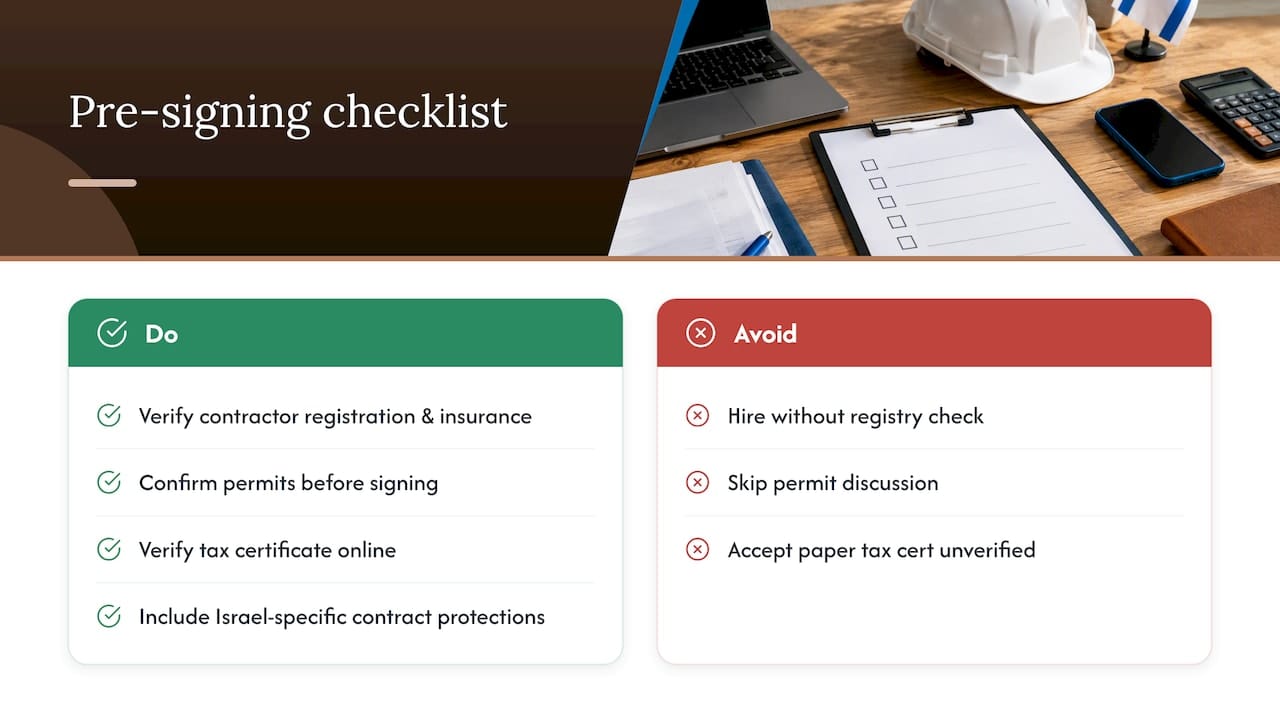
The mistakes we see most often follow a pattern: an owner hires a contractor based on a recommendation without checking the registry, skips the permit conversation because the contractor “handles that,” or accepts a paper tax certificate without confirming it online. Each of these gaps is fixable before signing, but far harder to fix afterward.
We work with clients who are not in Israel and cannot inspect a job site themselves. We verify registration and insurance documentation, coordinate with local inspectors and supervisors, draft contract protections specific to Israeli contracting law, and step in when enforcement becomes necessary.
— Menora Law
How Menora Law can help and how to get started
Buying property or commissioning construction work in Israel while living abroad puts you at a real disadvantage if you cannot verify paperwork in person. That is the gap we close for clients based overseas.

We review and draft contractor agreements, verify contractor registration and tax withholding status, and represent clients in disputes when a project goes wrong, all without requiring you to travel to Israel.
- We review or draft your contractor contract with Israeli-specific protections built in.
- We verify contractor registration, insurance, and withholding tax status before you sign.
- We represent you locally if enforcement or a claim becomes necessary.
To get started, gather your property title deed, any draft contract, and a Contractors Registry extract for the contractor you are considering, then reach out through Menora Law for a consultation. We respond quickly and work with clients across time zones as a standard part of how we practice.
This article is general information, not a substitute for advice from a qualified lawyer. Consult a qualified legal professional about your own circumstances before acting on anything here.
Sources
- המדריך לרישום בפנקס הקבלנים משרד הבינוי והשיכון
- הוראת ביצוע מס הכנסה מס’ 02/2021 – Income tax withholding guidance (Israel Tax Authority)
- חוק חוזה קבלנות, תשל"ד1974
FAQ
Can a foreigner legally sign a contractor contract in Israel?
Yes, foreign owners can sign contractor contracts in Israel without restriction based on citizenship or residency. The contract is enforceable under Israeli law as long as the contractor meets registration requirements for the value and type of work involved.
How do I check if an Israeli contractor is properly registered?
You can search the Contractors Registry maintained by the Ministry of Construction and Housing to confirm a contractor’s classification and whether it matches your project’s scope and value. Renovation work specifically falls under branch 131, which has its own listing and requirements.
What happens if my Israeli contractor breaches the contract?
Israeli law under the Contracts (Remedies for Breach of Contract) Law allows you to pursue enforcement of the contract, cancellation, or damages, though courts may decline to order enforcement if it would require excessive ongoing supervision. Most construction disputes resolve through cancellation combined with a damages claim, and provisional relief can protect your position while a case proceeds.
Do I need to verify tax withholding before paying an Israeli contractor?
Yes, payments for construction and related services can fall under withholding tax categories, and you should verify any certificate directly through the Israel Tax Authority’s system rather than accepting a paper copy. A contract clause requiring online verification before each payment protects you from relying on a certificate that may not be valid.
Can Menora Law help me manage a contractor dispute remotely?
Yes, we represent overseas clients in contractor contract drafting, verification, and dispute resolution without requiring travel to Israel. We coordinate with local inspectors and supervisors and handle enforcement steps on the client’s behalf when disputes arise.


 English
 Afrikaans
 العربية
 বাংলা
বাংলা Čeština
 简体中文
简体中文 Nederlands
 Suomi
Suomi Français
 Deutsch
 עִבְרִית
 हिन्दी
 Magyar
 Italiano
 日本語
日本語 한국어
한국어 Polski
 فارسی
فارسی Português do Brasil
 Русский
 Español de México
 Українська