
TL;DR:
- Israel’s data privacy law, reinforced by Amendment 13, requires organizations processing Israeli residents’ data to comply with strict governance, enforcement, and security standards. Foreign and local entities must adhere to classification, registration, and breach notification rules, with significant fines for violations. Ongoing compliance involves regular data mapping, security tier reassessment, employee training, and clear documentation to meet evolving regulatory expectations.
Israel data privacy law compliance is defined as the set of legal obligations organizations must meet under the Protection of Privacy Law (PPL) and its landmark Amendment 13, enforced by the Privacy Protection Authority (PPA). Any business holding data on Israeli residents, whether based in Israel or abroad, falls within this framework. Amendment 13 transformed Israeli data protection from a passive registration system into an active governance model with real enforcement teeth. Understanding what the law requires, and acting on it, is no longer optional.
What does Israel data privacy law compliance require?
The Protection of Privacy Law, originally enacted in 1981, is Israel’s primary data protection statute. Amendment 13, which took full effect in 2023 and 2024 with certain deadlines extending through october 31, 2025, overhauled the law’s enforcement architecture. The PPA now operates as an autonomous regulatory body with the power to impose fines and conduct audits without court orders. That shift matters because it means violations can result in immediate financial consequences, not just future litigation.

The legal framework in Israel is built on several core principles: transparency, purpose limitation, data minimization, security, and individual rights. Organizations must collect only the data they need, use it only for stated purposes, and protect it with controls appropriate to its sensitivity. These principles align broadly with international standards, but the specific requirements under the PPL are distinct and must be followed on their own terms.
Administrative fines are capped at 5% of annual turnover or NIS 9 million per violation, whichever is higher. That scale of penalty makes compliance a financial priority, not just a legal formality.
Who must comply with Israel’s data protection law?
The PPL applies broadly, and the scope is wider than many organizations expect.
Entities covered include:
- Israeli companies and public bodies processing personal data
- Foreign organizations holding databases that include Israeli residents’ personal information
- Data processors acting on behalf of database owners
- Non-profit organizations and associations that maintain personal data on members or donors
Types of databases covered:
- Digital databases (cloud, on-premise, hybrid)
- Physical databases, including paper files with personal records
- Any structured collection of data that allows retrieval by personal identifiers
Thresholds that trigger specific obligations:
- Holding data on more than 10,000 individuals for data trading purposes
- Processing sensitive data categories such as health, biometric, financial, or criminal records
- Operating as a public body regardless of database size
Activities generally excluded from compliance obligations:
- Personal, non-business use of data
- Journalistic activity protected under press freedom provisions
- Certain research activities conducted under approved ethical frameworks
The extraterritorial reach of the PPL is a critical point for international businesses. Foreign entities holding Israeli residents’ data are subject to Israeli security regulations and tiered cybersecurity controls, regardless of where the organization is incorporated. If your company collects data from Israeli customers through a website or app, you are within scope.
How to achieve compliance with Amendment 13: a step-by-step process
Compliance is not a single event. It is a structured program that covers governance, documentation, technical controls, and ongoing monitoring. The steps below reflect the core requirements under Amendment 13.
Conduct a data mapping exercise. Identify every database your organization holds, including its purpose, the categories of data it contains, who has access, and where the data is stored. This inventory is the foundation of every other compliance step.
Classify your databases by security tier. Israeli law assigns each database to one of four security tiers: Basic, Medium, High, or Very High. Classification depends on data sensitivity, volume of data subjects, and the number of authorized users. Get this right before implementing technical controls.
Appoint a Data Protection Officer if required. Mandatory DPO appointment applies to public bodies, organizations holding large databases, and processors of sensitive data. The grace period for DPO appointments ended october 31, 2025. If your organization meets the criteria and has not yet appointed a DPO, you are already in breach.
Register databases with the PPA where required. Certain databases must be formally registered with the Privacy Protection Authority. The registration requirement depends on database type and the sensitivity of the data held.
Update your privacy policy and consent mechanisms. Privacy notices must clearly state the purpose of data collection, the identity of the database owner, and the rights of data subjects. Consent must be informed, specific, and documented. Implied consent does not satisfy the PPL’s requirements.
Implement breach notification procedures. Amendment 13 requires organizations to notify the PPA and affected individuals of significant data breaches within defined timeframes. Build an incident response plan that covers detection, internal escalation, regulatory notification, and individual communication.
Apply security controls corresponding to your data tier. Each tier carries specific technical and procedural requirements. Basic tier databases require access controls and basic logging. Higher tiers require encryption, penetration testing, audit trails, and formal security reviews.
Train employees and document compliance activities. Staff who handle personal data must understand their obligations. Training records, internal audits, and documented procedures all support your compliance posture if the PPA conducts an inspection.
Pro Tip: Map your databases before you appoint your DPO. The DPO’s first task will be reviewing that inventory, and an incomplete map wastes time and creates gaps that regulators will find.
Israeli compliance for international clients often requires coordinating these steps across multiple jurisdictions, which adds complexity to the timeline.
How do Israel’s data security tiers work?
The Protection of Privacy Regulations (Data Security) establish four security tiers. Each tier defines the minimum technical and procedural controls an organization must implement. Security tier assignment depends on a complex assessment of authorized access, volume of data subjects, and data sensitivity. Incorrect classification risks serious compliance gaps.
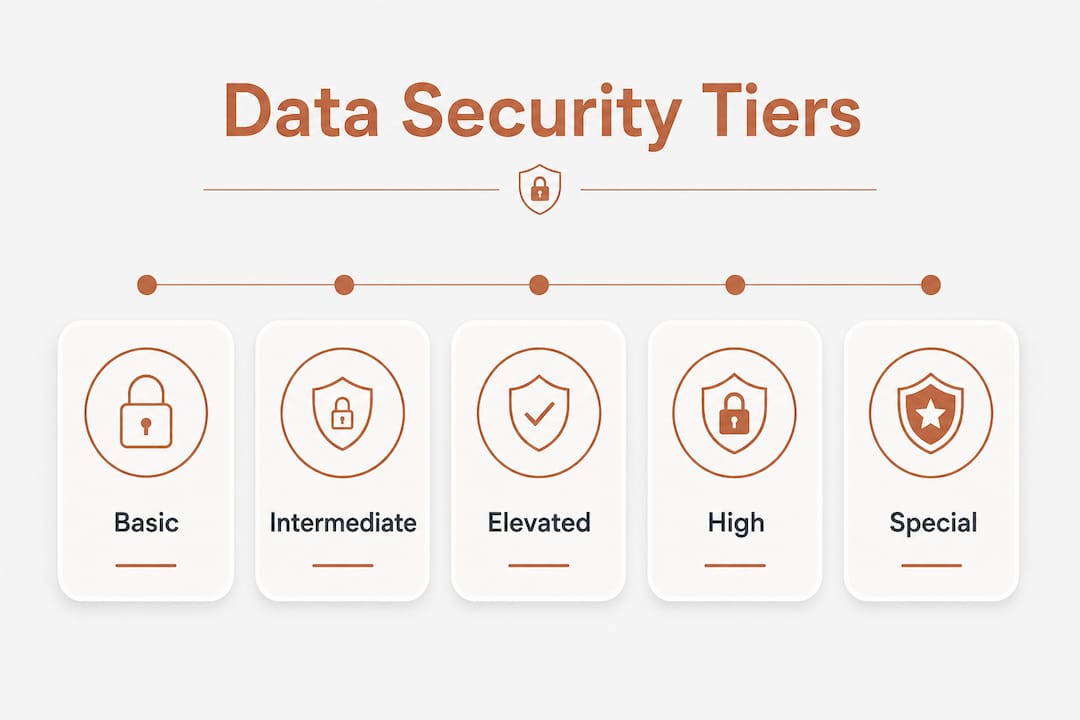
| Security tier | Classification criteria | Key control requirements |
|---|---|---|
| Basic | Low sensitivity data, limited users, small volume | Access controls, basic logging, user authentication |
| Medium | Moderate sensitivity or larger volume | Encryption at rest, access logs, defined security procedures |
| High | Sensitive data categories or large-scale processing | Penetration testing, audit trails, formal security officer role |
| Very High | Biometric, health, or financial data at scale | Continuous monitoring, advanced encryption, annual security audits |
Health records, biometric identifiers, financial account data, and criminal history all trigger classification at the High or Very High tier. Organizations that process these categories must implement controls that go well beyond basic IT security practices.
Static security configurations can cause gaps as organizations grow. A database that starts at the Basic tier can move to Medium or High as the number of records increases or as new data categories are added. Organizations must reassess their tier classification whenever their data processing activities change materially.
Pro Tip: Build your tier classification into your annual compliance review cycle. A database that grows from 8,000 to 12,000 records may cross a threshold that changes your obligations overnight.
How does Israel’s privacy law compare to GDPR?
Israel holds EU adequacy status, meaning the European Commission recognizes Israeli data protection as providing an adequate level of protection for data transfers from the EU. That status simplifies cross-border data flows but does not mean the two frameworks are interchangeable. Israeli Amendment 13 and GDPR share principles but differ in breach notification timelines, consent formalities, and enforcement mechanisms, requiring separately enforced jurisdiction-specific controls.
Key differences organizations must understand:
- Breach notification timelines. GDPR requires notification to supervisory authorities within 72 hours of becoming aware of a breach. Israel’s PPL sets its own timelines, which differ in scope and process. Organizations cannot assume that meeting the GDPR deadline satisfies Israeli requirements.
- Consent documentation. GDPR requires a clear affirmative act of consent. The PPL has its own consent formalities, including specific disclosure requirements that do not map directly onto GDPR consent records.
- Enforcement structure. The PPA operates differently from EU data protection authorities. It has autonomous enforcement authority and can impose fines immediately upon detecting violations, without the multi-step process common in some EU jurisdictions.
- Individual rights. Both frameworks grant data subjects rights of access, correction, and deletion. The procedural requirements for honoring those rights differ between the two systems.
- Penalties. Statutory damages under the PPL allow individuals to sue for up to NIS 100,000 per person without proving actual harm. The statute of limitations extends to seven years. That combination creates significant long-tail liability for organizations that experience breaches.
“Effective compliance for global organizations demands tailored governance architectures that enforce jurisdiction-specific controls to reconcile differences between Israeli and EU privacy laws. Treating one framework as a proxy for the other creates compliance gaps that regulators on both sides will find.”
Organizations operating under both frameworks need separate compliance tracks, not a single lowest-common-denominator policy. The Israeli legal system has its own procedural logic, and that logic applies even when your organization is already GDPR-compliant.
Common compliance challenges and how to maintain ongoing adherence
Achieving initial compliance is one challenge. Maintaining it over time is another. The PPA’s enforcement priorities in 2026 focus on DPO independence, data subject rights, and AI governance. Organizations that treat compliance as a one-time project will find themselves exposed as the regulatory environment evolves.
The most common ongoing challenges include:
- DPO independence. The DPO must have sufficient authority and resources to perform their role without interference from business units. Organizations that appoint a DPO in name only, without real independence, face enforcement risk.
- Data inventory drift. Databases change. New systems are added, data categories expand, and third-party processors are engaged without updating the central inventory. Regular audits are the only reliable way to keep the inventory accurate.
- Data subject rights requests. Individuals have the right to access, correct, and delete their data. Organizations must have clear processes for receiving, verifying, and responding to these requests within the timeframes the PPL specifies.
- Employee training gaps. Staff turnover means that training delivered at onboarding becomes stale. Privacy training must be repeated regularly and updated when the law or internal procedures change.
- Security tier reassessment. As noted above, database growth and new data categories can shift tier classification. Organizations that do not reassess regularly risk operating under the wrong security controls.
- Preparing for PPA inspections. The PPA can conduct audits proactively. Organizations should maintain documentation that demonstrates compliance at any point in time, not just after a complaint is filed.
Proactive privacy management is now a recognized competitive advantage. Organizations that build privacy governance into their operations attract partners and customers who treat data protection as a trust signal.
Key Takeaways
Israel’s Protection of Privacy Law and Amendment 13 impose specific, enforceable obligations on every organization holding Israeli residents’ data, with fines reaching 5% of annual turnover and individual damages up to NIS 100,000 per person.
| Point | Details |
|---|---|
| Amendment 13 is active and enforced | The PPA can impose fines immediately without court orders, making readiness urgent. |
| Extraterritorial scope is real | Foreign organizations holding Israeli residents’ data must comply with Israeli security regulations. |
| DPO appointment deadlines have passed | The grace period ended october 31, 2025; organizations meeting the criteria are already in breach if no DPO is appointed. |
| Security tiers require active management | Tier classification must be reassessed whenever data volume or sensitivity changes. |
| Israel and GDPR are separate frameworks | EU adequacy status does not eliminate the need for distinct Israeli compliance measures. |
Menora Law’s perspective on Israel’s evolving privacy framework
Working with international clients on Israeli legal matters, I have watched the shift that Amendment 13 represents in real time. Before the amendment, many organizations treated the PPL as a registration formality. They filed their database registration, updated a privacy policy, and considered the matter closed. That approach no longer works, and the organizations still operating that way are the ones most exposed right now.
What I find most significant about Amendment 13 is not the size of the fines, though those are serious. It is the cultural expectation embedded in the law. The PPA is signaling that privacy governance is an organizational competency, not a legal checkbox. The DPO independence requirement reflects that. The focus on AI governance in 2026 reflects that. The PPA wants to see that privacy is integrated into how decisions are made, not bolted on afterward.
The organizations that handle this well share a common approach. They start with an honest data mapping exercise, accept the results even when the picture is uncomfortable, and build their compliance program around what they actually have rather than what they wish they had. They also treat the DPO as a genuine resource rather than a compliance decoration.
Compliance builds trust with customers and international partners. That is not a marketing claim. It is a practical observation from watching deals move faster when the counterparty can see a mature privacy program in place. For international businesses operating in Israel, privacy compliance is part of the credibility package.
The advice I give consistently is this: do not wait for a breach or a PPA inquiry to start. The cost of proactive compliance is a fraction of the cost of reactive remediation, and the reputational damage from a public breach disclosure is harder to recover from than any fine.
— Menora Law
How Menora Law can help with your Israeli data privacy obligations
Menora Law works with businesses and organizations around the world that need to meet their obligations under Israeli law, including the Protection of Privacy Law and Amendment 13. The firm’s practice covers the full range of compliance requirements: data mapping, DPO appointment guidance, privacy policy drafting, breach response planning, and ongoing regulatory monitoring. For international clients, Menora Law provides cross-border legal coordination that accounts for the interaction between Israeli requirements and other jurisdictions your organization operates in. Remote consultations are available, and the team communicates clearly in English. If you are ready to assess your current compliance position or build a program from the ground up, contact Menora Law to schedule a consultation.
FAQ
What is the Protection of Privacy Law in Israel?
The Protection of Privacy Law is Israel’s primary data protection statute, originally enacted in 1981 and significantly updated by Amendment 13. It governs how organizations collect, store, use, and protect personal data on Israeli residents.
Does Israel’s data privacy law apply to foreign companies?
Yes. The PPL applies extraterritorially to any foreign organization holding a database that includes Israeli residents’ personal information, regardless of where the company is incorporated or operates.
What are the penalties for violating Israel’s data privacy law?
Administrative fines reach up to NIS 9 million per violation or 5% of annual turnover, and individuals can claim statutory damages of up to NIS 100,000 per person without proving actual harm.
Is Israel’s privacy law equivalent to GDPR?
Israel holds EU adequacy status, but the PPL and GDPR are separate frameworks with different breach notification timelines, consent requirements, and enforcement mechanisms. Dual compliance requires jurisdiction-specific controls for each framework.
When was the DPO appointment deadline under Amendment 13?
The grace period for mandatory Data Protection Officer appointments under Amendment 13 ended october 31, 2025. Organizations that meet the appointment criteria and have not yet designated a DPO are currently in breach of the law.


 English
 Afrikaans
 العربية
 বাংলা
বাংলা Čeština
 简体中文
简体中文 Nederlands
 Suomi
Suomi Français
 Deutsch
 עִבְרִית
 हिन्दी
 Magyar
 Italiano
 日本語
日本語 한국어
한국어 Polski
 فارسی
فارسی Português do Brasil
 Русский
 Español de México
 Українська