
TL;DR:
- Israeli small claims court provides a fast, inexpensive way for individuals to resolve civil monetary disputes up to approximately 39,900 NIS without legal representation. It handles common disputes such as consumer issues, contract breaches, and minor property damage, with strict procedural rules and limited appeal options. Proper preparation of organized written submissions is crucial, especially for foreign nationals, to ensure a successful case within this simplified court system.
Israeli small claims court is a simplified judicial forum designed for resolving civil monetary disputes up to approximately 39,900 NIS without requiring lawyer representation. Known formally in Hebrew as the court for small claims, it operates as a division within the magistrates court system. The process is built for speed and low cost, making it accessible to ordinary people who need to resolve consumer complaints, contract breaches, or minor property damage without hiring an attorney. If you are an individual or a foreign national with a dispute in Israel, understanding this court can save you significant time and money.
What is israeli small claims court and who can use it?
Israeli small claims court is defined as a specialized track within the magistrates court system, created specifically for low-value monetary disputes. The jurisdiction limit currently sits at approximately 39,900 NIS, updated in early 2026. That ceiling means any claim exceeding this amount must be filed in a different court track entirely.

The court is designed to be fast and cost-effective, with no lawyers permitted in most hearings. This is a deliberate policy choice. The Israeli legislature wanted to give individuals a real path to justice without the financial burden of legal fees eating up the value of a small claim.
Both individuals and registered businesses can file claims here. Foreign nationals living abroad can also file, provided the dispute has a connection to Israel. For foreigners, understanding Israeli legal jurisdiction rules before filing is a critical first step.
Types of claims commonly accepted
The court handles a specific range of disputes. Common claim types include:
- Consumer disputes: A contractor who did poor work, a retailer who refused a refund, or a service provider who failed to deliver.
- Contract breaches: Agreements between private parties where one side did not perform.
- Minor property damage: Damage to a vehicle, apartment, or personal belongings caused by another party.
- Landlord-tenant disputes: Deposit refusals or minor damage claims between renters and property owners.
- Unpaid debts: Small loans or unpaid invoices between individuals or small businesses.
Claims involving personal injury, family law, real estate title disputes, or criminal matters fall outside this court’s authority. Calculating the full claim value including damages, interest, and any statutory additions is critical before filing. A claim that exceeds the jurisdictional ceiling will be dismissed or transferred, wasting your time and filing fees.
Pro Tip: Add up all components of your claim before filing. Include the principal amount, any interest accrued, and any statutory damages you intend to request. If the total exceeds 39,900 NIS, the small claims track is not the right forum.
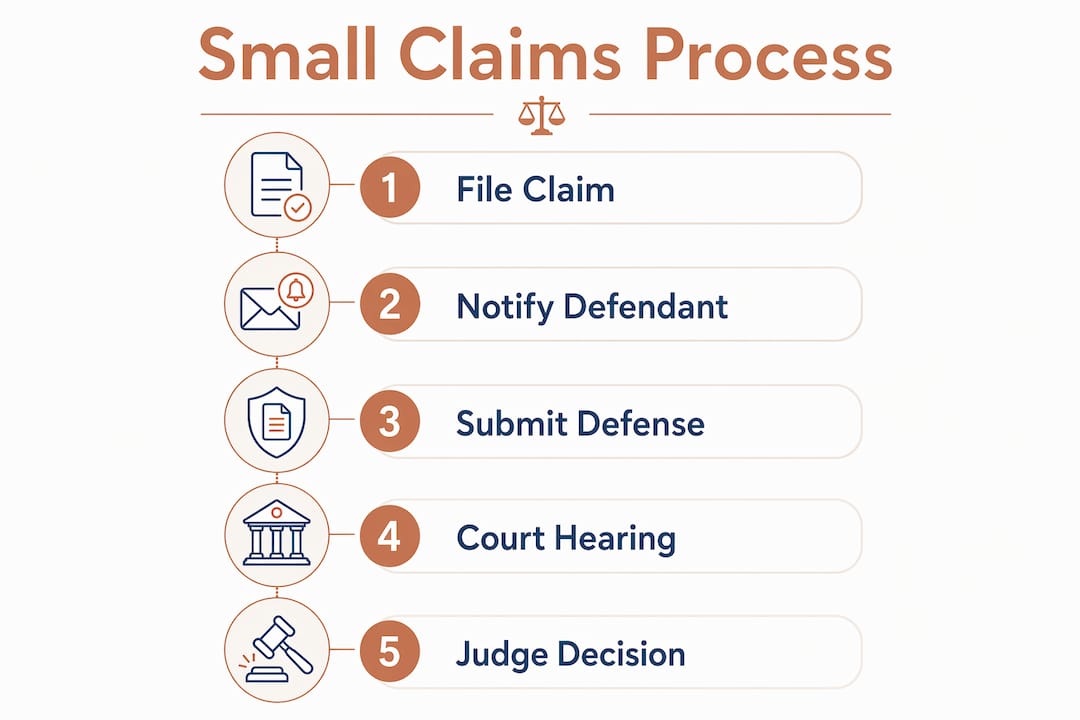
How to file a claim in israeli small claims court
Filing a claim in the Israeli small claims court follows a clear process. The court accepts both in-person and online submissions. Online filing through the Net HaMishpat system has become the standard method for most claimants.
Here is the step-by-step process:
- Prepare your claim document. Write a clear, factual description of the dispute. State what happened, when it happened, who is responsible, and exactly how much you are claiming. Attach all supporting documents such as receipts, contracts, photos, and correspondence.
- Create a Net HaMishpat account. The Net HaMishpat online system requires digital authentication. You will need a valid Israeli ID or, for foreigners, the appropriate identity verification credentials.
- Upload your documents. Organize your evidence clearly before uploading. Label each document so the judge can follow the logic of your claim without confusion. Document clarity and organization directly affect how well a judge understands your case.
- Pay the filing fee. Filing fees are generally low. The structure runs approximately 50 NIS as a base filing fee plus roughly 1% of the total claim amount. For a 20,000 NIS claim, expect to pay around 250 NIS in fees. Payment is made online through the system.
- Receive your hearing date. After submission, the court assigns a hearing date and notifies the defendant. The defendant then has a set period to respond.
The Net HaMishpat system timestamps every submission. Missing a cut-off means your filing is recorded as late, which can affect the court’s view of your diligence. Submit well before any deadline.
Pro Tip: Prepare a numbered list of your claim points before writing your submission. Match each point to a specific piece of evidence. Judges in small claims court read many cases quickly, and a well-organized, point-by-point claim stands out immediately.
What to expect during the small claims court procedure
The small claims court procedure in Israel is deliberately simplified. The goal is to allow ordinary people to represent themselves without needing a law degree. Here is what the process looks like from filing to judgment.
The hearing format
Hearings are informal compared to regular civil court. The judge leads the session, asks questions directly, and reviews the written submissions from both sides. There are no formal opening statements or cross-examinations in the traditional sense. The judge controls the pace and direction of the hearing.
Lawyers are generally not permitted to appear on behalf of parties in small claims court. This rule levels the playing field. A large company cannot send a legal team to intimidate an individual claimant. Both sides speak for themselves.
Defense submission and deadlines
Once a claim is filed and the defendant is notified, the defendant must submit a written defense within 15 days. This deadline is strict. If a defendant needs more time, they must request an extension before the 15-day window closes. Failing to request an extension in advance forfeits the right to one entirely.
A strong defense follows the same logic as a strong claim. Address each point raised by the claimant directly. Attach your own evidence. A well-prepared written defense significantly improves a defendant’s chances of a favorable outcome.
Key procedural limitations
- No appeals on factual grounds. Small claims court rulings are generally not appealable based on disputed facts. You can appeal on legal grounds, but if the judge decided the facts against you, that finding typically stands.
- No discovery process. There is no formal discovery phase. Both sides present their evidence upfront in their written submissions.
- Judgment delivery. The judge may deliver a ruling at the hearing or issue a written decision afterward. Enforcement of a judgment follows standard Israeli court enforcement procedures.
- Timeframes. Cases in small claims court typically resolve faster than regular civil litigation. Hearings are often scheduled within a few months of filing, though backlogs can extend this.
Understanding these limitations before you file helps you set realistic expectations. The small claims track is powerful for the right dispute. For complex cases with disputed facts and high stakes, the Israeli civil litigation process through regular courts may serve you better.
Small claims court vs. magistrates and district courts in israel
Choosing the right court is one of the most consequential decisions you make before filing. Each court track in Israel has different monetary thresholds, procedural rules, and cost structures.
| Feature | Small Claims Court | Magistrates Court | District Court |
|---|---|---|---|
| Monetary jurisdiction | Up to ~39,900 NIS | Up to 2,500,000 NIS | Above 2,500,000 NIS |
| Lawyer representation | Generally not permitted | Permitted and common | Required for complex matters |
| Filing fees | Low (~50 NIS + ~1% of claim) | Moderate | Higher |
| Procedural complexity | Simplified, self-represented | Standard civil procedure | Full civil procedure |
| Appeal rights | Limited (no factual appeals) | Standard appeal rights | Full appeal rights |
| Typical case duration | Months | 1–3 years | 2–5 years |
| Best suited for | Consumer disputes, minor contracts | Property, business disputes | Major commercial or civil claims |
The magistrates court handles a much broader range of civil matters, including property disputes, employment claims, and larger contract breaches. Lawyers appear regularly in magistrates court, and the procedure follows standard civil rules. The district court handles the largest and most complex civil and commercial matters.
For most individuals with a straightforward consumer complaint or a broken contract worth less than 39,900 NIS, the small claims track is the right choice. It is faster, cheaper, and designed for people without legal training. The moment your claim grows more complex or exceeds the monetary ceiling, you need to consider a higher court track. Consulting a legal professional about Israeli legal jurisdiction rules before filing prevents costly procedural mistakes.
The cost difference between tracks is significant. In small claims court, your total out-of-pocket expense for a 30,000 NIS claim might be 350 NIS in filing fees with no attorney costs. In magistrates court, attorney fees alone can run into thousands of NIS, often exceeding the value of smaller claims. That math explains why the small claims track exists and why it matters.
Key takeaways
Israeli small claims court is the fastest and most cost-effective forum for resolving civil disputes under 39,900 NIS in Israel, with no lawyers required and a simplified filing process through Net HaMishpat.
| Point | Details |
|---|---|
| Jurisdiction ceiling | Claims must not exceed approximately 39,900 NIS, including interest and damages. |
| No lawyer rule | Lawyers are generally barred from appearing, making self-representation the standard. |
| Online filing available | Net HaMishpat allows digital submission with timestamped deadlines and document uploads. |
| Defense deadline is strict | Defendants have 15 days to submit a written defense; extensions must be requested in advance. |
| Appeal rights are limited | Rulings cannot be appealed on factual grounds, making strong written submissions critical. |
Menora law’s take on navigating israeli small claims court
From our experience working with international clients on Israeli legal matters, the small claims court is genuinely one of the most accessible parts of the Israeli judicial system. That accessibility is real. But it comes with a catch that most people do not see until it is too late.
The court’s simplified format creates a false sense of ease. People assume that because lawyers are not permitted, preparation does not matter much. The opposite is true. The substantive leverage in small claims lies entirely in precise written pleadings and how well your evidence supports each specific point. There is no oral argument to save a weak written submission. What you file is essentially what the judge reads and decides on.
We have seen well-founded claims fail because the claimant submitted a disorganized bundle of documents without explaining how each piece connected to the dispute. We have also seen defendants lose cases they should have won because they missed the 15-day defense deadline or submitted a vague response that did not address the claimant’s points directly.
For foreign nationals, the challenge is compounded. Filing in a system you do not know, in a language that may not be your first, with procedural rules that differ from what you are used to, creates real risk. The court will not make allowances for unfamiliarity with Israeli procedure.
Our honest advice: treat the written submission as your entire case. Organize it like a legal brief even though you are not a lawyer. Number your points. Match each point to a document. Explain the connection clearly. If you are unsure whether your claim fits within the small claims jurisdiction or whether you are calculating the claim value correctly, get a professional opinion before you file. A small investment in legal guidance at the start can prevent a dismissal that costs you the entire claim.
— Menora Law
How menora law can help with your israeli legal dispute
Dealing with an Israeli legal dispute from abroad is genuinely difficult, especially when you are unfamiliar with the court system, the language, or the procedural rules.
Menora Law works with international clients on Israeli civil and legal matters, including disputes that may involve the small claims court or require guidance on which court track is appropriate. Whether you need help understanding your options, preparing a claim, or assessing whether your dispute belongs in small claims or a higher court, Menora Law provides clear, direct legal guidance tailored to your situation. For foreigners dealing with cross-border Israeli legal matters, having a trusted Israeli legal advisor makes the difference between a well-prepared case and a costly procedural mistake. Reach out to Menora Law today to discuss your situation.
FAQ
What is the monetary limit for israeli small claims court?
The current jurisdiction limit is approximately 39,900 NIS, updated in early 2026. Claims exceeding this amount must be filed in the magistrates court or district court depending on the total value.
Can foreigners file a claim in israeli small claims court?
Yes, foreign nationals can file claims in Israeli small claims court provided the dispute has a legal connection to Israel. Understanding Israeli jurisdiction rules before filing is strongly recommended to avoid procedural issues.
Are lawyers allowed in israeli small claims court?
Lawyers are generally not permitted to represent parties in small claims court hearings. Both sides present their own cases, which is why clear, organized written submissions are the most important factor in the outcome.
How long does the israeli small claims process take?
Most cases are scheduled for a hearing within a few months of filing, making small claims court significantly faster than standard civil litigation in Israel, which can take one to three years in magistrates court.
Can you appeal a small claims court decision in israel?
Appeals on factual grounds are generally not permitted. You may appeal on legal grounds, but if the judge’s ruling was based on disputed facts, that finding typically stands as final.

 English
 Afrikaans
 العربية
 বাংলা
বাংলা Čeština
 简体中文
简体中文 Nederlands
 Suomi
Suomi Français
 Deutsch
 עִבְרִית
 हिन्दी
 Magyar
 Italiano
 日本語
日本語 한국어
한국어 Polski
 فارسی
فارسی Português do Brasil
 Русский
 Español de México
 Українська