
If you own an apartment in Israel and live abroad, the rent you collect is taxable in Israel. The good news is that the rules for residential rent are fairly friendly, and you generally choose between three routes: a full exemption up to a monthly ceiling, a flat 10% rate on the rent, or regular marginal rates. Which one is right depends on how much rent you receive, whether you have other Israeli income, and how your home country treats the same rent.
This guide walks through each route in plain terms, shows the math on a realistic example, and explains what an overseas owner needs to handle from a distance. It is general information about Israeli tax rules, not advice on your specific file.
TL;DR
- Residential rent from an Israeli apartment is taxed in Israel even if you live abroad. Nonresidents can choose among an exemption up to a ceiling, a flat 10% rate, or marginal-rate taxation.
- The monthly exemption ceiling for 2026 is ILS 5,654. Rent at or under that amount in a given month can be fully exempt.
- Short-term and holiday-style rentals are usually treated as a business, so the residential tracks may not apply to them.
- Your home country may also tax the rent. Whether you get a credit for Israeli tax depends on its domestic law or on a tax treaty with Israel.
- Pick the track before the first rent payment arrives, not after. Switching later is harder than choosing well at the start.
The short version: three ways Israel taxes residential rent
For an apartment let out for living purposes, Israeli tax law gives the landlord a menu rather than a single rule. PwC’s Israel tax summary describes the monthly exemption for residential rental income, and notes that above the ceiling a landlord can use the 10% track or be taxed at marginal rates. In practice that gives you:
- The exemption track. Rent up to a monthly ceiling is not taxed at all, subject to conditions.
- The 10% track. A flat 10% on the rent, treated as the final tax on that income.
- The marginal-rate track. The rent is added to your Israeli taxable income and taxed at progressive rates, which lets you account for costs of earning the income.
Nonresidents can generally use the same menu as residents. That surprises many owners, who assume a foreigner is automatically taxed at a punishing flat rate. The rules do turn on a few definitions, though, so it is worth getting them right before you sign a lease.
Who counts as a nonresident for this purpose
Israeli tax residency is not decided by your passport. It turns on where your life is centered: where you live, where your family is, where you work, and how much time you spend in Israel each year. An Israeli citizen who has lived abroad for years can be a nonresident for tax purposes, and a foreign citizen who spends long stretches in Israel can be a resident.
This matters here because the nonresident label drives how other parts of your Israeli tax picture are treated, including reporting and what happens when you eventually sell. If your status is unclear, settle it first. We cover the residency and VAT pitfalls for people entering the Israeli market in our legal checklist on tax residency and VAT traps.
Route one: the monthly exemption
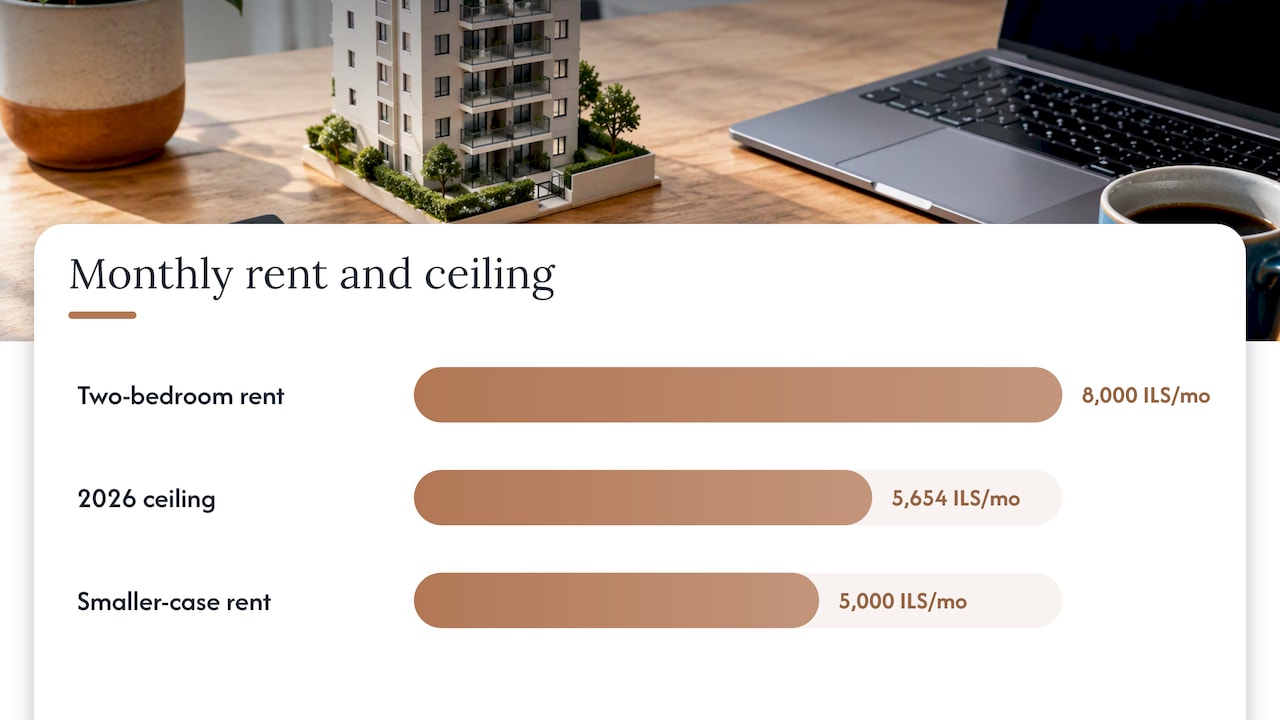
The simplest route is the exemption. According to PwC, rental income from Israeli residential homes is exempt if it does not exceed the prescribed monthly ceiling, which is ILS 5,654 in 2026, and no special approval is needed.
A few things to keep in mind:
- It is a monthly test. The ceiling applies to the rent for a given month, so a lease at or below the ceiling falls inside the exemption for every month.
- It is for residential letting. A home rented for living, not a hotel-style or holiday operation.
- There are conditions. The exemption is subject to a ceiling and conditions, so read the details before relying on it. One condition that often catches owners out is how much other residential rent you earn, because the ceiling is meant to be a total, not a per-apartment allowance.
- Little or no filing. The Knesset Research and Information Center noted in 2024 that there is no mandatory reporting requirement for residential rent under the monthly exemption threshold, though reform proposals have been under discussion. Check the current rule before assuming that is still the case.
For a small studio or a modest one-bedroom in a regional city, the exemption can mean you pay no Israeli income tax on the rent at all. For a typical apartment in Tel Aviv, Jerusalem, Herzliya or Haifa, rent often runs well above the ceiling, which is where the other two routes come in.
Route two: the flat 10% track
When rent exceeds the exemption ceiling, many owners choose the flat 10% route. It is a final tax rate on the rental income. You do not stack the rent on top of other Israeli income, and you do not pay the higher marginal rates.
The appeal is predictability. You know the number: ten percent of the rent you collect. There is no need to assemble a cost file, calculate depreciation, or argue about which repairs are deductible.
The trade-off is that the flat track is generally built around the gross rent, so the costs you bear as a landlord do not reduce the base. If your property carries heavy expenses, that matters. Questions about exactly what can and cannot be deducted under each track are the ones we recommend confirming against the current Tax Authority guidance and your own facts, since details have been amended over the years.
What the 10% track does not cover
The 10% track is designed for ordinary residential letting. Short-term and holiday rentals are treated as business activity, and are not eligible for the residential flat-rate track. If you list your apartment on a short-stay platform and turn it over every few days, you are likely outside this route, and the income should be reviewed as business income. Mixed arrangements, such as a furnished apartment rented in monthly blocks, sit on a line that deserves a short conversation before you pick a track.
Route three: marginal-rate taxation
The third option is to report the rent as ordinary taxable income and be taxed at the progressive rates. This is not the cheapest choice for most landlords with a single apartment and no other Israeli income, but it can be the right one in specific cases.
It can make sense when:
- your real expenses are high relative to the rent (financing costs, major maintenance, management fees, local property charges that you pay as owner);
- your total Israeli taxable income is low, so the lower brackets absorb the rent;
- you hold the property in a structure or situation where the other tracks are not open.
It is a worse fit when the rent is high and you have other Israeli income, because the top of your income then falls into the higher brackets. Higher earners should also keep in mind the additional surtax that applies to income above a yearly threshold. Ask for the current figure before you model your numbers, since the threshold is updated annually.
A worked example
Take an owner abroad who rents out a two-bedroom apartment for ILS 8,000 a month, with no other Israeli income. These figures are for illustration only.
| Item | Exemption track | 10% track | Marginal-rate track |
|---|---|---|---|
| Monthly rent | ILS 8,000 | ILS 8,000 | ILS 8,000 |
| Annual rent | ILS 96,000 | ILS 96,000 | ILS 96,000 |
| Is the track available? | Not in full: the rent exceeds the ILS 5,654 ceiling | Yes, for residential letting | Yes |
| Tax base | Not applicable at this rent | The gross rent | Rent less allowable costs |
| Tax at a flat rate | Not applicable | ILS 9,600 (10% of 96,000) | Depends on brackets and costs |
Two lessons from the table. First, at ILS 8,000 a month the exemption does not shelter the rent, because the ceiling is a hard line rather than a rate. Second, the flat track is easy to price: ILS 9,600 for the year. Whether marginal rates would beat that depends on your costs and on your other Israeli income, which is why we run both calculations before recommending one.
Now a smaller case. If the rent is ILS 5,000 a month, you are under the 2026 ceiling and the exemption can cover it entirely, provided you meet the conditions. In that situation the practical question is not the rate but whether your total residential rent across all your apartments stays inside the limit.
Several apartments, several tracks
Owners with more than one apartment often ask whether they can mix routes. The answer depends on the total rent and on how the conditions are applied across properties. The exemption and the 10% track are meant to work together within limits, not to multiply the benefit with each additional unit. If you own two or three apartments, get the combination planned in advance, because a wrong assumption can turn into a tax assessment years later.
Registration, filing, and payment from abroad
This is the part overseas owners worry about most, and it is manageable.
Exempt rent. As noted, there is generally no mandatory reporting for rent that fits under the monthly exemption, according to the Knesset Research and Information Center as of 2024. Keep the lease and proof of rent anyway.
The 10% track. Opting into this track means dealing with the Tax Authority: opening a file for the purpose, paying the tax, and reporting according to the rules in force. Deadlines and forms are set by the Tax Authority and change from time to time, so we confirm the current schedule on the official site rather than quoting a date here that may be out of date by the time you read this.
The marginal-rate track. Expect an annual return and a tax file in your name. If you are abroad, you usually need an Israeli representative to receive correspondence and submit the return.
A workable overseas routine looks like this:
- Confirm your tax residency status in writing.
- Decide on the track before the lease starts, using the real rent and your real costs.
- Open or update your tax file, with a power of attorney that lets your Israeli lawyer or accountant act for you.
- Set up a way to pay the tax in shekels, either from the Israeli bank account that receives the rent or through a payment arranged by your representative.
- Keep a folder for the lease, rent receipts, bank statements and any invoices.
- Calendar the annual reporting and payment dates, and check them each year on the Tax Authority’s site.
The power of attorney is the key to doing all of this without flying to Israel. We handle documents remotely for overseas owners, and an apostilled or properly notarized document is typically all that is needed on your side.
VAT, and when it does not apply
Most owners are relieved to hear that ordinary residential letting does not add VAT. Reports on Israeli property letting indicate that residential rent is exempt from VAT where the rental term is under 25 years, with hotels and tourist accommodation excluded. Commercial rent is different, and anyone letting an office, shop or storage unit should look at VAT separately. If you are a company letting property rather than an individual, our note on VAT registration for a foreign company in Israel explains how registration works.
Your home country may tax the same rent
Israeli tax is only half the picture. Income from real estate is typically taxed first in the country where the property sits, which here is Israel. Your country of residence may also tax the rent, usually with a credit or relief for the Israeli tax you paid, either under its domestic rules or under a tax treaty with Israel.
Three practical consequences:
- Keep proof of payment. If your home country gives a credit, it will want evidence of the Israeli tax paid, in shekels and with the date.
- Currency conversion matters. Rent arrives in shekels. Your home tax office may require conversion at a specific rate, and the Israeli and foreign figures will not match to the last digit.
- The track you choose may affect the credit. A flat final tax and a progressive tax can be treated differently abroad. This is a question for your home-country tax adviser, and we coordinate with them so the Israeli choice does not create a surprise elsewhere.
We stay within Israeli law on this site, so we do not advise on foreign tax rules. What we do is give your adviser the Israeli numbers and documents in a form they can use.
Selling later: why the rent file matters
Rental income is one tax event. Sale is another, and it comes with its own exposure: land appreciation tax (mas shevach), and the rules on reliefs for foreign residents have been tightened over the years. Careful records of what you bought, when, what you improved and what you let are all useful at sale time. If you are weighing a purchase or a sale, our guides on remote due diligence for Israeli property and on holding Israeli property through a trust explain the structure and audit issues that tend to follow foreign owners.
Mistakes we see overseas landlords make
- Assuming the exemption covers everything. It stops at the monthly ceiling, and the total of your residential rent counts.
- Renting short-term without realizing it is a business. A holiday-let model changes the tax treatment.
- Cash and informal arrangements. Rent paid in cash to a relative abroad, or to an account nobody reports, creates trouble when you sell or when an heir inherits.
- No one in Israel to receive mail. Notices from the Tax Authority go to the address on file. If nobody reads it, deadlines pass.
- Not planning for heirs. A rental property owned by someone abroad becomes an inheritance matter very quickly when the owner dies. A will drafted for Israeli property, and an estate plan that matches it, avoids a long delay later.
- Forgetting the tenant’s side. A written lease, a clear statement of who pays municipal property tax and building committee fees, and a bank account that receives the rent make everything else easier.
How we approach this at Menora Law
We are an Israeli law practice built around clients who live elsewhere. The usual conversation starts with a few questions: what is the property, what is the rent, what other Israeli income do you have, and how long have you been abroad? From there we compare the routes using your actual numbers, tell you which one we would pick and why, and then handle the filings and payments for you.
We work remotely by default, with calls and secure document exchange, and we can arrange consultations where you are when that is easier. You do not need to travel to Israel to set up your tax file, sign the power of attorney, or deal with the Tax Authority.
Our view: decide early, keep it simple, keep records
After years of working with owners abroad, our position is fairly consistent. The tax on residential rent in Israel is not the main danger. The danger is drift: no one decides on a track, no one files, and the problem surfaces during a sale, a refinance or an estate, when it is more expensive to fix. The owners who do best choose a track on day one, put a simple routine in place, and keep one person in Israel responsible for it.
The flat 10% track is the right answer for many overseas owners because it is simple, and simplicity is worth a lot when you are managing property across time zones. But it is not automatically the cheapest, and the exemption or marginal track will beat it in some cases. We would rather run the comparison for you than guess. And if you have a property with an unusual history, such as an inherited unit, a shared title or a purchase through a company, say so early, because it can change the answer.
— Menora Law
Work with an Israeli lawyer on your rental file
If you are renting out an apartment in Israel from abroad, or about to start, we can compare the three tracks on your numbers, set up your tax file by power of attorney, and handle the paperwork remotely. We also prepare real estate contracts, handle property transactions, and draft wills for Israeli assets. Contact us through Menora Law’s main page to start a conversation about your property.
FAQ
Do nonresidents pay tax on rent from an Israeli apartment?
Yes. Rent from property in Israel is taxed in Israel, whatever your residence. Nonresidents can generally choose among the monthly exemption, a flat 10% rate, or marginal rates, like residents. Which one is best depends on the amount of rent and your costs.
What is the exemption ceiling for 2026?
For 2026 the monthly ceiling for residential rent is ILS 5,654, according to PwC’s Israel tax summary. Rent at or below that level in a month can be fully exempt, subject to conditions. The figure is updated from year to year, so check it for the year you are in.
Can I use the 10% track for an Airbnb-style rental?
Usually not. Short-term and holiday rentals are treated as business activity and fall outside the residential flat-rate track. If your arrangement is a monthly furnished rental, talk to a lawyer before choosing, because the line depends on the facts.
Do I need to be in Israel to file or pay?
No. With a power of attorney, your Israeli lawyer or accountant can open the file, submit reports and pay the tax on your behalf. The document is signed where you are, with the notarization or apostille Israel requires.
Will my home country tax the same rent?
Possibly. Israel has the first right to tax income from property located there, and your country of residence may also tax it, usually with relief for Israeli tax under its own rules or a treaty. Keep proof of the Israeli tax you paid and ask your home-country adviser how the credit works.
Sources
- PwC Tax Summaries: Israel, Individual, Income determination
- Knesset Research and Information Center: Taxation of Rental Income and Implementation of Mandatory Reporting


 English
 Afrikaans
 العربية
 বাংলা
 Čeština
 简体中文
 Nederlands
 Suomi
 Français
 Deutsch
 עִבְרִית
 हिन्दी
 Magyar
 Italiano
 日本語
 한국어
 Polski
 فارسی
 Português do Brasil
 Русский
 Español de México
 Українська