
Non-residents can legally purchase and own property in Israel with rights that are largely equal to those of Israeli citizens. There is no citizenship or residency requirement to buy real estate, and foreign buyers can register full title in their own name through the Tabu (Land Registry). That said, several important restrictions and cost differences apply, and understanding them before you sign anything is the difference between a smooth transaction and a costly mistake.
Here is what every foreign buyer needs to know upfront:
- Ownership rights: Non-residents may purchase residential and commercial property in Israel and hold title in their own name.
- Land classification: Most Israeli land is state-owned or managed by the Israel Land Authority, meaning most buyers acquire leasehold rights on renewable terms, not freehold.
- Israel Lands Law (Amendment No. 3): This 2011 amendment prohibits any sale or lease of land for periods exceeding five years, directly shaping how ownership structures work for foreign buyers.
- Tabu registration: A signed sale contract does not transfer ownership. Legal title passes only upon registration in the Tabu, typically 4–16 weeks after contract signing.
- Purchase tax (Mas Rechisha): Foreign buyers pay 8% on the first approximately NIS 6,055,070 and 10% on the amount above that. No first-time buyer exemptions apply to non-residents.
- Mortgage financing: Israeli banks generally cap loan-to-value at half the purchase price for non-residents, which is lower than for resident first-home buyers. Plan to have at least half the purchase price in cash.
- No residency benefit: Buying property in Israel does not grant residency or citizenship. Israel has no golden visa or residency-by-investment program tied to real estate.
Menora Law works with foreign investors and non-residents navigating exactly these complexities, providing trusted Israeli legal representation from contract review through Tabu registration.
What is the legal framework governing foreign ownership in Israel?
Israeli property law rests on a small number of foundational statutes, and knowing them gives you a clear picture of what you actually own when you buy real estate in the country.

The Basic Law: Israel Lands, enacted by the Knesset, establishes that state land, Jewish National Fund land, and Development Authority land cannot be transferred by sale. This constitutional-level protection is why the leasehold model dominates the Israeli property market. The Israel Land Authority (ILA) administers these lands and grants long-term leases, typically for 49-year renewable periods, to both residents and non-residents alike. When you buy an apartment in Tel Aviv or Jerusalem, you are most often acquiring the leasehold rights to that unit, not the underlying land itself.
Israel Lands Law (Amendment No. 3) tightened this framework further. Enacted in 2011, it prohibits any person or entity from selling or leasing land for a period exceeding five years. For foreign buyers, this means that even where freehold-style transactions appear possible, the statutory ceiling on lease duration shapes the deal’s structure. Practically speaking, most urban residential purchases involve a long-term lease registered in Tabu, which functions similarly to ownership for all day-to-day purposes but carries renewal obligations.
The Tabu, formally the Land Registry, is the official government system for recording all property rights in Israel. Registration in Tabu is the only act that legally transfers ownership. A signed purchase agreement creates binding contractual obligations between the parties, but it does not make you the legal owner. Only the Tabu entry does that.
Pro Tip: Before making any offer, pull a Tabu extract (Nesach Tabu) directly from the Israel Land Registry to verify the current owner, any mortgages, liens, or encumbrances, and whether the land is freehold or leasehold. This single step prevents most title surprises.

| Land Type | Ownership Structure | Transfer Restrictions | Available to Foreigners? |
|---|---|---|---|
| State land (ILA managed) | Leasehold, 49-year renewable | Cannot be sold; leased only | Yes, via ILA lease |
| Jewish National Fund (JNF) land | Leasehold | Transfer restricted; JNF policy limits | Limited; subject to JNF rules |
| Private freehold land | Full ownership | Freely transferable | Yes, full title in Tabu |
| Border/security zone land | Varies | Government approval required | Restricted |
Freehold land does exist in Israel, particularly in older urban areas and some agricultural parcels, but it represents a minority of available real estate. When freehold property is available, foreign buyers can acquire full title with no additional restrictions beyond the standard purchase process.
How do you actually purchase property in Israel as a non-resident?
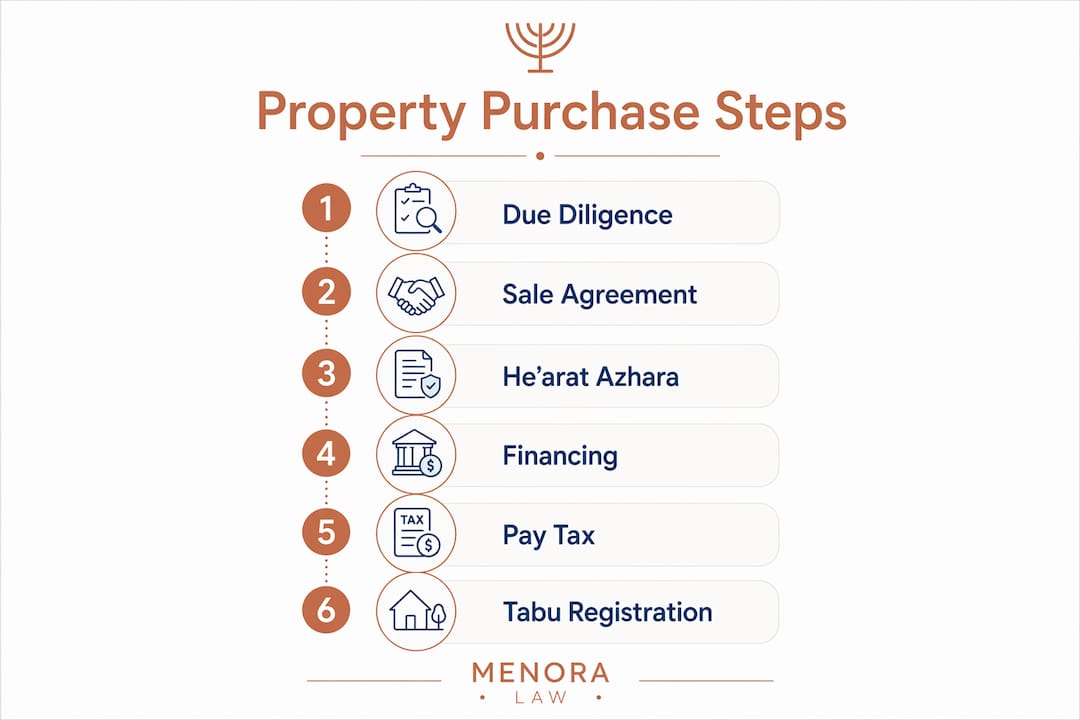
The purchase process in Israel follows a defined sequence, and skipping any step creates legal exposure. Here is how it works from start to finish.
Step 1: Due diligence before signing anything
Pull a current Tabu extract to confirm ownership, check for mortgages, and verify the land classification. For leasehold properties, request the ILA lease agreement to review the remaining term and renewal conditions. Check municipal records (Arnona) for any outstanding tax debts attached to the property, since these can transfer to the buyer.
Step 2: Negotiate and sign the sale agreement (Heskem Mekach)
The Heskem Mekach is the binding purchase contract under Israeli law. It sets the price, payment schedule, and transfer conditions. Signing it creates enforceable obligations, but it does not transfer title. Your Israeli attorney should review and negotiate this document before you sign. Contracts in Israel are typically in Hebrew, and a certified translation alone is not a substitute for legal counsel who understands the local market and statutory requirements.
Step 3: Register a He’arat Azhara (warning note)
Immediately after signing the purchase contract, your attorney should register a He’arat Azhara in the Tabu. This warning note alerts any third party searching the registry that a transaction is in progress. It protects you from the seller encumbering or selling the property to someone else before the final transfer is complete.
Step 4: Arrange financing and source-of-funds documentation
If you are taking an Israeli mortgage, begin the bank application process early. Non-resident buyers face a 50% loan-to-value cap, so you need to demonstrate that at least half the purchase price is available in cash. Israeli banks and attorneys are required to conduct anti-money laundering (AML) checks. You will need to provide documentation proving the legal source of your funds, typically bank statements, tax returns, or asset sale records from your home country.
Step 5: Pay purchase tax (Mas Rechisha)
Purchase tax is due to the Israel Tax Authority within 60 days of signing the contract. For non-residents, the rate starts at 8% on the first approximately NIS 6,055,070 and rises to 10% above that threshold. This is not a small cost, and it must be paid before Tabu registration can proceed.
Step 6: Complete Tabu registration
Once the full purchase price is paid, taxes are settled, and all documentation is in order, your attorney files for title transfer in the Tabu. Registration typically takes several weeks to complete. Only at this point do you become the legal owner of record.
For remote buyers: A notarized and apostilled power of attorney allows your Israeli attorney to handle every step of the transaction on your behalf, including signing documents, paying taxes, and completing Tabu registration. Many foreign buyers complete the entire purchase without traveling to Israel, provided the POA is properly executed through an Israeli consulate or a local notary with apostille certification.
Common legal pitfalls to avoid:
- Signing a contract without a He’arat Azhara registered immediately after
- Paying deposits directly to a seller or developer without escrow protection
- Failing to verify the seller’s actual authority to sell (particularly in inherited properties)
- Overlooking municipal debts or planning violations attached to the property
- Assuming a contract translation is sufficient without independent legal review
- Neglecting to confirm lease renewal terms on ILA-managed leasehold properties
- Missing the 60-day tax payment window, which triggers penalties
Pro Tip: For off-plan purchases, Israeli law under the Sale (Apartments) Law requires developers to provide a bank guarantee securing 100% of your payments during construction. Always confirm this guarantee is in place before transferring any funds. If a developer cannot produce it, walk away.
What ownership restrictions apply specifically to non-residents?
The good news is that Israeli law does not impose broad restrictions on foreign ownership of residential property. The restrictions that do exist are narrow but worth understanding precisely.
Jewish National Fund land
JNF parcels are governed by a separate legal framework from standard ILA-managed land. The JNF’s founding charter limits the use and transfer of its land to Jewish people and Jewish organizations. In practice, this means that JNF land is generally not available for purchase or lease by non-Jewish foreign nationals. This restriction applies regardless of residency status. Most urban residential real estate does not fall on JNF land, but due diligence on land classification is always necessary.
Border and security zones
Certain areas near Israel’s borders or in designated security zones require government approval for property transfers. These restrictions apply to all buyers, residents and non-residents alike, but foreign buyers may face additional scrutiny. Properties in these zones are relatively uncommon in the standard residential market, but they do appear in some northern and southern regions.
Leasehold versus freehold implications
For non-residents holding leasehold property, the practical ownership experience is similar to freehold for most purposes. You can sell, rent, renovate, and inherit the property. The distinction matters most when the lease term approaches expiration or when the ILA changes capitalization terms. Buyers should confirm whether the lease has already been “capitalized” (a one-time payment made to the ILA that effectively converts the annual lease obligation into a permanent right) or whether annual payments remain due.
Purchase tax rates compared
| Buyer Category | Rate on First approximately NIS 6,055,070 | Rate Above Threshold | First-Time Buyer Exemption |
|---|---|---|---|
| Non-resident / foreign buyer | 8% | 10% | None |
| Israeli resident (second home) | 8% | 10% | None |
| Israeli resident (first home) | 0%–5% (graduated) | 5% | Yes |
| New immigrant (Oleh) | Reduced rate | Reduced rate | Conditions apply |
The tax gap between a first-time Israeli resident buyer and a foreign buyer is substantial. An Israeli resident purchasing their first home benefits from a reduced purchase tax rate on the initial bracket and a graduated rate above it, while foreign buyers pay the full rate from the start. The difference in purchase tax between a first-time Israeli resident buyer and a foreign buyer can be substantial, resulting in significantly higher tax costs for the foreign buyer on otherwise comparable properties.
Mortgage cap for non-residents: Israeli banks cap loan-to-value at 50% for foreign buyers, compared to 75% for resident first-home purchasers. This means a foreign buyer acquiring a NIS 4,000,000 property must have at least NIS 2,000,000 in cash before approaching a bank.
Unregistered rights are another risk specific to buyers who delay Tabu registration. If a seller has multiple creditors or enters insolvency between contract signing and registration, an unregistered buyer’s claim ranks below registered creditors. The He’arat Azhara provides partial protection, but full Tabu registration is the only complete solution.
How does your residency or nationality affect your financing and tax position?
Residency status in Israel creates three distinct legal and financial categories for property buyers, and the differences are meaningful enough to affect how you structure a purchase.
Israeli residents (citizens and permanent residents) enjoy the most favorable terms. First-home buyers pay a graduated purchase tax starting at 0% on the lower bracket, access mortgage financing up to 75% loan-to-value, and qualify for various municipal and government programs. Capital gains on a primary residence are generally exempt from tax after a qualifying period.
New immigrants (Olim) receive a transitional benefit. Under Israeli law, Olim who purchase property within a defined period after making aliyah qualify for reduced purchase tax rates. The specific rates and eligibility window are set by the Israel Tax Authority and are subject to conditions. Olim who subsequently establish Israeli residency also gain access to resident mortgage terms over time.
Foreign buyers (non-residents) face the most restrictive conditions across all three dimensions: tax, financing, and compliance.
Key differences by status:
- Purchase tax: Non-residents pay 8%–10% with no exemptions; residents pay 0%–5% on a first home; Olim pay reduced rates under qualifying conditions.
- Mortgage LTV: Non-residents are capped at 50%; resident first-home buyers can access up to 75%.
- Capital gains tax: Non-residents are subject to Israeli capital gains tax on property sales. The applicable rate depends on the property type, acquisition date, and whether any exemptions apply. The Israel Tax Authority’s real estate tax simulator provides a calculation tool for specific scenarios.
- Inheritance: Foreign nationals who inherit Israeli property are subject to Israeli succession law, not the law of their home country. Israel abolished inheritance tax in 1981, so there is no estate tax on inherited property, but the probate and transfer process still requires Israeli legal proceedings.
- Documentation burden: Non-residents face more extensive AML documentation requirements, including source-of-funds evidence, foreign bank statements, and sometimes apostilled identity documents.
For buyers considering making aliyah, the timing of the purchase relative to immigration status can produce meaningful tax savings. Purchasing as an Oleh rather than as a foreign buyer can reduce the purchase tax bill by a material amount on higher-value properties. This is a planning decision that benefits from legal advice before any contract is signed.
Pro Tip: If you are considering aliyah and a property purchase in the same period, consult an Israeli attorney before signing any contract. The sequence of events, specifically whether you sign as a foreign buyer or as a new immigrant, directly affects your purchase tax liability.
Expert guidance on navigating Israeli property law as a foreign investor
Foreign buyers who treat an Israeli property purchase as a straightforward transaction often encounter problems that a structured, legally guided approach would have prevented. The legal framework is accessible, but it has specific requirements that differ from most Western real estate markets.
Engage a specialized Israeli real estate attorney from day one
The single most effective step any foreign buyer can take is retaining a qualified Israeli real estate attorney before making an offer. An attorney experienced in Israeli real estate law will conduct Tabu due diligence, negotiate contract terms, register the He’arat Azhara, manage AML compliance, and handle Tabu registration. Attempting to manage these steps without local legal counsel, or relying solely on the seller’s attorney, creates avoidable risk.
AML compliance and source-of-funds documentation
Israeli law requires attorneys and banks to verify the legal source of funds for all property transactions. Foreign buyers should prepare a clear documentation package before the process begins: bank statements covering the relevant period, evidence of the funds’ origin (salary records, investment account statements, property sale proceeds), and any relevant tax filings. Gaps in this documentation can delay or block a transaction entirely.
Off-plan purchases require bank guarantee verification
Developers selling off-plan residential properties in Israel are legally required to provide a bank guarantee under the Sale (Apartments) Law, securing the full amount of buyer payments during construction. This guarantee protects buyers if the developer becomes insolvent before completing the project. Always request and verify the guarantee documentation before transferring any payment. A developer who cannot produce a valid guarantee is a serious red flag.
Financing: prepare for a cash-heavy transaction
Because Israeli banks cap non-resident mortgage lending at 50% loan-to-value, foreign buyers need to approach the transaction with substantial liquidity. Beyond the down payment, budget for purchase tax (8%–10%), attorney fees, Tabu registration fees, and any renovation costs. The total acquisition cost for a non-resident typically runs well above the purchase price alone.
Treat the purchase as a structured legal project
The most successful foreign buyers approach an Israeli property acquisition the way they would approach any significant legal and financial transaction: with a checklist, a timeline, and professional advisors coordinating each stage. The key milestones are due diligence, contract signing, He’arat Azhara registration, tax payment, and Tabu registration. Each has a deadline or a legal consequence for missing it.
Practical steps for a well-managed purchase:
- Retain an Israeli real estate attorney before making any offer
- Pull a Tabu extract on every property you seriously consider
- Prepare source-of-funds documentation before contract negotiations begin
- Confirm the He’arat Azhara is registered within days of signing
- Verify bank guarantees on any off-plan purchase before transferring funds
- Pay purchase tax within the 60-day statutory window
- Follow up on Tabu registration and confirm the title entry is complete
For buyers purchasing from abroad, a properly executed power of attorney allows an Israeli attorney to manage every step of the transaction remotely. This is a well-established and legally secure mechanism that many foreign buyers use successfully.
Menora Law helps foreign buyers navigate Israeli property law with confidence
Buying property in Israel as a non-resident is entirely achievable, but the leasehold structure, purchase tax obligations, financing restrictions, and Tabu registration requirements create a process that rewards preparation and penalizes shortcuts. Menora Law provides exactly the kind of specialized Israeli legal representation that foreign investors need to get this right.

Menora Law works with international clients across the full arc of an Israeli property transaction: from initial due diligence and contract review through He’arat Azhara registration, AML compliance, tax filings, and final Tabu registration. The firm handles remote representation through properly executed powers of attorney, so you do not need to be in Israel to complete a legally secure purchase. For clients considering the timing of aliyah relative to a property purchase, Menora Law provides the tax planning guidance that can make a real difference in the final cost.
If you are ready to move forward with buying property in Israel as a foreign buyer, contact Menora Law to schedule a consultation. The earlier you engage legal counsel, the more options you have.
Key Takeaways
Non-residents can legally own Israeli property, but the leasehold structure, 8%–10% purchase tax, and 50% mortgage cap require careful legal and financial preparation before signing any contract.
| Point | Details |
|---|---|
| Foreign ownership is permitted | Non-residents can register full title in Tabu without citizenship or residency requirements. |
| Most land is leasehold | About 90% of Israeli land is ILA-managed with 49-year renewable leases, not freehold. |
| Purchase tax starts at 8% | Foreign buyers pay 8% on the first ~NIS 6,055,070 and 10% above that, with no first-time buyer exemptions. |
| Mortgage LTV capped at 50% | Non-residents must have at least half the purchase price in cash before approaching an Israeli bank. |
| Menora Law guides foreign buyers | Menora Law provides specialized Israeli real estate legal representation for international clients, from due diligence through Tabu registration. |
FAQ
Can non-residents legally own property in Israel?
Yes. Israeli law permits non-residents to purchase property and register full title in the Tabu (Land Registry) without any citizenship or residency requirement.
What purchase tax do foreign buyers pay in Israel?
Foreign buyers pay purchase tax starting at 8% on the first approximately NIS 6,055,070 and 10% on amounts above that. No first-time buyer exemptions apply to non-residents.
Does buying property in Israel give you residency or citizenship?
No. Purchasing real estate in Israel does not confer residency or citizenship. Israel has no golden visa or residency-by-investment program linked to property ownership.
How much of an Israeli property purchase can a foreign buyer finance with a mortgage?
Israeli banks generally cap mortgage lending for non-residents at 50% loan-to-value, meaning foreign buyers must have at least half the purchase price available in cash.
What is the Tabu and why does it matter for foreign buyers?
The Tabu is Israel’s official Land Registry. A signed purchase contract does not transfer ownership. Legal title passes only when the transaction is registered in the Tabu, typically 4–16 weeks after contract signing.


 English
 Afrikaans
 العربية
 বাংলা
বাংলা Čeština
 简体中文
简体中文 Nederlands
 Suomi
Suomi Français
 Deutsch
 עִבְרִית
 हिन्दी
 Magyar
 Italiano
 日本語
日本語 한국어
한국어 Polski
 فارسی
فارسی Português do Brasil
 Русский
 Español de México
 Українська